I bring stories from the community into the KTOO newsroom so that all of our reporting matters. I want to hear my community’s struggles and its wins reflected in our coverage. Does our reporting reflect your experience in Juneau?
A view from the Goldbelt Tram of a Princess Cruises ship docked in Juneau on Aug. 31, 2021. (Photo by Jennifer Pemberton / KTOO)
On Wednesday, the 4,000-passenger Norwegian Encore became the last big cruise ship to dock in Juneau for the year.
Until mid-summer, it was unclear if there were going to be any big ships visiting Southeast Alaska. The Canadian border was still closed in July and the Centers for Disease Control and Prevention still had restrictions on cruise ships and their passengers.
But cruising resumed in late July, and downtown Juneau sprang back to life after a virtually nonexistent 2020 season.
Most cruise ship passengers were required to be vaccinated for COVID-19 prior to the start of their trips.
More than 70 large ships and 20 small ships docked in Juneau during the shortened season, bringing over 123,000 people to town. That’s less than 10% of the number of passengers that came during 2019, the last season before the COVID-19 pandemic.
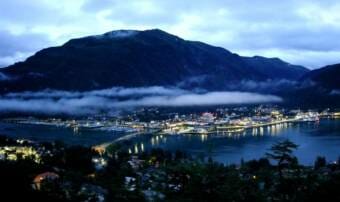
A Maloja Snake or naagáas’ cloud formation over downtown Juneau at dawn on Aug. 26, 2021. (Image captured from SnowCloud Services webcam)
In the 2014 film “Clouds of Sils Maria,” the climax of the story features a scene in the Swiss Alps where the two lead actresses, Kristen Stewart and Juliette Binoche, hike up high in the mountains to witness an early-morning cloud formation called the Maloja Snake — a mist that flows like water along the valley floor.
A Curious Juneau listener wrote in saying they’d witnessed something similar along the Gastineau Channel, and they wondered if there are any Lingít stories or a Lingít name for this cloud feature.
Wes Adkins with the National Weather Service office in Juneau had never heard of the movie or the Maloja Snake, but once he saw clips from the film, he knew exactly what it was.
“I think there is not a meteorologist in town who doesn’t observe this with awe every time they go hiking, every time they commute down Egan Drive,” he said. “We see it all the time here.”
In Juneau you’ll see these clouds crawling down Perseverance Trail or along Treadwell Ditch on Douglas Island. They’re very snake-like and cling to the sides of the mountains, close to the ground. Sometimes a fat snake as wide as the channel rolls into town.
Adkins says that the changes in temperature, pressure and moisture that cause the snake to form are always there but not always visible. But sometimes, when conditions are right, you can actually see the boundary between cloud and no cloud.
“So what’s really cool is when you start to see … these Maloja Snakes when they start to do flips or cartwheels,” he said. “And people can witness this, you know, just above them in downtown just over Gastineau Channel.”
There’s not a lot of cloud watching in Juneau. We don’t get white puffy clouds that appear in the shapes of animals while we lie in a field on our backs. So these moving fog banks — these snakes — are some of the most dynamic clouds we have.
But we don’t have snakes in Alaska, so what should we call them?
X̱’unei Lance Twitchell is an Associate Professor of Alaska Native Languages at the University of Alaska Southeast.
“I started looking through some resources,” he said. “And I found this verb, which is naagáas’: ‘Clouds are moving along.'”
Naagáas’ is a Lingít word. It also means migration.
“‘Gáas’ is a house post,” he said. “So this is the verb. There’s a version of it to say, ‘aadé haa wligáas’: ‘We migrated there.’ Which would be sort of like saying, ‘We picked up our house post, and we brought it over there.'”
So naagáas’ would be migrating clouds.
But X̱’unei found a metaphor where maybe there is just a cloud. For instance, Lingít has a whole bunch of readily available phrases to describe sunlight.
“Sometimes the Lingít language is just so matter of fact,” he said. “And I think what I’ve heard seems to be that way about clouds. Because we have clouds like 300 days a year, it figures you’d have this whole stack of metaphors for sunlight.”
X̱’unei says he doesn’t know if naagáas’ has been used to describe these clouds before. From multiple elders the consensus seemed to be that if there were another Lingít word for these cloud snakes, it might have been lost with the loss of language speakers.
“One of the great tragedies of colonialism — and there are many — is that nobody really took the time to figure out what the people knew about the land around them, the weather, the water,” he said.
You can see naagáas’ any time of year and any time of day in Juneau, but if you really want to be intentional about it, Wes Adkins at the National Weather Service says dawn or dusk are good bets, when the temperature is changing. Or just before or after a rainy spell.
The weather service doesn’t include these cloud snakes in their forecasts because they don’t really impact the weather. They don’t bring rain. They aren’t harbingers of storms. But Adkins says we should still be on the lookout for them.
“I’m originally from Alabama. We were really flat there, for the most part,” he said. “There’s nothing like this. So I think we can all relish this chance to see something special.”
And X̱’unei says the weather service and the rest of us should start practicing how to talk about it in Lingít.
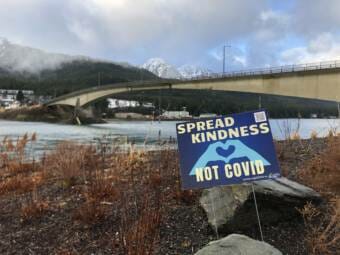
A City & Borough of Juneau sign reads “Spread Kindness, Not COVID.” Photographed Nov. 26, 2020, at Overstreet Park. (Jennifer Pemberton/KTOO)
A Juneau resident being treated at Bartlett Regional Hospital for COVID-19 has died.
Juneau city officials reported on Wednesday that a man in his 60s died at the hospital last Friday, Aug. 6. He is the sixth Juneau resident with COVID-19 to have died during the course of the pandemic.
There were 12 new cases of COVID-19 reported on Wednesday. Ten are residents and two are nonresident visitors to the city.
Juneau has 90 active cases of COVID-19. A cluster of cases related to an out-of-town youth sports event is now at 16 active cases. There are four people with the virus being treated at Bartlett Regional Hospital.
Chart showing Juneau’s active cases of COVID-19 for the past two weeks. (Screenshot from Juneau COVID-19 dashboard on Aug. 11, 2021)
Statewide, there were 380 new people identified with COVID-19 on Wednesday.
Close
Update notification options
Subscribe to notifications
Subscribe
Get notifications about news related to the topics you care about. You can unsubscribe anytime.