Jennifer Pemberton

Managing Editor, KTOO

I bring stories from the community into the KTOO newsroom so that all of our reporting matters. I want to hear my community’s struggles and its wins reflected in our coverage. Does our reporting reflect your experience in Juneau?

Still work to do to diversify the voices we hear on KTOO, but the pandemic brings an unprecedented opportunity

Alaska Gov. Mike Dunleavy, center, takes a tour of the Alaska Airlines Center in Anchorage on April 15, 2020.
Alaska Gov. Mike Dunleavy, center, takes a tour of the Alaska Airlines Center in Anchorage on April 15, 2020. The sports arena was set up as an alternate care facility for COVID-19 patients. (Creative Commons photo by Alaska Governor’s Office)

In the summer of 2019, KTOO commissioned a source audit, or a report on the make-up of the sources we use for KTOO news stories and the guests we have on Juneau Afternoon. The period between January through June of 2019 became our baseline data, because it was the first time we had looked at the demographics of the people whose voices we hear on the air.

In October of 2019, we started asking everyone who appeared in a news story or was a guest on Juneau Afternoon to identify their gender and race and/or ethnicity. You can read what our first report from the last quarter of 2019 revealed about who we’ve been interviewing.

We’ve just finished compiling our second report.

For the period from January 1 through March 31, 2020:

  • There were 452 total sources
  • 220 appeared in news stories
  • 230 appeared on Juneau Afternoon
  • 95% of sources self-identified their gender
  • 94% sources self-identified their race and/or ethnicity

Gender

In total, we had more female sources (54%) than male (46%). There were no sources in the reporting period who identify as non-binary.

The gender breakdown is very different between news stories and Juneau Afternoon guests. Juneau Afternoon has twice as many female guests (67%) as male guests (33%). Sources for news stories are more often male than female, though the ratio isn’t quite as extreme (60% / 40%).

To understand why the sources for news vs. Juneau Afternoon look so different, it’s important to look at who the sources are and what they are being asked to speak about. Sources for news stories are predominantly elected officials (37%) and government spokespersons (18%), where Juneau Afternoon guests are mostly activists (20%), artists (17%) and educators (15%).

Ethnicity

While 69% of Juneau’s residents identify as white-only, 77% of KTOO’s total sources for the past 3 months were white-only.

The two groups we have actively been trying to hear more from are people who identify as Alaska Native and Asian. If the goal is to reflect our community, these numbers should be 18% and 10% respectively. We didn’t achieve that in this quarter. In fact, we got further away from that goal than we were at the end of 2019 (Q4 had 17% Alaska Native sources and 4.5% Asian sources).

Sources for news stories and guests on Juneau Afternoon tracked similarly when it comes to race and ethnicity.

One important factor we look at when we look at the racial and ethnic make-up of our sources is the focus of the story. The mix changes when the story or program has a focus on race.

Not surprisingly stories that are not about race skew whiter than stories that address race. But this is not what we want our coverage to look like. We want a wide diversity of voices in every story we tell and every topic we cover.

Note: there were only 2 stories or programs this quarter that were primarily about race.

What’s Next?

Toward the end of this reporting period, something extraordinary happened that has changed almost everything about what we’re doing here at KTOO: The COVID-19 pandemic came to Alaska in mid-March. The pandemic has changed a few things for KTOO. For one, the volume of news stories we’re producing is up. That means there are more opportunities every day to talk to new people who haven’t been a part of our coverage before.

The conversations on Juneau Afternoon have shifted from promoting events and featuring art and advocacy work to truly building community out of our audience and blurring the lines between listeners and makers through our Community Connections segment.

Perhaps the biggest change the pandemic has brought is the opportunity to focus on the ways the impact of the pandemic exacerbates inequities in our community. We are hearing from people in power every day. Gov. Mike Dunleavy appears almost every night on TV and our website with Chief Medical Officer Anne Zink and other members of his cabinet. Juneau’s city manager Rorie Watt is on the air every morning and afternoon. These addresses bring important information to our audience and are a critical part of our service as a news organization. But for every elected official and authority figure we include, there must be an equal opportunity to hear from the voiceless, the powerless and the people who are disproportionately impacted by the disease and the economic disaster accompanying it:

Juneau’s cruise ship docks are eerily quiet as the postponed season doesn’t get started

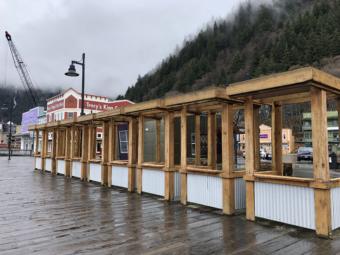
There are supposed to be lines of people at dozens of booths like this on April 23, signing up for whale watching or gold panning tours. The cruise ship season was supposed to begin, but sailings have been suspended due to the coronavirus pandemic. (Photo by Jennifer Pemberton/KTOO)

This week was supposed to herald the arrival of the first cruise ship to Juneau. But no cruise ships came. And they’re not coming for awhile. This isn’t just an economic blow to the town. It’s made the place completely unfamiliar in many ways.

The port schedule still says that the Carnival Spirit should have arrived at 7 a.m. on Friday. There could have been more than 2,000 people in Juneau for eight hours, spending money. And they would have been the first of nearly 1.5 million cruise ship visitors Juneau was expecting to see this summer.

Last year there was fanfare when the first ship of the season showed up. It was sunny and there were Native drummers there to greet passengers and a whole team of helpful people from the visitor’s bureau, steering people toward the best hikes or local shops.

This year, it’s gray and soggy and completely dead at the cruise ship docks.

There were supposed to be lines of people at dozens of booths signing up for whale watching or gold panning tours. The stores were supposed to be open. The Mount Roberts Tram was supposed to be hauling people up the mountain. There were supposed to be crowds of people from all over the world speaking a bunch of different languages.

But there was literally no one there. And nothing was happening.

The industry has been dealt a series of blows this year in the wake of the coronavirus pandemic. There have been port closures in Canada and Seattle and a federal no sail order. Not to mention the horror stories from several outbreaks of this very disease on cruise ships in the past 2 months.

So far, about 360 sailings that would have come through Juneau have been cancelled, which means that already 700,000 fewer passengers are coming during what was supposed to be a blockbuster year. There are sailings on the books starting in July, but there’s no guarantee that those will happen.

Juneau’s cruise ship docks are empty on April 23. The cruise ship season was supposed to begin, but sailings have been suspended due to the coronavirus pandemic. (Photo by Jennifer Pemberton/KTOO)

Juneau City Manager Rorie Watt has worked for 20 years on development of the city’s waterfront. He regularly goes out and checks on the construction projects on the waterfront that should be wrapping up soon ahead of the ships coming.

“There’s always a little bit of a fire drill to wrap things up,” he said. “Except everyone’s got all the time in the world right now and the waterfront is empty. And it feels sort of normal, but also strange, because it’s different.”

Between the loss of cruise ship taxes and local sales taxes, Juneau’s in a world of hurt for revenue this year.

Not that long ago, the city was in a totally different kind of hard spot. It was trying to tackle some of the problems that come with a million and a half visitors.

“It’s stunning how fast we went from trying to figure out what to do with too many tourists to not having any tourists at all — a totally different kind of problem.” Watt said. “On the one hand, too many people causes a social problem and not enough tourists causes an economic problem.”

Liz Perry runs Travel Juneau, which markets the city for conferences and non-cruise ship travelers.

With the governor’s health mandate that requires a 14-day quarantine for anyone who comes from out of state, Juneau probably won’t see any of those folks anytime soon.

“It’s not the right time to really be rolling out a big campaign to get people to travel because we’re not sure again when that’s going to be possible,” Perry said. “We have to be ready as an industry and the community has to be ready to welcome those folks back in.”

Even though independent travelers spend more per person when they come to Juneau than someone who gets off a cruise ship, the city just doesn’t have the capacity to backfill the kind of loss it’s facing now.

But Perry does see independent travel as a bright spot.

“It’s a real opportunity for us to really invite in — in a big, big way — our independent travelers and really show Juneau off as the cruise lines are recovering from the pandemic,” she said.

There’s no one to interview at the docks on Thursday. The shops are boarded up. The tram is under construction. Parts of the waterfront are under construction, too. The public bathrooms are locked. The trashcans are wrapped in plastic so you can’t use them.

It feels like no one is getting ready for anything to start anytime soon. Which is not an unfamiliar feeling for most people in most places right now.

Newscast — Wednesday, April 15, 2020

In this newscast:

  • Requests for emergency hunts are piling up for federal and state agencies
  • Practically all of the money the Juneau Assembly committed for its emergency small business loan program has been allocated
  • State spending audit finds problems after state denies auditors access to oil tax records
  • Princess Cruises and Holland America Line are canceling sailings and closing lodges and bus tours in Alaska
  • The city of Valdez is appealing a decision from the Regulatory Commission of Alaska that allows Hilcorp to keep financial documents confidential

Newscast — Friday, March 27, 2020

In this newscast:

  • 18 Alaska state representatives asked Gov. Mike Dunleavy to immediately issue a statewide shelter-in-place order
  • Sealaska Heritage Institute’s Board of Trustees has postponed Celebration until 2021
  • The City and Borough of Juneau is expanding its criteria for COVID-19 testing to include people who are medium or low risk for the virus
  • Health officials are encouraging people to go outside — with limits
Site notifications
Update notification options
Subscribe to notifications