Jennifer Pemberton

Managing Editor, KTOO

I bring stories from the community into the KTOO newsroom so that all of our reporting matters. I want to hear my community’s struggles and its wins reflected in our coverage. Does our reporting reflect your experience in Juneau?
Here’s the first diversity report since KTOO started asking everyone we interview about their gender and ethnicity

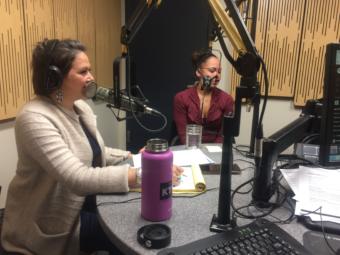
Host Christina Love (left) and Sara Gallagher on Juneau Afternoon, December 2, 2019. (Photo by Scott Burton/KTOO)

In the summer of 2019, KTOO commissioned a “source audit,” or a report on the make-up of the sources we use for KTOO news stories and the guests we have on Juneau Afternoon. The period between January through June of 2019 became our “baseline” data, because it was the first time we had looked at the demographics of the people whose voices we hear on the air.

In October of 2019, we started asking everyone who appeared in a news story or was a guest on Juneau Afternoon to identify their gender and race and/or ethnicity. We’ve been doing this for 3 months now, and here’s what that last quarter of 2019 revealed about who we’ve been interviewing.

For the period from October 1 through December 31, 2019:

  • There were 377 total sources
  • 194 appeared in news stories
  • 177 appeared on Juneau Afternoon*
  • 342 sources (91% of total) self-identified their gender
  • 334 (89% of total) sources self-identified their race and/or ethnicity

     * Juneau Afternoon numbers are for November and December only.

See the data

Gender

In total, we had more female sources (54%) than male (46%). One individual identified as non-binary (0.3%).

The mix of male and female sources is different for news stories compared with Juneau Afternoon.

Sources in news stories were roughly two-thirds male (62%), while guests on Juneau Afternoon were more than two-thirds female (69%). This is largely because of their differing areas of expertise. In news stories, the people we talked to the most include government officials and spokespersons (29%) as well as people from businesses and industry (12%). A lot of guests on Juneau Afternoon are activists and community organizers (36%) and artists (18%).

One takeaways from this section is that our reporters could be talking to more women for news stories.

Ethnicity

While 69% of Juneau residents identify as being white, 75% of KTOO’s sources for the quarter were white. This is closer to reflecting the community than the last survey period (Jan – June 2019), which was 84% white. One difference between the survey periods is that the Alaska legislature was in session during the beginning of the year and white lawmakers and the white governor appeared in stories nearly every single day.

The two groups who have been most under-represented in our coverage are Alaska Natives and Asians.

Alaska Natives make up 18% of Juneau’s population, and during this last quarter, 17% of our total sources identified as Alaska Native. For the previous survey period, that number was 13%, so this quarter was much closer to matching our community. Among Juneau Afternoon guests 13% were Alaska Native, and in news stories 21% of sources identified as Alaska Native.

The population of Juneau is 10% Asian. In the last quarter, 4.5% of our sources identified as Asian: 2% of news sources and 7% of Juneau Afternoon guests. This is an improvement over the six month period we looked at last year, which contained 1% Asian voices.

But more than just looking at the ethnic make-up of all our sources, we are also looking at the focus of the stories that include the most diverse sources. For example, in stories that are not about race at all, only 7% of sources identify as Alaska Native. In stories that address race, that number jumps to 47%. And when the story is primarily about race, 92% of the sources are Alaska Native.

This isn’t a criticism of our coverage and doesn’t diminish the importance of the the sources we heard from in those stories, but it does show us that we tend to reach out to the Native community for stories or programs that are about the Native community or issues facing Native communities exclusively. It is an important benchmark for me to hear from Native voices when the story isn’t focused on race. The first pie chart in the graphic above is the one that we think needs to look most like the make-up of our community.

What’s next?

We’re still asking everyone we interview to identify their gender and race/ethnicity. We’ll report on the first quarter of 2020 after March 31. That will include the start of the legislative session, where we expect to start hearing from lawmakers daily. We’ll continue to strive to include the voices of everyone in the community we serve despite the shift in focus of the news cycle.

Also, for Juneau Afternoon, one of the things we are looking at is not just who we have on as guests, and in what capacity, but also who is hosting and crafting each show. This quarter we had three individuals of Alaska Native descent as “guest hosts” who also produced the content for that day’s show. We see this as another important step in having our programming better reflect our community and are working on having these individuals, and others, host and produce more regularly.

Cruise Town, Ep. 5: We Almost Lost Yanni

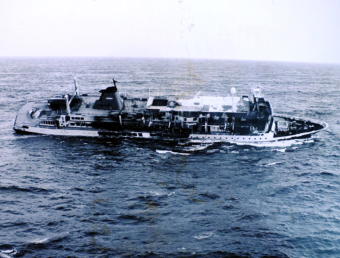
The Prisendam lists and is adrift in the middle of the Gulf of Alaska in October 1980. Passengers and crew evacuated the vessel after a fire crippled the Holland America cruise ship. (Photo courtesy of U.S. Coast Guard)
The Prisendam adrift in the middle of the Gulf of Alaska in October 1980. Passengers and crew evacuated the vessel after a fire crippled the Holland America cruise ship. (Photo courtesy of U.S. Coast Guard)

No discussion of cruise ships would be complete without talking about maritime disasters.

Yes, it’s morbid, but it’s hard not to think about what could go wrong when 5,000 people are trapped on a boat at sea — everything from ship-wide intestinal distress to people falling overboard. There was even a murder on a cruise ship in 2017 in the waters near Juneau.

The good news is, there are tons of safety measures in place.

In this episode, we talk to the people who have thought about how to prepare for the worst things that could happen — like if international superstar musician Yanni was stranded on a sinking ship, for example. (Yeah, that happened.)

Cruise Town, Ep. 4: The Weight of the World

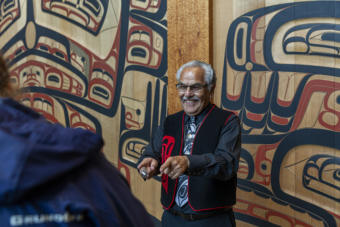
Sealaska Heritage Institute cultural interpreter John Lawrence talks to visitors at the institute’s Walter Soboleff Building in downtown Juneau, Sept. 5, 2019. (Photo by Rashah McChesney/KTOO)

The place we know as Juneau has been the home of the Aak’w Kwáan since time immemorial.

Tourists who are curious about this place — and the people who were here well before Cruise Town — often head to the visitor center at the Sealaska Heritage Institute.

When the visitor center opened about four years ago, they were getting so many tourists walking in off the street, that they decided to hire cultural interpreters to help out. And these interpreters are so much more than tour guides. Their task is to explain their history, their culture, their art — their existence — to someone who just got off a cruise ship.
And that’s what this episode of Cruise Town is about.

Cruise Town, Ep. 3: Camp Cruise Town

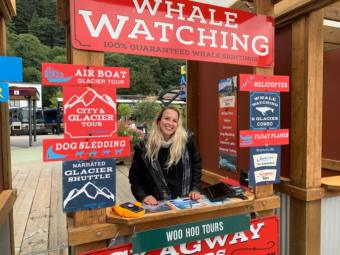
Natalie Constable spends the summer of 2019 in Juneau working as a dock sales representative. (Photo by Adelyn Baxter / KTOO)

The first thing cruise ship passengers see when they disembark in Juneau is a row of little covered booths. They’re made of wood and trimmed with corrugated metal and inside you’ll often find an attractive young person enticing you to book a tour.

Their official title is “dock sales representatives,” but we call them “hawkers” because they frequently yell out as they fight for attention and business from tourists as they get off their ships and plan their day of sightseeing in Juneau.

Sam is here from Utah for the season. It’s her second summer in Juneau. She’s selling glacier tours, whale watching trips, float plane rides and scenic helicopter tours.

In the off season, she works in tourism in Baja California, Mexico. She basically follows the whales.

“I see the exact same ones down there as up here,” she says. “We leave at the same time.”

Sam is one of the thousands of seasonal workers who come to Juneau to work in tourism. A lot of them are college students or college-aged, at least. They can make Juneau feel a lot like a summer camp.

The booth next door is occupied by Natalie from Dallas. She says there’s plenty of competition between sales reps in the booths, but they hang out after hours.

“We all go for drinks together very often,” she says. “We get to go on all the tours. We can go whale watching like, everyday if we wanted to.”

Juneauites are a lot like whales. Some are year-round residents — enduring or even thriving during the cold and wet offseason. But some migrate in for the summer — making a splash when they arrive and then leaving again, chasing prey or love or something else equally magnetic.

On this episode of Cruise Town, we meet some of the people who live here.

Cruise Town, Ep. 2: The Whale and the Head Tax

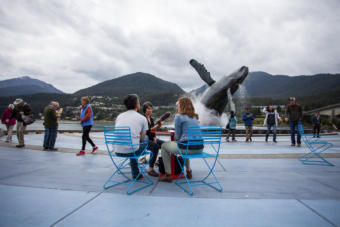
Herman Savikko of Douglas takes a photo of his sister Michele Savikko Bilyeu and her husband Larry Bilyeu of Salem, Oregon, at Overstreet Park in Juneau on July 3, 2018.
Herman Savikko of Douglas takes a photo of his sister Michele Savikko Bilyeu and her husband Larry Bilyeu of Salem, Oregon, at Overstreet Park in Juneau on July 3, 2018. (Photo by Jeremy Hsieh/KTOO)


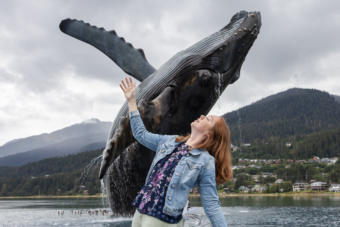
Tahku is a life-size statue of a humpback whale breaching from a reflecting pool, complete with water works. It’s a fairly new addition to Juneau’s waterfront, but it’s already iconic.

The statue is about a mile walk from the closest cruise ship dock — which is about a mile too far for some people. Because Tahku is basically a giant whale-shaped embodiment of Juneau’s relationship to the cruise industry.

The whale statue itself was privately funded, but the park where it lives and the restrooms, the cute cafe style tables and chairs and even the colored lights and the pump that runs the fountain were almost entirely funded by a controversial tax.

Juneau was one of the first places in the world to charge a per-person tax on cruise ship passengers. Then, the cruise industry actually sued the city over it, pointing its finger right at Tahku, singling it out as a prime example of the city’s irresponsible use of the cruise ship passenger tax.

So, in Juneau now, a whale statue is not just a whale statue: it’s a very large symbol for how Cruise Town benefits from hosting cruise ship tourists.

Jeremy Hsieh (Photo by Rashah McChesney / KTOO)
Adelyn Baxter (Photo by Rashah McChesney / KTOO)
Jennifer Pemberton (Photo by Rashah McChesney / KTOO)


We looked at everyone we interviewed for 6 months and this is what we found

KTOO strives to be inclusive and diverse in our coverage. Part of our newsroom’s mission is to “consciously seek out the voices, perspectives and stories not found in other news outlets.” In order to ensure that we’re doing our best to reflect the variety of lived experiences we know exist in our community, we are asking everyone we interview for a news story or on Juneau Afternoon their gender, their race or ethnicity and their date of birth. Answering these questions is voluntary, but there’s no way we can track our progress without asking.

We started this work by conducting a “source audit” — it’s like a snapshot of our inclusivity. We looked at six months’ worth of stories and segments broadcast over our airwaves from January 1 – June 30, 2019.

That included:

  • 309 News Stories
  • 237 Juneau Afternoon Interviews
  • 1,066 total sources (includes people we talked to multiple times for separate stories)
  • 725 unique sources (68% of sources were only interviewed once)

Information on these sources was collected using a variety of methods: an email survey, phone calls and personal knowledge of individuals. There was no guessing. All information was given voluntarily by the sources. Partial information was obtained for about 95% of the 1,066 total sources interviewed, and complete information was obtained for 60% of the total sources.

Here’s what our sources over that period looked like:

Ethnicity

While just 69% of Juneau community members identify as being white only, 84% of KTOO’s sources over the survey period identify as white only.

And two key minority groups are under-represented in our coverage: Alaska Natives represent 18% of Juneau’s population, but only 13% of KTOO’s sources. Asians make up 10% of Juneau’s population, but only 1% of KTOO’s sources.

We also looked at KTOO’s news stories and Juneau Afternoon segments separately.

Gender

Our source audit showed that two-thirds of the interview subjects used in our news stories are male and one-third are female.

Guests on Juneau Afternoon are flipped: almost two-thirds (64%) are female and just over one-third are male.

There was one Juneau Afternoon guest and one news source who identified as non-binary.

Some aspects of source gender is out of our control. For instance, Gov. Mike Dunleavy is a male and he was the single most interviewed source during the surveyed period (29 times). But if we want the voices and perspectives on our airwaves to reflect the community we live in, we could try to get this closer to what Juneau looks like, which is 51% male and 49% female.

Expertise

We also took a look at the expertise areas of everyone we interviewed. For the news stories, the most people we talked to, by far, were elected officials (35%) and government spokespersons (16%), followed by members of the general public (11%) — most of whom were individuals testifying before the Alaska Legislature during the session or reacting to legislation under consideration.

For Juneau Afternoon, guests most often represent non-profits or are activists / community organizers or artists.

What Happens Next?

We are asking everyone we put on the radio about their gender, race and /or ethnicity and age. This makes our goal of being inclusive and diverse part of our daily work.

We are also intentionally reaching out to people we haven’t talked to before and introducing KTOO, our news team and everything we do to more and more members of our community.

We’ll chart our progress and publish it for you here on a quarterly basis so you know exactly how we’re doing and how we’re deciding what and who to cover.

A Note on Methodology
We commissioned Rain Coast Data to perform our source audit.

Ethnicity was measured using the same demographic breakouts employed for the 2013-2017 American Community Survey 5-Year Estimates, in order to accurately compare and contrast audit results to current demographic information. Respondents were able to list up to three ethnicities during the survey. Questions involving gender contained three options: Male, Female and Non-binary. Sources were placed in age groupings based on generation.

Read the full report from Rain Coast Data.

Site notifications
Update notification options
Subscribe to notifications