Jennifer Pemberton

Managing Editor, KTOO

I bring stories from the community into the KTOO newsroom so that all of our reporting matters. I want to hear my community’s struggles and its wins reflected in our coverage. Does our reporting reflect your experience in Juneau?

Cruise Town, Ep. 1: The Making of a Cruise Town

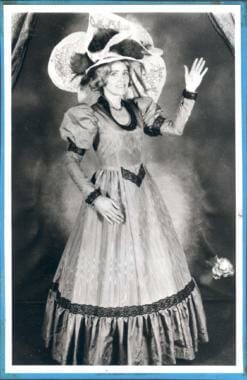
In 1984, Betty Breck, who dressed as a historical character named Belle Blue, sued the city over the proposed downtown parking garage. (Photo courtesy of Betty Breck)

Juneau is dwarfed by the cruise industry. In 2019, cruise ship passengers outnumbered locals 35 to 1.

The cruise ship docks and the few blocks of downtown right next to them come to life during the summer — we call it “the season” meaning the cruise season. But it’s more predictable than summer around here. And a lot longer — from late April until early October.

Most of this part of downtown looks like a tourist town with T-shirt shops, jewelry stores, a fudge shop and an old-timey bar called the Red Dog Saloon with squeaky swinging doors.

A lot of people call it the Disney part of town. Because it feels, frankly, fake.

But right in the middle of all of the gold rush facade is something that looks out of place: a concrete parking structure several stories tall.

And that’s where our story begins. Because it’s where a legal battle took place over old and new ideas about what the city should look like — for cruise ship passengers and the people who live in Juneau.

In the 1980s, a woman who dressed up like a turn-of-the-century dance hall girl sued the City and Borough of Juneau to prevent this parking garage from being built. She was fighting for authenticity and fairness at a time when the definitions of those terms seemed totally up for grabs.

On this episode of Cruise Town, we go back — not to the 1880s when Juneau was founded and steamships started coming north, but to the 1980s — when Juneau made a conscious decision to change its destiny.

KTOO reporter Elizabeth Jenkins will be our guide as we meet two people who were there when an old mining town embraced its history and transformed itself into Cruise Town.

Subscribe to Cruise Town on Apple Podcasts, NPR One or wherever you get your podcasts.

Cruise Town: Coming this November

For the people who live in Juneau, there’s a lot to love. It’s a small cosmopolitan capital city with a backdrop of almost-cliche scenery. We see whales and orca from our front porches and mountain goats and glaciers out the back. There are salmon swimming through town — bringing the bears with them.

But sometime in the 1980s, Juneau decided to become a Cruise Town — a destination that would open its port and its heart to what was then a hundred thousand people a year and is now… well over a million.

This year, cruise ship passengers outnumbered local residents 35 to 1.

Juneau was the first place in the world to let cruise ships turn off their diesel engines in port and plug into our municipal power supply — and use renewable hydropower. It was also one of the first places in the world to charge a per person tax on cruise ship visitors.

Juneau’s trying to get out ahead of this wave of tourists, but the fact of the matter is the community is dwarfed by the cruise industry. We can have up to six giant ships a day — each with thousands of passengers and crew. They’re taller than almost every single building in town and bring crowds of people that almost double the city’s population for the day.

The KTOO news team is excited to bring you Cruise Town, a podcast about how Juneau became a Cruise Town, what it’s like to live here and what the city’s future holds in light of the industry’s explosive growth.

A final trip on the Mount Roberts Tramway for 2019

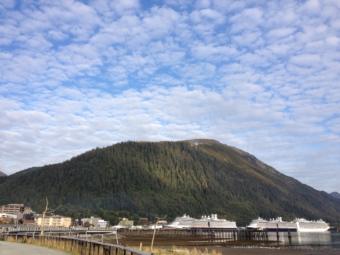
Juneau’s Mount Roberts from the Seawalk on Sept. 9, 2019. The Mount Roberts Tramway takes passengers on an ride up 1,800 feet from the cruise ship docks. (Photo by Jennifer Pemberton/KTOO)

Oct. 2 was the last day to ride Juneau’s Mount Roberts Tramway for 2019. The popular tourist attraction shuttles mostly cruise ship passengers up and down the mountainside all summer long.

The last cable car ride down the mountain for the season turned out to be a celebration, complete with drumming and singing by tram operator John Perkins.

Midnight Oil Bonus Episode: The Neighbors

Alaska is on the verge of a new oil boom — and the village of Nuiqsut is right in the middle. Oil development is affecting Nuiqsut more than any other indigenous community in Alaska. And the village faces tough choices. How do you maintain a way of life when the oil industry is knocking on your door?

To hear this and other episodes, subscribe to Midnight Oil on iTunes, NPR One or wherever you get your podcasts.

Paying Dividends, Episode 6: Between Now and October

Late last week, there was a big announcement from the Alaska Senate Finance Committee — one that Alaskans look forward to every year. It’s still a little early for finding out how much the Permanent Fund Dividend will be, but this one could be a doozy: something like $3,029. It could be the biggest check in state’s history. But there’s a lot standing between now and October when that amount would be paid out.

On this episode of Paying Dividends, Andrew Kitchenman talks about why the fate of this year’s dividend is still up in the air, and what Alaska’s senators still hope to accomplish before the end of the legislative session.

Paying Dividends, Episode 5: The Senate’s Turn

The Alaska State House of Representatives has passed the budget. Now, it’s the Senate’s turn. Senators have to decide how much to cut from public schools and health care, the ferry system and the University of Alaska. Where do leading senators stand and what do they see happening next?

Andrew Kitchenman shares what he’s been hearing at the state capitol. And Nat Herz reports on how Alaskans are responding to the differences between what Gov. Dunleavy said about the budget when he was campaigning last year and the budget he has proposed.

Site notifications
Update notification options
Subscribe to notifications