
Kaiser Health News

Gaps Remain Among States’ Medicaid Efforts To Help People Kick Smoking Habit

The 2010 federal health law has a provision that was supposed to make it easier for people on Medicaid to quit smoking. But in a number of states, it’s not, so far, having widespread success.

That’s the main takeaway from a study published Tuesday in the journal Health Affairs. The law says all state Medicaid programs have to cover tobacco cessation drugs — meaning they have to pay for things like nicotine patches, Chantix, nicotine gum or Wellbutrin, when patients are using them to try to quit smoking. But it leaves states relative freedom in how they go about doing so and what conditions they place on how the benefit is applied.

That flexibility has consequences, according to the study’s authors. They examined Medicaid data and found that very few enrollees — about 10 percent nationwide in 2013 — got medicine that might help them stop smoking, even though Medicaid recipients are around twice as likely as average Americans to be smokers.

Both from a public health standpoint and an economic one, that’s a problem, said Leighton Ku, director of the Center for Health Policy Research at George Washington University and the study’s lead author. Figures from the U.S. surgeon general indicate about 15 percent of Medicaid’s expenses — $40 billion in 2010 — are caused by smoking. The authors estimated that number will reach $75 billion this year. By contrast, Medicaid spent $103 million in 2013 on smoking cessation drugs.

“This is something where you can improve health, you can save you money,” he said. “And we’re just not very effective at it.”

In 2013, the study found, about 1.7 million prescriptions were filled or refilled for drugs to help Medicaid patients quit smoking. That’s estimated to be enough to treat about 830,000 people — out of about 8.3 million Medicaid patients whom the researchers estimated were smokers in 2013.

Some states have done a markedly better job than others. In Minnesota, for example, almost 27 percent of smokers on Medicaid were using medications to help them quit smoking, the researchers found. In Texas, only 1 percent did.

Ideally, Ku said, 100 percent of smokers on Medicaid would get help quitting. But even the Minnesota experience — which has the highest proportion of Medicaid smokers getting those prescriptions — indicates the extent to which other states currently fall short, he said.

It’s not entirely clear why, according to the researchers. But there are a number of factors that could be at play. In some states, patients have to make co-payments toward the medication, or get prior authorization from the Medicaid program before getting the drug. Those are more or less “functional barriers” that keep Medicaid beneficiaries from getting the medicine that could help them quit, said Michael Fiore, a professor of medicine and director of the University of Wisconsin Medical School’s Center for Tobacco Research and Intervention. Fiore wasn’t involved in the study.

And often, the study notes, people don’t realize Medicaid covers smoking cessation drugs.

“This is still a new thing,” Ku said. “It’s underappreciated, under-recognized.” The federal government hasn’t placed much emphasis on the regulation, he added, though he thinks more state Medicaid agencies are starting to prioritize it.

The study also notes another wrinkle. When it comes to states where smokers on Medicaid have less frequently gotten cessation drugs, most declined to expand Medicaid to cover a larger number of childless adults, a component of the health law the Supreme Court made optional in 2012.

That connection, Fiore said, is probably because the same states that declined the expansion are often ones that haven’t emphasized preventive care — though that isn’t always the case. He also pointed out that Wisconsin has actively publicized the smoking cessation benefit, despite choosing not to expand the low-income health insurance program.

When states don’t help people quit smoking, Ku said, they will ultimately face greater health care costs, since smoking helps cause diseases such as lung cancer and chronic obstructive pulmonary disease.

“If [those states] would expand Medicaid, more people would have access to Medicaid that would cover tobacco cessations,” he said.

For Medicaid programs that do emphasize the benefit there’s a major opportunity to recoup that spending, Fiore said, citing evidence that for each Medicaid dollar states put toward quitting smoking, they recover three times that, in as little as two years.

And that doesn’t even account for the savings in terms of how helping people quit smoking can bolster the economy, or improve a family’s health, Fiore said. When parents stop smoking, children aren’t exposed to second-hand smoke – which affects poor children more than those from higher income families — and are less likely to develop asthma. Smoking can damage someone’s health enough that he or she can’t hold a steady job, he added, a drag on the economy for which these figures don’t account.

“There are very few things we do in health care that have a positive return on investment, and smoking cessation is one of those,” he added. “It doesn’t take a decade.”

Read original article – January 5, 2016
Gaps Remain Among States’ Medicaid Efforts To Help People Kick Smoking Habit

Health Systems Dipping Into The Business Of Selling Insurance

In addition to treating what ails you, a number of health care systems aim to sell you a health insurance plan to pay for it. With some of the most competitively priced policies on the marketplaces, “provider-led” plans can be popular with consumers. But analysts say it remains to be seen how many will succeed long term as insurers.

It’s not surprising that health systems might get into the insurance business. Doing so funnels more patients to a health system’s hospitals and doctors. And it makes sense that combining clinical and claims data under one roof could lead to better coordinated, more cost-efficient patient care.

A number of well-regarded health systems have long sponsored insurance plans, including Kaiser Permanente, headquartered in Oakland, Calif., Geisinger Health System in central Pennsylvania and Intermountain Healthcare in Utah.

Yet even though health care systems can gain insurance know-how by partnering with or acquiring an insurer or third party administrator to handle claims, compliance and customer service, putting it all together can be challenging.

“They’re inexperienced,” says Gunjan Khanna, a partner in the health care practice at McKinsey & Company who co-authored a paper on this type of plan, when talking about newer entrants in this market. “The viability of that business and the ability to manage that is a question.” [] For example, it may take years to develop the necessary skills in managing financial risk and coordinating patient care beyond the hospital or clinic, among other things.

Health plans sponsored by providers are still rare. In 2014, 13 percent of health care systems in the United States offered plans that covered 18 million members, or about 8 percent of all people with insurance, according to McKinsey. Most of the people covered by provider-led plans are in Medicaid managed care or Medicare Advantage plans.

A growing number of provider-led plans are available on the health insurance marketplaces. When the marketplaces opened in 2014, there were 64 provider-led plans; next year there will be 72, according to McKinsey. In 2016, 19 percent of the new carriers on the exchanges will be provider-led plans.

The provider-led marketplace plans are priced very competitively, says John Holahan, a fellow at the Urban Institute’s Health Policy Center. In a number of rating areas, the plans will be the lowest priced at the silver level in 2016, according to a forthcoming analysis of 63 rating regions in 21 states, Holahan says. The lowest priced silver plans include those sponsored by New York’s North Shore-LIJ Health System, Oregon’s Providence Health and Services and Inova Health System in Virginia.

Inova, which is headquartered in Northern Virginia, partners with insurance giant Aetna to offer Innovation Health plans in several areas of the state. “Because of our strong relationship with Inova we’re able to buy our healthcare cheaper than most of our competitors,” which helps keep premiums down, says David Notari, CEO at Innovation Health.

An Innovation Health member who lives in Arlington, Va., and buys a marketplace plan, for example, has in-network access through Aetna’s marketplace network to all Inova hospitals, clinics and physicians and as well as other area providers.

Network coverage in provider-led plans varies. Some cover only services within the health system, while others offer broader access.

Consumers have generally been willing to accept narrower provider networks in exchange for lower premiums.

“The exchanges have pushed the concept of narrow networks front and center,” says Khanna. Consumers confronting that might want to “consider a provider health plan, because it’s based around a network of providers and at heart a network is built around a health care system.”

Read Original Article – Published November 10, 2015
Health Systems Dipping Into The Business Of Selling Insurance

Marketplace Customers Could See Higher Premiums, No Coverage For Out-Of-Network Care

When the health insurance marketplaces open on Sunday, consumers shopping for 2016 coverage may encounter steeper premium increases than last year and more plans that offer no out-of-network coverage.

open-enrollment-570According to an analysis released Monday evening by the Health and Human Services Department, the cost of the second-lowest silver plan in states using the federal marketplace will rise an average of 7.5 percent for 2016 coverage. Silver plans are the most popular type of marketplace plan. They pay 70 percent of medical costs, on average, leaving consumers to cover 30 percent. And premium tax credits that are available to people with incomes up to 400 percent of the federal poverty level — about $47,000 for one person — are benchmarked to the second-cheapest silver plan.

But the overall increase doesn’t tell the whole story for those shopping for insurance in the individual market — generally people who don’t get coverage through their work. Depending on the market, consumers may see larger or smaller increases or even declines in premiums. Premium changes for the second-lowest cost silver plan ranged from a 13 percent average decrease in Indiana to a 36 percent average increase in Oklahoma.

The consulting firm McKinsey & Company earlier had analyzed premiums reported in 26 states and found that in more than half of the rating areas in those states there will be a new insurer offering the lowest-cost silver plan next year.

“It’s indicative of the price jockeying that’s still going on in the market,” says Erica Coe, co-leader of McKinsey’s Center for U.S. Health System Reform. “If consumers want to have the lowest cost silver plan, they’ll have to shop.”

The open enrollment season for marketplace coverage runs from Nov. 1 through Jan. 31. People who want coverage to begin on Jan. 1 must buy a plan by Dec. 15.

Although most consumers zero in on premiums when comparing plans, next year it could be especially important to pay attention to the network of doctors and hospitals that are part of the plans that they’re considering. There will likely be fewer plans that cover broad networks of providers, says Kathy Hempstead, who directs health insurance coverage issues for the Robert Wood Johnson Foundation. In addition, a growing number of marketplace plans will cover only doctors or hospitals in their provider networks.

“The PPO and POS categories are definitely shrinking,” Hempstead says, referring to preferred provider organization and point of service plans, both of which typically offer coverage of out-of-network providers, although consumers generally have to pay a larger share of the cost. Instead, consumers may see more health maintenance organizations that don’t provide any out-of-network coverage.

Despite the well-publicized demise of nine health insurance co-operatives and other insurer exits, carriers moving into new markets next year will likely offset the declines. The number of carriers selling plans should be essentially unchanged at roughly 327 next year, according to McKinsey data based on 42 states.

This year, consumers in most states will have access to online tools to use while shopping for plans. Healthcare.gov unveiled its 2016 plans Sunday on the website, allowing customers in the two-thirds of states that use that federal marketplace to browse through plans in their area to see premium prices ahead of the actual start of enrollment. The revamped site also offered consumers a cost estimator to help determine their likely out-of-pocket costs in the plans. Two other new tools touted by federal officials to allow consumers to type in their doctors’ names or medication details and see whether they’re included in various plans are not yet ready to roll out. Federal officials said they hope to have them online soon, although they could not say if the tools would be ready by Nov. 1.

Some state-based marketplaces have similar tools available.

Although the online tools may streamline the process of comparing plans, consumers should always confirm details about doctors, hospitals and medications they receive online with the health plan directly.

Consumers who want telephone or in-person help choosing a plan can locate assistance on the state or federal marketplace websites. In addition, Enroll America, a consumer group that focuses on health insurance enrollment, connects people with local help through its website.

Even though shopping for plans should be easier this fall and it’s in consumers’ best interest to check out their options, chances are many won’t.

People who don’t renew their federal marketplace coverage will generally be automatically re-enrolled for Jan. 1 in their current plan, or a similar one if their plan has been discontinued. The government will incorporate the most up-to-date income, benchmark premium and poverty data when calculating the subsidy for auto-renewal.

That’s different from the past. When people didn’t update their income or other information for 2015 plans, they were automatically assigned the same premium tax credit amount they received in 2014.

Consumers who are automatically re-enrolled can change their plan until the end of January. But that may not be the best move, says Judith Solomon, vice president for health policy at the Center on Budget and Policy Priorities. “You’ll start your deductible all over again,” she says.

Read Original Article – Published October 27, 2015
Marketplace Customers Could See Higher Premiums, No Coverage For Out-Of-Network Care

For Former Foster Kids, Moving Out Of State Can Mean Losing Medicaid

Soon after moving to Utah this summer, Rainbow Sky Buck ended up at the hospital with a painful ear infection. There, Buck learned she no longer had access to the free health coverage she had in California as a former foster youth.

To pay for the care, Buck emptied out her bank account and borrowed money. “Luckily, I got my antibiotics and I am OK now,” she said. “But what is going to happen next time?”

Lezlie Martinez, 19, with Maverick Martinez, worries that she may be left uninsured and unable to pay for medical treatment for eczema, allergies and fibromyalgia if she moves from California to Colorado. (Photo courtesy of Jordan Verdin)

Under the health law, young adults who age of out of the foster care system are eligible for free Medicaid coverage until they turn 26. The provision was an attempt to give them the same opportunity as other young people who can stay on their parents’ insurance until their 26th birthday.

But these young adults are encountering a major barrier: They are only guaranteed coverage in the state where they were in foster care. States have the option of extending the benefit to all former foster youths, but only about a dozen have done so.

Now, advocates and policymakers are trying to change the law at the federal level, so former foster youths don’t lose access to Medicaid coverage no matter where they move.
Reps. Karen Bass, D-Calif., and Jim McDermott, D-Wash., have proposed legislation that would allow them to qualify for Medicaid, the government health program for low-income Americans, in any state. Sen. Bob Casey, D-Pa., has introduced a similar bill that he said would be a simple clarification of what Congress intended. Meanwhile, advocates are pushing the Centers for Medicare & Medicaid Services to change its interpretation of the original provision.

First Focus, which advocates for foster youths, has been receiving calls from young people who had no idea that they would lose health insurance when they moved.

“We really do feel an urgency about this,” said Shadi Houshyar, vice president of child welfare policy at the organization. “So many people who have aged out have significant health needs and coverage is so important. There shouldn’t be an additional barrier.”

Former foster youths are more likely than their peers to have physical and mental health needs, experts say. Ongoing research in Illinois, Wisconsin and Iowa shows that 22 percent of former foster youths had been hospitalized at least once in the previous year and one-third had two or more emergency room visits.

Just like other young people, former foster youths move to different states for school, jobs or family, said Fatima Morales, policy and outreach associate for the advocacy groupChildren Now. Morales said they shouldn’t be penalized for doing so.

Morales said her organization is trying to inform youths what they might face if they move. “They need to know how their health coverage might be impacted,” she said. “It’s just something that they need to weigh.”

Lezlie Martinez, 19, is weighing her options now. She is hoping to move from California to Colorado because she wants to live in a place with a lower cost of living. Her boyfriend is already there and she is looking for hospitality jobs to support herself and her 2-year-old son.

But she worries that she may be left uninsured and unable to pay for medical treatment for eczema, allergies and fibromyalgia. “It is causing foster youth to be stuck in the same state they were raised in,” said Martinez, who lives in Oceanside, Calif. “It is really stressing me out.”

Buck said she decided to move to Sandy City, Utah, because of the limited job prospects in the small Northern California town of Crescent City. Before moving, she asked social workers about whether she would still qualify for free health coverage and was told that she would. Buck said she was shocked to learn otherwise.

She is no longer seeing a therapist for depression and said she is weaning herself off antidepressants because she can’t afford them. Buck said she also worries about getting another ear infection and not being able to afford treatment.

“It is just scary to think I am completely on my own,” said Buck, who recently got a job at an automotive shop but doesn’t get insurance from her employer. “I don’t want to leave, but this is almost forcing me to move back to California.”

Read Original Article – Published October 20, 2015
For Former Foster Kids, Moving Out Of State Can Mean Losing Medicaid

Can Health Care Be Cured Of Racial Bias?

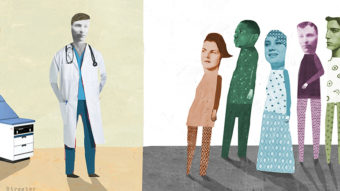
Illustration by Katherine Streeter for KHN/NPR

Jane Lazarre was pacing the hospital waiting room. Her son Khary, 18, had just had knee surgery, but the nurses weren’t letting her in to see him.

“They told us he would be out of anesthesia in a few minutes,” she remembered. “The minutes became an hour, the hour became two hours.”

She and her husband called the surgeon in a panic. He said that Khary had come out of anesthesia violently — thrashing and flailing about. He told Lazarre that with most young people Khary’s age, there wouldn’t have been a problem. The doctors and nurses would have gently held him down.

“But with our son, since he was so ‘large and powerful,’ they were worried he might injure the medical staff,” Lazarre said. “So they had to keep sending him back under the anesthesia.”

Khary was 6 feet tall. But he was slim.

“He wasn’t the giant they were describing him as,” Lazarre said.

Lazarre is white. Her husband is black. Lazarre says there’s no doubt in her mind that the medical team’s fear of Khary was because of race.

“I understood, certainly not for the first time, that my son — and my sons both — were viewed as being dangerous, being potentially frightening to people who were white,” she said.

She’s also sure the surgeon didn’t see it that way.

“Like most white people, I don’t think he was conscious of it at all,” Lazarre said.

She and her husband insisted on seeing Khary. They saw right away that he wasn’t angry or violent.

“He was scared,” Lazarre said. She and her husband leaned over and whispered in Khary’s ear: “‘It’s going to be OK, you can calm down.’ And he began coming out of the anesthesia more normally.”

Lazarre first wrote about this experience in her book “Beyond the Whiteness of Whiteness: Memoir of a White Mother of Black Sons.” Though it’s been years since Khary’s surgery, Lazarre says there’s still so much that hasn’t changed.

Racial Disparity In Medical Treatment Persists

Even as the health of Americans has improved, the disparities in treatment and outcomes between white patients and black and Latino patients are almost as big as they were 50 years ago.

A growing body of research suggests that doctors’ unconscious behavior plays a role in these statistics, and the Institute of Medicine of the National Academy of Sciences has called for more studies looking at discrimination and prejudice in health care.

For example, several studies show that African-American patients are often prescribed less pain medication than white patients with the same complaints. Black patients with chest pain are referred for advanced cardiac care less often than white patients with identical symptoms.

Doctors, nurses and other health workers don’t mean to treat people differently, says Howard Ross, founder of management consulting firm Cook Ross, who has worked with many groups on diversity issues. But all these professionals harbor stereotypes that they’re not aware they have, he says. Everybody does.

“This is normal human behavior,” Ross said. “We can no more stop having bias than we can stop breathing.”

Unconscious bias often surfaces when we’re multitasking or when we’re stressed, research shows. It comes up in tense situations where we don’t have time to think — which can happen frequently in a hospital.

“You’re dealing with people who are frightened, they’re reactive,” Ross said. “If you’re doing triage in the emergency room, for example, you don’t have time to sit back and contemplate, ‘Why am I thinking about this?’ You have to instantaneously react.”

Doctors are trained to think fast, and to be confident in their decisions. “There’s almost a trained arrogance,” Ross said.

But some medical schools are now training budding physicians and other health professionals to be a bit more reflective — more alert to their own prejudice.

Places like the University of Texas Medical School at Houston, the University of Massachusetts, and the University of California, San Francisco now include formal lessons on unconscious bias as part of the curriculum.

New Approach Teaches Students To Recognize Bias — And Slow Down

At UCSF, all first year medical school students take a workshop led by Dr. Rene Salazar, who coaches other members of the medical team, too.

“A lot of folks come to San Francisco thinking, ‘Oh it’s such an open-minded place, there are no biases here,’” he tells a class of newly arrived pharmacy residents. “That’s not true. You’re going to see this in every hospital. It’s going to be an issue.”

What Salazar wants these students to talk about isn’t other people’s biases, but their own. And not just the biases they know they have. But the ones they don’t know — or don’t believe — they have.

“Like it or not, all of us hold unconscious beliefs about various social and identity groups,” he says to the class. “Many times we think about bias and unconscious bias — they are incompatible with our conscious values, right?”

Before the class, students were asked to take an implicit association test, a series of timed computer tests that measure unconscious attitudes around race, gender, age, weight and other categories. Salazar asks who wants to share their results.

The students study their fingernails.

Salazar clears his throat.

“Well, I can share with you my story,” he says.

When he took the test for the first time, it showed that he had a preference for whites — or a bias against African-Americans. Research shows that 75 percent of people who take the race test show an automatic preference for whites.

“I was struck,” he tells the students. “Particularly being in the health professions and wanting to serve diverse communities, to learn that I had these biases — it was a bit disheartening.”

So he began to explore where these biases came from.

“I grew up in south Texas — 99 percent Mexican-American. Mostly Latino. In my high school, we had one black student,” he tells the pharmacy residents. “And so, up until age 18, you can imagine, a lot of my ideas — a lot of my attitudes, a lot of my beliefs — about folks who were black came from what? The media.”

A student named Amanda raises her hand. She asked that we not use her last name because she’s afraid that what she learned about herself could harm her career.

Amanda explains to the class that her parents made their way to the U.S. from Iran, and settled in Marin County, north of San Francisco. She took the version of the test that measures bias against Muslims, and another on light and dark skin tone.

“I kind of went in thinking that these are two areas that I would probably not have a bias, and that’s kind of why I chose them,” she said.

But the results were not what she expected.

“It was like, actually, ‘You’re biased and you don’t like brown people and you don’t like Muslims,’” she said. “Which is interesting for me — because that’s, kind of, the two things that I am.”

Traditional Diversity Training Didn’t Work — And Sometimes Backfired

The UCSF curriculum is based on a training program designed by Howard Ross, the diversity consultant. He says he developed the new “unconscious bias” approach to sensitizing people to their own predjudices after realizing that the traditional diversity training he was doing in the ’80s and ’90s wasn’t working.

“People who seemed to have transformative responses to those [earlier] trainings, to have that kind of ‘aha’ moment — particularly people in the dominant group, [of] whites, men, heterosexuals — often, if you talk to them a month or two later, they actually felt quite wounded by the experience,” Ross said. In some cases, he adds, participants seemed to become more defensive and hardened in their biases after those early trainings, not less prejudiced.

A 2007 study described in the Harvard Business Review examined diversity training programs at more than 800 companies over 30 years, and the results underscore Ross’s point. Overall, such programs seemed to do nothing to change people’s prejudices or improve diversity. Instead, in some cases, they reinforced bias.

“What happens is, ultimately, we feel bad about ourselves, or bad about the person that made us feel that way,” Ross said.

So rather than making people feel bad or awkward, Ross and Salazar say that, more than anything, they want people to accept that having biases is part of being human.

“You know we all have them,” Salazar tells his class in San Francisco. “It’s important to pause for a second and normalize this. And be OK with this.”

Salazar emphasizes that unconscious bias can’t be eliminated, but it can be managed.

“So how do we address our bias? What do we do?”

One student says, “Slow down.”

“Yeah,” Salazar responds. “A trick that I use is that I pause before I walk in, take 10 seconds even, 15 seconds, just to try to clear your mind and go in with that clean slate.”

It’s too early to know if these new types of trainings that explore unconscious bias are actually having any effect on what goes on in the exam room. Participants fill out evaluation forms after the class, and these anecdotal self-reports are often positive. But, so far, there have been no formal studies to measure if anything in patient care has actually changed.

“What happens when that door closes? What happens in the interaction when I can’t see the patient and the doctor talking?” Salazar said. “That’s a little hard to capture.”

Still, UCSF is betting the technique will help. Salazar and other leaders believe the younger generation of health care providers could help shift medicine — by learning early how to keep their own biases in check.

This story is part of a partnership that includes KQED, NPR and Kaiser Health News.
Kaiser Health News (KHN) is a nonprofit national health policy news service.

Read Original Article – Published August 20, 2015
Can Health Care Be Cured Of Racial Bias?

Site notifications
Update notification options
Subscribe to notifications