KFSK - Petersburg

KFSK is our partner station in Petersburg. KTOO collaborates with partners across the state to cover important news and to share stories with our audiences.

Tongass timber sale short on timber

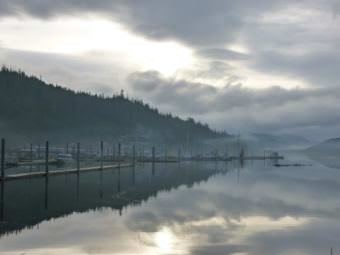
The harbor at Thorne Bay on Prince of Wales Island. (Photo courtesy Department of Commerce, Community and Economic Development; Division of Community and Regional Affairs’ Community Photo Library)

A large timber sale on the Tongass National Forest is not as large as it was advertised.

An environmental watchdog organization has uncovered a U.S. Forest Service document showing a 12-million-board-foot mistake on the Big Thorne timber sale on Prince of Wales Island in Southeast Alaska.

The U.S. Forest Service wants to settle the error with the Viking Lumber Company of Klawock, which was awarded the contract for harvesting the timber in 2014.

Public Employees for Environmental Responsibility, or PEER, based in Silver Spring, Maryland, has published Forest Service documents on its website detailing a review of timber sale contracts on the Tongass National Forest.

This spring, PEER highlighted a Forest Service review that found errors in procedures, oversight and contract enforcement.

Other documents from Regional Forester Beth Pendleton directed staff to fix an error in calculating the cost of hauling timber cut under the Big Thorne contract, but then rescinded that direction.

Jeff Ruch, PEER’s executive director, characterizes another document written by Acting Regional Forester Rebecca Nourse like this:

“One of the most extraordinary memos we’ve ever seen to the chief of the Forest Service basically demanding that he authorize additional retroactive payments immediately even though there’s in the terms of the memo no contract mechanism, meaning it’s not provided for under the contract, it’s not owed to them and in a situation where the company wouldn’t even file a formal claim,” Ruch said. “It’s a hell of a way to run a railroad ‘cause everyone thinks you guys up there on the Tongass are growing cedar and spruce but it looks like you’re growing money.”

In that memo, Nourse writes that a review of Big Thorne timber contract found the agency over-represented the amount of timber actually sold by 12 million board feet.

“The independent review shows unexplained departures from policy, which puts the Forest Service at risk of significant damages should the purchaser pursue a claim.”

The memo says the agency should seek to negotiate a settlement instead.

It proposes several options: taking no action and expecting a claim from Viking, or canceling the contract and re-offering the timber sale at a later date.

That could also result in a claim from the company.

Nourse’s preferred option is to modify the contract and change the rates charged to Viking.

That company was awarded the contract in 2014 and has been logging the timber on National Forest land around Thorne Bay on eastern Prince of Wales Island.

The contract at the time was for a harvest of 97 million board feet of timber valued at more than 6.5 million dollars.

As of the beginning of this year, the Forest Service said the company still had a little more than a third of that left to cut.

PEER’s Ruch calls for an in-depth audit of the sale contract.

“You would think given all of the confusion here they would bring in some outside people to basically go over the books to find out what’s going and that’s not the case,” Ruch said. “It’s sort of like the Region 10, the Alaska people of the Forest Service, are in flagrant violation of what we know as the rule of holes, which is when you’re in one, stop digging.”

The organization also has requested other documents under the Freedom of Information Act and subsequently filed a lawsuit in U.S. District Court in Washington, D.C., seeking to get more information on the agency’s review of Tongass timber sales.

The lawsuit says, “PEER has reason to believe that (sic) Forest Service was either actively engaging or complicit in the unlawful sale of high-value timber at prices far below market value.”

A call for comment from Viking Lumber was not returned.

Alaska Forest Association executive director Owen Graham said the industry group is not surprised to hear of less timber in that contract.

He did not trust the amount of timber that the sale supposedly contained in units to be logged by helicopter.

“The helicopter volume per acre that they were projecting for a partial cut was just triple what we’d experienced in the past,” Graham said. “We were always questioning whether that was, we didn’t believe it was there.”

Graham said there were other problems with the Forest Service’s timber cruise, or assessment of the quality, size and types of trees in various harvest units.

He thinks it makes sense for the agency to negotiate with the company to fix the mistake.

“You know, resolving issues on contracts is pretty common in all the industries, but particularly the timber industry,” Graham said. “You sit down and work it out. Everybody’s interested in long-term relationships, not just cash in your hand today or something.”

Graham thinks the other options would mean that sawmill runs out of wood and could be forced to shut down.

The Forest Service did not respond to a request for comment Monday or Tuesday.

An official previously said the agency would not discuss Big Thorne, because of PEER’s complaints.

Kake man found dead in Frederick Sound after boat runs aground

Searchers recovered the body of a 59-year-old man who had fallen from a boat Sunday in Frederick Sound near Kake.

The body of Willis Cavanaugh of Kake was located in the water by a good Samaritan searchers.

The U.S. Coast Guard received a call from the vessel Kalin Ann at 1 p.m. Sunday. The boat was aground in Herring Bay on the southern side of Admiralty Island.

According to the Coast Guard, the caller reported waking up and finding the boat aground with his father no longer piloting the vessel.

A Coast Guard helicopter from Air Station Sitka and plane from Kodiak launched a search assisted by six good Samaritan vessels.

Southeast’s summer Dungeness crab season shortened by three weeks

Dungeness crab is currently worth about $3 a pound. (Creative Commons photo by Kevin Cole)
(Creative Commons photo by Kevin Cole)

The summer season for the commercial Dungeness crab fishery in Southeast Alaska will be three weeks shorter than usual, closing on July 25.

The Alaska Department of Fish and Game made the announcement on June 29, after tallying the harvest from the first seven days of the crab season. The catch from that first week came in at 605,000 pounds.

Joe Stratman is the state lead crab biologist for the Southeast region.

“I would say it’s unprecedented. It’s only the second time we’ve come under threshold and it’s the largest reduction we’ve made to the fishing time to the summer season,” said Stratman.

The summer crab season was shortened once before, in 2013, but only by one week, not three.

The Dungeness crab fishery here is what Stratman calls a “data-poor” fishery. There’s no baseline stock assessment, so managers instead rely on early season harvest data to predict the total catch for the season.

An estimate of 2.25 million pounds is what’s needed to keep the season open the full two months. The current estimate for the combined summer and fall harvest is 1.68 million pounds. That’s the lowest since Fish and Game implemented a management plan in 2000.

Stratman says in this situation, they need to take a precautionary approach.

“I think the Department has to assume that the stock is of below-average health and the management plan dictates that we take action to reduce fishing pressure on the stock,” he said.

He says that one factor for the low catch could be that the male Dungeness crab molt, or growing a new shell, is happening later than usual. Molting typically occurs anytime between February and early July, but varies year to year and geographically.

Fish and Game is currently taking port samples to determine the amount of soft shell crab caught in the first week. Even if they find them, Stratman says biologists don’t really know why they might be molting late.

“We’ve heard anecdotally that water temperatures are low this year,” he said. “It could be a large class of crab recruiting into the fishery, so there’s competition for resources. That could also play a part in molt timing. I think it’s probably not just climatic forces at work.”

Delayed molts can sometimes mean bigger catches during the fall season, when on average 20% of the total crab harvest is taken, versus 80% during the summer.

State managers will know more about whether or not a late molt is occurring when they gather more harvest data in July.

Petersburg High students complete 34th year of glacier survey

Mariah Taylor, Nathaniel Lenhard and Izabelle Ith survey LeConte Glacier, which is about 25 miles east of Petersburg, on May 11. (Photo courtesy of Jon Kludt-Painter)
Mariah Taylor, left, Nathaniel Lenhard and Izabelle Ith survey LeConte Glacier, which is about 25 miles east of Petersburg, on May 11. (Photo courtesy of Jon Kludt-Painter)

Petersburg High School students completed their annual survey of the position of the LeConte Glacier on the mainland near Petersburg last month.

The southern-most tidewater glacier in the northern hemisphere has shown a little change since last year.

Temsco helicopters transports two teams of high school students into position on the steep rock wall on both sides of mainland glacial fjord.

Since 1983, students have been returning to those two survey markers fixed in the rock and taking readings on the position of the ice.

The large ice mass is constantly moving, and breaking off large chunks into the water.

That made it challenging this year, Petersburg senior Nathaniel Lenhard said.

“Halfway through our point thing we were getting our points, we were looking for ‘em and maybe like about a fifth of the glacier kind of calved,” Lenhard said. “We lost about three of our points.”

Students in the program practice surveying during their lunch hour starting sophomore year.

They typically go on the survey their junior and senior years, switching sides of the fjord.

Also taking sightings with Lenhard this year were classmates

Mariah Taylor and Izabelle Ith were there for their second year. Ith calls it an amazing experience.

“It’s a beautiful spot,” she said. “You’re up on the rock and you’re kind of where people don’t get this view of the glacier at all. To be able to get in a helicopter twice during your high school years is so cool and it’s beautiful. Both years we’ve had relatively good weather; this year was a little cloudy but regardless it’s one of the most beautiful places I’ve ever been.”

Taylor noted a difference from last year.

“You could see that the glacier had like receded a lot,” she said. “We switched sides from last year, so that was like a new experience. We could see the glacier from two different angles and you could tell like the different rivets better from one side than the other.”

Prior students have documented some big retreats of the ice mass in the 1990s.

The springtime location of the glacier’s terminus has not shown big changes in its location, in a relatively narrow and shallow part of the fjord, since then.

Petersburg science teacher Victor Trautman explained the glacier face is essentially where it has been for more than a decade.

“Realize that the glacier is a dynamic moving object and right now when we were there it was at the furthest, probably about 200 feet behind where it has been laying for the last 10 years,” Trautman said.

(Photo courtesy of Jon Kludt-Painter)

Researchers expect the ice will have more big retreats in the future.

LeConte Glacier is the subject of a multi-year joint research project into the interaction of the ice and the water of the fjord to better understand how those changes happen with a warming climate.

The survey students were able to watch some of that other research.

High school senior Emma Chase was on the north side this year.

“We saw a little boat right in front of the glacier and they would take a kayak, a little drone kayak and go near the face of the glacier,” Chase said. “When we were completely done, the south side, we looked through the theodolite and we looked up higher than the south side was and you could see the little camp that the glaciologists were on.”

The students wait on the north side for the other group to get their work done. That team then comes over to north side to tell which points on the face of the glacier to survey.

Chase explained that can be tricky.

“I think the hardest part was when the south side would come over and then we have to pick the points that they already shot,” Chase said. “Definitely different because the perspectives on the glacier are different.”

Another teacher on the project, Jon Kludt-Painter said technology helped with identifying points on the ice.

“One thing that we added is we brought in a larger iPad on the south side,” Kludt-Painter said, of the 12-inch screen and Apple pencil. “Izabelle, Mariah and Nathaniel were able to … pinpoint the marks and then go over to the north side.”

“They’re able to, actually it speeds up the process quite a bit to have that digital reference,” he said. “In the previous years they made sketches, so this is really advanced and have been able to make the points a lot more accurate.”

Another senior Alexandra Bless also was on the north side with Chase.

“It was really nice to go a second year,” Bless said. “I enjoyed it a lot last year. But like Emma said we were on the south side last year and it was a lot more down time. But I feel sorry for the south side because it was probably a lot more windy.”

The students bring home their measurements and with the help of math teacher Tommy Thompson compute their angles and distances, plotting the latest position to go along with the calculations from the past 33 years.

The annual helicopter visit to the Stikine-LeConte Wilderness is done under a special-use permit issued by the U.S. Forest Service.

Kludt-Painter produced a video of this year’s trip.

Southeast winter king salmon troll catch falls short of limit at record price

King salmon at a market in Seattle.
King salmon at a market in Seattle. (Creative Commons photo by Jill /Blue Moonbeam Studio)

Commercial salmon trollers in Southeast Alaska fell short of their limit of king salmon for the winter season that closed in April.

The preliminary harvest total is just over 43,000 kings. Around 40,000 are fish managed under the Pacific Salmon Treaty between the U.S. and Canada. Those fish mostly come from hatcheries in Canada and the Pacific coast of the U.S. The rest come from hatcheries in Southeast Alaska. The last two years the winter season has ended early as the fleet has surpassed a 45,000 fish guideline harvest level, or GHL, for treaty kings.

“So a down year,” said Grant Hagerman, the Alaska Department of Fish and Game’s troll management biologist for Southeast. “And I think for most of this winter if you talked to trollers that fished, they’d tell you that it was down. What was interesting you know basically three, four weeks ago, we’d only taken half of that guideline harvest level. So the last, basically the last three weeks of the fishery these trollers caught 22,000 kings or half of the GHL. Basically for the month of April they took half of the GHL.”

Last year the season ended in record time, closing March 8. This year fishing remained open for the full season, through the end of April. Both catch rates and effort picked up in the final weeks of the season. The bulk of the catch typically comes from waters around Sitka. Hagerman said the distribution of the catch was a little different this year.

“There were a lot of permits here fishing and Sitka did take a fair amount of those fish but there was very good fishing in other parts of the region,” Hagerman said. “You know south Chatham Strait in district nine and in south Sumner Strait in district five, which was also kind of interesting. That was a fair amount of fish for that area. You’d have to go back a number of years before you saw effort and harvest in that particular area as high as it was this spring.”

The price for troll caught kings was record setting. Fish fetched $8.50 a pound at the docks to start the season, topped $10 a pound during the winter and ended up averaging $9.83 a pound, the highest on record.

The spring troll fishery targeting kings from Alaska hatcheries started up in May and runs through June.
Areas and fishing time are decreased this spring because of conservation concerns with nonhatchery kings. Hagerman expects those restrictions will impact the fleet’s catch for the next two months.

“Areas that may have been open seven days a week are half of that and then delayed openings in some of these areas,” he explained. “It’s gonna have an impact on I think what our overall harvest is going to be for spring. So even in the face roughly 100,000 fish reduction in our annual quota for troll, we could be looking at carrying some additional fish into summer because of our reduced harvest in spring and, as I mentioned, our treaty harvest in winter at 40,000 fish, versus a GHL of 45,000. So we could be looking at carrying those fish over as well. So it adds a little bit to summer.”

Catch and effort in the spring season has been slow in the first weeks. The fleet has over 154,000 treaty kings to catch in the combined winter, spring and summer seasons.

Site notifications
Update notification options
Subscribe to notifications