
Lakeidra Chavis, KTOO

Flag with Confederate imagery to be removed from Egan Drive display

Some residents are asking for the removal of the Mississippi flag on Egan Drive because of the Confederate imagery in its upper left corner. (Photo by Lakeidra Chavis/KTOO)

After a month long dispute, the Mississippi flag on Egan Drive is coming down. Former Assemblyman Marc Wheeler received a permit earlier this morning to remove the flag this weekend. The flag has been debated ever since last month’s mass shooting at a Black church in Charleston, South Carolina.

Wheeler says he spoke with Friends of the Flags organizer Judy Ripley and longtime volunteer Jim Carroll, who said the group decided to allow the flag change.

Wheeler says he’s very happy about the decision.

“I just feel really grateful to the Friends of the Flags and really proud of my community,” Wheeler said. “It’s great to be standing with cities like Jackson, Mississippi, Hattiesburg, Mississippi, Grenada, Mississippi , the communities around the country that are refusing to fly this flag.”

The Department of Transportation issued the permit as it has authority over the right of way along Egan Drive where the flags are posted.

Wheeler says he will also try to fix the California state flag, which was blown off earlier this summer.

The Mississippi flag will be replaced with the Magnolia flag, the state’s first official flag.

Editor’s note: This is a developing story. Please check back later for more details. 

Confederate flag controversy prompts deeper look at racism in Juneau

Latarsha McQueen, secretary of Juneau's Black Awareness Association speaks about her decision to support removing the flag.
Latarsha McQueen, secretary of Juneau’s Black Awareness Association speaks about her decision to support removing the flag. (Photo by Jennifer Canfield/KTOO)

Nearly 200 people have signed a letter asking for the removal of the Mississippi flag downtown because it features an image of the Confederate flag.
After dust settles from the controversy, the people spearheading the removal of the flag are unsure what’s next in combating racism in the state’s capital.

“What do we do from here? Because I don’t think anyone has the answer,” Secretary of Juneau’s Black Awareness Association Latarsha McQueen says. “Once we’re able to be honest with ourselves and with each other, then we can move forward and do something about it, but I don’t know where we go from here.”

McQueen is among the nearly 200 people to sign a letter asking for the removal of the Mississippi flag in downtown Juneau.

The flag, which features Confederate imagery in its upper left corner, is a part of an all-states flags display organized each year by a volunteer group called Friends of the Flags.

Controversy surrounding the flag began a month ago, after the massacre of church parishioners at a historical black church in Charleston, South Carolina.

McQueen, who grew up less than two hours from the church, says she’s dealt with racism her entire life and has become desensitized to it.

Recently McQueen, former Juneau Assemblyman Marc Wheeler and the local Rev. Phil Campbell discussed their decision to call for the flag’s removal.

Former Assemblyman Marc Wheeler discusses views on the Confederate flag.
Former Assemblyman Marc Wheeler discusses views on the Confederate flag. (Photo by Jennifer Canfield/KTOO)

For Wheeler, it’s imperative to understand the flag’s significance, especially in relation to violence against blacks.

“Somebody told a story about seeing that flag around the head of a person that was hanged. So if you can’t imagine that, what that must be like, maybe you shouldn’t talk about it,” Wheeler says.

Prompted by the events in Charleston, they believe removing the flag is a step forward.

But local writer Ishmael Hope says that while he supports the flag’s removal, it sidesteps the larger problem — racism in Juneau is nothing new.

For Hope, the flag controversy looks at an overt example of racism, without addressing deeper issues.

“When you have terrorism in Black churches, it doesn’t ignite a civil rights movement, it starts a national conversation about a flag,” Hope says.

Juneau’s largest minority populations are Alaska Natives and Filipinos.

Hope, who’s Iñupiaq and Tlingit, says more open discussions about racism and privilege is a part of the solution.

The Rev. Phil Campbell, of   Nothern Light United Church, talks about the importance of  acknowledging one's privilege, as a step towards ending racism.
The Rev. Phil Campbell, of Northern Light United Church, talks about the importance of acknowledging one’s privilege, as a step toward ending racism. (Photo by Jennifer Canfield/KTOO)

Campbell, a supporter of the Black Awareness Association and member of the Alaska Native Brotherhood, says that it’s never too late to start the discussion.

“I don’t think there’s ever a wrong time to do the right thing, so now is the moment we have,” Campbell says.

Juneau Mayor Merrill Sanford says he will let the issue play out on its own.

“I went off to war when I was young, and fought for our flag and fought for our country. All of those flags are a part of our country, whether it be good or bad,” Sanford says.

In an email sent to a supporter of removing the flag, Friends of the Flags organizer Judy Ripley says while she understood the horrific attacks in Charleston, the mission of the group is to display the official states’ flags.

Ripley encouraged the woman to write the governor of Mississippi.

City looks to amend land use code to address child care crisis

AssemblyMeeting
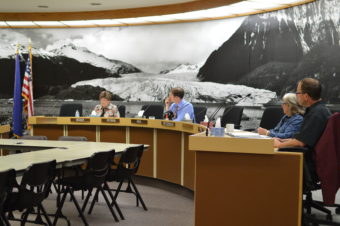
The Juneau Lands and Resources committee met Monday evening to push forward an amendment to the city’s land use code that would allow child care providers to care for more children. (Photo by Lakeidra Chavis/KTOO)

The Juneau Assembly is working on amending child care permit regulations in an effort to increase child care availability in Juneau.

On Monday evening, the city’s Land and Resources committee forwarded an amendment that would change part of the land use code, allowing at-home child care facilities to take in 12 children instead of eight.

The Association for the Education of Young Children, or AEYC, provides resources and advocates quality child care in the Southeast. Coordinator Nikki Love says the organization is in full support of the amendment.

“There’s enough licensed care for 1 in 4, or 1 in 5 children, under the age of 5, so the need is really high,” Love said.

In the past few years waitlists have increased but remain at a steady rate, according to Love.

“We’d like to see a decrease in barriers to child care facilities and businesses in town since there is such a great need for child care, and changing the zoning would help open the door to potential businesses,” she said.

The amendment also provides a clear definition of child care home-facilities, requires at home providers to have sufficient parking and if state fencing requirements apply, the city may require the fence to meet neighborhood aesthetics.

If passed, the amendment would not affect any child care facilities currently operating.

The amendment is a part of a larger comprehensive plan to fix the child care crisis Juneau.

Gold Creek Child Development Director Gretchen Boone says she’s in favor of the permitting — the more childcare, the better.

Boone says the waitlist at Gold Creek has 75 children on it — the highest she’s ever seen it despite working at the facility for nearly two decades.

“Having more child care out there would benefit the entire community. There are families on our waitlist who have been on our waitlist for over a year and will probably never obtain space with us,” Boone said.

Lisa White, former owner of Little Bear Daycare, says she also had long waitlists.

“Usually by the time I would get back to some names they had long since found a place, but sometimes it would a year or two,” White said.

White cites over-regulation as the reason she closed her child care center in 2007.  Nearly finished with the re-licensing process she called it quits as a child care provider in Juneau after 17 years, a profession that she cherished.

While speaking about the lack of childcare in Juneau, White got emotional. She looks forward to the situation improving for Juneau’s families.

“It’s just going to keep getting worse unless they do something about it. There are all these families — they need this, and they don’t need this years from now, they need it years ago,” White said.

The amendment was forwarded on to the full assembly, and will be considered at a future meeting.

Editor’s note: We’ve clarified the amendment’s fencing requirement.


Despite marriage equality ruling, LGBTQ Alaskans can still be discriminated against

A man waves a gay pride flag on the steps of the Supreme Court of the United States while arguments are heard on legalizing same-sex marriage. (Photo by Ted Eytan)

The State of Alaska has a commission whose sole purpose is to eliminate and prevent discrimination, but it can’t do anything when it comes to gender identity or sexual orientation.

Alaska is one of 28 states that allow workplace discrimination against these classes.

Rachel Pettijohn says she was discriminated against by two Juneau employers. The State of Alaska has no law protecting  (Photo by Lakeidra Chavis/KTOO)
Rachel Pettijohn says she was discriminated against by two Juneau employers. The State of Alaska has no law protecting discrimination based on sexual identity or gender orientation. (Photo by Lakeidra Chavis/KTOO)

Rachel Pettijohn believes she was discriminated against and humiliated at two tourism companies she’s worked at since moving to Juneau two years ago.

“They didn’t fire me, they just cut down my hours to where I wasn’t getting any hours,” she said.

Since she still works in the industry, Pettijohn declined to name them.

During her first job, a supervisor implied that she was a pedophile, according to Pettijohn.

Her boss was horrified after she made an innocent comment about a coworker’s toddler.

 “I said, ‘Hey, your little girl is really cute,” Pettijohn said. “’And she went, ‘You said that? I can’t believe you said that.’ She thought I was meaning it, in that way,” she said, “and it was just because I was gay. She wouldn’t think it if I was a straight person.”

But Pettijohn didn’t make a big deal about it.

“I think I was kind of embarrassed about it, to be honest,” she said.

Even if she could prove she was discriminated against because of her identity, she wasn’t protected by the law. Despite the U.S. Supreme Court legalizing same-sex marriage across the country, people who are lesbian, gay, bisexual, transgender or queer are not consistently protected under federal law from workplace discrimination.

Former Juneau Rep. Beth Kerttula, a Democrat, tried in 2011 and 2013 to outlaw this type of discrimination. Republican Rep. Cathy Muñoz is carrying the bill this time around.

The Alaska Human Rights Commission documents discrimination complaints each year in their annual report, but doesn’t include data on gender identity or sexual orientation discrimination.

“Very few people contact us because they’re concerned about discrimination based on lesbian, gay, transgender or queer issues because they know we don’t cover those,” according to Paula Haley, the commission’s director.

“So they don’t reach out to us, because they know we don’t have the ability to help them.”

In the past few years, Haley’s only seen a handful of cases. However, the U.S. Equal Opportunity Commission is beginning to accept some LGBTQ claims, according to Haley.

But this area of the law is complicated.

LGBTQ employees who work for the State of Alaska do have workplace protections, according to Department of Administration Commissioner Sheldon Fisher.

“If someone claimed they were not hired or fired due to reasons other than their ability to do the job, whatever those reasons are, that’s something we would work with,” Fisher said.

Some private sector employers may have their own policies.

Drew Phoenix is director of Identity, Inc., an Anchorage-based nonprofit that provides resources for the LGBTQ community. One of the services Identity provides is workplace cultural competency training, also referred to as sensitivity training.

“There’s no legal recourse, which is the really sad part. It’s like our hands are tied, so we can’t even report things at any point,” Phoenix said.

Requests for the training have doubled in the past year. Identity has administered more than 20 since January, according to Phoenix.

Rachel Pettijohn is now at her third company, where she says her employers are welcoming and respect her sexual orientation.


Juneau’s state flags display receives attention as nation debates Confederate flag

Some residents are asking for the removal of the Mississippi flag on Egan Drive because of the Confederate imagery in its upper left corner. (Photo by Lakeidra Chavis/KTOO)
The Mississippi flag on Egan Drive features Confederate imagery in its upper left corner. (Photo by Lakeidra Chavis/KTOO)

Some locals are calling for the removal of the Mississippi state flag flying on the main street into downtown Juneau because it prominently features the Confederate stars and bars.

On Monday evening business owner Marc Wheeler and community member Matt McGuan spoke to the Assembly about removing the flag.

For Wheeler, who’s originally from Louisiana, his connection to the Confederate flag goes back generations.

“On a personal level, my ancestors were slave owners, and I feel like that flag symbolizes our country’s original sin,” he said, “and we have to atone for that.”

Mississippi is a part of an all-states flag display organized every year by a group of volunteers who call themselves Friends of the Flags.

In light of recent events, McGuan decided to do something about it.

“That’s not a welcoming symbol. That’s a symbol of intimidation and hatred. It’s a relic of a terrible time in our country’s history,” McGuan said.

Jim Carroll, has been a Friends of the Flags volunteer since the display’s inception.

“Well, it’s a state representation of the flags, that’s what we have up, no matter what’s on the flag,” Carroll said.

Although he understands the controversy surrounding the flag, he said immediately removing it is impractical. The flags are replaced yearly using a donated piece of heavy equipment.

Mississippi adopted its current flag in 1894. In a controversial statewide referendum in 2001, voters doubled down on keeping the flag.

But the flag doesn’t belong in Alaska, according to McGuan.

“If the people of Mississippi want it on their flag that’s their deal, but we don’t have to give it a place of honor in our community,” McGuan said.

Chair of the Juneau Human Rights Commission Alavini Lata, says the board hasn’t received any complaints from the community. Lata says Friends of the Flags has the final say and the most the commission could do is to talk to them. The issue might be addressed at an upcoming meeting, but he doesn’t think taking down one flag would be effective.

“Generally we don’t take action unless something is brought up by the community and we internally haven’t talked about it as a group,” Lata said.

Georgia removed the Confederate stars and bars from its flag in 2003. South Carolina had flown an actual Confederate flag on its statehouse grounds until late June. South Carolina Gov. Nikki Haley called for its removal and five days later, an activist climbed the flagpole and took it down herself.

Mississippi is now the only state with Confederate imagery in its flag.

Criticism of the Confederate flag has grown after the racially charged mass murder of church parishioners at a historic black church in Charleston, South Carolina, last month.

Since the Charleston attack, stores and major companies like Wal-Mart and Amazon have stopped selling the flag. A supermajority of South Carolina legislators now officially supports removing the Confederate flag from the statehouse.

McGuan says about 10 other community members have met to discuss removing the flag in Juneau. One possible alternative, according to McGuan, is to use the Mississippi Magnolia Flag, which was the state’s first official flag.

Site notifications
Update notification options
Subscribe to notifications