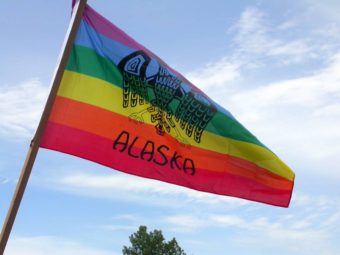
An Alaska Pride flag. The image is based on a double-faced eagle design from Alaska before Russian contact. (Creative Commons photo by Mel Green)
Last Wednesday, the University of California, Los Angeles, published a report on employment discrimination in Alaska based on sexual orientation and gender identity. Alaska is home to more than 19,000 lesbian, gay, bisexual and transgender adults, according to a Gallup poll.
The report, published by UCLA’s Williams Institute found that 17 out of Alaska’s 25 largest employers have corporate policies that prohibit discrimination based on sexual orientation. At least 11 of them list gender identity as a protected class. Some of these employers include Providence Health and Services, Wal-Mart, Fred Meyer and the Arctic Slope Regional Corporation.
Christy Mallory co-authored the report, and says it took about a month to compile.
The report predicts that if non-discrimination laws were expanded, approximately six complaints of sexual orientation or gender identity employment discrimination would be filed annually in Alaska.
“So, six complaints is pretty low,” Mallory said, “that’s mostly because there’s a smaller population in Alaska than many other states.”
The report also cites a 2012 web survey on LGBT discrimination in Anchorage.
According to the Anchorage survey, 44 percent of the respondents had experienced harassment and nearly a fifth had been turned down for a job or promotion. The survey found that transgender people are more at risk for housing and employment discrimination.
The report found that straight male workers’ income was 30 percent higher than gay male workers.
Mallory says their reports focus on the 28 states that don’t offer LGBT legal protection in the workplace.
In a 2011 poll, nearly 80 percent of Alaskans said Congress should pass a law to prohibit LGBT employment discrimination.
In 2002, Gov. Tony Knowles issued an administrative order protecting state employees from employment discrimination and harassment. There are no restrictions on the private sector.
Neither the Alaska State Commission for Human Rights or the Anchorage Equal Rights Commission processes discrimination claims based on sexual orientation or gender identity. But the Williams Institute says that this discrimination does take place, citing legislative testimony.
Juneau Assemblyman Jesse Kiehl is drafting a city ordinance that would prohibit discrimination based on sexual orientation or gender identity in the private sector, including public accommodations and housing. He says he decided to work on the ordinance after local residents discussed the issue with him.
“The recent recognition of marriage equality in all 50 states is a wonderful step forward,” Kiehl says,” but some of these folks were particularly worried that a person could get married on Saturday and show off the photos and be fired on Monday.”
Kiehl thinks broader discrimination protection would be better for everyone involved.
“Those items being included would help us to make Juneau both a welcoming and prosperous community, as folks can live and work here based on their contributions,” he says.
Juneau Rep. Cathy Munoz, a Republican, is sponsoring a bill that would add sexual orientation and gender identity as protected classes, requiring the state commission to handle those complaints. Similar bills have failed twice before.
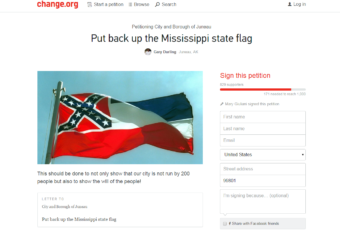
Screenshot of the online petition to put the Mississippi flag back up in downtown Juneau.
More than 800 people have signed a petition created Tuesday to put the Mississippi flag back up in downtown Juneau, just days after it was removed over its Confederate imagery.
It’s addressed to the City and Borough of Juneau, which doesn’t control the all-flags display on Egan Drive and hasn’t officially weighed in on the controversy.
“The city employees don’t put those flags up, there are no city vehicles, they’re not city poles, it’s not even a city right of way,” Juneau Assemblyman Jesse Kiehl said. “So the Friends of the Flags group has not gotten any instructions, directions or push from the Assembly that I’m aware of,” Kiehl said.
Durling doesn’t think that group should make the decision for all of Juneau.
“I feel that a lot of groups in this town try to push their ideas on others in this town, and it divides us,” he said.
Durling acknowledges the different sides of the issue, but says Mississippi’s official flag should fly downtown.
“All of a sudden it becomes an issue, and if you like the flag you’re racist or promoting slavery,” Durling said.
For Durling, who grew up in Juneau, the flag controversy is a part of a city that’s changing. He says it worries him a little. Now that his petition has garnered so much attention, Durling is unsure what he will do moving forward.
Juneau college student Amos Kissel is a supporter. While he acknowledges the flag’s association with racism, he says it’s also a part of people’s heritage.
“I understand people are offended by the Confederate flag, and I respect that and value their opinion. But I know there’s also people that are good and value the Confederate flag as a part of their history and it’s not just about racism and slavery,” Kissel said.
Assemblyman Kiehl says he recently spot-checked the supporters of the new petition and says the majority of them are locals.
“Eighty or 90 percent of the folks live in Juneau, and probably 90 percent of those are registered voters. So it’s clearly something folks in Juneau are starting to think about,” Kiehl said.
So far, five Mississippi cities have removed the flag from their municipal properties. Clarksdale is one of them.
Clarksdale Mayor Bill Luckett says he wishes he removed the state flag sooner. For him, the Charleston massacre was the tipping point.
“They call it heritage, I call it history. It’s not most peoples’ history, at least not around Clarksdale, Mississippi,” Luckett said.
He says the flag is a reminder of a darker time in America.
“That is a reminder to many people of oppression, suppression, slavery, divisiveness, it just carries a lot of negative connotations with it,” Luckett said.
Luckett hopes that the increased attention to the issue will encourage the Mississippi lawmakers to change the flag.
“Sometimes you need to stand out from the crowd and be different if it’s for the right reason, but we stand out and we’re different from most states for the wrong reason,” he said.
The Columbus city council recently voted unanimously to remove the flag, becoming the fifth city in Mississippi to do so. Councilman Charlie Box voted on the issue.
“I just felt like anything that divisive—it’s a piece of cloth—and to some it means so much, but I just feel like it’s really time to move forward,” Box said.
Box says his constituents are split down the middle.
If the change.org petition succeeds at reversing the Friends of the Flags decision, supporters in Juneau will need to pay for a replacement flag, installation equipment and a permit from the Department of Transportation.
The original Mississippi flag was donated to the Juneau-Douglas City Museum. Once collections are logged, the museum usually doesn’t give them back.
Friends of the Flag organizer Judy Ripley, who allowed the original flag replacement, did so because of the hateful associations with the flag. Although she would not comment on the new petition, she said she was not surprised.
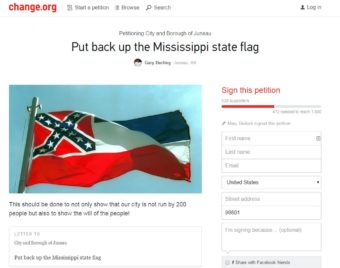
A screenshot of the Change.org petition to put the Mississippi flag back up as part of Juneau’s all-states flag display.
Yesterday evening, Juneau resident Gary Durling started a petition to put the recently removed Mississippi flag back up. The petition, addressed to the City and Borough of Juneau, has more than 500 supporters, most of who are largely from Juneau and the Southeast region.
The flag, which features a full image of the Confederate flag in its upper left corner, was removed Saturday morning after a monthlong debate. It was replaced with the Magnolia flag, the state’s first official flag.
Criticism of the Confederate flag has grown after the racially charged mass murder of church parishioners at a historic black church in Charleston, South Carolina, last month.
After taking down the Mississippi flag, volunteers donated it to the Juneau-Douglas City Museum.
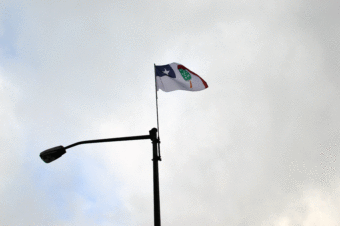
The Mississippi Magnolia flag flies on Egan Drive, in downtown Juneau. (Photo by Lakeidra Chavis/KTOO)
Former Assemblyman Marc Wheeler has set up a fundraiser for local volunteer group Friends of the Flags. Wheeler has so far raised more than $500 of the campaign’s $1,000 goal.
The funds will support Friends of the Flags, “and their courageous decision to replace the Mississippi state flag with the Mississippi Magnolia flag,” according to the website.
Friends of the Flags is a volunteer group that organizes and maintains the all-states’ flags display in downtown Juneau during the summer. After a monthlong debate over removing the flag—which has an image of the full Confederate flag in its upper left corner —the flag was removed last Saturday morning.
The funds will be donated to the group after paying the cost of replacing the flag, approximately $120, according to the website.
Latarsha McQueen changes the flag. (Photo by Lakeidra Chavis/KTOO)
Former assemblyman Marc Wheeler and community member Matt McGuan roll up the Mississippi flag for storage. Both men spoke to the Juneau Assembly in late June about removing the flag. (Photo by Lakeidra Chavis/KTOO)
Latarsha McQueen places Mississippi's original state flag, the Magnolia flag, into its slot on the flagpole. (Photo by Lakeidra Chavis/KTOO)
Latarsha McQueen holds up the newly replaced Mississippi Magnolia flag. (Photo by Lakeidra Chavis/KTOO)
The Mississippi Magnolia flag flies on Egan Drive, in downtown Juneau. (Lakeidra Chavis/KTOO)
Juneau community members embrace after the Mississippi flag is changed. (Photo by Lakeidra Chavis/KTOO)
Community members took the Mississippi flag down around 7 a.m. Saturday. Juneau’s Black Awareness Association Secretary, Latarsha McQueen, removed the flag — which has an image of the Confederate flag in the upper left corner — and replaced it with the state’s first official flag, the Magnolia flag.
McQueen, former Assemblyman Marc Wheeler, and six other community members and their families watched the flag change. Friday morning Wheeler obtained a permit from the state Department of Transportation — which has authority over the right of way where the flags are posted — to remove the flags.
The flag has been part of a discussion in the community ever since the racially charged mass murder of church parishioners at a historic black church in Charleston, South Carolina, last month. While several other state flags include the Confederate stars and bars, the Mississippi flag is the only one to feature the full Confederate flag.
Controversy surrounding the flag has also prompted discussion on the topic of racism in Juneau.
Close
Update notification options
Subscribe to notifications
Subscribe
Get notifications about news related to the topics you care about. You can unsubscribe anytime.