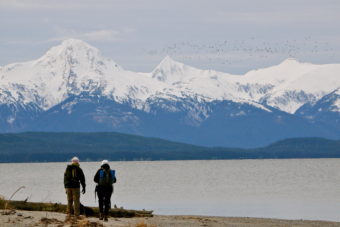
The Chilkat Range from Eagle Beach, Nov. 21, 2010. (Creative Commons photo by Joseph)
Four beaches in the Juneau-Douglas area have elevated levels of toxins that can cause paralytic shellfish poisoning.
Eagle Beach, Amalga Harbor, Auke Recreational Area and Outer Point all have toxin levels that exceed the Food and Drug Administration’s limit for safe consumption.
Elizabeth Tobin is a post-doctoral researcher. She and her team collected the data last month. She said it’s not abnormal to see high levels of PSP-causing toxins this time of year.
“Typically we see elevated levels of these toxic algae in May and June, and that’s why we’re having a lot of PSP notifications in the region,” Tobin said.
Tobin is a researcher for the University of Alaska Fairbanks School of Fisheries and Ocean Sciences. They collaborate with the Southeast Alaska Tribal Toxins network, which published the advisory earlier this week on its website.
Tobin’s team tests areas around Juneau and Douglas weekly. She said the only way to know if shellfish is toxic is to conduct lab tests. There are no testing facilities in the region that check noncommercial catches.
“It’s very, very difficult to tell, or to taste, or to eat a small bit and see if you feel funny,” she said. “That’s kind of gambling a bit. So, while some people, that’s the method they use, I tend not to recommend that, it’s not safe.”
Some people associate unsafe areas with red tides caused by certain algae blooms.
“But it’s kind of misleading, actually,” Tobin said. “Specifically for the algae, it’s called alexandrium, that cause the saxitoxins that cause paralytic shellfish poisoning—kind of a mouthful— but that specific species of algae doesn’t produce a red discoloration of the water.”
Tobin said that’s why the advisories are so helpful.
The Central Council of Tlingit and Haida Indian Tribes of Alaska is doing something few tribal organizations do.

Earlier this month, June 15, the tribe acquired KIRA, Inc., an international maintenance contracting company. The Colorado-based entity has scored more than $1 billion in federal contracts, according to its documents.
Southeast Alaska’s largest tribal organization wants to boost revenue with its acquisition. Central Council President Richard Peterson said the ultimate goal is to serve all of their tribal members, and not just those in Southeast.
“It feels somewhat disingenuous to repeatedly say, ‘I’m sorry you live outside of service area, but hey you’re a citizen, thank you,’” Peterson said.
Grant money that CCTHITA receives mostly limits its services to Southeast. The tribe provides educational, employment, elderly and financial assistance for its tribal members.
Central Council of Tlingit and Haida Indian Tribes of Alaska President Richard Peterson. (Photo courtesy CCTHITA)
Peterson said half of the tribe’s more than 33,000 members live elsewhere in the state or Seattle.
“There’s a misconception out there that we generate funds based on our general enrollment, and we don’t,” he said. “We only generate funds based on the service area enrollment.”
In recent years, CCTHITA has made an active push to generate unrestricted funds by creating a separate company, Tlingit Haida Tribal Business Corp., or THTBC.
Last year, the Small Business Administration certified the company for special government contracting status under its 8(a) program.
Alaska Native corporations have long used the program to win federal contracts, but it’s unusual for tribes.
Congress created the 8(a) certification decades ago to help small and minority-owned businesses win federal contracts. Special provisions were added in 1986 for federally recognized Native American and Alaska Native corporations — they can outgrow “small” status but continue to enjoy the program’s benefits.
Carlos Garcia is KIRA’s founder and president. It was once 8(a) certified, too, but outgrew the program. KIRA will now have those small business contracting opportunities again.
“We were only allowed to bid on a small percentage of them,” Garcia said. “We wanted to bid and the only thing that was missing was the certifications that the tribe enjoys.”
The acquisition of KIRA became official after about a year of negotiations. KIRA was actually looking for an Alaska Native corporation partner, according to company documents from 2014.
Garcia said he decided to sell to CCTHITA instead of an Alaska Native corporation to ensure the profits directly benefited shareholders.
“The money that we make is going to go straight to their tribal members. Many of these large ANCs have enormous bureaucracy in Anchorage and the money goes to those executives,” he said. “And there doesn’t seem to be a lot of profit put forth to the Native programs.”
Richard Rinehart, CEO of Tlingit Haida Tribal Business Corporation. (Photo courtesy of Sealaska)
THTBC’s CEO Richard Rinehart wouldn’t disclose the acquisition price or the projected revenue from the purchase. But he did say one of the goals is to have KIRA compete in Alaska’s market.
“KIRA has not competed a lot in Alaska because there’s so many Alaska-based corporations that have an advantage,” Rinehart said. “Well now they’ll be able to.”
In the coming weeks, Garcia said KIRA will add on multiple new contracts.
He believes that if everyone works hard, the company — and its profits — will multiply quickly.
Aquatics Board Chair Max Mertz presents the annual report to the Juneau Assembly. (Photo by Lakeidra Chavis/ KTOO)
The city’s Aquatics Board presented its first annual report to the Juneau Assembly on Monday.
The assembly created the board last spring to improve the quality of service at the city’s two swimming pools — the Augustus Brown Swimming Pool downtown and the Dimond Park Aquatic Center in the valley.
Board chair Max Mertz told the assembly that the group has made a lot of progress in their first year. Some of the changes they’ve made include reducing the cost of annual passes and allowing customers to use their passes at both city pools.
“We’ve had pretty stunning success, honestly,” Mertz says. “This year compared to last year, since the new rates were implemented, we’re about 38 percent up on revenue.”
According to the report, the pools recover a nearly a third of the more than $2 million it takes to run them. Mertz hopes the board can increase that within the next two years. Food services and partnerships with larger organizations are part of the plans.
“We want to figure out a way that we can market the pools for corporations in such a way that it makes sense for them to buy passes for their employees and use the pools,” he said.
The board is set to sunset in spring of 2018. Until then, Mertz says the seven-member group will continue to find ways to improve the city’s aquatics services in staffing, cost recovery and customer satisfaction.
Correction: An earlier version of this story misstated the increase in revenue.
More than 60 people crowded into the Juneau Assembly Chambers to listen to testimony on Juneau’s proposed anti-discrimination ordinance. (Photo by Lakeidra Chavis/ KTOO)
The Juneau Assembly heard nearly unanimous support for a proposed ordinance that would protect people from discrimination based on gender identity and sexual orientation in a committee meeting Tuesday evening.
Thirty people testified on the ordinance, including Rev. Sue Bahleda of the Resurrection Lutheran Church.
Her testimony focused on the importance of belonging.
“We are straight or gay, lesbian or transgender, we belong here, we belong in our workplaces, we belong in our apartments and homes,” Bahleda said.
The proposed ordinance would create a new, local equal rights law. Unlike the state’s law, Juneau’s would include gender identity and sexual orientation.
It would protect the two classes from discrimination in local businesses, employment, education, housing and public accommodations, like hotels. The ordinance also includes some religious and tribal exemptions.
People from the LGBT community, allies, local business people and clergy shared personal stories in the hopes of highlighting its importance.
The first to speak was Mark Hutter, who shared that he always felt welcome growing up in Juneau, but said he was recently fired from his job for being gay.
“You can’t make someone accept someone that is different from them,” Hutter said, “but you can provide protections for individuals like me who face discrimination when all we want to do is work hard and pay the bills.”
More than 60 people crowded into the Assembly Chambers for the public hearing that lasted nearly two hours.
Kristen Bomegen, who identifies as a lesbian, said she’s lived in Juneau since the ‘80s. She focused her testimony on her experiences with housing discrimination, sharing her experiences with eviction.
“The second eviction was from a four-month sublet, and when I had occasion to a complain about the noise from another neighbor, and I was told that ‘If you don’t like it here, I don’t want you here, I don’t like your lifestyle,” Bomegen said.
“And I, of course, wanted to say, ‘Well you can’t do that.’ But she could. And she still can.”
State law doesn’t include sexual orientation or gender identity as protected classes.
But cities continue to expand protections. If Juneau’s ordinance passes, it will become the second city after Anchorage to provide discrimination protection for the LGBT community in housing, private employment and businesses.
For now, the Juneau Assembly members recommended clarifications to the ordinance’s language, which will be discussed again next month.
Correction: An earlier version of this story misspelled Kristen Bomegen’s last name and incorrectly attributed her quote.
Women are underrepresented in state boards and commissions. These groups – comprised of experts, citizens and officials – guide state policy, make regulations and protect Alaskans in areas, from hairdressing to the Permanent Fund.
This past summer, KTOO collected data on Alaska’s 134 boards and commissions to which the governor makes appointments. Only a third of the members are women.
The majority of current board members were appointed during Sean Parnell’s administration. A few currently serving members were appointed as far back as Jay Hammond’s and Bill Sheffield’s administrations in the ’80s. So far into his tenure, current Gov. Bill Walker has appointed 104 people to the state’s boards and commission, of which 34 have been women.
There are some public officials who serve on multiple boards, including Walker. Taking this into account, more than half of Alaska’s boards are still overwhelmingly occupied by men.
Boards that were run by majority women and featured no men were under departments that focus on social and community development. Some of these entities were the Board of Professional Counselors, Board of Certified Direct-Entry Midwives, and Governor’s Council on Disabilities and the Advisory Council on Libraries.
Despite this, nearly a third of the boards had fairly equal members, like the Alaska Judicial Council, Alaska Oil and Gas Conservation Commission, and the Council on Domestic Violence and Sexual Assault.
Of the 12 departments these boards fall under, Health and Social Services had the most gender balanced membership.
In early July, Walker established and appointed people to the five-member Marijuana Control Board. Although 38 of the 131 applicants were women, none were chosen.
Here’s a closer look at the state’s new Marijuana Control Board, formed in July, which has no women.
Kim Kole is a 41-year-old mother and high school science teacher in Anchorage. Last year, she was also the face of a parent coalition campaigning for regulating marijuana like alcohol. Literally, her face was on campaign posters, newspaper ads, the web, coupon mailers.
“There definitely was a little bit of backlash,” Kole said.
Campaign poster for the Campaign to Regulate Marijuana Like Alcohol. (Image courtesy of Strategies 360)
Kole said she and her school district received emails and complaints calling on her to resign as a teacher. But she received more support than negativity.
“I actually had random people stop me in cars and say, ‘Hey, that was really brave of you. I’m glad that you’re doing that. Thank you.’ That was actually really, really cool to get that kind of response. And the nasty-grams and nasty emails that I got from random people that I didn’t know, it’s going to happen. You can’t please everybody.
“The idea is basically to encourage women to be part of the cannabis industry because we want it to be the first industry where women really have an equal footing. In any other industry that hasn’t been the case,” Kole said.
The hope for gender equality within the industry doesn’t hold up for the board responsible for regulating the industry or deciding who gets a license. Walker appointed five men to the Marijuana Control Board.
That’s despite the fact that almost a third of the 131 applicants were women, and seven of them were interviewed.
Kole was one of them. Her interview lasted about an hour and she left feeling good about it. She says she applied for the board to offer a unique voice.
“Coming as somebody who’s a little bit younger, who comes from a different demographic, who has children, who works with children, it’s definitely just a different perspective and a different lens to look at this whole industry,” Kole said.
Loren Jones, a Marijuana Control Board member, said it’s valuable to have both genders represented in a board.
“When you’re talking about an issue as complex as marijuana going from illegal to legal with controls, and issues about minors and schools and daycare and that kind of thing, then I think women would bring a much different perspective oftentimes to those kinds of discussions,” Jones said.
The initial board had to include two members from the marijuana industry, one from public safety, one from public health and one from a rural area. Walker said he struggled with staying within these requirements, “That was probably one of the toughest boards for me to select.”
Walker said he’s sensitive to gender equity and takes that into consideration for all appointments. But only a third of the roughly 100 board and commission appointments he’s made since becoming governor are women.
“I think we can certainly improve on that. Absolutely we can. And I think that if you look at our administration I think you’ll see we’ve done a good job on that as well,” Walker said.
Eight members of his 23-person cabinet are women.
Walker said he wasn’t comfortable with appointing an all-male board. There was a woman in Anchorage he hoped to get on the Marijuana Control Board – he didn’t recall her name – but he said another form of diversity took precedence.
“I wanted somebody from Southeast. There’s somebody from Juneau. There’s somebody from Fairbanks. There’s somebody from Anchorage. So regional is important to me as well, that there’s a regional representation,” Walker said.
For the rural seat, Walker appointed a Bethel man. For public safety, he chose a Soldotna man.
The appointments must be confirmed by a majority of the Alaska Legislature, but a deadline is coming up before that. By Nov. 24, this initial all-male board is responsible for adopting regulations for how the industry is going to operate. It controls the cultivation, manufacture and sale of marijuana in Alaska.
That’s a big deal.
“Very, very, very big job. I will agree with you, it’s huge,” said Cynthia Franklin, director of the Marijuana Control Board and the Alcoholic Beverage Control Board. She thinks regional diversity on the board is especially important at this early stage.
“If you had a board that was mostly Anchorage and Juneau, or even Anchorage, Juneau and Fairbanks that didn’t have representation from some of the small- and medium-sized areas, then you might get rules that might work for one area of the state that might not work for another area of the state,” Franklin said.
Amy Lovecraft finds having an all-male Marijuana Control Board troubling, “It would be unusual for a board that deals with social policy and health policy to be a board composed entirely of men.”
Lovecraft is a political science professor at the University of Alaska Fairbanks. She teaches courses on law and society, which involves looking at gender issues.
“When you’re dealing with, in particular, policies that may affect men and women, and may affect youth – girls and boys – may affect our elders all differently, those kinds of boards should make a special effort to have gender diversity,” Lovecraft said.
The Marijuana Control Board isn’t the only all-male state board. There are 12 others. Most of the members on these boards were originally appointed by other governors. Walker’s most recent appointment was Attorney General Craig Richards to the Alaska Permanent Fund Corporation Board of Trustees, which is also all-male.
That’s another board Lovecraft thinks should have some women.
“Certainly in 2015, one would think that concerns of mainstreaming gender across different kinds of policy areas would be something that an administration would take seriously,” Lovecraft said.
The main question is, Lovecraft said, “Can both genders have equal expertise in the gender concerns of the other to represent them in policy? And, while I would like to say yes…”
We’re still not quite there yet, she said, and it’s best to preserve gender diversity.
One member’s term on the Marijuana Control Board expires next year. Walker says when further appointments to the board are made, women will be represented.
Kim Kole has already submitted her resume.
Jennifer Canfield contributed reporting to this story.
Alaskans voted in 1998 to define marriage in the state constitution as only between a man and a woman. Now that the U.S. Supreme Court has invalidated that definition, Alaska and the entire country has marriage equality.
To some it may seem like things are changing fast, but Alaska’s fight for gay rights began half a lifetime ago.
Walker has not given a direct answer when questioned about his position on LGBT rights. He’s only stated that he believes marriage is between a man and a woman. When questioned further in this interview about his stance on LGBT rights, he still did not provide a direct answer.
“Just imagine if you couldn’t call the fire department because you were LGBT. If you are LGBT you should be able to call any state agency and get the same service,” says attorney Caitlin Shortell. She represented the same-sex couples that sued the state for the right to marry. “This is an injustice that needs to be corrected.”
Politicians and activists weigh in
Anchorage activist MoHagani Magnetek
Juneau Assemblyman Jesse Kiehl on LGBT protections in Juneau.
Gov. Walker on handling LGBT rights during his tenure.
Activist and Researcher Melissa Green.
Documents
This list includes the official files from bills that have included sexual orientation or gender identity in drafts of legislation dating back to 1975. The grid also includes links to significant court cases and video focusing on LGBT rights.