Lakeidra Chavis, KTOO

Assembly adds gender expression to equal rights ordinance

Assembly members Jesse Kiehl and Debbie White listen to the City Attorney Amy Mead. (Photo by Lakeidra Chavis/ KTOO)
Assembly members Jesse Kiehl and Debbie White listen to City Attorney Amy Mead July 25, 2015. (Photo by Lakeidra Chavis/KTOO)

The Juneau Assembly has made changes to the proposed Juneau Equal Rights Ordinance, which would create non-discrimination laws for the capital city.

If passed, it would add protections under sexual orientation, gender identity and, in the newest draft, gender expression.

During a work session Monday evening, the assembly focused most of its time on the ordinance, now in its second draft.

Some of the proposed changes included adding ministerial exemptions. If included, the exemption would allow an educational religious institution to consider the applicant’s religion. The assembly did not make a final decision on including the exemption, and asked the City Attorney Amy Mead for possible alternate language.

The assembly voted to delete a section regarding discrimination in public activities or programs that receive grants or other forms of financial assistance from the city. Assembly members Jesse Kiehl and Loren Jones agreed it was a non-issue within the ordinance.

Another changed focused on housing, adding the lessee, or renter, as an individual allowed to make housing preferences. Owners already have this freedom.

The assembly will go through the third draft of the ordinance at its next Committee of the Whole meeting Aug. 15, where it will hear public comments.

Eight tons of chum salmon destroyed after truck spill

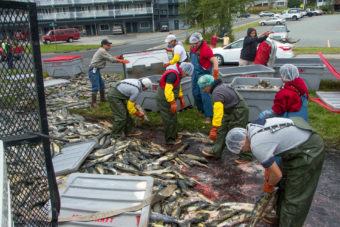
Crews load salmon back into fish totes after a tuck rollover on Egan Drive on July 25th, 2016. (Photo by Mikko Wilson / KTOO)
Crews load salmon back into fish totes after a tuck rollover on Egan Drive on July 25th, 2016. (Photo by Mikko Wilson/KTOO)

An estimated 16,000 to 18,000 pounds of chum salmon were destroyed after a truck overturned in downtown Juneau Monday afternoon. The spill blocked Egan Drive, a major roadway leading in and out of downtown.

Department of Environmental Conservation’s Environmental Health Inspector Jason Wiard received phone calls after the spill. He said he called around to find out who it belonged to.

He said Taku Fisheries, a local business, owned the truck, and the business name on the totes was Icy Strait. Wiard said the fish were destroyed after being considered unsafe for consumption since they fell onto the roadway.

News of the accident quickly spread through town, with some drivers holding up traffic by taking photos.

“I think time of day was a big issue, right at that 5 o’clock traffic, right downtown, when people are trying to get in and out–had a big impact on that whole fiasco, and today with social media being the way that it is, it was instantaneous, everybody kind of knew,” he said.

Although it’s rare for a truckload of spilled fish to block a major roadway in the capital city, Wiard said it’s not the first time.

“I think it has happened in recent years, just on a smaller scale” Wiard said. “I believe one of their [Taku’s] competitors, it happened where they lost a tote of fish—a single tote by the way, not 16 totes.”

The truck driver was taken to the Bartlett Regional Hospital and released the same day. The overturned truck caused a traffic jam for roughly three hours. After about a dozen employees from Taku Fisheries helped pick up the fish, the road was cleaned and sanded.

Taku Fisheries could not be immediately reached for comment.

Why Juneau’s rape stats tripled in one year

The number of reported rapes in Juneau nearly tripled from 2014 to 2015. That increase is from more rapes being reported, but also because the Juneau Police Department had been undercounting rapes in its annual report.
“We did have an increase in rapes,” said Juneau Police Chief Bryce Johnson. “For the 23 rapes that were reported in 2014 to 68 in 2015, which is almost a 200 percent increase.”

He said the sharp increase in rapes is different than other crimes in the annual report because as a crime, rape is different.

“We don’t have one victim of a car theft who had 20 cars stolen,” he said. “An amount of time the crime can occur in rape cases is much higher than other cases.”

But until last year, if a single rape victim were violated 20 times, it might have been counted as one rape case. Now, each instance is being counted.

The issue was highlighted after staff members received updated training last year.

“What they discovered when they were counting the rape cases is that what they were supposed to be doing is counting each time it occurred, not the victim,” he said.

Johnson said the change doesn’t affect how officers respond to the crime or how the cases are prosecuted. But this does help JPD get a better understanding of what’s going on in the community.

If the old victim-based counting method were applied to 2015, the stats would still show a 135 percent increase in rapes. Johnson added, it’s not necessarily a bad thing that more rapes are being reported, since it’s a historically underreported crime.

There’s a uniform crime reporting system, or UCR, outlined by the FBI that law enforcement agencies must follow.

Christen McClure works for the Department of Public Safety’s UCR program. She said that when it comes to spotting trends in crime data, the numbers alone don’t tell the whole story.

“Those raw numbers don’t necessarily reflect that and the agencies, of course have to protect the identities of their victim, because they need to protect anonymity,” McClure said. “It is important to keep that in mind when you look at increases and decreases.”

For example, crimes might’ve spanned years. But when it comes to the annual report, the total number of crimes will be included in the single year it’s reported.

McClure said that while JPD and other police departments might report data differently in their local reports, UCR is the standard.

And right now, the FBI accepts two reporting systems for law enforcement — a summary reporting system, which Alaska uses and has been around since the early 1900s, and a more recent one called the incident-based reporting system.

Lisa Purinton is a program coordinator with DPS.

“The summary based system is basically exactly that, it’s a summary of crime incidents,” she said.

For an example of how cases would be reported in the system, Purinton said, think of a single case involving a burglary, a robbery and an assault.  In the summary system, the only crime reported would be the robbery, since it’s the most severe crime.

She said eventually, Alaska will switch to the incident-based system, which would report three crimes in that example.

Purinton said that change, mandated by the FBI by 2021, will take some time and a lot of training.

Johnson said the goal is to be honest with the community.

“We want to be a transparent organization; we don’t want to underreport the crime,” he said. “We’re just trying to give an accurate representation to the community about what’s happening in the community.”

B.C. mine officials announce new changes to mining code

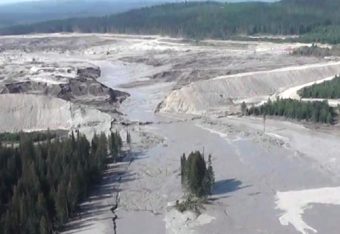
This aerial image shows Aug. 5's Mount Polley Mine tailings dam break and some of the damage downstream. The mine just won permission to reopen on a limited basis. (Cariboo Regional District Emergency Operations Centre photo)
The Mount Polley Mine tailings dam failed on Aug. 4, 2014, devastating areas downstream. (Photo courtesy Cariboo Regional District Emergency Operations Centre)

Two years after one of the worst mine disasters in Canada’s history, mine officials in British Columbia are rolling out new mining codes.
They say the new codes will improve safety, prevent future disasters like the Mount Polley mine disaster in 2014, and increase transparency. B.C. officials announced the changes to the Canadian province’s mining code Wednesday afternoon, following all of the recommendations from an independent expert review panel.

Bill Bennett, B.C.’s minister of energy and mines, said the changes include updated design standards and management for tailings storage facilities, or TSFs.

“These changes ensure that there are design standards for TSFs that are tailored to the particular conditions that are encountered in B.C. The changes for TSFs and dam safety emphasized protection for the public and the environment,” he said.

TSFs hold all of the waste from a mine. The independent review found that Mount Polley’s had a poor design and build — a key failure that led to the disaster.

Al Hoffman is the chief inspector of mines. He said the goal is to prevent big disasters from happening again.

“This is an area that we didn’t see as a significant risk, the mining industry didn’t see it as a significant risk, but we’ve realized it’s there now and we’ve worked very hard on these code revisions,” Hoffman said, “and  I think that we’ve filled in a lot of those cracks so it’s very unlikely it would happen again.”

Other changes include creating independent tailing review boards, to help make sure the mines are in compliance, updating the permit applications process and posting all inspection documents and board activity overviews online.

Officials are planning to address more than a dozen recommendations from another report by the end of next year.

Guy Archibald is with the Southeast Alaska Conservation Council. He said that while the code changes are good, there’s still work to be done, especially when it comes to transboundary issues.

“We do we need international oversight for these mines, these are international waters,” Archibald said. “There are international fish and wildlife — they don’t respect that line of the map — and the tribes have relatives on both sides of the border.”

He said in the future, he’d like to see more collaboration with people affected on Alaska’s border.

The Mount Polley mine will open again next month.

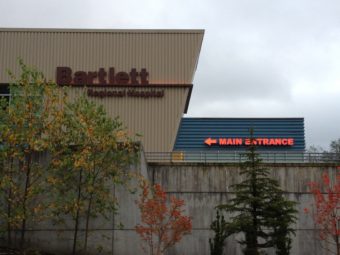
Bartlett continues effort to build a youth psychiatric treatment center in Juneau

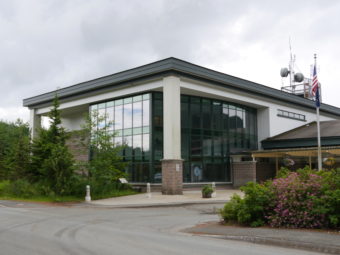
Bartlett Regional Hospital
Bartlett Regional Hospital. (Photo by Lisa Phu/KTOO)

When residential psychiatric treatment services for youth aren’t available in the state, children are sent out of Alaska. But Bartlett Regional Hospital in Juneau is trying to change that by building a treatment center in the state’s capital.

According to reports earlier this month, about 120 children have been sent out of state for high-level psychiatric treatment. In 2004, the number of children sent out of state was six times that. That number has dwindled largely due to a statewide initiative that ended two years ago.

Bartlett Regional Hospital began planning to a build treatment center in Juneau in 2004. Now, things have changed.

“A lot of the discussion was more about an acute care level of service,” said Mark Johnson, one of the hospital’s board members. “And so this kind of changes the service to a different level, and I think it takes a bit of time for that discussion to take place in the community.”

That different level of service is a residential psychiatric treatment center, or RPTC, which has a longer treatment model and focuses on children who’ve experienced severe trauma and suffer from multiple mental illnesses.

“There is a need, there are kids who need this level of service, it is not available in this region right now,” he said. “There’s not enough available in this state right now, and when the kids have to be sent somewhere else it’s very challenging for the families of those kids.”

Although RPTC services are offered around the state, there is none in Southeast. Bartlett hopes to change that with a 28-bed facility.

Sally Schneider is the hospital’s chief behavioral health officer and oversees the project, which is still in the feasibility stage.

“We started looking at what is called a residential psychiatric center that allows children a longer spectrum of care, to be able to better their development needs,” she said.

But running these services is expensive, and some other organizations in Alaska have tried to provide these services, then down-sized or shut down. According to the state Department of Health, the cost of providing these services has increased by 25 percent in the past 11 years, while reimbursement rates from the state have barely changed.

Brita Bishop is a program manager with the state’s Division of Behavioral Health and helped coordinate the Bring Back the Kids Initiative, which helped reduce the number of kids being sent out of state.

“In terms of what we’re seeing in kids who are going out of state, what we’re seeing at this point is that it’s not the kinds of children and youth that are easily served in other community programs,” Bishop said.“And so if we are going to develop additional services in Alaska, one of the things I’m concerned with is that we develop the services we actually need.”

An example, Bishop said, is a child with fetal alcohol syndrome, who also suffers from intellectual disabilities and has other behavioral needs. They’d seek out-of-state services because the child’s needs are so specific.

Bartlett officials will present an update to the Juneau Assembly in September. Aside from finding potential land, they’re asking if providing this type of care in Juneau makes sense financially.

Juneau Assembly asks voters to decide on marijuana tax and permanent sales tax

Juneau voters will be asked three questions on the October ballot affecting sales taxes: Should marijuana be taxed an extra 3 percent, like alcohol? Should the long-standing 3 percent “temporary” sales tax be renewed another five years? And should that “temporary” sales tax become permanent?

The Juneau Assembly voted Monday to put those questions on the Oct. 4 municipal election ballot.

Assemblywoman Debbie White supported the marijuana ordinance.

“The industry themselves said, ‘Treat us like the alcohol industry,’” White said. “So that’s what we’re doing — exactly what they asked for.”

Making the 3 percent sales tax on retail, rentals and other services permanent, if enacted, would start in July 2022. The community has renewed the “temporary” sales tax every five years for decades.

Both White and Assemblyman Jerry Nankervis objected. White said it excluded younger generations from having a say.

Nankervis, who called into the meeting, said the recurring ballot question helps keep the city in check.

“I like the fact that we have a temporary sales tax in this town,” he said. “I like the fact that voters get to give us a report card on how we’ve done.”

Mayor Ken Koelsch also proposed a resolution urging the legislature to pass a “balanced, sustainable and predictable state fiscal plan,” which the assembly adopted.

Also during the meeting, multiple assembly members and Koelsch extended their thanks to the Juneau Police Department in light of recent national news.

Correction: An earlier version of this story omitted one of the ballot questions that voters will decide in October.  Voters will also be asked to renew the temporary 3 percent sales tax. 

Site notifications
Update notification options
Subscribe to notifications