
Lisa Phu

Managing Editor, KTOO

"As Managing Editor, I work with the KTOO news team to develop and shape news and information for the Juneau community that's accurate and digestible."

With session winding down, House passes Erin’s Law

Rep. Charisse Millett, R-Anchorage, wraps up debate on House Bill 44, also known as "Erin's Law," in the Alaska House of Representatives on Saturday. (Photo by Skip Gray/360 North)
Rep. Charisse Millett, R-Anchorage, wraps up debate on House Bill 44, also known as “Erin’s Law,” in the Alaska House of Representatives on Saturday. (Photo by Skip Gray/360 North)

The House passed a version of Erin’s Law on Saturday. Now, three versions of the child sexual abuse prevention bill are stuck in the Senate Education Committee as the legislature winds down for the year. Majority leadership has indicated there’s no rush to pass the bill.

Republican Rep. Tammie Wilson said deciding how to educate children about sexual abuse prevention should be done on a local community level, and not mandated by state law.

House Bill 44 would require public schools to provide age-appropriate K-12 sexual abuse education.

Wilson says the legislature should be more concerned with what resources schools have when something comes up.

“We have a 7-year-old who’s been mistreated at home, comes and says something to the teacher about it. Do we have the safety nets to be able to – and the people we need – to find out exactly what happened? Or does that child get taken immediately from the home, spiraling the family downward for something that might have been innocently said and nothing happened. Children say things,” Wilson said.

Republican Reps. Dan Saddler, Shelley Hughes and Wes Keller also spoke on the floor against adding another unfunded mandate for school districts, exposing young children to problematic material and said the bill would not solve the problems. Hughes, however, ultimately voted yes on the bill.

Rep. Mike Hawker said the bill imposes an inappropriate burden and additional liability on teachers who are not professional psychologists.

“They are not behavioral health specialists. They are educators and we are demanding that they be something they are not and are not trained to be,” Hawker said.

Rep. Geran Tarr, D-Anchorage, gets a congratulatory hug from Rep. Cathy Muñoz, R-Juneau, after the house passes House Bill 44. Tarr first brought "Erin's Law" to the legislature last year. (Photo by Skip Gray/360 North)
Rep. Geran Tarr, D-Anchorage, gets a congratulatory hug from Rep. Cathy Muñoz, R-Juneau, after the house passes House Bill 44. Tarr first brought “Erin’s Law” to the legislature last year. (Photo by Skip Gray/360 North)

Bill sponsor Republican Rep. Charisse Millett said almost half of the state’s school districts already teach sexual abuse prevention in grades K through 12. The bill also includes prevention efforts against dating violence, and gives parents the option of excusing their children from either. Millett acknowledged that parents who perpetrate sexual violence may be the ones who opt their children out.

“This may not be the linchpin that solves the epidemic, however we know that every victim matters. If we can save one child, one teenager, I think we’ve done our job,” Millett said.

She also agreed with critics who said her bill was not perfect.

“I’m not shaming anyone. I respect every single person’s vote. I understand your concerns, I get it. This is not a perfect bill, but let’s not let perfect get in the way of good,” Millett said.

The bill passed 34-6, with Republican Reps. Hawker, Craig Johnson, Keller, Lance Pruitt, Saddler, and Wilson voting no. It’s in the Senate now.

In January, Gov. Bill Walker called for Erin’s Law to be on his desk, and said last Thursday it’s still a high priority. At a press conference, he said he’d consider including it in a potential special legislative session.

Editor’s Note: The story has been updated to clarify who voted no on the bill. 
Without SAGA, no Eagle Valley Center programs this season

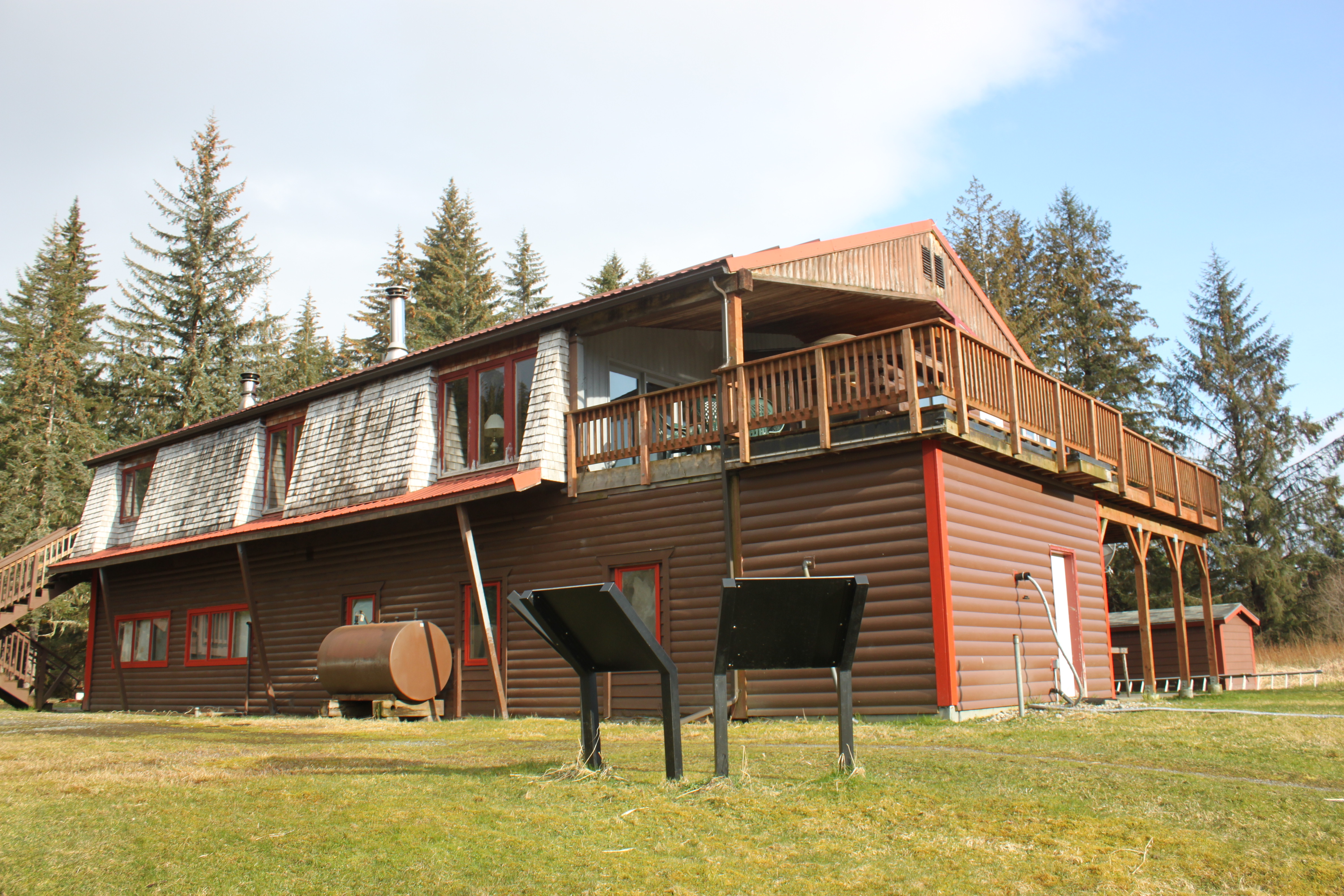
The Eagle Valley Center is located out the road in Amalga Meadows Park. (Photo by Lisa Phu/KTOO)

The City of Juneau has taken over temporary management of the Eagle Valley Center after Southeast Alaska Guidance Association, or SAGA, stopped overseeing it. The outdoor education and lodge facility is located out the road in Juneau’s Amalga Meadows Park.

It’s unclear what will happen to the Eagle Valley Center in the future, but for this season, the city says it won’t be running any programs.

SAGA has been managing the city-owned Eagle Valley Center since 1992. The latest use agreement goes through 2016, but Parks and Recreation Director Kirk Duncan says the city may be terminating that much sooner.

“We’ve just found out that SAGA has not been maintaining its insurance which puts it in violation of its contract and we can terminate for cause, and so we’re moving forward with that,” Duncan says.

Amid financial troubles last year, SAGA lost its Eagle Valley Center manager but kept a caretaker and did minimal maintenance. The caretaker left the Eagle Valley Center several months ago and didn’t notify the city, Duncan says. The city moved in its own this month.

Duncan says he’s not sure if Parks and Recreation will take on long-term management.

“The city is hard pressed to take on any new obligations without adequate funding. Eagle Valley Center doesn’t come with any funding so we would be looking at – can we do something out there that we can break even on? And would we go get grant funding to help us provide low cost services to the residents of the community? And none of that comes quickly,” Duncan says.

SAGA still has property at the Eagle Valley Center, like kayaks, vans and ropes course gear. Duncan says that’s between the organization and its bank; the city is not getting involved.

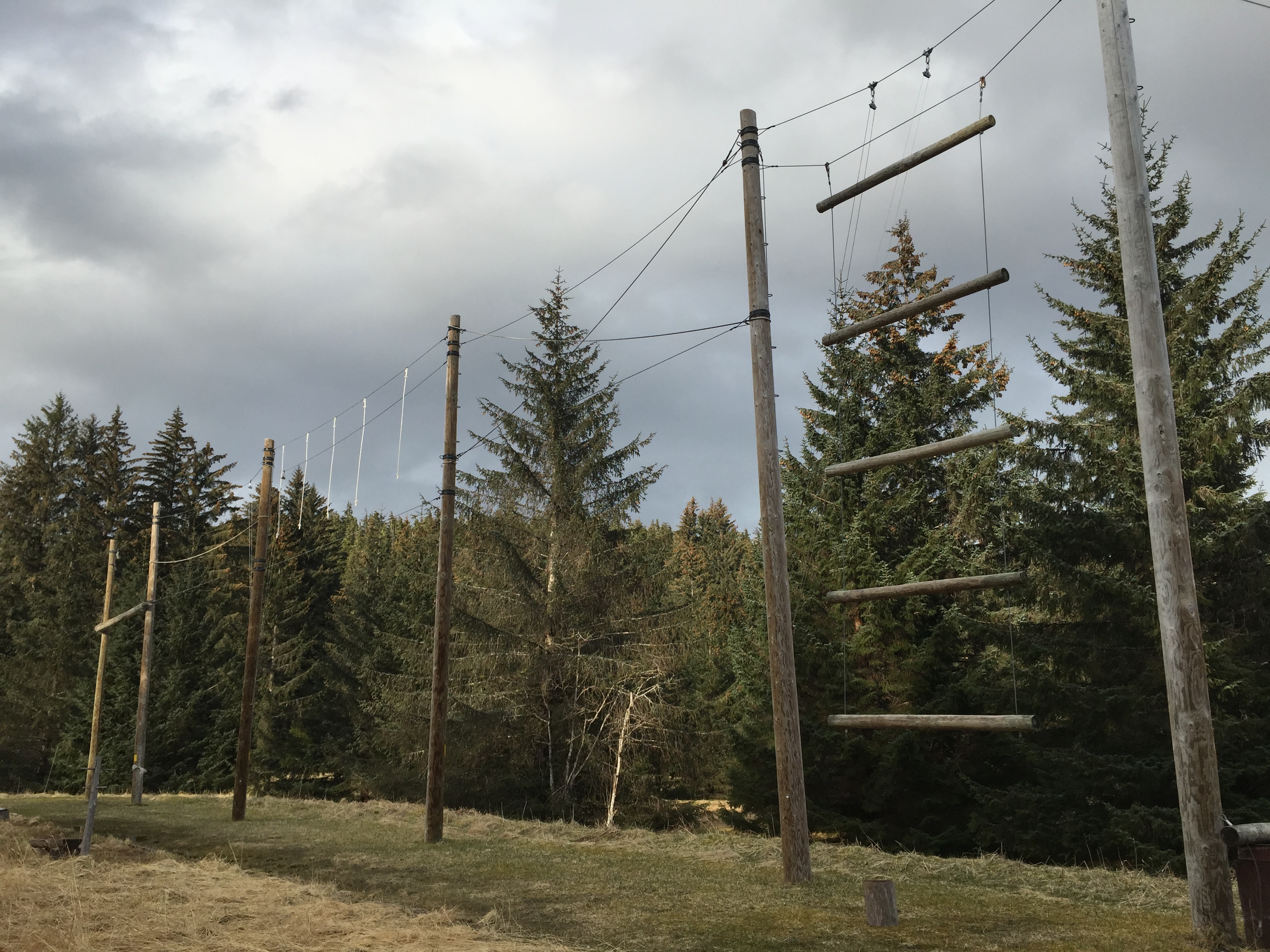
“The poles and the cables are still in the ground and in the air, but all the harnesses and everything else are tied up with the First Bank-SAGA situation,” Duncan says. “So if somebody came to me and said, ‘We want to manage the ropes course. We will provide the equipment. We will market it. We want to operate it. We have adequate insurance. We have people that are trained.’ I’d be all over it. But the city will not be operating any programs out of the Eagle Valley Center this summer.”

The ropes course still stands at Eagle Valley Center, but the city will not be running it this summer. (Photo by Lisa Phu/KTOO)

Duncan says he’s open to the idea of the city partnering with an organization for management, like Discovery Southeast or the Eagle River United Methodist Camp, if there was interest, or partnering with a conglomerate of agencies. He knows it’s a good asset to the community and wants to keep it available.

At the end of last year, community members came together to brainstorm ways to keep the Eagle Valley Center going, but no leading organization emerged.

Discovery Southeast Executive Director Shawn Eisele says the Eagle Valley Center is a great outdoor education resource, particularly for middle and high school students, one that he wants to see stick around. At the moment, though, it’s not something Discovery Southeast can take on.

“There’s just a lot of stuff going on there and it’s hard to find an organization that’s in a position where they can run summer camps, they can run kayaking expeditions, they can run ropes courses. My hunch is that it’s going to take a lot of different groups coming together and each playing a role, which ultimately, I think, is a lot stronger for the community,” Eisele says.

Darren Snyder hopes the Eagle Valley Center remains a community resource. As a Cooperative Extension agent for the University of Alaska Fairbanks, he also hopes it’ll be the site of locally grown food on a commercial level.

“There is a rich history of that valley being used for food production. There was a farm at one point and it’s excellent flat land for that purpose potentially. I think that that should be part of the conversation on how that valley gets used,” Snyder says.

Parks and Recreation Director Kirk Duncan says he’d like to hear ideas for the Eagle Valley Center. He also says groups that are interested in using the retreat facility this summer should contact his department.

“I don’t want to say, ‘No, we’re not using it.’ There’s a lot of unanswered questions. I’d like to use it, but I want to make sure that we do it in a responsible way,” Duncan says.

SAGA board chair Matt Smith declined to comment for this story.

Full disclosure: Kirk Duncan is on KTOO’s Board of Directors, and Darren Snyder is a KTOO employee spouse.

Juneau School District hopes special election will make $14 million difference

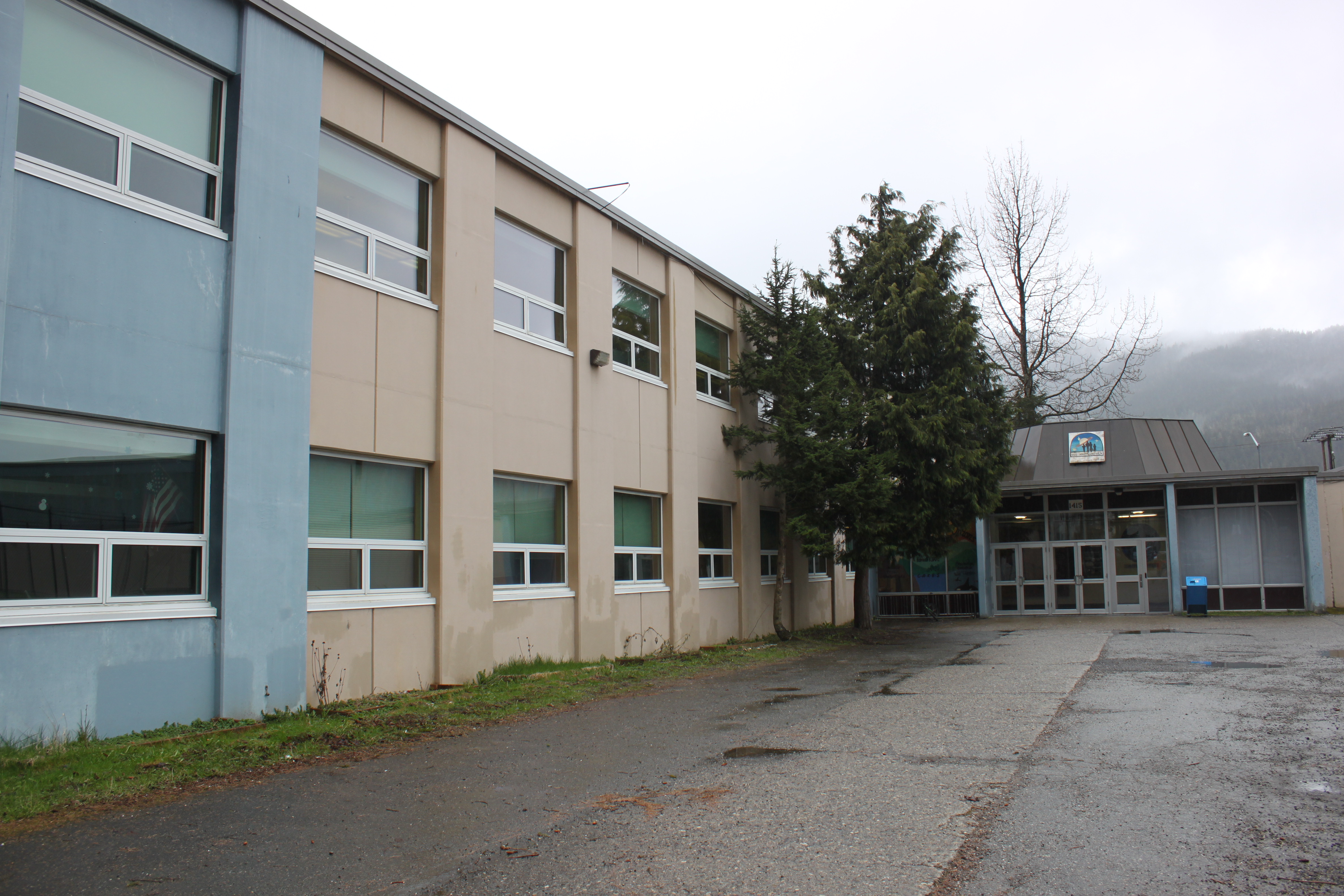
The Marie Drake Building was built in 1965 and hasn't gone through any major renovations since. (Photo by Lisa Phu/KTOO)
The Marie Drake Building was built in 1965 and hasn’t gone through any major renovations since. (Photo by Lisa Phu/KTOO)

The Juneau School District wants a special June election asking voters to approve a bond measure for school renovations before a law stopping state reimbursements for school construction takes effect. The governor still hasn’t signed the bill, but if he does, the school district has 90 days before it becomes a law to hold an election. Even if all goes smoothly and the district beats the countdown, it’s still unclear if it will get reimbursed.

The Marie Drake Building was built in 1965 as a junior high school. Now, it houses Yaaḵoosgé Daakahídi Alternative High School, Montessori Borealis and some district offices.

“It’s very difficult to teach science in a classroom that has one sink that is as old as the building that works most of the time, but not all the times,” says Ryia Waldern, science teacher at Yaaḵoosgé Daakahídi, which doesn’t have any lab facilities.

“We do different squid and fish dissections. We also teach a really incredible forensics class where it can get pretty messy because we’re doing different blood splatter analysis,” Waldern says.

All of that is done in a normal classroom.

“And my floors and the lights are original to the building and when the students upstairs in Montessori are doing their really fun activities, our lights shake and it’s very loud. And I’m glad they’re having fun up there, but it can be a little distracting when we’re taking notes and things like that,” Waldern says.

The room off Ryia Waldern's classroom has one sink and is used for storing lab equipment and cleaning up. (Photo by Lisa Phu/KTOO)
The room off Ryia Waldern’s classroom has one sink and is used for storing lab equipment and cleaning up. (Photo by Lisa Phu/KTOO)

Getting proper science labs for both the high school and Montessori is part of renovation plans for Marie Drake. Other improvements include the heating and ventilation system, lighting and general updates to learning spaces. The school district would ask voters to approve about $21 million in bond debt, mostly for the Marie Drake building. A small portion, about $1 million, would fund upgrades at Juneau-Douglas High School.

The district has been working on the capital improvement process for the past few years. Originally, the district planned to have it on the normal election ballot in October, but that would be too late if Senate Bill 64 becomes law.

With the state currently reimbursing up to 70 percent of a school construction bond, Superintendent Mark Miller says a lot’s at stake.

“There’s $14 million on the table and if we don’t get an election in the next 90 days that $14 million is gone, I mean, it’s gone forever,” Miller says.

Superintendent Mark Miller  (Photo by Lisa Phu/KTOO)
Superintendent Mark Miller (Photo by Lisa Phu/KTOO)

The bill would stop the state’s school debt reimbursement program for 5 years, at which point the program would be brought back at a lower reimbursement level.

With the state facing multibillion dollar deficits, Miller says he understands the legislature wanting to be fiscally solvent. But he also wants to protect the Juneau School District.

“The law is the law. The law is clear about when bills take effect and we have every right to do what’s legally acceptable in order to do what’s best for our kids,” Miller says.

Elizabeth Nudelman is head of school finance and facilities for the Alaska Department of Education. She says the department hasn’t received a completed application for Marie Drake debt reimbursement from the Juneau School District, but anticipates receiving one.

“If they have their application reviewed as eligible by the department, if the voters approve the project and if the sale of the bonds is in compliance, and the procurement and design and reporting is in compliance, then they would move through the system for reimbursement,” she says.

But Nudelman says even if the state enters into a contract with the district, nothing is guaranteed if the bill becomes law.

“There’s language in the contract around future events that could happen or could not happen. And in a funding for construction programs, it always is based on the legislature appropriating funds,” Nudelman says. “So I think that there are a lot of questions out there that really would need to be solidified to come up with a final answer.”

Laura Pierre is chief of staff to Eagle River Republican Sen. Anna MacKinnon, co-chair of the Senate Finance Committee, which sponsored the bill.

“I would be very surprised if the Department of Education approved any application at this point knowing what the legislature’s intent is,” Pierre says.

But Rep. Sam Kito III, D-Juneau, thinks it’s a smart move for the district to try to enter into a legal contract with the state.

“It appears as though there will be some grey area, but any contracts entered into between now and when the bill actually takes effect should be valid,” Kito says.

And he says it’ll be hard for the legislature to undermine that contract.

Gov. Bill Walker’s press secretary says the governor is still reviewing SB 64.

Proposed aquatics board gets stripped of some power

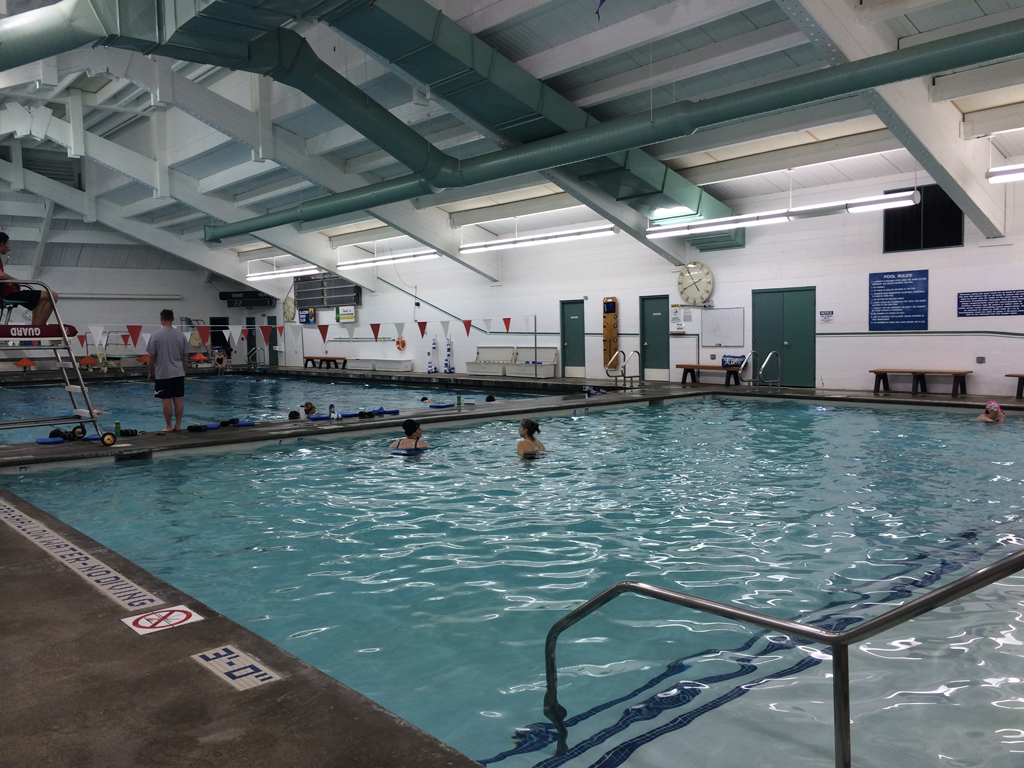
The Augustus Brown facility includes two pools, a sauna and an exercise area. (Photo by Aaron Russell)
The Augustus Brown Swimming Pool. (Photo by Aaron Russell)

The Juneau Assembly on Monday weakened the authority of a proposed aquatics board. It’s the empowered pool board that Juneau voters gave the Assembly permission to make in October through a ballot initiative. The board being proposed now wouldn’t be able to hire and fire its own CEO.

Assembly member Loren Jones proposed an amendment to keep the Parks and Recreation director as head of the pools. Jones said the empowered board would still be responsible for budgeting and operations.

“It sets up a dual responsibility for the director of parks and rec in the way that he will be answerable to the empowered board for the pools when the issues are the pools,” Jones said.

Kirk Duncan became Juneau's Parks and Recreation Director Jan. 5 (Photo by Lisa Phu/KTOO)
Kirk Duncan became Juneau’s Parks and Recreation Director Jan. 5 (Photo by Lisa Phu/KTOO)

For the rest of the time, Parks and Recreation Director Kirk Duncan would still answer to the city manager. Duncan started the job in January after heading the city’s public works department. Prior to that, he was the manager of the city-owned Eaglecrest Ski Area, which is run by an empowered board.

Assembly member Karen Crane says the amendment is a good compromise. She doesn’t see much conflict in having Duncan working for both the city manager and the aquatics board.

“I think that communication between the two sides and the skills frankly that our parks and rec director possesses would be a real advantage in this case and so this is about the only way under which I would favor an empowered board,” Crane said.

Assembly member Jerry Nankervis says it simply won’t work.

“When one boss says I want you to do this and it directly conflicts with what the other boss says, what you do is you take that baby and you tear it in half, and it’s a no-win situation,” Nankervis said.

Jones’ amendment passed with Assembly members Nankervis, Kate Troll and Debbie White voting no. The Assembly directed city staff to add a sunset clause of 3 years and language clarifying the director’s chain of command. The amended ordinance is scheduled for public comment at the Assembly’s April 27 meeting.

Duncan says he understands the concerns about conflict. But he says he’s looking forward to the potential challenge.

“It’s not written in stone that you can’t work for two bosses and if this is a short term fix – 3 years – I’m certainly willing to give it a try. I came to Juneau to take over a government-run ski area. It was a real challenge. There aren’t very many of them around. So this challenge of working for two entities, heck, I think that sounds like kind of an interesting challenge,” Duncan says.

As the Assembly continues to work through the process of establishing the aquatics board, the city has hired an outside firm to manage the pools. USA Pool Management also runs Bethel’s new city pool.

Juneau’s last aquatics manager left the position in February and it hasn’t been filled since. Duncan says the contract is for 6 months at a cost of $14,500 a month.

Full disclosure: Kirk Duncan is on KTOO’s Board of Directors.

Juneau Assembly to decide fate of Haven House

Signs protesting Haven House's location can be seen all over the Malissa Drive area, even in front of Haven House. (Photo by Lisa Phu/KTOO)
Signs protesting Haven House’s location can be seen all over the Malissa Drive area, even in front of Haven House. (Photo by Lisa Phu/KTOO)

The Juneau Assembly heard an appeal Monday night challenging a transitional home for women who are former inmates.

Andrew Hughes and the Tall Timbers Neighborhood Association contend the conditional use permit granted to Haven House in October by the Juneau Planning Commission was improper.

Each side of the appeal had 30 minutes to present its arguments. Prior to the hearing, the Assembly had about 1,700 pages of supporting documents to review.

Representing the Tall Timbers Neighborhood Association, attorney Dan Bruce argued Haven House is a halfway house. He quoted how city code defines a halfway house:

“‘A single-family dwelling for not more than nine persons over the age of 12, together with not more than two persons providing supervision and other services to such persons, all of whom live together as a single housekeeping unit. Residents may be serving a sentence for a criminal act.’ That is Haven House. There is no ifs, ands or buts about it.”

Under city code, halfway houses are not allowed in typical residential districts, like the zoning that covers Malissa Drive in the Mendenhall Valley where Haven House is located.

Attorneys Dan Bruce, Robert Palmer, Mary Alice McKeen presented arguments to the Juneau Assembly Monday night. (Photo by Lisa Phu/KTOO)
Attorneys Dan Bruce, Robert Palmer, and Mary Alice McKeen presented arguments to the Juneau Assembly Monday night. (Photo by Lisa Phu/KTOO)

Bruce said the short-term residents of Haven House would not take ownership of the neighborhood and its presence would lower property values.

“This is the wrong move. It is placing transitory individuals with criminal records in a stable and mature neighborhood and I think that’s completely inappropriate. And I think it is in effect a social experiment and the people of this neighborhood are being asked to be part of the experiment,” Bruce said.

Attorney Mary Alice McKeen represented Haven House. She said Haven House is not a halfway house and the head of Alaska’s Department of Corrections agrees.

“And the reason is that people live in Haven House by their choice. They are not sentenced to live at Haven House. The women living in Haven House could live anywhere as long as they got the permission of their probation or parole officer,” McKeen said.

Representing the planning commission, assistant city attorney Robert Palmer III said Haven House is considered transitional housing and is allowed in a residential neighborhood with a conditional use permit.

“The record clearly establishes that there’s substantial evidence that transitional housing will improve the public health and safety. The structure complies with all fire and building codes. And probably most importantly, evidence was presented that the recidivism rate without transitional housing is roughly 60 percent. With transitional housing as proposed by Haven House, recidivism rate drops down to 20 percent,” Palmer said.

The Assembly met later last night to deliberate. City attorney Amy Mead says the Assembly has 45 days to issue its decision to the parties.

Haven House is currently operating on Malissa Drive with staff, including a live-in manager, and two residents.

Tom McKenna to lead Harborview Elementary

Tom McKenna (Photo courtesy Juneau School District)

Tom McKenna will be the next principal of Harborview Elementary School. He’ll replace Dave Stoltenburg who’s retiring at the end of the school year.

McKenna joined Harborview in 2005 and currently teaches fourth grade. He was one of five finalists who interviewed for the job earlier this month.

McKenna has been an educator in the state for 24 years. In 2012, BP recognized him as a Teacher of Excellence. He was awarded a Teaching Ambassador Fellowship from the U.S. Department of Education the following year.

McKenna holds a masters in English and a bachelor of arts from Middlebury College in Vermont. He completed the Teachers for Alaska Program at the University of Alaska Fairbanks and Educational Leadership program at the University of Alaska Anchorage.

Site notifications
Update notification options
Subscribe to notifications