"As Managing Editor, I work with the KTOO news team to develop and shape news and information for the Juneau community that's accurate and digestible."

On Monday night, Mayor Merrill Sanford said the ordinance would result in “a lame duck board,” instead of an empowered aquatics board. (Photo by Casey Kelly/KTOO)
The Juneau Assembly earlier this week established an empowered aquatics board to run the city’s two pools. Much of the discussion revolved around whether or not the board is truly empowered.
Two weeks ago, the Assembly amended the ordinance to keep the Parks and Recreations director as head of the pools. The position would answer to the aquatics board on issues related to the facilities, and would answer to the city manager for everything else. That means, unlike other empowered boards in Juneau, the aquatics board would not be able to hire and fire its own director.
With that change, Assemblyman Jesse Kiehl said the ordinance still establishes an empowered board.
“It manages the operations and marketing of the pools. It sets the regulations for the pools. It sets the terms under which groups and organizations can use the pools and, above all else, it approves the budget, or the budget that is submitted to the Assembly for the pools. And if you control the flow of the money, frankly, you control what government does and doesn’t do,” Kiehl said.
Assemblywoman Debbie White wasn’t convinced. She said the ordinance still sounded more like an advisory board than an empowered board.
“The voters said they wanted an empowered board. Yes, they have the responsibility of setting the budget, setting the regulations, but they have nothing to back it up,” White said.
White ultimately voted yes. Mayor Merrill Sanford was the lone vote against the ordinance.
“This is not an empowered board,” he said. “If you happen to believe in an empowered board and what the empowered board can do for the aquatics facilities, then that’s what you believe and we should keep it in line with the empowered boards that we have, and this has veered away from that and has given us a lame duck board.”
The ordinance has a sunset date after three years. City Manager Kim Kiefer says the next step is to end the aquatics facilities advisory board. Applications for the new empowered board are due by June 1 and the Assembly will conduct interviews June 10 and 15.
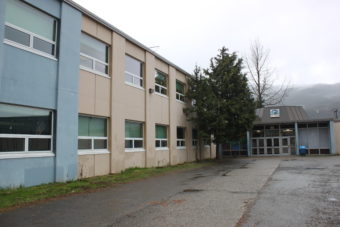
The Marie Drake Building was built in 1965 and hasn’t gone through any major renovations since. Juneau schools Superintendent Mark Miller says that’s not changing any time soon. (Photo by Lisa Phu/KTOO)
The Juneau School District will no longer be advocating for a special election on a $21 million school bond to renovate the Marie Drake Building. This comes after Gov. Bill Walker let a bill stopping state reimbursements for school renovations become law. The Anchorage School District, on the other hand, already had its election and still expects to be reimbursed.
Even though Gov. Walker allowed the bill to become law, he didn’t sign it. In a Friday letter to Senate President Kevin Meyer, Walker wrote about the public’s confusion regarding the bill’s effective date and the bill’s retroactive clause. He says he supports efforts to reduce the state budget, but would’ve preferred that “this have been done in a manner more understandable for Alaskans.”
Even Alaskans inside the Capitol building were confused. Two weeks ago, Juneau Rep. Sam Kito III explained:
“When the bill takes effect, the retroactivity clause will still take place. The bill’s retroactivity kicks in to Jan. 1.”
But Laura Pierre said something entirely different. Pierre is chief of staff to Eagle River Sen. Anna MacKinnon, co-chair of the Senate Finance Committee, which sponsored the bill.
“The retroactivity failed so it wouldn’t be retroactive to Jan. 1,” Pierre said.
According to Assistant Attorney General Cori Mills, “The retroactivity clause and the effective date are two different legal items in a bill.”
And she says they have nothing to do with each other. “The effective date is 90 days from when it’s enacted by the governor,” which in this case is July 23.
The confusion likely stems from when the House of Representatives failed to pass an effective date clause, which Mills says would’ve made the bill effective immediately.
“The retroactivity clause is not a part of the effective date, was not a part of the vote,” says Mills. “It’s within the bill and it has to be called out and so that’s why it has its own provision for retroactivity, and the retroactivity applies regardless of the effective date. So although the effective date is 90 days from last Friday, the bill will be retroactive to Jan. 1, 2015.”
A letter from Attorney General Craig Richards to Gov. Walker dated April 16 says, “If a municipality holds a bond election after January 1, 2015, under the bill, the state would not provide debt reimbursement to the municipality.”
Juneau Schools Superintendent Mark Miller got a copy of that letter on Monday.
“What’s very clear is that whether we have an election or not, the state will not be giving us money for any portion of that bond,” Miller says.
The Juneau School Board wanted the city to hold a special election in June to take advantage of state’s current debt reimbursement program, which would’ve covered up to 70 percent of a $21 million debt.
With all the new information, Miller now thinks a special election would be pointless. He says the district will slow down on the renovation process and figure out a way to phase it in.
The Anchorage School District is moving forward with renovations to eight schools. During the city’s regular April 7 election, voters approved a $59.3 million general obligation bond.
Anchorage schools Chief Operating Officer Mike Abbott says the district got confirmation from the state in December that the renovations were eligible for reimbursements.
“It’s our understanding that our 2015 school bond will be eligible for debt reimbursement,” Abbott says.
Abbott learned of the bill’s retroactive clause on Tuesday.
“We clearly need to work with the governor’s office and likely the AG to make sure they understand why we don’t think that the retroactivity should apply in this case,” Abbott says.
Even without state reimbursement, Abbott says the district is still moving forward with selling the bond.
“We are clear with voters, and we always have been, that the property taxpayers of Anchorage are on the hook for the entire obligation,” he says.
Abbott hopes, and expects, the state will maintain its commitment to the debt reimbursement obligation, but he says there’s no guarantee.
One of the event organizers, Maureen Longworth, speaks to the crowd rallying outside the Dimond Courthouse, across the street from the state Capitol. (Photo by David Purdy/KTOO)
As the U.S. Supreme Court heard oral arguments on marriage equality, around 40 people gathered at the Dimond Courthouse plaza across from the State Capitol in Juneau to rally through song and dance.
The group wants Gov. Bill Walker and Attorney General Craig Richards to end Alaska’s same-sex marriage appeal in one federal case and withdraw its support of gay marriage bans in the Supreme Court case.
With a single speaker wrapped in plastic, two microphones and backup dancers, around 30 people stood in the rain singing, “Stop in the name of love/ Before you break my heart/ Gov’nor Walker, I’m aware of what you do/ After we voted for you/ You signed on the amicus brief/ Against marriage equality/ There’s time before you spend money/ Causing us pain and hurt/ Think it over/ We gave our trust to you…”
Rally participants carried flags and wore Statue of Liberty headpieces. (Photo by David Purdy/KTOO)
At the end of the 5-minute performance, one of the organizers, Maureen Longworth, asked everyone participating and watching to “call Gov. Walker and ask him to stop in the name of love. And have all your family and friends do the same.”
Longworth is referring to the state’s appeal to the federal court decision that legalized same-sex marriage in Alaska. Gov. Sean Parnell’s administration initiated the appeal, and it’s been carried forward by Gov. Walker’s administration.
Longworth and others singing also want the state to withdraw from the amicus brief to the U.S. Supreme Court defending gay marriage bans.
Kimberly Crawford, who voted for Walker, has been doing exactly what Longworth is asking people to do.
“I’ve called him several times, emailed him. I mean, it’s unacceptable in my opinion,” says Crawford, who hasn’t received a reply from the governor.
Kimberly and Marguerite Crawford attended the rally. They were married twice – once outside the Dimond Courthouse in 2012 and again in Connecticut in 2013. (Photo by David Purdy/KTOO)
Kimberly married Marguerite Crawford in 2013 in Connecticut, and their marriage was recognized in Alaska last October when same-sex marriage became legal.
“We had our first marriage, what we consider our real marriage, Aug. 4, 2012, in the courtyard here. Since we couldn’t get married inside the court, we were married outside,” Marguerite Crawford says.
She hopes the singing and dancing will send a message to the governor and attorney general.
“It’s a good lighthearted way to say they are breaking our hearts by denying us the equality that other community members receive,” Crawford says.
Through a spokesperson, the governor says he respects the separation of power from the attorney general; the issue of withdrawing the state’s same-sex marriage appeal or from the amicus brief is up to the attorney general.
Assistant Attorney General Cori Mills says the Department of Law doesn’t plan on withdrawing from either. In January, the Walker administration asked to hold the appeal. Mills says it’s prudent to wait for the Supreme Court decision.
“We haven’t done any work on the case. We have been waiting until the U.S. Supreme makes its decision and the Ninth Circuit granted that stay to wait and see what happens,” she says.
Since the stay was issued, Mills says no money has been spent on litigation. She also says signing onto an amicus brief is a routine department function and didn’t result in additional costs.
As of Tuesday morning, the Department of Health and Social Services reports there have been 134 same-sex marriages in Alaska since it became legal on Oct. 14.
Juneau has a lack of affordable housing. The survey will help city contractors figure out how to solve that problem. (Photo by Justin Heard/KTOO)
The city is asking residents to take an online survey to help solve housing issues plaguing Juneau.
City Lands Manager Greg Chaney says Juneau has a lack of affordable housing, which is housing that costs 30 percent or less of a person’s income.
“Many people in Juneau are paying 40, 50 – sometimes even more than that – percent of their income for their housing,” he says.
The city contracted with czb LLC in January for about $72,000 to come up with solutions to Juneau’s housing issues.
“Not to tell us that we have a problem. We know we have a problem,” Chaney says. “What we need to know is, how can we get out of this? How, as a community, can we have an affordable housing supply that meets the needs of the residents and people who want to move here?”
The city chose the Virginia-based company over a Juneau firm to put out a housing action plan. Chaney says czb has a proven track record dealing with housing issues.
Part of the firm’s work is conducting an online survey. It’s on the city’s website and takes about 15 minutes to complete.
“For the average person, I think it’s going to seem kind of strange,” Chaney says. “It’s very academic. Some of the language is a little thick. I think they could’ve said the same thing with fewer words and shorter words. But if you just read it a couple times and you figure out what the question is, do your best to answer it.”
For example, one of the questions asks, “Under which conditions, if any, would you be willing to consider additional height/stories and density beyond current code requirements/allowances?” Here’s another: “The future of Juneau hinges on successive generations of residents and stakeholders regularly reaffirming their values and acknowledging what they inherited from prior generations, not in words, but in deeds, policies, and programs. In your words, what if anything do you think is most essential to continuing this legacy?”
Besides the survey, Chaney says czb has been conducting other research. It’s interviewed Realtors and lenders, city staff, developers, community organizations and property managers.
Around 400 bowls have been made for The Glory Hole’s Empty Bowls fundraiser on Sunday. This is the ninth year the soup kitchen and emergency shelter has held the event, which allows participants to eat soup and take home a locally handcrafted bowl. The Canvas Community Art Studio & Gallery was in the midst of the bowl-making process earlier this week.
Dozens of clay bowls at The Canvas just finished being glazed and waiting for final firing (Photo by David Purdy/KTOO)
“We’re putting them through the first firing right now, the bisque firing,” says Mercedes Muñoz, ceramics studio manager at The Canvas. She was part of a six-person team who made 200 hand-thrown clay bowls in less than a week.
“I made 70 bowls in one day on Saturday, which was quite a bit,” she says.
Muñoz was in the studio for 9 hours that day.
“I just plugged away at them. I was going from doing a bowl in about 10 minutes when I first started to doing a 2-minute bowl at the end,” Muñoz says.
After the bowls come out of the kiln, Muñoz and Canvas Artistic Coordinator Brandon Howard will glaze them before the last firing.
“We have a licorice, which is just a really dark black, and then a waterfall brown, which has some blues and reds in it as well,” she says. “We’re going to have the body of it be black and then the rim dipped in the waterfall brown so get a little bit of that brown trickling down. It’ll be nice.”
Mercedes Muñoz glazes clay bowls at The Canvas (Photo by David Purdy/KTOO)
Glory Hole Executive Director Mariya Lovishchuk says Empty Bowls is the shelter’s biggest fundraiser of the year. It brings in up to $40,000, which goes toward staff salaries, utilities and food. The Glory Hole’s total budget is slightly under $500,000 a year.
“We spend a lot of time throughout the year talking about what we do, but we don’t usually get to see all the people who support us, and so a big part of this fundraiser is actually getting everybody together in the same room,” Lovishchuk says.
The Glory Hole relies on community donations throughout the year. In 2014, it provided about 56,000 meals and 10,000 overnight stays. The nonprofit also provides food boxes, activities and assistance with housing and job searches.
Lovishchuk says many Glory Hole clients will be helping at the event.
“They volunteer their time to do a lot of clean up and set up and transferring stuff back and forth. It would be really hard to do without them,” she says.
Lovishchuk says 18 Juneau restaurants are each donating between 5 and 10 gallons of soup. That’s more restaurants than has ever participated before.
Empty Bowls is this Sunday from 5 to 7 p.m. at Centennial Hall. A $30 ticket will get you a handcrafted bowl to take home and all-you-can-eat soup, bread and cookies.
Mercedes Muñoz glazes clay bowls at The Canvas (Photo by David Purdy/KTOO)
Mercedes Muñoz dips a bowl into the bucket of glaze (Photo by David Purdy/KTOO)
Mercedes Muñoz demonstrates dipping the rim of a bowl (Photo by David Purdy/KTOO)
Mercedes Muñoz with the bowls she has just finished glazing for the Empty Bowls fundraiser (Photo by David Purdy/KTOO)
The Canvas Community Art Studio & Gallery contributes clay bowls to the Empty Bowls fundraiser. (Photo by David Purdy/KTOO)
The Juneau Assembly plans to give schools the maximum local contribution allowed by state law, but that amount is based on how the Alaska Legislature will fund schools, which hasn’t been settled yet.
The Juneau School Board met with the Juneau Assembly on March 4 and asked for full funding. The Assembly has a meeting tonight to discuss education funding. (Photo by Lisa Phu/KTOO)
The Juneau School District submitted a budget request of more than $25.5 million dollars to the Assembly at the end of March. The Assembly is budgeting for that amount, but at tonight’s meeting, the city manager is recommending $1 million less.
Assemblyman Jesse Kiehl is the Assembly liaison to the school board. He spoke at the board’s special meeting last night.
“The charter mandates us to provide a guaranteed minimum of funding, however we are permitted to go above that amount as we complete our budget process,” he said.
Kiehl said the Assembly won’t know how much it’s allowed to provide the schools until the legislature passes a budget.
“So I would anticipate it being, even more so than usual, setting a minimum and everyone hoping that there will be an opportunity to provide more,” Kiehl said.
Last year was the first time in years the Assembly hasn’t funded schools to the maximum, It was $500,000 shy of the cap. It also reduced funding for activities, to which the cap doesn’t apply, by almost $400,000.
Kiehl said the Assembly is still considering giving supplemental money to the school district for this current fiscal year. He said that decision will be made independent of next year’s funding.
Close
Update notification options
Subscribe to notifications
Subscribe
Get notifications about news related to the topics you care about. You can unsubscribe anytime.