Lisa Phu

Managing Editor, KTOO

"As Managing Editor, I work with the KTOO news team to develop and shape news and information for the Juneau community that's accurate and digestible."
Juneau School Board approves revised $85.6 million budget

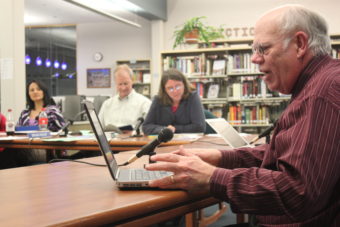
Juneau School District finance head David Means addresses the school board during Tuesday night's regular meeting. (Photo by Lisa Phu/KTOO)
Juneau School District finance head David Means addresses the school board during Tuesday night’s regular meeting. (Photo by Lisa Phu/KTOO)

The Juneau School Board approved a revised budget of $85.6 million for next school year last night. It takes into account two possible scenarios since the school district is still waiting for the Alaska Legislature to approve the state budget.

If the legislature passes the governor’s proposed budget, the Juneau School District would keep class sizes the same in kindergarten through fifth grade, but increase them in grades 6-12.

If the legislature passes the budget it adopted at the end of its regular session, the district will increase class sizes in grades 3-12. District finance head David Means says that’s a difference of 1.5 teaching positions. To maintain current K-2 class sizes at the lower funding level, the district would use about $300,000 from $500,000 in back funding the Juneau Assembly recently appropriated to schools.

Board member Brian Holst was the only no vote. He says wanted more discussion about how to use the new funding from the city. One of the things he’s concerned about is money for activities.

“In our accreditation for the high schools, we saw that technology was our weakest area. And I also think we should talk about – are there some things that we could be doing to better utilize technology in our schools?” Holst said. “So those are just some ideas that I thought we needed to discuss before we commit the very limited resources that we have.”

Means says depending on how the budget turns out, he’ll be going back to the board to decide how to use the remainder of the $500,000.

“Some of us administrators are thinking we ought to be using this over a two-year period, because we’ll be facing some difficulties next year as well, the FY ’17,” Means said.

The approved budget assumes the Juneau Assembly will fund the district to the maximum amount allowed by state law and give an additional $770,000 outside the cap, mostly for high school activities.

The Assembly will finalize its own budget and the school budget on Monday.

Hoonah City Schools receives its first threatening phone call

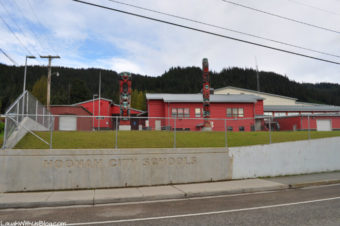
Hoonah City Schools (Photo courtesy laughwithusblog.com)

At around the same time Juneau’s Harborview Elementary School received a threatening phone call yesterday, Hoonah City Schools received one as well.
Harborview received a call threatening a school shooting at 1:21 p.m. Hoonah Schools Superintendent PJ Ford Slack says around 1:25 p.m., a call was received by the secondary school secretary “who described it as sounding like it was an automated call coming from down a long tunnel. She couldn’t pick up all the words that were said on the phone but there was clearly something about ‘attack is eminent.’ She got that.”

The school of 112 students in pre-K to 12th grade went into lockdown. Hoonah Police Department searched the building, which also houses the town’s public library, and didn’t find any threats.

The lockdown was lifted about 15 minutes later and the school resumed its normal day.

Due to an old phone system, Ford Slack says the school district doesn’t have a way to alert parents of a threat to students. She says the district plans on retraining staff on safety protocols. Overall, she said the lockdown went smoothly.

“The kids were great. They followed all the instructions so that’s a good thing. I hope we don’t have any more phone calls. I’d like to be off their phone list, but we’ll see,” Ford Slack says.

Monday’s call was the first threatening phone call Hoonah City Schools has gotten.

Juneau schools have received six phone calls threatening school shootings since April 27. Several other schools across the state have also received similar calls. The Fairbanks Daily News-Miner reports that, as a way to combat the problem, Fairbanks North Star Borough schools’ phone system will no longer accept calls from blocked or anonymous numbers.

Front and Franklin streets to undergo major reconstruction

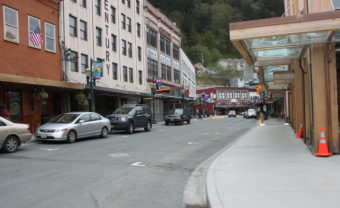
City right-of-ways on Front and Franklin streets haven't undergone major reconstruction in 30 years. (Photo by Lisa Phu/KTOO)
City rights of way on Front and Franklin streets haven’t undergone major reconstruction in 30 years. (Photo by Lisa Phu/KTOO)

The City and Borough of Juneau plans to reconstruct Front and Franklin streets downtown. It hosted an initial meeting last month to find out what the public wants and is still looking for suggestions.

Standing outside the new downtown Heritage Coffee Cafe, project manager Michele Elfers says it’s been 30 years since Front and Franklin streets have had major reconstruction.

“When you look at the sidewalks and you see the paving pattern with the joint lines that are about 10 inches apart, that was done in the ‘80s and it was meant to look like planks to give it a historic feel because this is the historic district, and so they thought, well, maybe it looks like wood planks,” Elfers explains.

These sidewalks were originally designed to look like wood planks. (Photo by Lisa Phu/KTOO)

She says those sidewalks are crumbling.

“It’s time for an upgrade. Here’s a little tripping spot right here. That’s probably 3/4 of an inch to an inch, which is not OK,” Elfers says.

As we walk down Franklin Street, Elfers points out gaps in the sidewalk, deteriorating curbs and uncomfortable pinch points.

“Right here, we’re in front of the Alaska Liquor Cache,” says Elfers, “and there’s a street pole – the base is almost two feet wide and then you have the corner of the building, and your walking space is maybe 4 feet.”

A pinch point near the Alaska Liquor Cache makes it hard for people to walk comfortably. (Photo by Lisa Phu/KTOO)

Elfers says the city is considering things like utility upgrades, curbs, gutters, sidewalks, parking, intersections, lighting, gathering spaces and art. She says a lot of it will be decided by the public.
It was the public after all that brought the project forward. Bruce Denton is one of the owners of the Senate Building on Franklin Street. He says the street reconstruction project stems from the Downtown Improvement Group, which formed almost a year ago.

“The issues go, I think, beyond homelessness. It’s just a general state of decay downtown, whether it’s property owners or business owners or city infrastructure or city maintenance or the whole gamut,” Denton says.

After Denton went to city staff and the Juneau Assembly about Front Street and Franklin Street reconstruction, the Assembly appropriated $100,000 for this planning stage of the project.

Denton says he wants to see downtown developed to its potential. He wants it to become a more family-friendly place.

“It just makes me really sad when people say, ‘I never come downtown. I can’t stand coming downtown.’ I think it’s a super dynamic spot and it’s the face of our city,” Denton says.

He says the city moving forward with the downtown street reconstruction will spur more improvements.

“If somebody paints their building then the neighbor feels like they should paint their building. There’s a lot of that going on. Just raising the level of care, whether it’s painting fire hydrants or crosswalks or fixing the curbs and the sidewalks that are covered with gum – it’ll feed on itself,” Denton says.

At the first public meeting for the project, Elfers says many people talked about improving downtown lighting. (Photo by Lisa Phu/KTOO)

Another $250,000 will go toward design, Elfers says. How much the total project will cost hasn’t been determined.

“What we need to do is figure out what the community wants, make some decisions, recommendations to the Assembly and then the Assembly gets to decide what’s funded and what’s not and where it’s coming from,” Elfers says.

City staff will have recommendations and draft plans for comment at the next public meeting June 17.

Harborview Elementary is the sixth Juneau school to receive threatening phone call

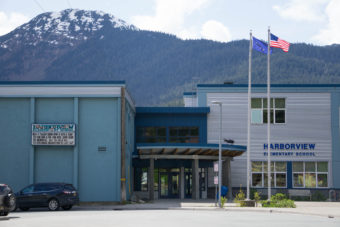
Harborview Elementary School
Harborview Elementary School received a threatening phone call around 1:30. (Photo by Jeremy Hsieh/KTOO)

Harborview Elementary School is the latest Juneau school to receive a phone call threatening a school shooting. Superintendent Mark Miller says the call came in around 1:30 p.m. and the school, as well as neighboring Juneau-Douglas High School and the Marie Drake building, went into stay-put mode.
Miller went to Harborview as the Juneau Police Department was responding.

“It was just the police officers doing the hallway search and a roof search just to make sure that there were no people who shouldn’t be there,” Miller says.

Nothing was found and the stay-put was lifted 15 minutes later.

Juneau schools have received six phone calls threatening  shootings over the last two weeks. None were valid, but Miller says each one has been taken seriously.

“I have to assume that everyone is real and assume that, until I know otherwise, that it is a threat,” Miller says.

Juneau Police are working with the Alaska State Troopers and the FBI in investigating the series of phone calls.

With $500,000 to schools, Juneau Assembly makes up for last year

The Juneau Assembly recently decided to fund schools next year to the maximum extent allowed by law, and give additional money for high school activities.

The Assembly also voted to retroactively give the district $500,000 for this current budget that ends June 30, making up for not funding to the cap last year.

The Juneau School District offices. (Photo by Heather Bryant/KTOO)

Juneau School District’s finance head David Means says he was surprised at the how the Assembly voted during its finance meeting.

“I expected a number maybe less than $500,000. I thought maybe they would go halfway or somewhere in there,” he says.

Means says the money will be rolled into next year’s budget. Regardless of what happens with state funding, the Juneau district now won’t have to increase class sizes in kindergarten to second grade. Other class sizes will likely still grow.

Means wasn’t the only one who was surprised. Mayor Merrill Sanford, who voted no with Assemblyman Jerry Nankervis, thought more members were in the same camp.

“We put the school district in a very positive way so that their future year or two budgets are helped a little bit, but we didn’t do anything for our budget at the general fund in the city and borough,” Sanford says.

The city has been dealing with its own cutbacks due to a multi-million dollar deficit.

Sanford says the city unexpectedly received about $600,000 in federal money through the Secure Rural Schools Act, money the Assembly hadn’t budgeted for. He says even though the city manager and the Assembly have done a lot to balance next year’s budget, he says the city still might need that money.

“Next year is going to be really tough for us if the state keeps to the hard line that they’re at right now,” Sanford says.

He fears more state jobs leaving Juneau, which could mean a dip in property and sales tax revenue. Sanford says his no vote to back-fund the district doesn’t mean he doesn’t support education.

“I support schools in my town to the maximum that I can. I’m just a little bit more conservative than some people and I worry about our future budget more than sticking that money into the school district right now,” Sanford says.

Assemblywoman Karen Crane was skeptical at first about giving the schools the money, but with the city getting the Secure Rural Schools funding, she voted yes.

“It’s a one-time request. We funded next year to the cap so there is no additional money that can go in for next year,” Crane says. “This fiscal year, unfortunately, we weren’t able to do the cap. It’s what Juneau has always tried to do and so, since the money was there, I think it was the right thing to do.”

Assemblywoman Mary Becker was the first to propose back-funding the school district two months ago. She’s happy with the vote and is proud the city can give $500,000 to the district, but she says the schools will still be struggling due to declines in state funding.

The Assembly plans to finalize its budget and the school’s budget May 18.

How events unfolded inside Juneau schools after threatening phone calls

Juneau Police officers made sure Juneau-Douglas High School was secure after a threatening call prompted heightened security at the school for the second time in eight days.  (Photo by Casey Kelly/KTOO)
Juneau Police officers made sure Juneau-Douglas High School was secure after a threatening call prompted heightened security at the school for the second time in eight days. (Photo by Casey Kelly/KTOO)

Juneau schools have received five phone calls threatening school shootings in the past two weeks. In each instance, nothing was found, but the threats had to be addressed. Here’s how schools and police responded to the incidents.

Paula Casperson says there isn’t time to be scared, “You have to go straight into decision-making mode.”

Casperson is the principal of Juneau-Douglas High School, which has 650 students. The school has received two threatening phone calls — one on April 27 and another May 5.

“I don’t know that it’s any more or any less disconcerting to have it happen more than once. We’re taking it seriously every time and it’s important that none of us get lazy in our response times as a result,” Casperson says.

In both situations, Casperson decided to go into “stay-put” mode, which means locking the exterior doors, making sure all the students are out of the hallways and common areas and into more secure areas.

“We continue with our teaching and learning environment. A stay-put allows us to continue instruction whereas other safety protocols, say an evacuation or a lockdown, would severely disrupt our educational day,” Casperson says.

Within minutes of the high school receiving its first call, Yaaḵoosgé Daakahídi Alternative High School received a similar one and also went into stay-put.

Seventeen-year old senior Cassidy Legowski was in fourth period English. She said the teacher locked up the room, “We put the green sign in the window and we had no idea what was going on. We found out later though text messages and everything else that somebody had called.”

The green sign indicates everyone inside is safe and no suspect is present. Legowski says she wasn’t scared, but her classmates seemed edgy.

Of the five threatening calls to district schools, Glacier Valley Elementary is the only one that has gone into lockdown.

“You kind of have to look at the circumstances for your school,” says Principal Lucy Potter. “We felt like if the phone call was in fact true, our students were in danger. At that point, we had kids on the playground, we had kids coming back from field trips. They were in many different places.”

Potter says during a lockdown, teaching stops, lights are turned off, doors are locked and kids are moved from windows and doors. She says the suspicious call came in to the main school number and an office staff person picked it up.

Potter says everyone experiences the threat differently.

“When you receive the phone call, the way that you handle the situation or see the situation is going to be very different from a teacher who’s in their classroom with a student, and they hear over the intercom, ‘This is a lockdown. I repeat, this is a lockdown,'” she says.

The superintendent says the first two suspicious calls that were made on the same day came up on caller ID as Skype.

Juneau Police spokesman Lt. David Campbell says there is an active investigation into the calls. He says a detective is determining if there’s any pattern.

“We view each individual threat as real and we respond appropriately because what we can’t have happen is allow us to get complacent and say, ‘Oh there hasn’t been a threat the last five times, there’s not going to be a threat this time,'” Campbell says.

A JPD press release says the calls are not identical, but all came from a computer or electronic sounding voice. Other schools across the state in Fairbanks, Anchorage and Kenai have also received threatening phone calls in the last two weeks. Campbell says Juneau Police are working with the Alaska State Troopers and the FBI in the investigation. He says he cannot comment on if there are any suspects.

Juneau-Douglas High School Principal Paula Casperson says it’s unfortunate that this is the climate schools need to work through, but it’s the reality. She says, for the past few years, the high school has gone into stay-put mode one or two times a year.

Site notifications
Update notification options
Subscribe to notifications