"As Managing Editor, I work with the KTOO news team to develop and shape news and information for the Juneau community that's accurate and digestible."
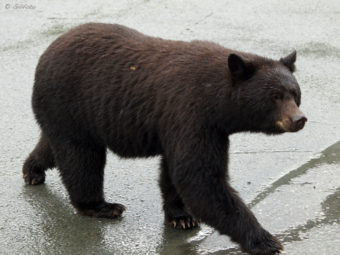
Motorists should slow down or stop when they see a bear on or near a road. This photo was taken in September 2008. (Creative Commons photo by Gillfoto)
A black bear sow died after she was struck by a motorcycle Thursday morning in Juneau. As a result, wildlife officials had to euthanize her two cubs.
Sgt. Chris Gifford with the Juneau Police Department says a 58-year-old local man was riding a BMW motorcycle near mile 32 of the Glacier Highway, just past Eagle Beach.
“The bear basically darted out in front of the man that was riding his motorcycle, and it’s a section of roadway that has a 55 mph zone, and he wasn’t able to stop,” Gifford says.
The man was wearing a helmet. Gifford says his injuries were serious, but not life threatening. He was taken to Bartlett Regional Hospital. The motorcycle is estimated to have $5,000 in damages. Gifford doesn’t know how fast the man was riding. He wasn’t cited, but Gifford says an investigation is ongoing.
Alaska Department of Fish and Game personnel and State Wildlife Troopers also responded to the incident.
Wildlife biologist Stephanie Sell says they noticed the 180-pound female bear was lactating. She found two cubs in nearby trees. They were about 6 pounds each and about the size of large rabbits. She thinks they were born in January or February.
Sell tried to find a home for them in a zoo or another facility that takes orphaned wildlife.
“Unfortunately there are black bears all over the United States and they’re kind of a dime a dozen, so not many people want the black colored cubs. They want those glacier bear phase cubs, so there wasn’t any placement for the bears,” she says.
Cubs of the year rely on their mom for nutrients and Sell says they likely wouldn’t have survived more than a week in the wild.
“As mom is going around and foraging, these cubs are nursing and they’re getting protein, but they’re also getting their water from their mom as well and they have not learned how to forage on their own,” Sell says. “So basically they would either starve, they’d get hit by a car themselves, or a predator or scavenging bird would probably kill them.”
Sell advises motorists to slow down or stop if they see a bear on or near a road.
“More than half the time it might be a sow and those cubs are going to dart out after the mom after the fact. So if mom and one of the cubs make it across the street, then maybe that second or third cub gets hit,” Sell says.
A few bears are hit by motorists each year in Juneau. This is the second that Sell knows of this season. A car hit a bear last month near the Auke Rec area in the middle of the night. The bear was severely injured and Sell says it was euthanized.
John Pugh joined UAS in 1987. (Photo by Lisa Phu/KTOO)
UAS Chancellor John Pugh, left, and Marie Olson chat after speeches concluded at the university's convocation for new professors and staff on Tuesday, Aug. 19 (Photo courtesy of UAS)
Yukon College president Karen Barnes and UAS chancellor John Pugh in 2013 signing an agreement renewing the partnership between the two institutions. UAS provost Richard Caulfield oversaw the signing. (Photo by Lisa Phu/KTOO)
University of Alaska Southeast Chancellor John Pugh. (Photo courtesy of UAS)
University of Alaska Southeast Chancellor John Pugh, left. (Photo courtesy of UAS)
University of Alaska Southeast Chancellor John Pugh. (Photo courtesy of UAS)
John Pugh’s last day as chancellor of the University of Alaska Southeast is Friday. He’s retiring after almost three decades with the college. Pugh leaves a legacy of being much more than a chancellor to students — he was a teacher, adviser and friend.
Valerie Davidson was 19 when she met John Pugh. She was interning for the Alaska Legislature and studying elementary education at UAS. He was her college adviser.
“As many 19-year-olds are, I had these grand visions of how I was going to change the world and what I so appreciated about John was he enthusiastically accepted all of my grand visions of the world, but helped me to establish more realistic timelines,” Davidson says.
Davidson is commissioner of the Alaska Department of Health and Social Services, a position Pugh formerly held. When she was appointed, Davidson and Pugh saw each other at a governor’s reception and they reconnected. She says he continues to be her adviser.
John Pugh was DHSS Commissioner Valerie Davidson’s college adviser when she was a UAS student. (Photo by Mark Rainery)
“You know there are just times in your life when you meet people who are there at exactly the right time, exactly the right place and for exactly the right reason. And I was very fortunate because I got not only one of those experiences with John but I got two, at times in my life that were really critical decision points for me,” Davidson says.
Pugh arrived in Juneau in 1978 to work for health and social services. Afterward he worked briefly as a legislative staffer before joining UAS in June of 1987 to help with the budget. By fall, Pugh was the dean of Arts and Sciences.
Since then the number of full-time students has grown from 300 to more than 800. Several facilities, like the Egan Library and residential housing, have been built on the Juneau campus.
Pugh was also part of the 1987 reorganization to integrate what was then Ketchikan Community College and Sitka Community College into campuses of UAS. Pugh says that was a hard transition.
“We worked constantly getting to Sitka and Ketchikan and making sure they felt a part of this, and I’d say it took a good ten years to get to where there was a real comfort level of trust,” Pugh says.
Ketchikan Campus Director Priscilla Schulte has been at the school for 35 years, back when it was a community college. She says Pugh has done a great job of being inclusive.
“We get the feeling that he understands our community. He has always kept us in mind so that when issues came up he was always, ‘What does Ketchikan think?'” Schulte says.
She says Pugh really supported the bachelor of liberal arts distance program, which helped UAS Ketchikan evolve.
“Once the pulp mill closed and we were losing the local students, moving into the e-learning was really important for us,” Schulte says.
Pugh was appointed chancellor in 1999. He says his biggest challenge was making sure UAS got enough funding to be a quality institution. With UAS representing less than 10 percent of the entire University of Alaska budget, Pugh says it was never about competing with the bigger schools for resources.
“We’re not UAF, we’re not UAA. We’re UAS. What is it that we can do? What can we do for our region? What can we do for the state?” Pugh says.
Pugh is known for walking around campus with a smile. He’s a self-proclaimed “glass half full” type of person, but if he ever did find himself down, “I would find where the students are and it always picked me up.”
UAS Student Body President Callie Conerton says Pugh would do anything to make the students laugh.
“John did the dunk tank at Spring Carnival and students, of course, lined up. How many students can say that they dunked their chancellor,” Conerton says.
He’s had pies in his face. He’s jumped into frigid water for the polar plunge. Pugh has even been duct taped to a library pillar.
When he was a dean, John Pugh was duct taped to a library pillar for a student fundraiser.
Conerton says having an approachable college leader has made a difference in her academic career.
“It makes me want to attend school. It makes me realize that people care about me. One thing that UAS is great about is that it’s a community and so John was great about making sure that students knew that they were a part of something bigger than themselves,” Conerton says.
Pugh says he got just as much from the students as they got from him.
“Those interactions really buoyed me and gave me strength and it made me understand why I’m doing what I’m doing, helped me to really push harder to advocate for higher education,” Pugh says.
He says his departure from UAS is filled with mixed emotions.
“I often wonder what I’m going to do when I get up in the morning. I’ve said that to my wife. So not coming out here – that will be very different,” Pugh says.
Pugh became Chancellor Emeritus as UAS’s recent commencement ceremony. Pugh says that means he’ll have a permanent connection to the college. He doesn’t see the rank as just a title, but as a responsibility.
UAS is hosting a retirement party for John Pugh this Saturday from 4:30 to 7:30 p.m. at the Lakeside Grill in UAS’s Mourant Building. The public is invited.
This photo was taken in the beginning of the month. Due to a warmer and dryer than normal May, the mountaintops are now a lot more bare. (Photo by Lisa Phu/KTOO)
National Weather Service forecaster Bob Tschantz says Juneau residents can expect cooler temperatures tonight through tomorrow and intermittent rain, becoming steadier Wednesday night.
“After that it should start to dry out again as we head into Thursday and we should warm back up again,” Tschantz says.
May is ordinarily a dry month for Juneau, along with April and June. But this year it’s been drier than normal. On average, Juneau gets 3.4 inches of rain in May. So far, less than half an inch has fallen. Tschantz says this month could break a 2004 record for driest May.
The capital city has also been warmer than average. Normal high temperatures in May are in the upper 50s. This month, the airport reached 73 degrees on several days. But it’s still far from breaking a record high temp in May of 82 degrees set in 1947.
For the rest of the summer, Tschantz says the National Weather Service is forecasting warmer and dryer than normal weather, but that could change quickly.
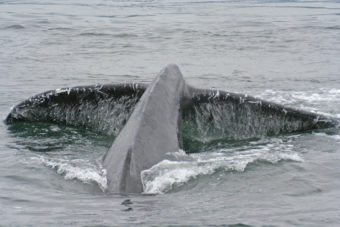
Humpback whale diving in Juneau. (Creative Commons photo by Tony Hisgett)
Local tour company Juneau Whale Watch recently finished paying almost $12,000 in fines for violating the Marine Mammal Protection Act and the Endangered Species Act.
The National Oceanic and Atmospheric Administration cited Juneau Whale Watch last fall for two violations that occurred in August 2013. Both incidents were reported to NOAA by members of the public and were verified with video and photo evidence.
The first violation took place around Horse and Colt Islands. In a news release, NOAA says a Juneau Whale Watch boat was seen chasing a pod of orcas, which caused the whales to change direction.
A week later, the company violated the “100-yard rule.” It is unlawful to approach a humpback whale within 100 yards. During off-duty time, Juneau Whale Watch staff members were seen paddle boarding near humpback whales, including a mother and calf.
Juneau Whale Watch accepted responsibility and agreed to pay the fines soon after being notified of the violations. General Manager Serene Hutchinson says the company has made sure incidents like those don’t happen again.
“This was an eye-opening experience. We have increased our trainings of our captains, and we’ve gone over the regulations better and we have more experienced captains now,” she says.
Hutchinson says the captain involved in both violations is no longer with the company.
NOAA enforcement officer Robert Marvelle says, so far this season, NOAA hasn’t received any complaints about potential violations on the water. But he says it’s also early in the season. When the cruise ship season is in full swing, he says up to 60 boats can be in North Pass watching whales. They include charter fishing boats, whale watching boats and sport boats.
Besides following to the 100-yard rule for humpback whales, Marvelle says boaters shouldn’t alter the behavior of marine mammals by getting too close.
“Give the animals space to do what they naturally need to do — for eating, just transiting the area, playing, all that,” Marvelle says.
If you see a violation on the water, you can call the NOAA Fisheries Enforcement hotline at 1-800-853-1964.
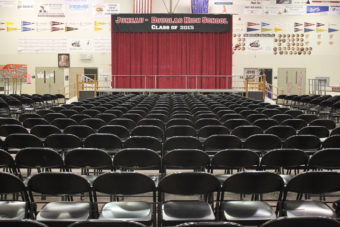
The gym at Juneau-Douglas High School is set up for graduating 160 students on Sunday. (Photo by Lisa Phu/KTOO)
Juneau’s high schools are celebrating graduation on Sunday.
The ceremonies kick off at 1 p.m. with Yaaḵoosgé Daakahídi Alternative High School‘s at Centennial Hall. Principal Kristin Garot says advisors will do a short presentation for each of the 30 graduates.
She says the ceremony will also have a twist.
“For those of you longtime fans of Yaaḵoosgé Daakahídi, you’re going to want to come to this graduation ceremony. We have a little special surprise. It’s going to be a really fun wrap-up of the school year with some special guests,” Garot says.
Thunder Mountain High School will hold its graduation ceremony for 122 students in the school gymnasium at 4 p.m. Five foreign exchange students will also be walking.
This year’s valedictorians are James Barnhill, Madeline Hall, Thane Reishus-O’Brien and Danielle Steinman. Barnhill, Reishus-O’Brien and Dana Bogatko are the student speakers. Juneau Pastor Mike Rydman is the ceremony’s community speaker.
Juneau-Douglas High School’s graduation ceremony is at 7 p.m. in the main gym. There are 160 students in the class of 2015. That includes students who might’ve done part of their schooling with Homebridge or other alternative programs.
Juneau-Douglas Principal Paula Casperson says it’s a special and emotional time for graduating seniors.
“Not only are they wrapping up their high school experience, but that means they’re moving on. I think there’s a balance between the energy and the excitement as well as the, ‘Oh, now I’m off to other things,’ and I think that can be a little daunting at times,” Casperson says.
JDHS’s ceremony will feature student speakers Charity Anderson, Max Blust and Robert Newman. The guest speaker is 2014 congressional candidate Forrest Dunbar.
The nonprofit group Parents for a Safe Graduation is holding a party for all high school graduates at Centennial Hall on Sunday night from 10 p.m. to 2 a.m.. The annual event is alcohol, drug and smoke-free.
Betty Ann Samato reads a book with her grandson Bryson Stepetin at a Baby Raven Reads family night. (Photo by Brian Wallace/Courtesy Sealaska Heritage Institute)
Families and young children mill around tables in the lobby of the Walter Soboleff Building. There’s a station for coloring, one for science. Margaret Katzeek and her 2-year-old niece Elayna are at the snack table.
Margaret Katzeek brought her niece Elayna Katzeek to the Baby Raven Reads family night. (Photo by Lisa Phu/KTOO)
“Do you want some water?” Katzeek asks Elayna. “Do you remember what it’s called? Heen. Let’s say heen.”
This is their second Baby Raven Reads family night. The free early childhood program run by Sealaska Heritage Institute builds on the strengths of Alaska Native culture in teaching early literacy. Katzeek says they’re a fun way to learn the Tlingit language, for her niece and herself.
“They say the best way to learn something and get to know something is trying to teach it,” she says, “so I definitely work on the words that I do know, I work with her on it lot.”
But Katzeek says Elayna picks up songs better and, lucky for her, there are several that evening with language learner and teacher Mary Folletti.
Inside the clan house, about 30 children, infants to 5-year-olds, start off sitting on small rugs or on the laps of family members. Moments later, many of them are on their feet, singing, laughing and dancing along. About 40 adults sitting on the periphery watch their children, smiling. Some join in the singing.
Inside the clan house at the Walter Soboleff Building, Mary Folletti sings familiar sounding songs with Tlingit lyrics. (Photo by Lisa Phu/KTOO)
Folletti leads the group in Tlingit songs to the tunes of “If You’re Happy and You Know It” and “The Hokey Pokey.” She helped translate these songs several years ago.
“Those songs are great because the kids are already familiar with them and they are the same idea. We do things different, like, ‘Dance like a Tlingit,’ but it is like, ‘Turn yourself around,’ so it’s got a lot of the same ideas,” she says.
Folletti says exposing children to the sounds of the Tlingit language is important for development.
“I know people who learn the Tlingit language when they were older and because they had never tried to make those sounds before, they’d never heard those sounds before, they physically could not make the sounds, so I think it’s important for them to hear it,” Folletti says.
(Photo by Brian Wallace/Courtesy Sealaska Heritage Institute)
Early education specialist Karen Larson is working with Sealaska Heritage Institute. She says the Baby Raven Reads program emulates other successful early learning practices. It gives out a free children’s book at each session, like the Dolly Parton Imagination Library. It brings families together, like events organized by the Association for the Education of Young Children. And it’s all done in ways relevant to Alaska Native families.
“People are really craving cultural experiences for their children and language exposure. And then people bring their own culture to it and it grows from there,” Larson says.
Pamela Craig and her son, Kee Night Gun Cole. (Photo by Lisa Phu/KTOO)
Parent Pamela Craig is one of those people. She’s with her 2-year-old son.
“This is exactly the kind of thing that I think he needs, to be able to meet up with his Native peers from an early age and be able to work with them and have people to talk to, especially learning language,” Craig says.
The Baby Raven Reads events are good for her as well.
“Just looking around, I have family here, my relatives and other people I’ve met through the years going to different Native events, and so it’s a good opportunity for me,” Craig says.
That’s part of the early childhood program – creating community.
Jackie Kookesh is the education director for Sealaska Heritage Institute. She hopes people like Mary Folletti will be an inspiration to parents and relatives.
“To sing along with Mary and their children and try to pronounce the Tlingit words that are in the song, that takes a lot of courage,” Kookesh says. “And so if that’s an outcome we come away with, I say that’s phenomenal, creating those safe places for the language to be in the air and to be heard and for everybody to do it together.”
Kookesh hopes the program will make more parents comfortable singing “Twinkle, Twinkle, Little Star” in Tlingit with their children.
Sealaska Heritage Institute is hosting another Baby Raven Reads family night for Alaska Native families this Saturday, May 23. For more information, contact Jackie Kookesh at 586-9229.
Close
Update notification options
Subscribe to notifications
Subscribe
Get notifications about news related to the topics you care about. You can unsubscribe anytime.