Lisa Phu

Managing Editor, KTOO

"As Managing Editor, I work with the KTOO news team to develop and shape news and information for the Juneau community that's accurate and digestible."
How David Holthouse decided to name the ‘Bogeyman’

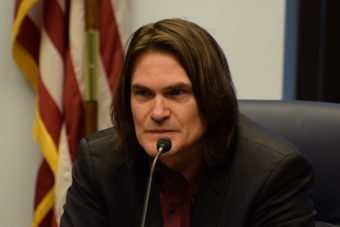
David Holthouse's talk in the Capitol in February set off a chain of events that led him to publicly name his rapist. (Photo by Skip Gray/360 North)
David Holthouse’s talk in the Capitol in February set off a chain of events that led him to publicly name his rapist. (Photo by Skip Gray/360 North)

A high profile case about an alleged child rape from 1978 is at an impasse because of Alaska’s old statute of limitations.

When David Holthouse retold his story of being raped as a child to lawmakers in February, he had no idea it would set off a chain of events that would lead to filing a police report and publicly naming his rapist in the Anchorage Press last week.
Writer David Holthouse had never publicly identified the person who raped him in Eagle River when he was 7 years old.

“I did not want to destroy his life by naming him,” he says.

But Holthouse’s 2004 article “Stalking the Bogeyman” gives clues, including one to throw people off. According to Holthouse, the perpetrator was a star athlete at Chugiak High School and was profiled in the Anchorage Daily News. As an adult, he moved to Broomfield, Colo., a Denver-area suburb. Holthouse also wrote that his rapist was about 17-years-old. Now, Holthouse says he deliberately misrepresented the age and his perpetrator was 14 at the time.

In the story Holthouse describes the traumatic experience, his plans to kill his rapist and finally confronting him as an adult.

“After meeting him in person and hearing him swear to me that he had never raped a child before or after he perpetrated the crime on me, I decided that it was possible that he was telling the truth,” Holthouse says.

There was a caveat though. Holthouse followed up with a letter, which said,

“If any other victims come forward at any point in the future, I’m going to write a second article and this one will name you,” Holthouse says.

Nearly 11 years after writing that letter, Holthouse was in the Alaska State Capitol Building sharing his story. He spoke in support of a law that would require public schools to teach sexual abuse prevention.

After the talk, Holthouse says two people in the Capitol told him they might know other victims of his rapist.

“I was very careful about the way I dealt with the situation,” Holthouse says. “I sort of heard them out. In both conversations, it got to the point where they said, ‘I’m going to say the name and you tell me if it’s the same person.’”

It was. Holthouse says he felt relieved.

David Holthouse named his rapist in the Anchorage Press June 19. (Image by Angela Ramirez and Stef Vigoren/Anchorage Press)

“I guess the relief was just in finally knowing. The question of whether or not he was telling me the truth – it haunted me for more than a decade and I felt like I finally know,” Holthouse says.

Since that day in the Capitol, Holthouse says he’s wanted to write the story naming him, but “I needed to meet one on one with people and have them tell me their stories for me to feel like I had the information to go through with it.”

He tracked them down.

“Eagle River in the late 1970s and the 1980s was an even smaller town than it is now, so once I had a couple of leads and a couple of names of kids, now adults, but kids who ran in the same social circle, it took me a couple months but I could sort of gently reach out to them and point them to my original piece and say, ‘Is this something that you would like to sit down and talk to me about by any chance?’”

Holthouse says he’s convinced his rapist sexually assaulted two other boys and a girl. He’s heard about other suspicious incidents as well.

KTOO could not reach the man for comment. According to property records, he owns a home in Broomfield, Colo. Holthouse says he still lives there. Phone numbers listed for the man were out of service. He’s not listed in sex offender registries in Alaska or Colorado.

Holthouse wrote “Outing the Bogeyman” in the Anchorage Press for himself “to just finally tell on him, just to finally  give that 7-year-old a voice and tell on him.”

And to let other survivors know “no matter how much time has passed, when someone rapes you when you’re a kid, they give you the power to avenge yourself and that power is you know their name and you can use it,” Holthouse says.

It could be online, it could be in a letter, it could be confronting the person, it could be reporting them to the police.

Holthouse has done all of these things.

He recently reported the rape to the Anchorage Police Department.

“My report alone is not going to prompt a criminal investigation let alone an arrest or prosecution, but they said reports like this are still important because if other victims were to come forward it would help corroborate their accounts,” Holthouse says.

In 1978, the year Holthouse says he was sexually abused, the statute of limitation on child rape was ten years. Lawmakers eliminated that time constraint in September of 1992. There’s currently no statute of limitation for child rape cases.

Holthouse’s case may not be viable for prosecution. But if someone comes forward with an incident that occurred after 1982, that’s fair game.

Historic Juneau park becomes an oasis for Alaska artists

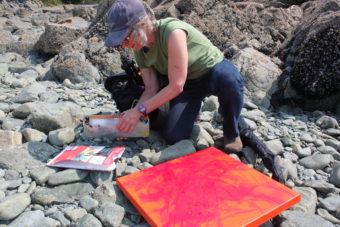
Constance Baltuck says she spends hours on the rocks painting. (Photo by Lisa Phu/KTOO)

Juneau artist Constance Baltuck paints in the rocky shoreline of Lynn Canal. The legs of her easel are getting wet from the incoming tide. On the canvas, details emerge from the colors.

“This is the barnacles and the kelp and the mussels, they’re just so beautiful the way they interact and cling to the rocks,” Baltuck says.

Baltuck is the first artist of a pilot program at the cabin run by Alaska State Parks. Located 26 miles from downtown Juneau, the cabin is where former territorial Gov. Ernest Gruening wrote the book “The State of Alaska,” making a case for statehood several years before it would happen. The cabin started out as a summer getaway for the family and later became a year-round residence. More than six decades later, the historic cabin is now used as a retreat for Alaska artists.

The Gruenings moved to Juneau in 1939. The cabin, known by the family as Eaglerock, was built in 1947. (Photo by Lisa Phu/KTOO)

Park Superintendent Mike Eberhardt says the Ernest Gruening State Historic Park received $30,000 to run an artist-in-residence program for two years. The artists are required to hold a community workshop and contribute a piece of art to the park. Eberhardt hopes the program will generate more interest in the site.

“Whatever art comes out of there, whether it be written or music or paintings, using that to publicize the state park system and with notoriety hopefully comes additional funding, comes additional support,” Eberhardt says.

Eight artists from across the state applied for the residency and all were admitted for this startup year. Each will stay in the cabin for up to two weeks through September.

As the tide comes in, Baltuck gathers her art supplies. (Photo by Lisa Phu/KTOO)

For Baltuck, the park has been one inspiration after another.

“This place is just alive, everywhere you look, there’s something flowering, jumping, creeping around in the woods, flying past the window,” Baltuck says.

And she’s trying to capture as much of it as possible. Baltuck describes it as gathering starts — the beginnings of paintings she’ll finish later.

Baltuck's work during the residency depict scenes of the park. (Photo by Lisa Phu/KTOO)
Baltuck’s work during the residency depict scenes of the park. (Photo by Lisa Phu/KTOO)

Inside the cabin, unfinished works are laid on a bench or leaned against walls. She counts how many there are out loud.

“Eleven this first week, plus I’m doing a series of little wildflower drawings,” Baltuck says. “This is supercharged for me. I’m going to have to go back to town and get more canvas because I’ve just about used up what I brought that I thought would last the whole 15 days.”

Baltuck has done other artist residencies. She’s been in the middle of the desert at Arizona’s Petrified Forest National Park, in sand dunes above the Arctic Circle in Alaska’s Kobuk Valley National Park and once spent three months in Norway. Baltuck says each has shown her windows into different lives.

For this residency, when she’s not on the rocks painting or at the easel inside the cabin, she’s on the deck sipping coffee. She watches people fishing and “the eagles,” Baltuck says. “They’re sometimes right up in the trees right over here and the evening is when they swoop back and forth, and I can see whales. And it’s always changing, whether it’s a beautiful sunset or just the clouds, how deep they settle on the mountains.”

Baltuck says she'll leave an easel for other artists this summer. (Photo by Lisa Phu/KTOO)
Baltuck says she’ll leave an easel for other artists this summer. (Photo by Lisa Phu/KTOO)

More than once, Baltuck calls the residency a gift – a gift of no distractions, no internet, no phone ringing, nobody waiting on you. It’s also a gift of time.

“It’s so neat to settle into an experience of observing nature for hours, just looking at the same scene for hours and just knowing you have that time. There’s no rushing out here,” Baltuck says.

The only concern, she says, is the tide. When the water comes up by your feet, it’s time to move.

Breaking the link between childhood trauma and suicide

The first day of the conference, "Trauma and Suicide: Breaking the Link," attracted about 185 participants, mostly from Juneau. All the sessions take place at Centennial Hall and continue into Friday. (Photo by Lisa Phu/KTOO)
The first day of the conference, “Trauma and Suicide: Breaking the Link,” attracted about 185 participants, mostly from Juneau. All the sessions take place at Centennial Hall and continue into Friday. (Photo by Lisa Phu/KTOO)

Close to 200 people in Juneau joined forces Thursday to break the link between childhood trauma and suicide. They’re taking part in a two day suicide prevention conference. Day one focused on establishing the trauma-suicide link.

After analyzing data from state surveys on trauma and risky behaviors, Alice Rarig says she was taken aback.

“It shocked me to see that one in five young people think about suicide and that more than half of them have major problems with sadness or feeling alone or not having adults in their lives to talk to,” she says.

Rarig is a retired state health planner and a member of the Juneau Suicide Prevention Coalition. She says she’s also troubled by the amount of youth who’ve experienced bullying, violence, sexual abuse and other traumatic experiences.

(Creative Commons photo by Andreas Levers)

The coalition identified childhood trauma to be a leading factor contributing to suicide in Juneau.

Patrick Sidmore is a planner with the state Department of Health and Social Services. He helped coordinate the Adverse Childhood Experiences study in Alaska. For the past 20 years, the national study has shown that traumatic experiences, like abuse, neglect or growing up with substance abuse, may lead to serious health problems into adulthood.

“In the original study, they looked at suicide attempts and adverse childhood experiences and it had the strongest correlation of any of the items they looked at,” Sidmore says. “For example, 80 percent of suicide attempts can be tied back to adverse childhood experiences. This is the rate similar to lung cancer and cigarette smoking.”

Sidmore says many scientists think adverse childhood experiences actually cause suicide. He says addressing trauma will help prevent suicide.

Shirley Pittz says one of the ways this can be done is examining the quality of relationships for kids. Pittz is an early childhood expert with the state’s Office of Children’s Services.

“What are we doing to support families so that they can have good nurturing relationships with kids? What kind of messages does our community give about the value of children and how we’re supporting kids? All you need is somebody who cares about you and that can get you through a lot, so how can we make sure that every kid has that?” Pittz asks.

The rate of suicide in Juneau is similar to the state’s. There were six suicides in Juneau in 2013, similar numbers in prior years. It peaked in 2007 with nine. The Juneau Suicide Prevention Coalition formed the following year.

Walter Majoros is the coalition’s chair. He’s also the executive director of Juneau Youth Services. He says the number of suicides may have gone down, but “there are a lot of deaths that have occurred in recent years, particularly with people in their 20s, that have been drug overdoses, so we have to look beyond the real numbers to what’s actually happening,” Majoros says. “And so in that sense there are still a lot of deaths that are occurring within our community that maybe aren’t being labeled as suicide, but if you look a little deeper, I think they really are.”

Coalition member Alice Rarig adds the numbers don’t account for suicide attempts or suicidal plans and thoughts.

She says preventing suicide means also preventing other bad things

“We’ll probably reduce the fighting, the bullying, the unsafe sex, the self-harm through alcohol use and substances,” Rarig says.

On day two of the conference, participants will focus on putting their knowledge to work on a community level.

Community weighs in on reconstructing parts of downtown Juneau

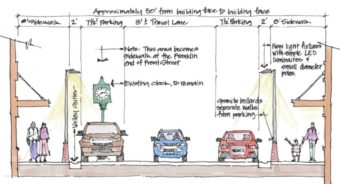
To create a more pedestrian friendly atmosphere, the project team recommended raising parts of the street to be level with the sidewalks. (Image courtesy City and Borough of Juneau)


Imagine more canopies in downtown Juneau. Imagine a bike rack where a parking space used to be. Imagine more art. These were some of the ideas presented by the city’s Franklin and Front Street Reconstruction project team.
Around 80 people were at Centennial Hall Wednesday night to talk about what downtown should look like. The project team presented their vision, and members of the public got to weigh in.

Laura Wallrath was in favor of some proposals, like parking for bicycles and scooters.

Wallrath lives and works downtown and has been riding a scooter since 2007. She rides a mile to and from work every day year-round, except when it snows. She says downtown parking for smaller modes of transportation is lacking.

“My scooter is taking about a sixth of a car and I think that bicycles and scooters should have ample parking,” Wallrath says.

She also liked the idea of wider sidewalks. She says she cringes when she has to drive on South Franklin Street near the tram.

“It’s just this impossible mile to get through downtown. And you just wish that there was an easier way to keep tourists on the sidewalks because tourists have the right-of-way and they’re not thinking about that we’re living here and we’re trying to get from one place to another,” Wallrath says.

Greg Fisk, Margo Waring and Chris Mertl discuss concepts for improving Franklin and Front streets during a community meeting Wednesday night. (Photo by Lisa Phu/KTOO)

Keli Donnelly works for the small cruise line Un-Cruise Adventures and lives downtown during the tourist season. She liked hearing about adding gateways, physical markers denoting different parts of town.

“Make the gateways subtle, but themed and consistent. I like that idea. I want to bring the people back into the heart of the town. I want the people to be up by the Salts and the Rookeries and the local places. That’s important,” Donnelly says.

The project team's recommendation of adding more canopies in downtown will be part of a larger discussion engaging private business owners. (Image courtesy City and Borough of Juneau)
The project team’s recommendation of adding more canopies in downtown will be part of a larger discussion engaging private business owners. (Image courtesy City and Borough of Juneau)

But she doesn’t want those gateways to be arches across the street.

“I think that’s tacky” Donnelly says.

The city’s project manager Michele Elfers says she’s received a lot of comments about closing down parts of Franklin or Front streets to motor traffic and making it a pedestrian mall.

“Some of the comments were to do it permanently. Then we got a lot of comments just about special events, hosting festivals,” Elfers says. “It’s probably not feasible to shut them down permanently just because in downtown, we don’t have that many access roads in and out.”

But she says the pedestrian feel could still be accomplished by raising parts of the street to be on the same level as sidewalks.

Greg Fisk doesn’t necessarily like that idea. Fisk owns a small consulting company on Seward Street and is on the board of the Downtown Business Association. He’s a strong proponent of a downtown circulator, possibly a street car.

“The raised street design could cause a problem ‘cause you end up with a bump. It’s pretty hard to put track in the street, if you’re going to go to a street car, over a bump,” Fisk says.

Part of the process is figuring out what the community wants, Elfers says. Throwing out a lot of ideas helps people sort out what they like and don’t like.

“What you communicate to us is what your values are and there’s a cost to everything and there’s impacts and there’s values, and that’s where we are right now, trying to balance that,” Elfers says. “So keep that in mind. We’re kind of at a high overhead view now and we’re slowly getting more specific as we go through the process.”

The city will continue to take public comments on reconstructing Franklin and Front streets. Elfers says the project team will revise recommendations based on them and come out with a final report in July, followed by the design phase.

Juneau school budget finalized, finally

Superintendent Mark Miller  expects the next budget cycle to be just as rough as this year, if not rougher. (Photo by Lisa Phu/KTOO)
Superintendent Mark Miller expects the next budget cycle to be just as rough as this year, if not rougher. (Photo by Lisa Phu/KTOO)

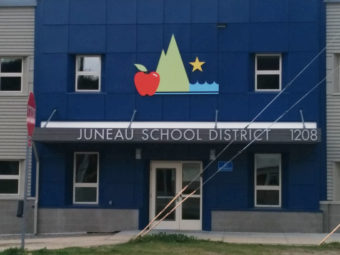
The Juneau School District was finally able to put its budget to bed after the Alaska Legislature wrapped up last week.

Superintendent Mark Miller says he’s relieved, even though he thinks the district is worse off than it was this time last year.

“Not knowing where exactly we were going to land caused more than a few sleepless nights for me. So it feels great to actually know exactly how much we’re going to be getting,” Miller says.

In May, the Juneau School Board and Juneau Assembly passed an $86.5 million school budget.

“Basically we anticipated what the legislature would do so we do not need to make any additional budget changes,” says the district’s finance head David Means.

Overall, the district says it cut spending by about $2.5 million. Means says almost 11 positions were cut, most of which is being absorbed through attrition. Class sizes in the elementary schools will stay the same, but they’ll increase in middle and high school.

The district postponed buying a new social studies curriculum. The high school activities program was also pared down.

“We will pay for officials, coaching salaries and the dues that we have to pay to our state associations and then travel is basically going to be up to the teams and the students to figure out,” Superintendent Miller says.

The district still hasn’t touched the extra $500,000 allocated by the Juneau Assembly for the budget year that’s ending this month. Miller says it’ll be up for board discussion.

Miller expects next year to be rough, too.

“We will not get enough money to keep up with inflation; we just won’t. And so we’re going to end up next year having to spend more with about the same amount of revenue coming in, so exactly where those cuts need to be made and where scaling back needs to happen are all discussions that are going to have to occur,” Miller says.

District administration and the school board will start the whole budget process again in just a few months.

Former gaming manager George Wright to reopen Canton House

Canton House is located in Kootznoowoo Plaza near the Nugget Mall. (Photo by Lisa Phu/KTOO)

Juneau restaurant Canton House is set to reopen under new ownership. The restaurant closed at the end of March after the former owner stopped paying rent.

George Wright has signed a lease with Chatham Properties, which owns and manages the building Canton House is located in.

“His lease actually hasn’t started yet. It’ll start on July 1, but if he’s able to open earlier he will,” says Keith Comstock, general manager of Chatham Properties.

George Wright is paying to have new floors put in Canton House. (Photo by Lisa Phu/KTOO)

Comstock says Wright has paid a deposit of about $30,000 for the Canton House space. Wright is paying to have the floors redone, and Chatham Properties has made other changes to bring the space up to safety code.

Wright denied requests for an interview but says he hopes to reopen the restaurant in three weeks.

Wright is the former manager of gaming cooperatives in Juneau, including Last Chance Cooperative and Multiple Charities Association. He’s also the former gaming manager of Alaska Native Brotherhood Camp #2. In the late 1990s and early 2000s, these entities were involved in municipal and state-level disputes, according to archived news reports. Nonprofit charities that benefited from the gaming had their funds skimmed; city sales taxes also went unpaid.

A 2007 state report says the Department of Revenue filed suit against Wright to recover money owed to nonprofit and charity organizations. In the settlement, all the money had to be paid and Wright was issued a lifetime ban on charitable gaming in Alaska. At the end of 2007, the state had collected about $285,000 and payments were ongoing.

Comstock says Chatham Properties issued an initial eviction notice to the previous owner of Canton House, Thuy Kwong, in early February. Kwong had not paid rent for close to year and still owes Chatham Properties about $100,000.

After evicting former owner Thuy Kwong, Chatham Properties took possession of all the assets that were left in the restaurant. (Photo by Lisa Phu/KTOO)

Wright got a business license April 2 under Canton Asian Bistro LLC shortly after the restaurant closed, and paid the deposit to Chatham Properties not long after. Chatham Properties has taken possession of all assets that were left in the restaurant, such as furniture, dishes and restaurant supplies. Wright has expressed interest in buying them.

Comstock says Chatham Properties, which is owned by Angoon’s village corporation Kootznoowoo Inc., is aware of Wright’s past.

“We certainly did our own due diligence as part of the normal process and found him to be an acceptable tenant,” Comstock says. “I know I personally checked with the city to see if there were back tax issues, if there was anything out there that was going to come up that was going to be a problem. We called people he had rented space from in the past to see if he paid his rent and we got really good responses there. Our biggest issue is will the renter pay their rent.”

Comstock says several people to expressed interest in renting the Canton House space, but Wright was the first to bring a check.

Site notifications
Update notification options
Subscribe to notifications