Lisa Phu

Managing Editor, KTOO

"As Managing Editor, I work with the KTOO news team to develop and shape news and information for the Juneau community that's accurate and digestible."
Haven House appeal may be heading to court

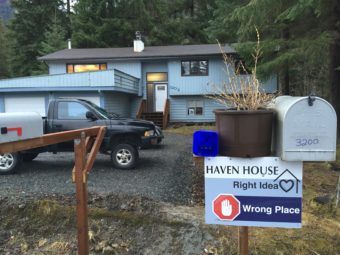
Signs protesting Haven House's location can be seen all over the Malissa Drive area, even in front of Haven House. (Photo by Lisa Phu/KTOO)
Signs protesting Haven House’s location can be seen all over the Malissa Drive area, even in front of Haven House. (Photo by Lisa Phu/KTOO)

A Juneau neighborhood association is taking its fight against a transitional home for just-released female inmates to court, after exhausting all of its municipal appeal options.

Haven House can continue operating on Malissa Drive in the Mendenhall Valley for now.

The Juneau Assembly denied the Tall Timbers Neighborhood Association’s appeal Monday, upholding the planning commission’s decision to allow permitting for Haven House.

“My clients intend to appeal that decision to the Superior Court,” says attorney Dan Bruce, who represents the neighborhood association.

He wants the state court to overturn the city’s decision. Bruce and his clients continue to argue that Haven House is a halfway house, which under city code, isn’t allowed in typical residential districts, like the area around Malissa Drive.

“Haven House is the only non-single family use in that whole neighborhood,” Bruce says.

Bruce says the home will lower property values and have an adverse effect on the neighborhood. He hopes the legal fight will shut the house down.

Haven House Director Kara Nelson says she isn’t surprised. In the beginning of the Tall Timbers’ protest, she says she took it personally. Nelson herself has been in prison and struggled with addiction. She’s been sober since 2011. Now, she sees the fight as an opportunity.

“It really brings a good challenge for those of us that have been in prison to really show what we know, and that is what we’re being perceived as is not true when we’re living in long-term recovery,” Nelson says.

Haven House is a faith-based non-profit. It provides a structured living situation where residents have to come up with an individual action plan and get the support to follow it through. They must attend some sort of women’s support, recovery or Bible group. Haven House can accept up to nine women transitioning out of prison who can live there for up to 2 years.

Nelson says the Tall Timbers’ perception of what Haven House will do to the neighborhood is an example of the stigma Haven House residents face on a daily basis.

“We’re not going to be ashamed,” Nelson says. “We’re not dismissing the crimes that have been committed, but what we’re saying is addiction is a disease and so we’re focusing on the solution. The solution is long-term recovery and to do that you surround yourself with other people who have done it before you.”

Nelson says it’s been a long journey to get Haven House going and she says an appeal at the Superior Court level is just another step.

CBJ to issue new sales tax exemption cards to Juneau seniors only

Gladi Kulp senior sales tax exemption
As of July 1, this CBJ senior sales tax exemption card will no longer be valid. (Photo by Jeremy Hsieh/KTOO)

Juneau’s new senior citizen sales tax exemption rule takes effect July 1. That means old exemption cards will no longer be valid.

The Juneau Assembly passed an ordinance change last month that limits the 5 percent sales tax exemption to only Juneau residents. Currently, all Alaska residents who are 65 or older are eligible.

To implement the change, the city is issuing new cards in June to those who can prove Juneau residency. Clinton Singletary, sales tax administrator for the City and Borough of Juneau, says the city will be strict about the effective date of the new ordinance.

“If July 1 rolls around and they haven’t come in for the new exemption card, the old exemption cards are going to be invalid. It’s going to be up to merchants to be tough on that,” Singletary says.

He says about 3,000 new cards will be issued. Through the ordinance change, the city anticipates increasing revenue by about $200,000 to $350,000 a year.

Narrowing who qualifies for the tax exemption to only Juneau residents will affect some Alaska seniors who are used to not paying sales tax in the capital city.

“We’ve got legislative people that come down just for session. Because they’re a state of Alaska resident, they were entitled to have an exemption card for their Juneau purchases. Similar to some of the neighboring communities that generally come to town and shop,” Singletary says.

The city is encouraging Juneau seniors to get their new cards next month to avoid any hassles come July 1, but the city will still be issuing cards after that date.

(Excerpt of a CBJ notice)

State employees react to governor’s warning of widespread layoffs

State workers react to the governor's email about potential layoffs. (Photo by Lisa Phu/KTOO)
State workers react to the governor’s email about potential layoffs. (Photo by Lisa Phu/KTOO)

In an email Monday, Gov. Bill Walker warned state workers of massive layoffs if the legislature doesn’t pass a fully funded budget by July 1.

Of the 16,000 State of Alaska employees, more than a quarter of them work in Juneau. Here’s what a few at the State Office Building had to say.

Britten Burkhouse says her office at the Department of Health and Social Services was pretty quiet after getting the email from Gov. Bill Walker.

“I think we were all just dealing with the punch. Recuperating maybe a little bit. It wasn’t a very good thing on a Monday,” she says.

Britten Burkhouse (Photo by Lisa Phu/KTOO)

Burkhouse isn’t surprised by the email. The threat of a government shutdown and layoffs has been a possibility since the legislature recessed at the end of April, but she says it makes the situation seem more desperate. She thinks Gov. Walker is doing the best he can, but “it’s come to the point where maybe he’s using state employees as leverage to kind of get the legislature to act.”

Burkhouse is a grants administrator for the department. She says she makes sure nonprofits get money to provide services for Alaskans.

“State employees do more than just show up to work every day. We actually help protect the life, health and safety of Alaskans,” Burkhouse says.

Jim Duncan is executive director of the Alaska State Employees Association, a union that represents about half of all state employees. He says this level of state layoffs is new territory.

“It’s never happened in the state of Alaska and it shouldn’t happen,” he says. “I was in the legislature for 24 years; we never came close to this. And prior to that, that never happened either. So all the legislature has to do is fulfill their constitutional responsibilities of funding a balanced budget.”

Duncan says, if that happens after workers are laid off, those employees can return to work. He says some questions remain unanswered, like will there be back pay?

Duncan says the state is contractually obligated to give workers 30 days’ notice of a potential layoff. Notices would go out in early June before state functions start shutting down in July.

Mike Lewis (Photo by Lisa Phu/KTOO)

“It’s our job as a union to be sure that our members are fully informed and to urge them to become and remain very active in urging the legislature to take appropriate action,” Duncan says.

Mike Lewis has been a state worker for 15 years. He’s the lead courier in mail services. Over the years, he’s made sure Alaskans get their Permanent Fund Dividend checks. He says the potential layoffs are all part of a game.

“This is what they do. It’s government. It’s politics. I don’t like politics because of this,” Lewis says.

And he doesn’t think there’s anything he can do, like contacting a legislator, to change the situation.

“It’s the big people up there that make all the decisions. I don’t think they really care much about the little guys,” Lewis says.

If he’s laid off, “I’ll go fishing, crabbing – all the things I can do when I’m off. If it’s only a week, it wouldn’t bother me that much, but if it’s longer, then it’s the financial thing,” Lewis says.

Mackenzie Merrill (Photo by Lisa Phu/KTOO)

Mackenzie Merrill, 23, just wants to have job stability. Before this email, she says she was getting other ones about positions getting cut. She’s been an economist with the Department of Revenue for only eight months. It’s her first job out of college.

“I just signed a year-long lease and I want to work here and I want to save money for my future. I went to college. This is what I signed up for. Entering the state during a time of severe fiscal uncertainty has been kind of disappointing,” Merrill says.

Merrill has a vacation planned in July anyway, when layoffs could begin. But she’d like to know that she has a job to come back to.

Grocery shopping for the Stikine Icefield

In 2010, Børge Ousland and Vincent Colliard were part of a four-person sailing crew on the first ever circumnavigation of the Arctic Ocean in one season, sailing through both the Northeast and the Northwest passages.

Now, they’re in the midst of skiing the Stikine Icefield in Southeast Alaska and British Columbia. The journey is part of a decade-long project to traverse the world’s 20 largest glaciers. So far, they’ve crossed glaciers in Patagonia, Chile and Svalbard, Norway.

A photo from their trip across a glacier in Svalbard, Norway. (Photo from icelegacy.com)

The two men started skiing on the Stikine Icefield May 9. Beforehand, I joined them on an important excursion – a trip to the grocery store.

I find Ousland and Colliard in the baking aisle of Foodland IGA standing in front of the oils. Ousland says they’re looking for sunflower oil for breakfast, “because we need to boost the porridge with some extra fat because we need a lot of energy on this trip.”

This is something they have to consider that other people normally don’t – does something have enough fat? Ousland struggles with this when looking for string cheese. He reads the nutrition stats on several, before he settles on the organic cheese strings. Sixteen of those – one for each day. Ousland says the trip will likely take 12 days, but they’re shopping for 16 to be safe.

Børge Ousland finds a package of dry milk that's enough for both him and Colliard. Otherwise, they shop separately for their individual needs. (Photo by Lisa Phu/KTOO)
Børge Ousland finds a package of dry milk that’s enough for both him and Colliard. Otherwise, they shop separately for their individual needs. (Photo by Lisa Phu/KTOO)

Ousland is 52 and from Oslo, Norway. He’s done about 30 expeditions that’ve taken him to places like the North Pole, the South Pole and the Himalayas. And he does them unsupported. That means no help along the way, no caches of food, even on months-long trips.

“The longest trip I’ve done was when I crossed the Arctic Ocean solo from Siberia to Canada. Took me 83 days,” Ousland says.

For that trip, he started out with more than 400 pounds of food and gear which he carried on his back and pulled on a sled. For crossing the Stikine Icefield, Ousland says they’ll each be carrying about 120 pounds.

“So this is lightweight, but we still have to be careful and take it seriously and do the right thing,” Ousland says.

The idea behind the long-term expedition is to shed light on how climate change is affecting glaciers. They document their journeys with glacier measurements, notes and photos. One of their sponsors, National Geographic, outfitted them with a video camera.

“We go out there to show the world what’s happening and how it looks like. Because you can’t just draw things on the map or listen and read to scientific reports, someone has to visualize it. So we’re not scientists but we’re the eyewitness to the climate change,” Ousland says.

Ousland also sees these trips as a way to pass down knowledge to 29-year-old Colliard. Colliard is from France. He says he first communicated with Ousland, who he calls his hero, by email when he was 19.

“One day I was harassing him that I really wanted to go on a trip with him on a sailboat around North Pole and he said, ‘Yeah, OK, we’ll give you a chance,'” Colliard says.

Børge Ousland and Vincent Colliard in Juneau a couple nights before departing for the Stikine Icefield. (Photo by Lisa Phu/KTOO)

Since then, Ousland has been Colliard’s mentor, friend and expedition partner. Colliard says he’s learned the importance of preparation and how to be meticulous.

“I saw him packing things and everything is extremely organized so when you’re on the field you don’t think, ‘Where’s this thing? And where’s the other?’” says Colliard.

He’s learned it’s important to practice the same steps of setting up and packing up camp over and over, even when the weather is nice and calm.

“So when it’s really windy and you’re alone and you want to pitch your tent, you have to make sure you have a nice procedure because if you’re in the middle, let’s say, of an ice cap or Greenland or on the sea ice and you lose your tent – your tent is like the only refuge that you have – you’re done if you lose a tent,” Colliard says. “You can just call for emergency.”

Vincent Colliard shops for groceries prepared with a list of how many kilograms he needs of each item. (Photo by Lisa Phu/KTOO)

What he’s not so sure about at the moment is chocolate. He stands in front of dozens of choices and zeros in on the milk chocolate Cadbury bar. I suggest the caramel bar.

“No, no, no liquid inside,” Colliard explains.
“How about dark chocolate?” I ask. “You’re more milk than dark?”
“Yeah, we need a little more sugar also,” he says.

Colliard hems and haws before going back to the milk chocolate Cadbury.

“Do you think I can just open one and then I can pay and I try it?” Colliard asks.
“You must have had Cadbury, no?” I wonder.
“Yeah, but not this one,” Colliard says,

So he opens the wrapper, breaks off a square and after a few chews, “Mmm, that will do the job. Mmm, yeah, perfect.”

Borge Ousland's shopping cart. (Photo by Lisa Phu/KTOO)
Borge Ousland’s shopping cart. (Photo by Lisa Phu/KTOO)

Besides chocolate, string cheese and sunflower oil, Colliard and Ousland’s carts are filled with nuts, raisins, dry milk, beef jerky, toilet paper and several bags of potato chips. Those get crushed into crumbs, then packed in individual Ziploc bags.

For this trip, Ousland isn’t bringing one of his standbys.

“Normally, I bake a cake which is almond cake with egg cream and I bring it on the trip to celebrate the small victories. Especially on the long trips, there’s always something to celebrate – my son’s birthday or when I’m halfway or things like that. You need things to look forward to,” Ousland says.

Of course, the real motivation is the journey itself, Ousland says, the adventure – finding out what’s after the next curve, what’s beyond the next ridge.

To follow Ousland and Colliard’s travels, go to icelegacy.com and read daily dispatches from the Stikine Icefield.

Juneau Police: ‘heightened media coverage’ may encourage threatening calls to schools

The Juneau Police Department will no longer issue press releases about threatening phone calls to schools. Lt. David Campbell made the announcement in an email Thursday.

He says the department continues to take threats seriously, but “heightened media coverage” may have a detrimental effect on the community and could encourage those making the calls.

Email from Lt. David Campbell saying that JPD will no longer inform media of threatening phone calls made to schools.

Of eight menacing phone calls received by Juneau schools in recent weeks, JPD has released information on about half of them. All have been from a computerized or electronic sounding voice that alluded to general violence, but no specific threats. In each case no danger has been found.

The calls have disrupted several Juneau schools, causing them to go into lockdown or stay-put mode.

Today Juneau Empire Publisher Rustan Burton said the paper will do one more story on the issue, but then plans to stop reporting on every threatening call for similar reasons.


Threatening phone calls continue, FBI wants schools to remain vigilant

Mendenhall River community school
Mendenhall River Community School received its first threatening phone call Wednesday afternoon. (Photo by Heather Bryant/KTOO)

Juneau schools received their seventh and eighth threatening phone calls Wednesday. Juneau Police continue to sweep the schools each time and find no danger, but an FBI spokesperson says the federal agency is actively trying to make the calls stop.

Mendenhall River Community School and Juneau-Douglas High School received threatening phone calls on Wednesday around 1 p.m., sending both schools, the Marie Drake Building and Harborview Elementary School into stay-put mode.

“[Juneau Police Department] responded to both schools simultaneously and we had them cleared between 10 and 15 minutes,” says school superintendent Mark Miller.

Miller says the calls were similar to previous ones received around the district – the caller had a computer-generated voice and alluded to a school shooting. This is the third call Juneau-Douglas High School has received, but it’s gone into stay-put mode four times in the past three weeks.

“The other unfortunate thing, quite honestly, is when elementary kids see police with automatic weapons coming through the hallways, it freaks them out, and you can’t blame them. It’s a disruption. It’s scary for them,” Miller says.

Schools have received threatening phone calls all over the state including in Fairbanks, Anchorage, Kenai and Hoonah.

The FBI is actively investigating the calls with local law enforcement and the Alaska State Troopers. Spokeswoman for the FBI in Anchorage Staci Feger-Pellessier wants the schools to understand, “If you receive one of these threats that matches what these threats are – computer generated, automated of some sort – please make sure you are reporting that to your local law enforcement officials so that we can find out about it.”

She says it’s important for superintendents to keep taking the threats seriously and follow the appropriate safety protocols when a call comes in.

“They may receive 10. On the 11th, we want them to make sure they’re continuing to follow the same protocol,” Feger-Pellessier says.

Her agency is reaching out to other parts of the country to find out where else this is happening. News outlets in California, Arizona and as far off as New Jersey have reported similar calls causing school lockdowns.

If the calls happen to stop on their own, Feger-Pellessier says the investigation will continue.

Site notifications
Update notification options
Subscribe to notifications