Lisa Phu

Managing Editor, KTOO

"As Managing Editor, I work with the KTOO news team to develop and shape news and information for the Juneau community that's accurate and digestible."
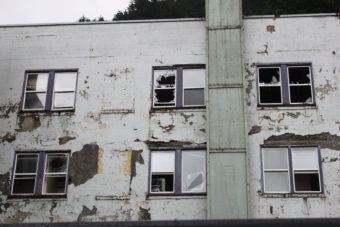
Falling debris from Gastineau Apartments closes Pocket Park, demolition scheduled for November

Tourists stand in front of the closed Gunakadeit Park, also known as Pocket Park, on Monday. (Photo by Lisa Phu/KTOO)

The burnt out Gastineau Apartments will finally be demolished by the end of November, according to Juneau’s city attorney. In the meantime, the city says the downtown buildings are a public safety concern. It’s temporarily closed the neighboring park due to falling debris.

The city closed Pocket Park at the end of last week.

“One of our workers was in there the other day and noticed some broken glass in the fountain area,” says Colby Shibler, park maintenance supervisor for Parks and Recreation, “and realized that it wasn’t a broken bottle and then looked up and noticed a bunch of the windows were broken out in the building there and realized that the glass was probably falling out of the window or had been broken out from the inside, it looked like, and was concerned about glass falling on people in the park.”

Dave Lane admits people have trespassed into the apartments in the past, but now he says the buildings are more secure. Lane does construction for the owners of Gastineau Apartments, James and Kathleen Barrett.

“We as of late, and that being the past 8 months, 9 months, have been patrolling more. Almost every evening, we come through and we make sure there’s no one in here at that time. We made sure everything is secure to the best of our abilities,” Lane says.

Gastineau Apartments still have unboarded, broken windows. (Photo by Lisa Phu/KTOO)

City building official Charlie Ford says the Barretts are being negligent with security.

“I had been working with Mr. Barrett to try and keep the building secured and all of a sudden, I noticed a side door was open and there was a ladder leaning up against the Rawn Way side of the building that was obviously used for access to get into the upper floors,” Ford says.

Ford sent a letter to the Barretts Monday asking them to board up more windows and clean up the remaining glass shards. He says if they don’t care of it, the city will.

Gastineau Apartments have been uninhabitable since a November 2012 fire. The city declared the buildings a public nuisance soon after. The Barretts have repeatedly missed deadlines for repairs or demolition. Part of the building caught on fire again in March.

The Barretts had until June 19 to turn in paperwork and plans for demolishing the buildings. When they failed to do that, the city sent a letter a week later stating that it would demolish them on its own. At the end of June, the Assembly appropriated $1.8 million to do that.

James Barrett says that’s hindered his own plans to sell or demolish the buildings. He says he’s talked to more than 30 companies.

“It’s just put me at a standstill when we thought we were moving forward. I’m going to see where the other contractors who are bidding are going to end up. That’s about all I can do at this point,” Barrett says.

Barrett says he’s seriously considering suing the city.

Forest Service to allow more guided tourism at Mendenhall Glacier

Tour companies will soon be able to guide more visitors on Mendenhall Glacier trails. This group accessed the glacier from the West Glacier Trail. (Photo by Lisa Phu/KTOO)

The U.S. Forest Service is allowing commercial operators to bring more visitors on the lake and trails in the popular Mendenhall Glacier Recreation Area. Later this month, companies can compete for visitor spots through an application process.

Commercial operators have been allowed to bring about 462,000 visitors to the area. That number isn’t changing. Instead, the federal agency is shifting more spots to be used by visitors being guided on the trails and lake versus simply visiting the glacier by bus.

Jennifer Berger is in charge of special uses on the Juneau Ranger District. She says there’s more demand to bring visitors on guided trips than spots available.

“What we’re hearing is that people would like to engage in some active hiking, biking, and lake and river activities, and also get a little further afield from the immediate visitor center which can on certain days be rather crowded,” Berger says.

There are currently 28 permit holders for the Mendenhall Glacier Recreation Area, most just provide transport. The bidding process will allow new and existing guide companies to bring more visitors to the glacier.

“We are going to advertise the prospectus far and wide because we know that there may be business from across the state, there may be businesses from outside the state, and we would want all of them to have an opportunity to apply,” Berger says.

About 200,000 visitor spots will be up for competition. It’s been 19 years since the Forest Service has made so many spots available.

The Forest Service plans to open the bidding process later this month and companies will have 60 days to turn in an application.

Hoonah vets recount Vietnam war, homecoming in new documentary

(Image courtesy Samantha Farinella)

A new documentary profiles the lives of Tlingit veterans from Hoonah who fought in the Vietnam War. “Hunting in Wartime” premieres in the Southeast Alaska Native village Friday.

“When I grew up, I wanted to be a hunter and a fisherman and I could do both of them,” says Donald See in the film trailer.

“I don’t think any of us said that we’re going to be soldiers when we grew up,” says Fred Bennett.

“When I was in Vietnam, I told myself if I ever make it out of here, I’m going back home and I’m staying there until the day I die,” says Victor Bean.
"Hunting in Wartime" director Samantha Farinella (Photo by Lisa Phu/KTOO)
“Hunting in Wartime” director Samantha Farinella (Photo by Lisa Phu/KTOO)

See, Bennett and Bean are three of the men Brooklyn filmmaker Samantha Farinella interviewed for her documentary “Hunting in Wartime.”

“It’s about the human cost of war and survivability in a community. It’s also how you go through something and survive it and come out the other side. And thank goodness a lot of these guys did,” Farinella said.

For some of the vets, her interviews released decades of bottled up emotion. As Ron Paul says in the film, many didn’t talk about the war when they returned.

“Everything you went through, you hide it and you’re smiling on the outside but you’re cold inside.”

In some ways, the Hoonah soldiers had a lot in common with the Vietnamese people they were fighting.

“Almost every veteran I interviewed in the film says that they had a lot of respect for the Vietnamese people,” Farinella said. “They did feel close to them. It was a similar culture. One of the vets Fred Bennett said, ‘They come from a small fishing village like I did. They’re tight-knit with their families.’”

Farinella and Hoonah veteran George Lindoff. (Photo courtesy Samantha Farinella)

Farinella said the film explores Tlingit culture and their connection to the land. As hunters, the soldiers from Hoonah were used to taking life, but in war, it’s different.

“Hunting in Wartime” plays at the Gold Town Nickelodeon in Juneau on Monday night, in Homer July 16 and in Anchorage July 19.

“A good portion of the veterans I interviewed said that when they first had someone in their sights, they tried to think of them as a deer,” she said. “But as George Lindoff said, ‘I knew I was lying to myself.’”

When the men returned from war, many had terrible nightmares and experienced post-traumatic stress disorder. Some struggled with drugs and alcohol. “Hunting in Wartime” explores how, with the help of family and community, many of the vets climbed out of despair.

“My wife is tough,” says Warren Sheakley in the film. “She slammed me up against the wall, almost knocked my lights out and said, ‘You talk about it.’ And then I said, ‘OK.’”

Hoonah veteran Fred Bennett (Photo courtesy Samantha Farinella)

Farinella started the film in 2010. She visited the village several times, traveled to Juneau and as far away as Hawaii to interview about 20 vets from Hoonah. With a local friend and other connections, she built relationships in Hoonah with the veterans, their families and the community.

“It took a village, everybody was helping and that felt good. Small things, like the Hoonah Senior Center opened up so I could interview people in a quiet space. I was invited to play softball. It took a while. It was building trust,” Farinella said.

Marlene Johnson was one of Farinella’s local connections. Johnson was born and raised in Hoonah, and her nephew Ronald Greenewald fought and died in Vietnam. Johnson thinks most people in Hoonah are happy about the film.

“And I think the veterans are, too, that somebody realizes they did something for their country. And for people that’ve never been thanked for it, this to them is their thank you,” Johnson said.

The film has already started a conversation. After a screening of last year, one vet’s nephew said to Farinella, “I never knew my uncle did that.”

A look inside sex offender rehab at Juneau’s prison

(Photo by Lisa Phu/KTOO)

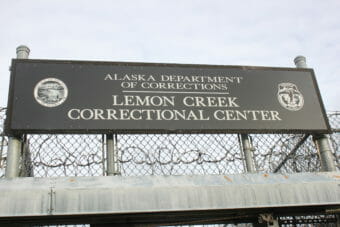
Since 2010, sex offenders in Alaska prisons have been able to opt in to an intensive treatment program at Lemon Creek Correctional Center in Juneau, but it’s unclear if it reduces recidivism.

A 2012 University of Alaska Anchorage Justice Center publication identified a statewide benchmark; of about 240 sex offenders released from Alaska prisons in 2008, 2 percent were reconvicted on sex offenses within two years.

Here’s a look inside the treatment program at Lemon Creek Correctional Center.

Andrew Peabody has served about 27 years in prison for sexual assault. He said he’s scheduled to be released in February. Peabody said he used to feel numb and didn’t want to deal with what he’d done.

During an event at Lemon Creek Correctional Center earlier this year, Peabody said the sex offender treatment program is teaching him empathy “for my victim. You have to write a letter to that person realizing what you’ve become to that person, how you affected that person’s life.”

The letters aren’t actually sent.

Licensed clinical counselor Malcolm Nichols created and runs the sex offender treatment program at the Juneau prison. Nichols has a history of working with high risk populations. Prior to Lemon Creek, he ran a sex offender treatment program in Columbus, Ohio.

Licensed clinical counselor Malcolm Nichols joined Lemon Creek Correctional Center in 2010. He created and runs the sex offender treatment program. (Photo by Lisa Phu/KTOO)

The 2-year program is a combination of structured group therapy and individual counseling. Some inmates are also prescribed medication for sexual urges. Nichols says the program is not supposed to be a cure. The goal is for inmates to learn to control and manage risk factors that could lead to sexual assaults.
Another assignment is writing a narrative describing the period of time leading up to their crime.

“It starts a year out from their sexual crime and then takes them 9 months, 6 months, 3 months and then 24 hours before it happened and this can be very difficult and dramatic,” Nichols said.

It’s supposed to be self-revealing. Nichols doesn’t let inmates get away with denying or minimizing what they’ve done. These are tactics, he says, to avoid change. Nichols recounted what happened when one inmate described his offense during a recent group session.

Inmates in the program helped build this exterior classroom for their group sessions. (Photo by Lisa Phu/KTOO)

“He was telling it from his own personal position but I always want them to also give the objective, what actually happened, which he didn’t. So when I confronted him, he sort of got extremely dysphoric and broke into some deep sobbing and the whole group [got quiet]. You could hear a pin drop,” Nichols said.

The Lemon Creek Correctional Center program treats 24 men at a time. Inmates enter the program when they’re within 3 years of being released. All have been convicted of at least one sex assault and have admitted to at least one. Nichols says some have a long history of committing many sexual assaults. One even claimed to have committed hundreds.

“Some of the high risk guys have a history of sex offending going way back into their adolescence or even childhood,” Nichols said.

Alaska leads the country for the rate of reported forcible rape, according to FBI crime statistics. There are about 770 sex offenders in the Alaska prison system, which Nichols says represents a fraction of total offenders.

He says it takes a lot of patience to work with sex offenders.

“I don’t see people as necessarily the sum of their parts. I think that people are capable of choice and that I have to not shame them or ostracize them or let them think that they’re not human or they’re not incapable of change,” Nichols said.

The work takes its toll. When Nichols leaves the office he tries to completely disengage with work. To avoid stress, he bikes and exercises regularly.

And there’s a lot at stake when inmates leave the treatment program and are released into the community.

“We all in this field live in dread of one of our guys getting out and committing some kind of horrendous sexual offense,” Nichols said. “And I’ve had some extremely dangerous inmates who, as they were leaving the program, I was keeping my fingers crossed.”

So far, of the 52 who’ve completed the program and been released, one is back in prison for a sexual offense.

Missing hiker on Mt. Roberts trail found dead

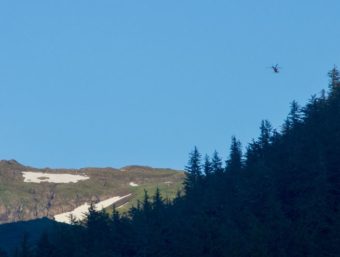
With Temsco Helicopeters, Alaska State Troopers performed an aerial search over Mt. Roberts Sunday evening. (Photo by Mikko Wilson/KTOO)
With Temsco Helicopters, Alaska State Troopers performed an aerial search over Mount Roberts Sunday evening. (Photo by Mikko Wilson/KTOO)

A Florida man hiking on Juneau’s Mount Roberts trail system on July 4th was found dead last night.

Alaska State Troopers were notified Sunday afternoon that 35-year-old Michael Patrick Blaisdell was missing. Blaisdell, an Orlando resident, hadn’t been seen or heard from since around 11:30 Saturday morning.

Trooper spokeswoman Megan Peters says the agency launched a search and rescue operation with Juneau Mountain Rescue and SEADOGS. Five search teams went up the Mount Roberts trail and Temsco Helicopters provided an aerial search.

“A little bit before 8 o’clock last night, an aerial search team located Blaisdell off the Mount Roberts trail system near the base of a 50-foot drop in the Bear Valley area,” Peters says.

Blaisdell’s family has been notified. His body was recovered and will be sent to the state medical examiner’s office in Anchorage for autopsy.

With Whale SENSE, Juneau whale watch companies commit to a higher standard

A whale in Berners Bay, near Juneau, Alaska. (Creative Commons photo by Gillfoto)

Seven whale watching companies in Juneau are the first in the state to participate in a voluntary stewardship program that challenges them to go above and beyond federal and state viewing guidelines. The National Oceanic and Atmospheric Administration has brought the East Coast program Whale SENSE to Alaska.

It’s a windy day at Statter Harbor in Juneau, where Dolphin Jet Boat Tours stage trips. A new orange Whale SENSE flag adorns each vessel, “so that other boats on the water can see that we’re a member of Whale SENSE and then they know that we’re well trained and carefully observing all the guidelines and protecting the whales,” says Kathleen Turley, port captain for Dolphin. She’s been with the company for 12 years and does everything from maintaining the boats to being an on-board naturalist.

Participating Whale SENSE companies display an orange flag on their vessels. (Photo by Lisa Phu/KTOO)

Each tour begins with an educational Whale SENSE talk.

“We’re informing the passengers about the stewardship aspect of the whales, that we’re not just here to see the whales, we’re here to protect them,” Turley says.

Federal regulations include a hard rule requiring that vessels keep 100 yards away from a humpback whale. Beyond that distance, the rule is to be “slow” and “safe.” Whale SENSE is more specific and has a tiered set of speed guidelines that start one mile from a whale.

“Basically it’s what we do anyway because you don’t want to just roar up on a whale or leave rapidly or anything like that. I think it’s helpful for new captains especially that haven’t been doing this for a long time,” Turley says.

Kathleen Turley has worked for Dolphin Jet Boat Tours for 12 years. (Photo by Lisa Phu/KTOO)

Other guidelines include additional training and coordinating location and viewing times with other vessels. Program participants go through on-board evaluations. Juneau companies Alaska Galore Tours, Allen Marine Tours, Gastineau Guiding, Juneau Whale Watching Tours, Orca Enterprises and Rum Runner Charters are all part of Whale SENSE.

In return, NOAA and Whale SENSE advertise participating companies on their websites. And the companies know they’re taking the extra step to be more responsible.

For the most part Suzie Teerlink says the industry in Juneau does a good job of respecting the whales. Teerlink is a doctoral student at the University of Alaska Fairbanks. She’s been studying Juneau humpback whales and the whale watching industry.

“Even though companies generally are following the regulations, because of the growth of the industry and the number of vessels on the water, there was just need for more,” Teerlink says.

In the early 1990s, Teerlink says there were no whale watching boats in Juneau. Now, she estimates there are about 35. She’s heard operators complain of overcrowding. She calculates the industry generates in Juneau between $20 and $25 million a year.

NOAA Fisheries marine mammal specialist Aleria Jensen coordinates Whale SENSE Alaska. Worldwide, she says whale watching is a multibillion dollar industry.

“How are we going to make our little piece of that industry in Juneau sustainable? Because we’re on the map as a whale watching destination, we’re probably one of the top destinations and it’s thrilling that we can offer this experience to visitors but we need to do it right and we need to be really careful about how we behave around them,” Jensen says.

Jensen doesn’t see the growth of the whale watching industry leveling off anytime soon. She says the humpback whale population in the North Pacific is growing at a rate of 5 to 7 percent each year, and with more whales come more vessels to watch them.

Site notifications
Update notification options
Subscribe to notifications