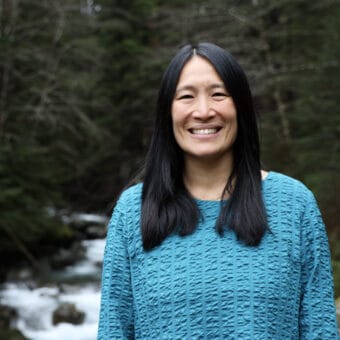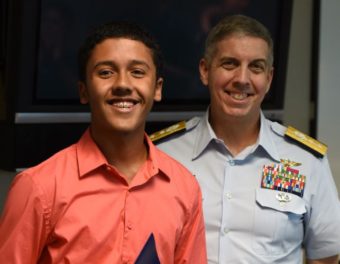
Lisa Phu

Managing Editor, KTOO

"As Managing Editor, I work with the KTOO news team to develop and shape news and information for the Juneau community that's accurate and digestible."
The ups and downs of raising 3 children with FASD

The Lohrey family. From left to right: Elena, Kylie, John, Kristyanna, Diane (holding a foster child) and Emilyanne. Elena, Kylie and Kristyanna have all been diagnosed with FASD. (Photo by Lisa Phu/KTOO)

Not many people wish to raise a child with a fetal alcohol spectrum disorder, or FASD. Diane Lohrey is no different. But when she and her husband adopted three children, all later diagnosed with an FASD, they accepted the hardships and the rewards.

When you walk into the Lohrey household, kids seem to materialize out of thin air.

“We have five of our own and one foster, so six kids right now,” says the mom, Diane Lohrey.

Two are biological, three are adopted and the foster child is through the state Office of Children’s Services.

“And they just called us a few minutes ago to see if we would take an 8-year-old boy, but we have no room right now,” Lohrey says.

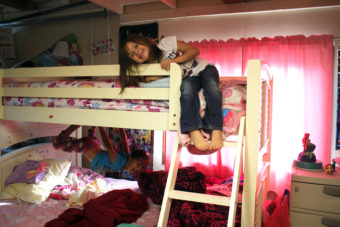
They’ve already converted their garage into a comfortable bedroom. At least a dozen foster children have passed through the four-bedroom house since 2005, staying anywhere from one night to 18 months.

Elena Lohrey, 12, looks at pictures from an FASD Family Camp her family attended in Arizona earlier this summer. (Photo by Lisa Phu/KTOO)

The Lohreys’ first adoption was Elena from Russia in 2004.

“Within two days, I knew something was wrong,” she says.

Elena was 21 months old. Lohrey says she was different than the other Russian infants getting adopted.

“She would stare at things. She didn’t know how to play with toys. She would play with a little piece of lint more than she would a toy,” Lohrey explains.

Years later, the Lohreys adopted biological sisters Kylie and Kristyanna from Juneau through OCS.

They receive a stipend from the state for the two girls, who are now ages 5 and 6, and any foster children that pass through. Lohrey is a stay-at-home mom and her husband is a highway engineer.

All three adopted kids were diagnosed with fetal alcohol spectrum disorders at the FASD clinic in Juneau. Medical professionals at the clinic require some kind of evidence that the biological mother drank during pregnancy in order to do the diagnosis.

That was hard for Lohrey. She pleaded with Kylie and Kristyanna’s biological mom, “‘Go to OCS and write down that you drank or that you drank before you knew you were pregnant. That is the greatest gift you can give these children,’ and she did it,” says Lohrey, crying.

Emilyanne, 21, is one of Lohrey’s biological children. She says the diagnosis opens the doors for getting help, “and for, like, other people to understand, they’re not just bad kids. There’s a logical explanation for why they are the way they are, and how to give more ideas how to help them and not discard them like trash.”

The Lohreys converted the garage into a bedroom that Kristyanna, 6, and Kylie, 5, share. (Photo by Lisa Phu/KTOO)

FASD is an umbrella term that’s used to describe a range of disabilities, minor to severe. Lohrey says each of her three adopted kids falls in different areas. Issues include short attention spans, disorganization and being overly trusting. One of her kids has a tendency to lie and steal.

Elena, who’s also been diagnosed with an autism spectrum disorder, doesn’t communicate her own needs.

“She won’t voluntarily say, ‘I need something,’ or ‘I need help,’ or ‘I’m lost.’ So one of the things they told us is that she might need long-term care, that she might not be able to live on her own. And that was like – that hurt,” Lohrey says.

It’s tough to accept that your child has a lifetime disability for which there’s no cure, Lohrey says. In most cases, you can’t tell by looking that someone has an FASD.

“A lot of times, you’re out in the community and your kids are doing something stupid and you’re embarrassed and some people will say really rude things to you, like ‘You need to control your child,’ and you’re like, ‘Wait a minute, I’m doing the best I can. You have no idea.’ And sometimes I would love to wear a shirt that says, ‘My child has FASD. Don’t judge us,'” Lohrey says.

The Lohreys did not set out to adopt three kids with fetal alcohol spectrum disorders.

“And there are days when I’m like, ‘Oh, I wish I had never adopted.’ I think that’s with your typical family, too. I think there are days where parents say, ‘I wish I didn’t have any kids.’ I think that’s normal,” Lohrey says.

She admits she may say it more than other parents, but there are times when she can’t imagine not adopting.

“Each little child that you adopt, each little child that you foster, hopefully you’re giving them something that will make this world a better place and better understanding and teach more empathy,” Lohrey says.

Lohrey sometimes blames the biological parents, but she knows that’s pointless. She says you can’t change the past. You can only focus on the here and now, and the future.

Elections director resigns abruptly at Mallott’s request, Nome city manager to take over

KNOM reporter Matthew Smith interviews Nome City Manager Josephine Bahnke earlier this month. Bahnke will step in as the Division of Elections Director in October. (Photo by John Handeland)

A veteran election official resigned abruptly on Friday at Lt. Gov. Byron Mallott’s request. The Walker-Mallott administration was Gail Fenumiai’s third as head of the state Division of Elections.

“There’s nothing personal in the request,” says Claire Richardson, special assistant to Lt. Gov. Byron Mallott. She says they accepted Fenumiai’s resignation on Friday.

“The lieutenant governor would like to move in some new directions with the Division of Elections and it was felt that it was time for different leadership,” Richardson says.

Gail Fenumiai (Photo by Liz Ruskin/APRN)

Fenumiai has been director of elections since 2008, and has 10 years of earlier experience in the division. She didn’t return calls for comment.

She’s being replaced by Nome City Manager Josephine Bahnke, who’ll start in October. In the meantime, election supervisor Lauri Wilson is acting director.

Richardson says Mallott hasn’t worked closely with Fenumiai since he and Gov. Bill Walker took office, but they’ve had meetings about the Tyokuk v. Treadwell case, which is in settlement negotiations. A federal judge ruled last year the state doesn’t do enough to serve voters who speak Native languages.

Richardson says there was no particular issue that led to Fenumiai’s resignation request. Rather, she characterized it as the prerogative of the administration to bring in new people.

“I think it’s just that the lieutenant governor would like to move forward and reach his goal of having the best elections division in the country,” Richardson says.

That means being customer service-oriented and “the ability for Alaskans to register and vote,” according to Richardson.

“We’re excited to have her move to Juneau and to really take a look at elections from a different perspective,” Richardson says.

Bahnke was born and raised in Nome. She says she was contacted by the lieutenant governor’s office sometime in the past month and has been going through a vetting process. Bahnke says it’ll be hard to leave Nome. She’s been city manager for 7 years.

“I did let the governor know, I love my job, I love Nome, but I think our philosophies are aligned and so I feel very honored to be asked to be a part of this administration,” Bahnke says.

Prior to her city manager role, Bahnke was a local government specialist in the Bering Strait region for the state. She was also a program director for Kawerak Inc., according to her resume. Bahnke has a master’s degree in public administration from Portland State University and a bachelor’s in political science from Fort Hays State University in Kansas.

“For the past 15 years working with tribal, state and local government and my management experience will help greatly in my new job. I haven’t gotten really into the weeds on elections. This is going to be a steep learning curve for me, but like any challenge, I’m up for it,” Bahnke says.

Bahnke plans to travel to regional election offices at the end of August.

Bahnke contributed $500 to Bill Walker’s gubernatorial campaign. After he merged with Mallott, she gave another $200, according to campaign finance disclosures.

The Division of Elections is the only division under the lieutenant governor’s office. Mallott is in Canada this week and could not be reached for comment.

KNOM’s Matthew F. Smith contributed reporting.

Elections director resigns abruptly at Lt. Gov. Mallott’s request

Gail Fenumiai, director of the Division of Elections. (Photo by Liz Ruskin/APRN)
Gail Fenumiai. (Photo by Liz Ruskin/APRN)

Lt. Gov. Byron Mallott has asked the head of the state’s Division of Elections to resign.

Claire Richardson is special assistant to Mallott. She says they accepted elections Director Gail Fenumiai’s resignation Friday.

“There’s nothing personal in the request. The lieutenant governor would like to move in some new directions with the Division of Elections and it was felt that it was time for different leadership,” Richardson said.

Fenumiai is being replaced by Nome’s city manager, Josephine Bahnke. She’ll start in October.

In the meantime, election supervisor Lauri Wilson is acting director.

The Division of Elections is the only division under the lieutenant governor’s office.

Fenumiai had been director of elections since 2008, and has 10 years of prior experience in the division.

Editor’s note: The headline has been updated.

Where’s the trail? Boy Scout hopes to curb West Glacier rescues

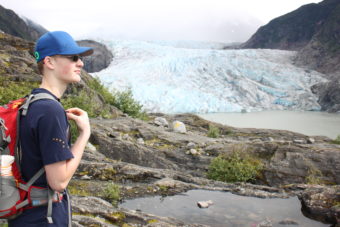
Colton Tersteeg, 15, hopes his Eagle Scout project will help keep hikers safe. (Photo by Lisa Phu/KTOO)

Up to 12 times a year, search and rescue agencies send crews out to the West Glacier trail area to find lost and stranded hikers.

A Boy Scout is trying to fix that problem, and teach about the glacier’s history at the same time.
Colton Tersteeg, 15, grew up down the street from the West Glacier Trail.

“This is where I’ve hiked most of my life,” Tersteeg says.

When he was an infant, his father walked the trail carrying him on his back. As Tersteeg got older, he’d hike the trail about a dozen times a year. Then, about two years ago, his family adopted a blue heeler.

“Ever since we got Buddy, I’m pretty sure I’ve gone almost every day, whether it’s biking or hiking,” he says.

Tersteeg is in the process of making his favorite trail safer and more educational. He’s been a Boy Scout since he was 6. For his Eagle Scout project, Tersteeg is organizing and plotting a series of 15 signs. Each one will say “Glacier was here” with the date.

“And it’ll be a big reflective sign and we’re hoping to put a bar code on it so that if you have your phone, you can scan it and you’ll be able to see a picture of where the glacier was,” he says.

Colton Tersteeg, his parents Jeff and Diana, and their dog Buddy hiked to the glacier on Friday and built some of the rock cairns that the signs will be planted in. (Photo by Lisa Phu/KTOO)

The signs could serve another purpose as well. Tersteeg hopes it’ll cut down on the search and rescue efforts that take place in the area.

The West Glacier Trail is maintained by the U.S. Forest Service. But many people hike off the main trail to access the Mendenhall Glacier. They often end up on a rocky peninsula.

“A lot of the terrain looks very similar so it’s easy to get disoriented,” says Rich Etheridge, chief of Capital City Fire/Rescue. He says the city department is one of about a half dozen agencies that respond to emergencies in that area.

“It’s one of our most frequent spots for search and rescues in Juneau,” Etheridge says.

He says visitors to Juneau and locals go unprepared for the weather or the rough terrain, which can be very slippery and poorly defined. People get lost and injured. Etheridge has seen everything from an ankle sprain to a skull fracture. Rescue crews have airlifted, boated and walked hikers out of the area.

“We’ve had rescue crews where they’ve had to spend the night on the trail with the victim. It’s not pleasant for anybody,” Etheridge says.

He says Tersteeg’s sign project could help.

“I think it’ll speed up the time for locating victims and hopefully it’ll also make people a little bit more aware of their surroundings,” Etheridge says. “Yes, the Mendenhall Glacier is in our backyards, but it is still the wilds of Alaska.”

Tersteeg says volunteers will help build 11 more rock cairns. (Photo courtesy Colton Tersteeg)

Tersteeg has been organizing the project all summer and has gotten a lot of help from community members. On Friday he and his parents hiked out to near the face of the glacier. They piled up a bunch of large rocks in four spots where signs will be planted.

That leaves 11 more trail markers to be built. Tersteeg says the signs will come later.

Editor’s note: A previous version of this story misidentified Colton Tersteeg’s rank in the Boy Scouts. Tersteeg is pursuing the Eagle Scout rank, but has yet to attain it. The headline and story have been corrected.

Muñoz talks special session, Permanent Fund & gasline at Chamber lunch

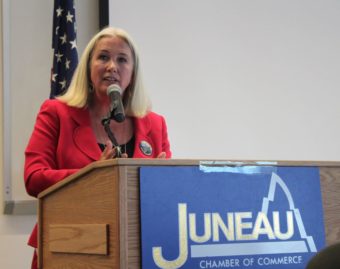
Juneau Rep. Cathy Muñoz  speaks at the Chamber of Commerce lunch in the Alaska Room of the Juneau International Airport. (Photo by Lisa Phu/KTOO)
Juneau Rep. Cathy Muñoz speaks at the Chamber of Commerce lunch in the Alaska Room of the Juneau International Airport. (Photo by Lisa Phu/KTOO)

Juneau Rep. Cathy Muñoz says to expect a special legislative session sometime in the fall, this time in the capital city. The Republican lawmaker spoke at Thursday’s Juneau Chamber of Commerce lunch.

The legislature met in Anchorage for the last special session. Muñoz says it would’ve been difficult to have held it in Juneau due to seismic retrofitting work being done on the Capitol building.

“It was very noisy and there was a lot of construction work, but now that that’s done we are ready, and I have confidence that the special session will be held in Juneau,” Muñoz says.

By early fall, Muñoz says the governor plans to hold a series of public meetings across the state, including in Juneau. She says community members will be asked to weigh in on new revenue ideas for the state, like the possibility of managing the Permanent Fund as an endowment. She says the fund generates $3-4 billion a year and the dividend equals $1.3 billion.

“So it’s possible if we were to manage the earnings of the fund where a portion of the earnings could go toward public education or transportation, and maintain the dividend at a level that Alaskans have come to be accustomed to. We can do both and it would significantly help address our revenue problems,” Muñoz says.

One thing Muñoz doesn’t want to talk about during the special session is the next phase of the gasline project.

“I don’t believe we’re ready yet. I think there’s been a lot of going back and forth and potential changes (in) direction with the new administration,” she says.

Muñoz says gasline issues that still need to be resolved include size of the pipeline, route and ownership.

Muñoz thanked Chamber members for weighing in during the last session on issues like eliminating daylight saving time and the Juneau Access project. She says the daylight saving bill may come up again in the next session.

On the road, Muñoz says the state is close to having enough matching funds to secure federal money for moving forward.

Man arrested for threatening calls to Arizona schools similar to Alaska’s

(Creative Commons photo by Andreas Levers)

A New York man was arrested last week for making threatening phone calls to Arizona schools that were motivated by online gaming on an Xbox, authorities say. Details of the calls sound similar to ones made to Alaska schools, though the FBI says the arrest hasn’t been connected.

The FBI arrested 29-year-old Viktor Lisnyak of New York on July 15 for making several menacing calls to schools in Flagstaff, Arizona.

“At this point, I do not have the information that it is related to the cases in Alaska,” says Staci Feger-Pellessier, spokeswoman for the FBI in Anchorage.

At least eight threatening phone calls in April and May disrupted Juneau schools. Similar phone calls were made to schools all over the state including Anchorage, Fairbanks, Talkeetna, Soldotna, Kenai and Hoonah.

The phone threats to Juneau schools alluded to school shootings and the caller had a computer-generated or robotic sounding voice. Investigators reported similar details in the Flagstaff calls.

Lisnyak told Flagstaff detectives he made threatening phone calls to schools in the United States, so many “he doesn’t remember all the specific calls,” according to the charging document. It says the calls “were in response to on-line video gaming. He would gain ‘points’ for making these calls and at times had to make these calls if he ‘lost’ a game.”

Lisnyak is suspected of making calls between March and May. He could face 25 years in prison and a $1.25 million fine.

FBI spokeswoman Feger-Pellessier says the Alaska calls are still under investigation.

Site notifications
Update notification options
Subscribe to notifications