Lisa Phu

Managing Editor, KTOO

"As Managing Editor, I work with the KTOO news team to develop and shape news and information for the Juneau community that's accurate and digestible."
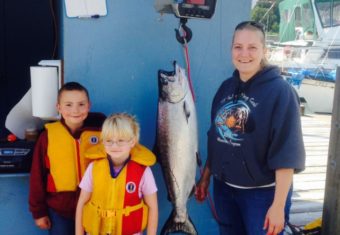
27.4-pound King is unofficial winner of Juneau derby

The Golden North Salmon Derby weigh station at Auke Bay. (Photo courtesy Territorial Sportsmen Inc)
The Golden North Salmon Derby weigh station at Auke Bay. (Photo courtesy Territorial Sportsmen)

Juneau resident Jody Hass is the unofficial winner of this year’s Golden North Salmon Derby. She caught a 27.4-pound king salmon on Friday at 11:53 a.m. and weighed it at Douglas Harbor. Hass also reeled in the number one fish in 2013.

In other unofficial results, Brandon Godkin came in second with a 27-pound king caught on Saturday around 10:30 a.m. and turned in at the Auke Bay weigh station. Mike Bethers caught the third place fish, a 22.3-pound Chinook, Sunday morning around 7:30 and weighed it at Auke Bay.

The Territorial Sportsmen organized the 69th annual event, and its board will confirm the results Tuesday at noon. The derby started Friday morning and ended Sunday evening. Michael Olsen caught the 69th biggest fish — a 14.9-pound Coho — Saturday night at 6:15.

Awards night is on Thursday at 7 p.m. at Centennial Hall. First place winner takes home $10,000. Prizes are given to the 69 biggest fish and there will also be drawings for those who turned in scholarship fish.

The top fish are posted at the Golden North Salmon Derby website.

Update: Man dies at Juneau prison 12 hours after being booked

(Photo by Lisa Phu/KTOO)

Update | Aug. 16, 12:00 p.m.

Joseph Murphy died of an apparent heart attack in a Lemon Creek Correctional Center holding cell, according to the Alaska State Troopers online dispatch. It says he was found deceased at 6:30 a.m Aug. 14.

Original story:

A Juneau man died at Lemon Creek Correctional Center Friday morning, about 12 hours after he was brought in. Joseph Murphy, 49, was booked at the prison around 7 p.m. Thursday and was being held on noncriminal charges.

Department of Corrections spokeswoman Sherrie Daigle says Murphy was being kept in a holding cell and was due to be released after 12 hours.

“I don’t know the specifics in this case and I can’t give any specifics in this case, but in general, people are brought in on a 12-hour hold if they are intoxicated and they can’t be on the street, but are combative and can’t go to a detox center. There also could be some type of behavioral health issues that people are brought in on noncriminal holds,” Daigle says.

In the past, Murphy had been found guilty of at least two misdemeanors for driving while intoxicated, according to online court records.

Daigle says Alaska State Troopers are investigating the death and the state medical examiner’s office is conducting an autopsy. She says it could take three to six weeks until a cause of death is known.

Corrections will do its own investigation, which Daigle says takes up to four weeks. She says those results are confidential due to attorney client privilege between the attorney general and Corrections, and they contain medical, security and personnel information.


Public comment sought on proposed Capital Transit changes

A Capital Transit bus stops at the Federal Building. (Photo by Lisa Phu/KTOO)
Public meetings on proposed changes to Capital Transit routes and schedules:

  • University of Alaska Southeast, Egan Wing, Room 224: Aug. 18, 5-7 p.m.
  • Thunder Mountain High School library: Aug. 19, 7-9 p.m.
  • Dzantik’i Heeni Middle School: Aug. 20, 7-9 p.m.
  • Douglas Library: Aug. 24, 7-8 p.m

The public can weigh in on proposed changes to the city bus routes in a series of meetings starting Tuesday.

New service is proposed
for Riverside Drive, Dimond Park, Mendenhall Mall and Stephen Richards Memorial Drive.

Service will continue to downtown and be reduced to the University of Alaska Southeast. Some service to Davis Avenue in Lemon Creek will go away. Service in Douglas will be shifted from St. Ann’s Avenue to the Treadwell Arena.

When the city proposed route changes last year, about a dozen Capital Transit drivers showed up at a Juneau Assembly committee meeting. They said their voices weren’t heard. They were worried about sacrificing popular stops for new ones. Project manager Paul Beck says the drivers were included on the current changes.

After the public meetings, the proposal will go to the Juneau Planning Commission and the assembly. New routes could start in October.

University of Alaska defines consent in new student code of conduct

The University of Alaska system updated it's Student Code of Conduct to include a definition of consent.
The University of Alaska system updated it’s Student Code of Conduct to include a definition of consent.


The University of Alaska system has defined “consent” for the first time when it comes to sexual misconduct terminology. The definition is in the university’s new student code of conduct, which is the basis of university disciplinary proceedings. One expert calls the definition good, but thinks it could go further.

“Consent is defined as being clear, knowing and voluntary. It can be withdrawn at any time. It’s defined as being active, not passive and cannot be given while an individual is incapacitated,” says Michael Votava, reading from the  University of Alaska’s updated Student Code of Conduct.

Votava is the director of student conduct and ethical development for the University of Alaska Anchorage. He was part of the working group that established the definition.

“Past consent does not imply future consent. And that silence, or an absence of resistance, cannot be interpreted as consent,” Votava adds.

It can be words or actions that create mutually understandable clear permission.

“So in other words, UA is not requiring a verbal yes,” Votava says.

He gives this example:

“If there were two parties that were involved in a romantic encounter and one party started removing their clothes and started motioning with their finger for the other party to come toward them and had a smile on their face, that’s in my mind, I think a reasonable person would argue that that was a form of nonverbal consent,” Votava says.

“Why not start with verbal? Because verbal is the most common way we make agreements for anything,” says Mandy Cole, deputy director of AWARE, Juneau’s domestic abuse and sexual assault prevention nonprofit.

“What I would like to see and what I think is kind of a best practice is that we get more used to getting verbal consent and that we get more used to saying the words, ‘Do you want to have sex with me?’” Cole says. “Because honestly if you feel comfortable enough to have sex with somebody, you should be comfortable enough to say the words.”

Cole says UA’s definition of consent has the necessary elements. Other higher education institutions like The State University of New York, Northwestern University and University of California have similar language defining consent as either words or actions.

Cole says it’s difficult to require a verbal agreement, but she’d like society to move in that direction.

“It’s kind of a new thing really. When I went to college, no one said a word to me about consent. Certainly no one ever said a word to me about getting verbal consent before sexual contact, so I think this is developing,” Cole says.

One company Consent Game Changers has gone beyond verbal by selling consent kits. Each pouch comes with a contract card, breath mints and a condom. The company’s website says the contract gives both parties “the confidence of a documented consensual encounter (or to at least remind you to have the consent conversation).”

Cole says she’s happy UA has defined the term and is part of a national conversation, even if it was prompted by an increasing number of sexual assault reports in colleges.

More than a year ago, the U.S. Department of Education put UA on a list of about 60 colleges nationwide being investigated as part of a compliance review or for mishandling sexual assault complaints. That list is now at about 130.

Cole says advancing the conversation about consent keeps people safer and more prepared to discuss sexuality.

“So that we don’t continue propagating this idea that sex is about power,” Cole says. “So if we talk about sex being more about consent and agreement, and it’s freely and knowingly decided by both people, then it takes away some of the old thinking about what is legal and what’s not legal.”

Cole says it’s more about what’s right.

Juneau’s next charter school may the first of its kind in Alaska

Supporters for a new charter school in Juneau filled the audience at Tuesday night's school board meeting. (Photo by Lisa Phu/KTOO)
Supporters for a new charter school in Juneau filled the audience at Tuesday night’s school board meeting. (Photo by Lisa Phu/KTOO)

A group of educators and parents in Juneau are advocating for a new charter school focusing on science, technology, engineering and math. They think it would be the first elementary STEM school in the state.

More than two dozen people at Tuesday night’s school board meeting were wearing paper badges pinned to their shirts that said “Summit STEM School Supporter.” The blue and green logo on it shows an abstract design of a mountain.

“We don’t have a local indigenous or a local Native design there,” said Alberta Jones, a member of the formation committee for the Summit STEM School.

“That needs to be brought from our school members, from our people involved in the community to give us a local indigenous name. We spent a lot of time with this, trying to think, ‘OK, summit. What’s the Tlingit name for summit?’ But it’s really important that it’s a community buy-in of students and people in our community, so that we’re following proper protocols,” Jones said.

Jones is Tsimshian and Alutiiq. She’s a retired teacher from the Juneau School District and has coordinated Native education grants. She says a key component to the charter school is integrating local indigenous knowledge.

The committee proposes putting Summit STEM School within an existing Mendenhall Valley elementary school. Up to 80 students would be in multi-age classrooms – two classes of kindergarten through second graders and two classes of third through fifth graders. The hope is to later add a preschool level.

Advocates for the Summit STEM School wore these pinned to their shirts. Alberta Jones,  a member of the school's formation committee, says the logo is incomplete. (Photo by Lisa Phu/KTOO)
Advocates for the Summit STEM School wore these pinned to their shirts. Alberta Jones, a member of the school’s formation committee, says the logo is incomplete. (Photo by Lisa Phu/KTOO)

Juneau mom Stephanie Buss spoke in support of the STEM school. She says it would give parents more choice. Buss has been homeschooling her two kids since last year and says the charter school could bring her family back to the district.

“As a scientist and a business owner, I feel there is a real need for more targeted education in math and science. Each and every child in the district should be given a strong opportunity to be proficient in science and math. I love science and math and would love to see more kids excited about these fields,” Buss said.

The charter’s formation committee has been working on the proposal for two years, but Lexie Razor just heard about it a couple weeks ago. Razor is a math teacher at Juneau-Douglas High School.

“Right away it was something that struck me as something that Juneau needs. I’ve been teaching math for 15 plus years. All my years have been with minorities and low socioeconomic students. I noticed the main thing is just their confidence. And the more opportunities they have with the math, with the engineering, science, all of it, they’d be more comfortable with it,” Razor said.

Summit STEM School hopes to serve students who are economically disadvantaged – they’d make up 50-75 percent of the student population.

School Board member Barbara Thurston says the district’s existing placement process makes that goal highly unlikely.

“We’ve had issues with our placement process over the years with our other alternative programs, probably none of which have what we would consider the ideal ratios, distributions of demographics in them,” Thurston said.

The applicant pool for alternative programs tends to be made up of non-targeted students, she added. Thurston wants the board to set up a subcommittee to review the placement process.

The School Board will have a work session on the Summit STEM School on Aug. 31. If the board accepts the charter application on Sept. 15, it would go on to the State Board of Education for final approval.

The new charter school would receive an allocation of $1.1 million if it has 80 students, according to the district.

The Summit STEM School hopes to open fall of 2016.

Rookery’s Beau Schooler wins national seafood competition

Juneau chef Beau Schooler and sous-chef Travis Hotch at the Great American Seafood Cook-Off in New Orleans. (Photo courtesy Alaska Seafood Marketing Institute)

Juneau chef Beau Schooler was crowned “Best Seafood Chef” at the Great American Seafood Cook-Off this weekend in New Orleans. He was one of 12 competing chefs from all over the country. He won with a dish that only had one main ingredient – Alaska wild salmon.

Louisiana Chef Cory Bahr tears open the first place envelope.

“From the state of Alaska, Chef Beau Schooler!” Bahr announces.

As Schooler kneels on one leg to be crowned, confetti falls from the ceiling. Schooler is chef and co-owner of The Rookery Café in Juneau.

“First time ever Alaska’s winner,” Bahr says.

Alaska is usually at the competition, which has been around for 12 years. Gov. Bill Walker nominated Schooler to compete this year and the Alaska Seafood Marketing Institute paid his way.

Schooler and sous-chef Travis Hotch brought sockeye salmon from Juneau company Taku River Reds to the competition.

Schooler describes their cooking method as a nose-to-tail approach, using every piece of the fish.

“The fillet portions, we brined and cedar roasted. All the scrap that’s usually clinging to the bone and the belly pieces, we ground that up and turned it into a salmon chorizo,” Schooler says.

They made crispy chips out of the skin and fried the salmon collars, the bony part between the head and the body.

“And then we have been working on this thing called bone salt where we’re taking salmon bones and cleaning them up and dehydrating them and then grinding them up and they kind of have this oceany, salmony flavor, so we seasoned the whole dish with this salmon bone salt,” Schooler says.

Schooler's winning dish featured salmon skin chips, salmon bone salt and salmon chorizo. (Photo courtesy Laura Hotch)
Schooler’s winning dish featured salmon skin chips, salmon bone salt and salmon chorizo. (Photo courtesy Laura Hotch)

For Schooler and Hotch, cooking the various components came easily.

“We were kind of doing stuff we do at the restaurant every day. So getting that all done in an hour and presenting it to people, it was just kind of another day at work really,” Schooler says.

You can find the chorizo at The Taqueria, another Juneau restaurant Schooler is part of. Everything else has been on the menu at The Rookery before.

Schooler and Hotch had discussed different ideas before settling on, “Let’s do all the different parts of the fish and just put it on one plate and not put anything else on there,” Schooler says.

That was a pretty novel concept at the competition. The cook-off hosts talked about it while the judges deliberated.

“How dangerous is that to just do fish on the dish?” asked Johnny Ahysen, a Baton Rouge TV reporter.

“I don’t know. I think he was really confident. It was just fish but it was a lot of different flavors there, a lot of different preparations there,” replied Louisiana Chef Randy Cheramie. “Could it be seen as a gamble? Maybe so, maybe not. We’ll see.”

“That was a bold dish from Beau Schooler,” added New Orleans TV News Anchor Charles Divins.

After the competition, Schooler and Hotch spent time exploring the food scene in New Orleans, then Seattle for, as Schooler put it, “a couple days of gluttony,” before returning home.


Site notifications
Update notification options
Subscribe to notifications