Lisa Phu

Managing Editor, KTOO

"As Managing Editor, I work with the KTOO news team to develop and shape news and information for the Juneau community that's accurate and digestible."
Planned Parenthood wins “medically necessary abortion” case

The Alaska Superior Court on Thursday struck down a state law that would have limited Medicaid coverage of abortions for low-income women. The judge found the law imposing a strict definition of “medically necessary abortion” violates the equal protection guarantees of Alaska’s constitution.

Laura Einstein is legal counsel for Planned Parenthood of the Great Northwest, which filed the lawsuit.

“We’re extremely gratified that low-income women in Alaska can continue to get assistance in paying for an abortion if they need to have one and their doctor agrees that it will be beneficial to their health,” Einstein said.

Planned Parenthood is the largest provider of abortions in Alaska. In 2014, it administered about 1,400. Of those, about 400 were covered by Medicaid.

In order to qualify for Medicaid reimbursement, a procedure needs to be medically necessary as determined by a physician. In 2014, the Alaska Legislature defined medically necessary with a list of specific health conditions.

“What the court found was that requiring women to have a health condition that was dire, that was essentially one where their life was at risk, was too high a standard and too fundamentally different than the standard that would be applied for the provision of other health services in the Medicaid program,” Einstein said.

Republican Sen. John Coghill sponsored the bill defining what’s medically necessary. He says he’s very disappointed with the court’s decision, although he hasn’t yet read it.

“I think it does show that quite often judges come to a decision based on their own political philosophies. I think it’s just very, very evident in this particular case,” Coghill said.

He said the state shouldn’t pay for abortions that don’t meet the criteria under his law.

“When it’s medically necessary, there’s a reasonable cause. When it’s not medically necessary and it’s more optional, then I think people should carry the load of their own decisions,” Coghill said.

A spokeswoman with the state attorney general’s office said the agency is still reviewing the decision and doesn’t know if it will appeal.
B.C. mine protestors hold “Extra Tuff” rally on Capitol steps

About 40 people stand on the steps of the Alaska Capitol in hopes of encouraging Gov. Bill Walker to "Get Extra Tuff on B.C. Mines." (Photo by Lisa Phu/KTOO)
About 40 people stand on the steps of the Alaska Capitol in hopes of encouraging Gov. Bill Walker to “Get Extra Tuff on B.C. Mines.” (Photo by Lisa Phu/KTOO)
Edie Leghorn addresses the rally crowd on Wednesday. (Photo by Lisa Phu/KTOO)

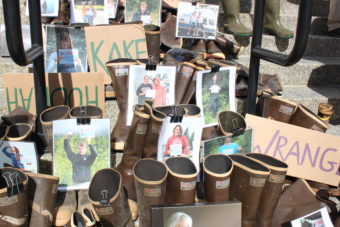
Xtratuf boots are ubiquitous in Southeast Alaska. About a hundred pairs of the brown rubber boots, along with photos of Alaskans, were on the steps of the Capitol building Wednesday to protest mines in British Columbia.

“This day and this gathering is truly about celebrating clean water and healthy fisheries and the things that make Southeast what it is,” said Edie Leghorn, speaking into a microphone.

Leghorn lives in Sitka. She’s an organizer with Inside Passage Waterkeeper, a group focusing on clean water in Southeast Alaska. She stood on the steps of the Capitol with about 40 other people.

“This day is also about standing united as Alaskans, to hold our elected officials accountable to the will of the Alaskan people who have responded with a resounding ‘not on our watch’ to the threat of mines in our Southeast Alaskan salmon streams,” she said to a cheering crowd.

The rally participants carried signs that read “Get Extra Tuff on BC Mines” and “No More Mount Polleys.” It’s been about a year since the Mount Polley Mine disaster in British Columbia, which spilled millions of gallons of mine waste into creeks and lakes. The protesters don’t want the same thing to happen at other B.C. mines near the border.

Pictures of Southeast Alaska residents and about a hundred pairs of Xtratuf boots lined the Capitol steps. (Photo by Lisa Phu/KTOO)
Pictures of Southeast Alaska residents and about a hundred pairs of Xtratuf boots line the Capitol steps. (Photo by Lisa Phu/KTOO)

Among the people and signs were pairs of Xtratuf boots. Caitlyn Cardinell, also with Inside Passage Waterkeeper, said they represent the livelihood of people in Southeast Alaska.

“We use and rely on these boots … for our work that we do outside with commercial fishing, forestry, research. They are pretty much a staple in every Southeast Alaskan’s footwear,” 

Cardinell said.

She brought about 200 pounds of boots from Wrangell to Juneau. Boots also came from other communities like Petersburg, Sitka and Kake.

“What we found for this project of collecting salmon stories and boots from Alaskans throughout the region is that Alaska is united on this issue,” said Malena Marvin, executive director of Southeast Alaska Conservation Council.

Among the rally participants are Juneau state lawmakers Cathy Muñoz, Dennis Egan and Sam Kito III. (Photo by Lisa Phu/KTOO)
Juneau state lawmakers Cathy Muñoz, Dennis Egan and Sam Kito III attend the rally. (Photo by Lisa Phu/KTOO)

She met with Bill Bennett, B.C.’s top mine official, who’s traveling in Juneau and Ketchikan to discuss concerns about transboundary mines.

“We really hope to send him and everyone the messages that this is everybody,” Marvin said. “We don’t see unity on issues in Alaska. Certainly there are so many different types of people and controversies around many issues, but on this, people are united. We want to protect our salmon, our jobs, our way of life.”

The rally participants want to see an international solution through the Boundary Waters Treaty, which was signed by Canada and the United States in 1909.

The boots will be donated to Juneau’s soup kitchen and shelter.

Iraq war veterans remember Joseph Murphy

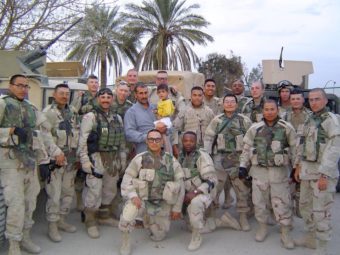
Joseph Murphy (from left, first man kneeling) served in the Iraq War. The squad was led by Ed Irizarry (standing to the left above Murphy). Mike Mercer (far right) was a gunner with Murphy. (Photo courtesy Ed Irizarry)

Earlier this month, 49-year-old Joseph Murphy died at Juneau’s prison 12 hours after being booked on noncriminal charges.

Among other things, Murphy was an Iraq War veteran. His squad commander says it changed him forever. I spoke to some of the men Murphy served with.

Mike Mercer joined the Alaska Army National Guard in the summer of 2001.

“That’s where I met Murphy,” he says.

Mercer and Spc. Joseph Murphy both lived in Juneau.

“Murphy taught me how to march. Murphy taught me all the really basic stuff – how to shine my boots, how to stand at the position of attention, the position of parade rest,” Mercer says.

One weekend each month, they saw each other for training. Then in 2005, Mercer and Murphy and many others in the Alaska National Guard were sent to war for one year.

“When we went to Iraq, we all got different little nicknames and Murphy got Eskimo Joe,” Mercer says.

Murphy’s wife of many years could not be reached for comment. According to a paid obituary in the Juneau Empire, Murphy was born in Anchorage, but grew up in Emmonak.

Mercer and Murphy were both gunners, each conducting patrols from a gun turret of a Humvee.

“Murph just worked harder than everybody else it seemed like, just because he was always giving as much as he could give. He definitely took care of the guy to his left and to his right. If somebody needed more water, if somebody needed somebody to talk to, if somebody needed some help with anything, Murph was really supportive of people,” Mercer says.

Ed Irizarry says Murphy put his life in jeopardy looking out for others. Murphy was part of the squad Irizarry led in Iraq. During patrols, “we encountered other vehicles that were blocking roads that were suspicious. Could be a car bomb,” Irizarry says.

Irizarry recalls times when, “I was going to walk up to it and Murphy, you know, ‘No, I’ll go do it sergeant.’ He takes off running and he comes back and he says, ‘All clear.’ So what do you tell a man that has just went out there and could give his life for you? What do you tell that guy? A thank you doesn’t seem to be enough.”

Irizarry was deeply sad when he heard Murphy died, “Joe was living with a lot of demons as the rest of us are.”

He mentions a specific car bombing in Iraq, but doesn’t give details.

“He had to witness something a human should never have to see. And I think that damaged him. You take a 40-year-old man who’s never seen anything like that in his life. And he’s got such a big heart, family oriented, do anything for anyone, happy-go-lucky, and then he sees that hell. That changes a man,” Irizarry says.

Irizarry lives in Ketchikan and retired from the military after 22 years, including time in four combat zones.

He says Murphy experienced post-traumatic stress disorder and sought help. More than 40 percent of National Guard members who served in Iraq or Afghanistan have symptoms of PTSD, according to the National Center for PTSD.

Murphy’s obituary says he also battled depression and struggled with substance abuse. But Irizarry wants Murphy to be remembered as the funny, kind man he was.

“You could crack a joke on him or tease him about something and he would laugh so hard at himself and just never got upset. He’d just kind of shake his head, ‘OK, you got me.’ So he was just like a young kid and you couldn’t help but fall in love with him,” Irizarry says.

Mike Mercer also experienced symptoms of PTSD, although he’s never been clinically diagnosed. Before Iraq, Mercer says he was a people person. When he returned to Juneau in 2006, he was apprehensive of large groups. He had bad dreams. He couldn’t watch July Fourth fireworks and had trouble driving close to other cars.

“All of us have had problems here and there. Some stuff fades, some stuff doesn’t,” Mercer says.

The last time Mercer saw Murphy was about five years ago at Fred Meyer.

“It doesn’t matter how long we go without seeing each other. Could’ve been another 10 years before I saw Murph, we’d still embrace each other as if we’d just seen other yesterday,” he says.

When you serve in war together, Mercer says, you’re brothers.

“It’s just a bond. You can’t break that. Time ain’t going to break it. I guess even the death of one of your brothers can’t break that either. Murph will always be my brother,” Mercer says.

Murphy was in the emergency room of Bartlett Regional Hospital the night of Aug. 13. Juneau Police transferred him to Lemon Creek Correctional Center on a 12-hour protective hold. A police spokesman says alcohol was a factor. Murphy died in a holding cell the next morning of an apparent heart attack.

The obituary says Murphy will be buried in Emmonak.

Death or transition: A transgender woman’s journey to happiness

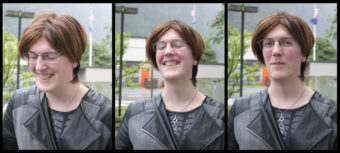
In the past, Jennifer Fletcher refused to believe transitioning would make her happy. "I'm very pleased to note that I was absurdly wrong," she says. (Photo composite by Lisa Phu and David Purdy/KTOO)
In the past, Jennifer Fletcher refused to believe transitioning would make her happy. “I’m very pleased to note that I was absurdly wrong,” she says. (Photo composite by Lisa Phu and David Purdy/KTOO)

It’s been a year since Juneau resident Jennifer Fletcher started to publicly present herself as a woman, less than two years since she first started to shed her male identity and rebuild herself as female. But the inner journey to get to that point began long before then.

Jennifer Fletcher used to spend up to five hours a day escaping reality. She’d play games on the computer, visit websites for the transgender community, “Pretty much anything I could do to not focus on the present, not focus on how things actually were so I could actually at least attempt to function throughout the rest of the day,” she says.

She’d go through binge and purge cycles of cross dressing. She regularly thought about suicide. Fletcher was severely depressed.

“I was continuously hiding who I was and trying to quite literally leave no mark on the world,” she says.

Fletcher is 33 and moved to Juneau as a teenager.

On any given Friday night now, you can almost always find her at social night run by SEAGLA, the Southeast Alaska lesbian, gay, bisexual and transgender organization in Juneau.

But it took her a long time to realize she was transgender, even though signs throughout her life pointed to it.

“Let’s just say that I had consistently wished from the time I was about 12 on every star, on every birthday that I’d wake up as the female version of myself,” Fletcher says.

As an adolescent, she’d wear her mother’s clothes when she was home by herself, taking items from the laundry so no one would notice.

Fletcher was 14 when she first tried to castrate herself. She tried again when she was 15.

“I was actively envying all the girls who were going through their own puberties, their own processes and just not very happy with what was going on. While I have occasionally, temporarily, appreciated having things like facial hair or greater strength or things of that sort, they just aren’t me,” Fletcher says.

But in her teens, she refused to consider she was transgender. Fletcher went to high school in Juneau, but was born in Laramie, Wyoming, where gay college student Matthew Shepherd was murdered in 1998. She learned being different wasn’t safe.

She saw transgender individuals on talk shows where they were mocked and laughed at.

“At that point in time, society was teaching individuals like myself that no, it’s not OK to be. That if you wanted to actually have any chance of happiness that you had better suppress what’s going on and you had better hope that you aren’t really,” Fletcher says.

She says finally deciding to transition almost two years ago didn’t stem from courage, but from an utter sense of fear.

“I was faced with what I thought were basically two alternatives – death or transition. Whether it would’ve been death by suicide or by the slow gradual path of alcoholism or whatever other coping mechanisms I attempted to use that would’ve inevitably failed,” Fletcher says.

She chose transition. Fletcher dropped what she calls the male mask and started rebuilding herself. She came out to close family and friends and started dressing as a woman at social functions. Fletcher eventually started the medical process and taking hormones. At each step, she was so afraid of rejection.

“Almost all of the hurdles I’ve experienced in my transition have been self-imposed. They’ve all been fears that may have had a legitimate base, but had invariably been blown completely out of proportion into these vast monsters that seemed like I’d be incapable of standing against,” Fletcher says.

When I ask Fletcher what her prior first name was, she doesn’t tell me, “Not particularly relevant, I don’t think.”

She says there tends to be an overemphasis on who people once were or appeared to be.

“I had been looking at some old photos of myself and actually opted to post some of them on Facebook just to kind of show how very different a person I am now. One of my friends actually said outright that they felt they were looking at a dead person, which I think actually sums up how I was feeling in those photos as well,” Fletcher says.

She does a lot of things she used to do before she transitioned, like rock climb, play board games, read. But she says her priorities have shifted.

“Before I actually started this process, I was merely existing in the world and, to be honest, waiting to die. Now I am actually alive and the difference is quite amazing,” Fletcher says.

And she wants to make a difference. Fletcher helps run a transgender support group in Juneau called the Trans* Alaska Pipeline. She wants to make finding medical and professional resources easier. She wants to help others avoid some of the internal conflict she had and help them face their fears, one monster at a time.

High school activities fee creep causes sticker shock

The JDHS swim team practices at Augustus Brown Swimming Pool, Aug. 19, 2015. (Photo by Jeremy Hsieh/KTOO)

Classes in Juneau are just starting on Thursday, but some high school activities have been underway for weeks. This school year, the district has drastically cut funding for activities and athletics, leaving some parents paying hundreds of dollars more for their kid to participate.

Michelle Norman has two kids at Thunder Mountain High School. Her daughter is on the swim and dive team. At the first parent meeting for the activity, she was asked to pay “an activity fee of $600 and approximately $150 travel fee for each meet out of Juneau.”

Last year, Norman paid $275.

She says this higher fee struck her as ridiculous. So Norman did her own research on travel costs to meets in Ketchikan and Sitka, and says the $600 activity fee only makes sense if her daughter qualifies for state competition.

“My daughter has a good chance of qualifying for state and I expect if that happened that I’d contribute more, but I’m not comfortable with paying $600 now for a $200 expense,” Norman says.

According to Juneau School Board policy, individual activity fees for participation and travel must be approved by the activities director and the superintendent. For students who are in financial need, the district has a scholarship fund.

Superintendent Mark Miller says he hasn’t approved any activity fees.

“To my knowledge we do not have actual individual fees,” he says.

Miller doesn’t call the costs put on students or parents “fees.”

“Different sports are going about fundraising in different ways and some are asking for contributions from participants in order to limit or defray the amount of fundraising that they do,” Miller says.

Thunder Mountain High School Activities Director Jake Jacoby says every fall sport does have an activity fee.

“This is an individual fee that varies from activity to activity and it’s very low for activities that have low budget needs and it’s pretty darn high for the more expensive programs,” Jacoby says.

He says $600 for the swim and dive team isn’t the highest. The coaches come up with the fees, and Jacoby approves them, but he hasn’t taken them to the superintendent.

Jacoby says the fees go toward gear and travel, but the cost shouldn’t be coming out of pocket.

“There are fundraising opportunities that need to be provided by the teams in order for students to raise the money,” Jacoby says.

In an email from the swim and dive booster board at Thunder Mountain High School, parents were instructed to “bring your checkbook” to an Aug. 4 meeting. The main fundraising event is selling Christmas trees and parents were asked to think of other ideas.

Due to district budget cuts to activities, Jacoby says everyone – coaches, booster clubs, parents, activities directors – is working through a new process this year.

“I have had conversations with various coaches within the last week about fundraising and funding and we’ll continue to do so as all teams figure out what this means as far as funding all of their own travel,” Jacoby says.

Last school year the district budgeted about $1.5 million for the high school activities program, including staff. About $600,000 of that went toward travel.

For this school year, the district budgeted less than a million dollars for high school activities. Close to $600,000 of that came from the Juneau Assembly, and the majority of it goes toward administrative costs.

Superintendent Miller says in the past, the district covered the majority of travel costs for high school activities.

“Unfortunately we’ve been dipping into the bank in order to cover those costs and our bank account ran dry last year and so this is really the first year that we’ve had to say we can’t go over what we’ve allocated under any circumstance and we can’t allocate what we used to,” Miller says.

The district has set aside $150,000 of the Juneau Assembly money for potential travel to state competitions, travel that teams don’t necessarily budget for because it’s last minute. It’s hard to say if that’s enough money because it depends on how well teams do. There will likely still be fundraising post-postseason.

Jody Hass wins Juneau derby again

Jody Hass, son Carvin and daughter Landia pose next to the 2015 derby winning fish at the weigh-in station at Douglas Harbor. (Photo by Jason Hass)
Jody Hass, son Carvin and daughter Landia pose next to the 2015 derby-winning fish at the weigh-in station at Douglas Harbor. (Photo by Jason Hass)

Jody Hass is only the second person in Juneau’s Golden North Salmon Derby’s 69-year history to win the top prize more than once. Ryan Beason won in 2001 and again the following year. Hass won in 2013 with a 29.2-pound king. Here’s how she landed this year’s derby winner.

Jody Hass in 2013 (Photo courtesy Jody Hass)

Jody Hass says it might have something to do with a comfy sweatshirt, blue jeans and Xtratufs.

“I wore the same fishing clothes that I won the derby in last time, so that was my good luck charm,” Hass says laughing.

Although that didn’t work last year. Whatever it may be, Hass reeled in the big fish south of Juneau within hours of the derby starting Friday morning.

“It was really slow actually. We had gotten a couple bites and two small shakers that we threw back. Then all of sudden, it just hit and it hit hard. I grabbed the pole and I knew it was a bigger one. I didn’t know it was the big one,” Hass says.

The big king salmon didn’t fight as much as Hass expected, but it did do some running.

“It almost spooled us. We actually had to go in reverse a little bit so that it wouldn’t spool all the line off the reel. Then it just immediately stopped running and turned directly around and starting running towards the boat and it was hard to keep my reel going as fast as he was swimming towards the boat,” she says.

After getting the fish on, Hass and her family went directly to Douglas Harbor and weighed in the fish just before noon. Then, the family turned around and fished for the rest of the weekend.

“Twenty-seven-point-four is a pretty small fish and it’s surely beatable and that’s what we were expecting all weekend, for it to be beat,” Hass says.

But it never was. The number two derby fish came close at 27 pounds.

Last time Hass won the derby, her family used the $10,000 prize money to buy land in Gustavus. This year, the first purchase Hass plans to make is electric downriggers.

Site notifications
Update notification options
Subscribe to notifications