
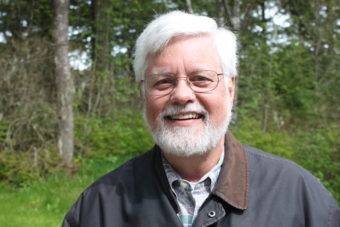
"As Managing Editor, I work with the KTOO news team to develop and shape news and information for the Juneau community that's accurate and digestible."
Two duck hunters found a body around 7:30 a.m. Wednesday in the Mendenhall Wetlands. Juneau Police recovered it near Sunny Point.
“It appears as though the man had been in the water and exposed to the elements for a minimum of several days, maybe even longer. So the condition of the man was really poor, which really limited the ability to do some identification,” said Lt. David Campbell, a Juneau Police spokesman.
Juneau police could not determine the man’s race or age, but he appeared to be middle-aged.
“He had no identification, but there are some items that make us think we might know who this gentleman is,” Campbell said.
Campbell can’t disclose what the items are because it’s an open investigation. He said the man was wearing “normal” clothing. Police don’t think he’s a crewman on a ship or is linked to any crime. Campbell said he doesn’t fit any missing person reports from the last 30 days. He said it’s possible the man was homeless.
The cause of death is unknown, but Campbell said it likely isn’t connected to the duck hunting season.
“Something caused this gentleman to pass away. He was in the channel. The channel brought him to the area where he was ultimately recovered and the fact that it was opening day and the hunters happened to be on the area is how he was discovered,” he said.
The man’s body was sent to the state medical examiner in Anchorage.
Anyone with information on the man’s identity is encouraged to contact Juneau police, 586-0600.
Summit STEM School supporters and organizers sit in the audience of Tuesday’s regular School Board meeting. (Photo by Lisa Phu/KTOO)
Final action has been postponed for a proposed charter elementary school focusing on science, technology, engineering and math. The Juneau School Board heard about potential legal issues and opposition from within the district in a meeting Tuesday.

Summit STEM School hopes to serve students who are economically disadvantaged — they’d make up 50 to 75 percent of the student population. At least, that’s the goal.
To do this, the charter school organizers propose heavy recruiting and partnering with organizations that cater to low-income families. They’d also use the district’s current placement process for optional programs, which gives preference to low-income students. That may be illegal, according to City Attorney Amy Mead.
City attorney Amy Mead says there are legal issues with the current charter school application. (Photo by Lisa Phu/KTOO)
“Weighted lotteries are not allowed for charter schools under Alaska law,” Mead said.
Applications for the Summit STEM School’s 80 spots would be open to all students in the district.
“When there are too many applicants for the spots available, federal law and state law require a lottery to fill the spots,” Mead said. “State law is very specific about how you fill spots for a charter school and it’s by random drawing.”
School board member Barbara Thurston said the charter school can’t guarantee the makeup of the student body because the organizers have no control over it.
“They have control to the extent that they can do really good outreach among certain communities, but they can’t control who else puts their name in the applicant pool,” Thurston said. “If they get a great number of applicants from low-income kids, but they get three times as many applicants from high-income kids, that’s just the way to works out.”
Mead said there were other problems with the charter school application, like potential issues with the collective bargaining agreement, transportation and its contract with the district.
The school board also heard opposition to the proposed charter school during public comment.
Lori Hoover is principal of Auke Bay Elementary School. Five of her current teachers want to work at the charter school.
“They are incredible teachers who work and do incredible things with kids every day, and I’m not saying anything these teachers don’t know, but I’m not in favor of the charter school. I’m just not in favor of it. I don’t believe that Juneau is big enough for another charter school and the impact that [it] has on all the other schools and all the other programs that are currently in place,” Hoover said.
Every student in Juneau, she said, should have access to the concepts brought forward by the charter school, like project-based learning and the focus on STEM.
“Any one of the teachers in my building could say, ‘I want to do a STEM-integrated unit. How do I go about doing this?’ We have lots of resources in the building [and] in the community that allow for that to happen. I think we need to see that, not pull apart schools or go into other schools, but work the best we can for the kids in the system,” Hoover said.
Amy Jo Meiners is a parent and an extended learning teacher at Auke Bay and Riverbend Elementary schools. She opposes the charter school. Instead, she wants to the board to “empower our neighborhood schools.”
“I would love to see this be Riverbend. Let us adjust our hours. Let us meet the needs of our kids,” Meiners said.
Nancy Norman is one of the Summit STEM School organizers. She’s a former teacher, has won national teaching awards and is an education consultant. She agrees that all Juneau students should have an opportunity for the kind of education they’re proposing. She said the rest of the district can learn from their school being a model.
“One of the things is, even if the charter school isn’t approved, it has at least sparked a conversation. I’m not convinced the conversation will get results. I am convinced that if they approve the charter school that we will get results,” Norman said.
Norman plans on working with the superintendent, district staff and the city attorney to get the legal issues resolved.
The next regular school board meeting is scheduled for Oct. 20, at which point the school board could have up to three newly elected members.
Jill Ramiel opened the Silverbow Bakery in 1997. It’s closing Oct. 4. (Photo by Lisa Phu/KTOO)
The Silverbow Bakery in downtown Juneau is closing. For 18 years, the eatery has been a popular gathering spot for locals and visitors. It’s known for its cookies, soups and sandwiches and, of course, its bagels.
Nicky Love, 30, is a longtime Silverbow Bakery customer. She’s been coming here for most of her life.
Nicky Love has been a Silverbow customer since she was a kid. Now, she brings her own kids to the restaurant. (Photo by Lisa Phu/KTOO)
“Silverbow is definitely something I think of when I’ve been away and think about home,” Love said.
You can find Love at Silverbow two to three times a week. On this day, she’s seated at a corner table, typing on a tablet. Several others in the dining area are doing the same.
“I’ve been a fan of the breakfast bagel with sausage and egg and cheese and it’s huge and messy and filling. I think I’ve had that almost every time I come here,” Love said.
Love has memories of getting lunch here as a high schooler. As an adult, “I can come here with my kids now and they have somewhere fun to play. It’s kid-friendly environment.”
Love considers Silverbow an integral part of Juneau’s fabric. She’s in shock that it’s closing.
“It’s taken a minute to sink in. I’m going to be really sad to see it go,” Love said.
Silverbow owner and operator Jill Ramiel says she’s heard similar sentiments from other customers.
“It has been fantastic how many people have come out and been emotionally distraught about it. And I was like, ‘Wow, I had no idea that bagels had such an impact on people.’ Or people say, ‘My kids grew up here,’ and then I say, ‘Oh my gosh, it’s been way too long. I’ve been doing this too long,'” Ramiel said.
During the bagel shop’s early years, owner and operator Jill Ramiel worked the front counter every day and baked twice a week. (Photo by Lisa Phu/KTOO)
Ramiel is originally from New York and went to school in Seattle to study architecture. She worked in Juneau the summer of 1996. She says Juneau was missing a place to grab a quick lunch.
“And a bagel place was what I grew up with. You eat bagels every day after school. It seemed like the most normal thing to me. I didn’t realize it wasn’t the most normal thing for everyone in Juneau at that time,” Ramiel said.
Ramiel bought a historic building on Second Street and renovated it. The bakery opened in June 1997.
Over the years, the Silverbow has hosted art exhibits, Alaska Folk Fest singers, movie showings and World Cup events. Ramiel and her husband Ken Alper also operate the attached Silverbow Inn.
“We still own this building and we still live above it and we’re still raising three kids in this community and we still run an 11-room hotel, so we have no plans to leave,” Ramiel said.
Ramiel is putting her energy into another business venture, Juneau Legacy Properties. She and her business partners want to transform a historic Juneau building, like she did.
“When I look back, that’s really what I liked the most was taking something that maybe is dilapidated or maybe it’s underutilized and making it fresher and newer and having new energy put into it,” Ramiel said. “And so we’ve been looking for a building to buy and I would love to add more hotel rooms, or apartments and residences. There’s a lot of options.”
Silverbow Bakery is most known for its bagels. It’s last day of operation is Oct. 4. On that day, Ramiel said everything will be priced like it was in 1997. (Photo by Lisa Phu/KTOO)
Ramiel is going to miss being a part of people’s everyday lives. But she won’t miss the long, endless hours.
“Because our operation functions 24 hours a day, my bakers work all night long and things go wrong all the time. So I’m looking forward to one solid night of sleep,” Ramiel said.
While the Silverbow Bakery is closing, what it’s most known for isn’t going away. The business taking over promises to carry on the bagel tradition.
Delta Air Lines year-round service means more competitive fares. (Photo by Heather Bryant/KTOO)
The end of summer signals a few things – goodbye cruise ships, superfluous jewelry stores and many food trucks. One thing that is sticking around this fall and winter is Delta Air Lines. That means more affordable ways to leave the capital city.
Delta Air Lines started seasonal flights in Juneau the summer of 2014. Last January, the airline announced it would introduce year-round service, so this is the first fall Juneau will see competitive air fares to the Lower 48.
“Delta is making a play to really make an impact on this market,” said Scott McMurren, a travel analyst based in Anchorage.
He’s a loyal Alaska Airlines flyer, has MVP Gold status and usually gets upgraded.
“But Delta does a fine job, too. They’re world class. So people can make their own decisions and now they can save some money in the process,” McMurren said.
Between Juneau and Seattle, you can fly roundtrip for as low as $190 on both Alaska and Delta. For other cities like Portland, Las Vegas, Phoenix and Boston, Delta has the edge.
Scott McMurren is a travel expert based in Anchorage. (Photo by Lisa Phu/KTOO)
“Alaska has reacted by lowering its prices but not all the way and not on every flight and not on every day. For example, between Juneau and L.A., Alaska is sitting in there at $330 round-trip. So it’s lower, but not quite as low as Delta, $240 round-trip.”
McMurren anticipates Alaska will ultimately match the low prices if its passenger loads aren’t meeting expectations, “but I don’t know how long it’s going to take.”
McMurren encourages flyers to take a holistic approach to flying. Don’t just take the base fares into account. Also look at checked baggage costs, mileage, schedule of the flights and type of aircraft. Alaska offers free checked baggage to its Club 49 members, whereas Delta only offers that if you join its mileage program.
“But if you got a family of four and you’re going to L.A. and it’s a hundred dollars apiece difference, I think that people are really going to take a second look,” McMurren said.
McMurren says he will always prefer flying Alaska, but it’s worth checking the competition.
A 2014 general election sample ballot in Gwich’in from the State Division of Elections website.
In a historic settlement, the state has agreed to provide increased language assistance for voters whose primary language is Yup’ik or Gwich’in.
The federal lawsuit was filed in 2013 by two Alaska Native voters and several tribal governments. The plaintiffs claimed the state doesn’t do enough to serve voters who speak Alaska Native languages.
“The choices that were made in the settlement open the door for Alaska Native access to the polls in a way that we have not seen before,” Landreth said.
The centerpiece of the settlement is translating the state’s official election pamphlet into Gwich’in and up to six different dialects of Yup’ik. The pamphlet contains pre-election information on how to vote, biographical information on candidates and explanations of ballot measures.
The state agrees to provide outreach workers with standardized training and translations, which Landreth calls significant. The settlement also creates more partnerships with tribal governments, establishes Gwich’in and Yup’ik dialect glossaries of election terms and calls for a full-time state elections employee in charge of language assistance activities.
Originally called Toyukak v. Treadwell, the case had been in negotiations for about nine months. Lt. Gov. Byron Mallott inherited the case.
“I am pleased to put the issues that were the basis of complaint behind us (and reach) an agreement going forward that I think strengthens Alaska’s election procedures and processes,” Mallott said.
“The obligations on the division and its director going forward to implement the settlement are going to be hugely significant and it was on that basis that we felt new leadership would be required,” Mallott said.
Bahnke, the outgoing city manager of Nome, is scheduled to begin in October.
The settlement between the state and the plaintiffs was filed Tuesday in U.S. District Court. The state is expecting a final judgement on it in the next few weeks.
Above and Beyond Alaska employee Corey Denton explains kayak basics to J.C. Terrill during an ORCA adaptive kayak training. (Photo by Lisa Phu/KTOO)
A spinal cord injury or amputation doesn’t have to stop someone from being active on the water. A few Juneau instructors now have the know-how to modify kayaking equipment for people of all abilities after a training that wrapped up Tuesday.
J.C. Terrill gets into a kayak that’s sitting on a classroom floor. ORCA volunteer Jerad Spencer and an Above and Beyond Alaska employee are helping him get familiar with the kayak, how it works and how it might be modified to accommodate his needs.
Terrill’s left leg was amputated about 10 years ago after he was diagnosed with cancer. He said he had a volley-ball sized tumor on his spinal cord.
“It sucks, but you can’t keep dwelling on it. That’s no fun,” Terrill said.
Terrill is 44 years old and a stay-at-home dad.
“I miss a lot of things though that I can’t do, like snow skiing, working, construction. I loved it. I worked in fab shops, oil companies, chemical companies, didn’t matter. Go out to the field, got to travel. It’s not meant for everybody, but I liked it,” Terrill said.
Trainees use different kinds of foam and basic tools to modify a kayak. (Photo by Lisa Phu/KTOO)
Being a part of this adaptive kayaking workshop is Terrill’s first experience with ORCA, the recreation program of Southeast Alaska Independent Living. ORCA staff contacted Terrill about being a part of it and the opportunity to kayak.
“As soon as they said that, I was thinking, ‘Yep, I’m going to take lightweight gear and go catch some trout,'” Terrill said.
With basic tools, the trainees have made a foam wedge, which they’ll attach under the seat with duct tape.
Without his left leg, Terrill is constantly keeping his weight on the right side of his body. Spencer said it will make Terrill more comfortable.
“So that when he sits in there, he’s level. The seat’s nice and comfortable for him, but without it being shimmed, he’s listing,” Spencer said.
They may also attach water jugs on the left side of the kayak for weight distribution.
“If we put two gallons of water over here and we tie it on to the side of the boat, then it compensates for the missing leg,” Spencer said.
J.C. Terrill says sitting in a kayak is more comfortable than sitting in a chair. (Photo by Lisa Phu/KTOO)
Modifying a kayak allows individuals of all ability levels to learn the same skills. Jeremy Oyen is an adaptive paddling educator for the American Canoe Association. He’s leading the training.
“When you’re out on the water, if they do it really well, you can’t tell that the boat’s been outfitted. We’ve always said that the water is the ultimate equalizer because when everyone’s out there paddling, we’re all just paddlers. It doesn’t matter if somebody uses a wheelchair or crutches or they have a cognitive disability. When they’re out there and they’re paddling and they’re having fun, we’re all just part of that paddling community,” Oyen said.
Oyen finds the process inspiring. He said it can change lives.
To get involved with adaptive paddling or other sports, contact ORCA by calling 586-0104.
“It lets people get back to an activity that they thought they couldn’t do anymore, or just getting people out recreating and realizing that they can do this wonderful thing and go paddling in the ocean or the lake and see eagles and get back to just being and just really enjoying the outdoors,” Oyen said.
After sitting in the kayak and hearing about the modifications, Terrill said he’s excited.
“Yeah, this will work out. I didn’t think so. I never thought of it. I didn’t think I could be in a kayak,” he said.
Terrill said it’ll give him something to do in the summer with his son or friends.
“I can’t sit in the sun and just sunbathe, I got to do something, like fish. I don’t even have to catch any fish to have fun, just to be outside. I’ve always been like that,” Terrill said.
Later that day, Terrill tried out the modified kayak in a pool. He capsized a few times, but remains undeterred.
Close
Update notification options
Subscribe to notifications
Subscribe
Get notifications about news related to the topics you care about. You can unsubscribe anytime.