"As Managing Editor, I work with the KTOO news team to develop and shape news and information for the Juneau community that's accurate and digestible."
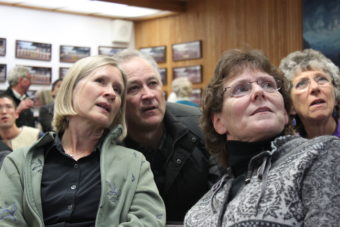
View from Mount Roberts in September. (Photo by Lisa Phu)
Juneau resident Robert Sauerteig was rescued from Mount Roberts Tuesday afternoon.
Alaska State Troopers spokeswoman Megan Peters said the 53-year-old went hiking with his dog Monday and later found themselves stuck.
“He just got himself into a tight spot after trying to take what he thought was a shortcut,” Peters said. “He spent the night on the mountain and then after the sun came up, realized he was in a tighter spot than he initially thought.”
Peters said Sauerteig called for help Tuesday morning. Local search and rescue agencies reached him by helicopter.
To get eighth graders to understand Shakespeare’s “Othello,” Perseverance Theatre’s Shona Osterhout has them act it out. (Photo by Lisa Phu/KTOO)
Shona Osterhout, director of education at Perseverance Theatre, has 20 eighth graders at Dzantik’i Heeni Middle School enraptured.
Students playing Othello and Desdemona are in front of the rest of the class. The seeds of doubt have been planted in Othello’s head. Desdemona is trying to convince him she hasn’t been unfaithful.
“He doesn’t believe her,” Osterhout says, “because he’s had the proof, air quote ‘proof,’ and he goes to her and he strangles her.”
Most of the students react in shock. One student says, “I knew it.”
Eighth grader Beni Lata plays Othello. Izza Luna is Desdemona. (Photo by Lisa Phu/KTOO)
Othello, played by student Beni Lata, wraps his hands around his wife, Desdemona, played by another student. Desdemona is dying.
“You can take your hands off her,” Osterhout directs. “And enter Emilia. She’s heard a lot of commotion.”
Playing Emilia, eighth grader Chloe McAdams goes over to the dying Desdemona, “What has happened here?”
“Suicide. I’ve killed myself,” says Izzy Luna, playing Desdemona.
“And then she dies,” Osterhout announces to the class.
In shock at her own character’s death, Luna says, “Oh my gosh.” The rest of the class laughs.
Thanks to a national program called Any Given Child, every Juneau eighth grader got to see Perseverance Theatre’s “Othello” before it ended Sunday. To help prepare students, the theater’s education director went into the classrooms and had the students act it out.
Dana Tran, 13, said it was fun watching her classmates act out Othello, “and it was shocking ‘cause I didn’t think that he would kill his wife.”
Student Lindzy Nguyen said Osterhout’s teaching style got her to pay attention: “From her shouting — not in a bad way — the shouting and her expression, it made me listen.”
That was Osterhout’s goal — to make Shakespeare’s play accessible to the middle schoolers.
“Shakespeare just writes about human truths. He writes about racism. He writes about jealousy. He writes about love. He writes these amazing relationships. That to me just goes through every age group,” Osterhout said.
Osterhout visited every eighth grade class at Floyd Dryden Middle School and most at Dzantik’i Heeni. Perseverance also planned post-play discussions of Othello at Montessori Borealis and Juneau Community Charter School.
Osterhout said getting the students to move around and act the parts instills the plot, and that makes it easier to watch the play.
“When they see what’s going on and they hear what’s going on and the words are a little different and hard to understand, they’ll know exactly because they’ve done it themselves or they’ve watched their friends do it, which is always way more important. I can sit there and talk to them for hours and hours, but if their friends do it, we’re in like Flynn,” Osterhout said.
A character like Iago, she said, is easy to get into.
“Iago is an archetypal villain. He’s the villain’s villain. When he’s onstage, kids in classrooms over at Floyd Dryden were booing him every time he went to do something. For me, that’s perfect. That’s what Shakespeare would’ve wanted anyway. He wanted audiences to feel what’s happening,” Osterhout said.
Eighth grade teacher Amy Lloyd said she enjoyed watching the students gasp and cheer during the class.
“They were all engaged. Everybody was paying attention. Nobody was squirming around. I didn’t have one bathroom pass. That’s a good sign,” Lloyd said.
The goal of Any Given Child is to provide an equitable arts experience for all students. With the program’s launch in Juneau, every eighth grader, regardless of what teacher they have or what socioeconomic level they come from, saw Othello for free. A student ticket would’ve cost $8.
“Theater isn’t as accessible to everybody unless you get that push,” Lloyd said. “I’m hoping this really makes them feel like, ‘If I went again on my own, I’d feel more comfortable. It would be somewhere I’ve been before and I understand how it works.’”
In total, more than 500 Juneau eighth graders saw Othello at Perseverance Theatre. It’s good preparation for the spring, when they’ll be reading Shakespeare’s “A Midsummer Night’s Dream.”
At The Glory Hole, James Knudson, 57, becomes emotional while talking about his brother, John Knudson, who died last month. (Photo by Lisa Phu/KTOO)
There are moments when James Knudson forgets his younger brother, John Knudson, is dead.
“Riding on the buses, I start looking out where we used to see him, around Switzer or A&P or down at the bus barn, places you know he hung out. I catch myself looking for him,” Knudson says.
His brother’s body was found in the Mendenhall Wetlands in mid-September. Juneau Police said he had likely been in the water and exposed to the elements for at least several days. His body was sent to the state medical examiner.
John Knudson, 56, is one of at least eight people who have died outside in the past three years. These are just the ones we know about based on the 2012 Juneau Homeless Coalition survey.
John Knudson during his younger adult years. (Photo courtesy Jennie Knudson)
Juneau Police still don’t know what caused Knudson’s death. His brother James Knudson doesn’t either, but he has a theory: “My suspicion is that he was by either Switzer Creek or Lemon Creek and fell in there and then got washed out.”
Knudson says his brother was staying with a friend in the Lemon Creek area. He assumed he was safe, even though he hadn’t heard from him in a few weeks. The two brothers had always looked out for each other.
“If somebody got in a little scrap with somebody else, somebody would show up and help out. But this time I didn’t have any feeling. I thought he was safe,” Knudson says.
Knudson is staying at the Bergmann Hotel at the moment. He says he’s been homeless for 10 years. He says his brother became homeless when he split up with his girlfriend.
“He had his issues with alcohol, like other people, like I do at times,” Knudson says. “It’s a tough life living on the streets. I’d been there and we’d both lived on the streets together at different times.”
Just one year apart, the two brothers — of seven children total — were close growing up and as adults. They were both born in Juneau but spent their early years in Hoonah.
John Knudson’s school picture. (Photo courtesy Jennie Knudson)
James Knudson’s favorite story about John is one their mom used to always tell.
“My dad had just gotten back from deer hunting, had a couple deer hanging out in the shed. That night my brother came up to me. He had a butter knife in his hand, goes, ‘Jer, let’s go hunt some deer.’ That’s what they called me, ‘Jer.’ I looked at my brother and go, ‘What if we run into a bear?’ Holding a butter knife, he goes, ‘We’ll jump on his back,'” Knudson says, laughing.
Knudson says his brother fell into the wrong crowd at a young age, got in trouble and paid for it the rest of his life. Knudson says his brother went to a mining trade school.
“The instructor thought he would be a good mine worker, but with his felony, he couldn’t get a job at the mine. I tried to talk to him about it. I guess some people can work around a felony as far as working in the mine, but my brother just wouldn’t look into it,” Knudson says.
Instead, John Knudson went into construction and mechanical work.
“He’s a real good worker. It’s just alcohol got the best of him,” Knudson says.
Knudson continues to struggle with alcohol. He’d been sober for two months, but started drinking again while planning his brother’s memorial services. He says John’s body will be cremated, his ashes spread over their parents’ graves.
“In the meantime, we should just not accept this as an acceptable reality, because it’s not acceptable. It’s not acceptable to have people die on the street,” says Glory Hole Executive Director Mariya Lovishchuk.
If you see someone laying outside, ask if they’re OK. If they’re not, call for help.
“We just need to treat people like human beings,” Lovishchuk says.
A memorial service will be held for John Knudson on Sunday, Oct. 4 at 6 p.m. at the Tlingit-Haida Community Council Building on Hospital Drive.
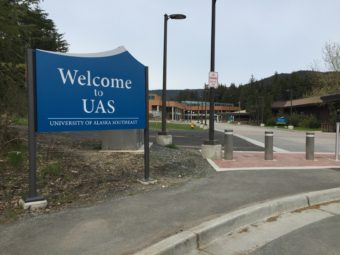
Students at the University of Alaska Southeast will recognize Indigenous Peoples’ Day on Oct. 12, a day otherwise known as Columbus Day. The student government recently passed a resolution to do this on the second Monday of every October.
David Russell-Jensen is a third-year student at the UAS. He’s a member of the student government and cosponsored the resolution.
“I had an essay assigned to me in high school about whether or not we should even celebrate Columbus Day and so I think that’s where some of my thoughts came about why we shouldn’t celebrate it,” Russell-Jensen said.
Growing up in Juneau, he said Columbus Day has never been a big deal. But he knows it’s still recognized in other parts of the country.
“They do Columbus Day sales, I guess. That’s kind of weird, but does that just mean you just walk into a store and just steal whatever you want?” he said.
For Russell-Jensen, Christopher Columbus represents the beginning of colonization and the genocide of indigenous people, not the discovery of America.
At a recent local municipal candidate debate, David Russell-Jensen asks school board candidates if they’d support a Tlingit language immersion school. (Photo by Lisa Phu/KTOO)
He got the idea to bring the resolution forward from Seattle. Its city council unanimously voted to rename Columbus Day as Indigenous Peoples’ Day last year. Minneapolis did it beforehand. Berkeley, California has been recognizing it since the 1990s.
The State of Alaska and the university system do not recognize Columbus Day as an official holiday. But Russell-Jensen said we’re all a result of colonization.
“We’re all results of genocide and language loss. I mean, I’m speaking English. That’s kind of weird. A hundred years ago, I’d probably be speaking three different languages if I lived here,” Russell-Jensen said.
He hopes the resolution continues the dialogue UAS is already having. Russell-Jensen is a Tlingit language student and says the college is playing an important role in revitalizing Alaska Native languages.
“UAS is doing some really amazing things about the importance of indigenous languages and culture, so I know that this isn’t going to be one day on the calendar, where, ‘Oh, we’re done.’ It’s not going to be like that,” he said.
But Russell-Jensen still thinks UAS can do better. He wants to see more Alaska Native teachers. Of the 102 full-time faculty members at UAS, only 3 are Alaska Native.
Chancellor Rick Caulfield said that’s something the college is focusing on through a new diversity action committee. He says UAS is continually looking at ways to expand educational opportunities around Alaska Native culture.
“It is something that I believe is important for all Alaskans and I think, to the extent that UAS is located in the homeland of the Tlingit, Haida and Tsimshian peoples … we have an obligation to provide education to include the languages and cultures of the peoples in this ancestral homeland,” Caulfield said.
UAS currently offers Alaska Native Languages and Studies as a minor or as an emphasis for a liberal arts degree. Caulfield says university faculty are discussing the possibility of turning it into its own degree program.
Juneau’s St. Vincent de Paul Society and Seattle-based GMD Development were supposed to break ground on low-income senior housing on this land near the airport. With the partnership over, the land remains untouched. (Photo courtesy St. Vincent de Paul Society)
A partnership that was going to bring 41 units of low-income senior housing to Juneau has ended, leaving a Seattle-based developer with $9 million in funding and no land to build on.
“We put in a lot of time, effort, money, blood, sweat, tears into this project and it’s very disappointing, very disappointing,” Austin said.
Both entities say it was the other that withdrew from the partnership.
Austin said St. Vincent de Paul and GMD Development weren’t able to agree on things like the administration of the project and the role of the housing’s thrift store.
“It’s mainly differences in management philosophy and mission between the two organizations. One is not necessarily better than the other, but we got to a point where it appeared that they were incompatible,” Austin said.
The proposed project targeting low to moderate income seniors was to be a mix of studio, one-bedroom and two-bedroom units with a thrift store on the ground floor. The plan was to build it on a lot adjacent to the nonprofit’s current property near the airport.
Alaska Housing Finance Corporation awarded the $9 million in financing to the project. With the broken partnership, director of planning and program development Mark Romick said the award contractually stays with GMD Development.
The Seattle-based company has until Dec. 31 to find another partner for the proposed Juneau housing.
“The project has to be exactly the same as it was proposed — same units, same energy efficiency, techniques, same design, same everything,” Romick said.
Romick hopes the proposed project can still happen.
“We want to see the units developed in Juneau and we’re hoping that this whole thing can work itself out,” Romick said.
If GMD Development doesn’t use the financing, AHFC gets it back. Romick says there’s a possibility it could be restricted to a Juneau project.
GMD may still have the financing, but it doesn’t have the land. That belongs to St. Vincent de Paul.
Project manager Emily Breidenbach said GMD is looking for new development sites and a new nonprofit partner. It’s been in discussions with a few agencies in Juneau, including Tlingit-Haida Regional Housing Authority, but doesn’t have anything concrete.
“Certainly because these are going to be seniors, we are looking for a site that’s well connected that has access to buses and sidewalks so that seniors can get out and be connected to the community,” Breidenbach said.
GMD and St. Vincent de Paul are still partners on a current renovation to Channel Terrace apartments in Douglas, and have funding applications in for other projects.
As GMD looks for another partner and land to build on, St. Vincent de Paul continues to pursue developing its land for low-income senior housing. Austin says he’s meeting with a potential partner in a few weeks.
Overturned dumpsters in the alleyway between Tracy’s King Crab Shack and Diamonds International on Sunday morning. (Photo by Heather Holt)
It’s that time of year again. Bears have descended on Juneau dumpsters and garbage cans, which mean people have to be extra responsible about how they dispose of trash.
When employees of Tracy’s King Crab Shack went into work Sunday morning, they were greeted by cardboard boxes, trash bags and crab bisque containers scattered all over the alleyway. Three dumpsters had been overturned.
For the past couple of weeks, manager Tina Degarimore has gotten used to this.
“There seems to be one bear that terrorizes South Franklin Street with the garbages,” Degarimore said.
In June, the business tried to secure their two dumpsters properly.
“We did put a fence up. Well, the bear decided he didn’t like the fence so he did break the fence. We’re definitely going to be looking at different solutions and trying to find something more bear-proof,” she said.
In the meantime, Degarimore said the staff is securing the dumpsters with carabiners and doing what it can when a bear does get in.
“Clean it up, put the cans back up and continue on with our day,” Degarimore said.
That bear terrorizing South Franklin Street is getting ready to den. As summer comes to an end, bears try to pack on as much fat as they can.
“They’re certainly driven by their stomachs and they’re going to find food wherever they can and a lot of the time, that brings them into town,” said Stephanie Sell, wildlife biologist with the Alaska Department of Fish and Game.
Last week, a bear with a plastic container stuck on its head was walking around Cope Park. Sell says Alaska Department of Fish and Game immobilized the bear, got the container off and moved it out of town. The bear is now marked with a red ear tag. (Photo courtesy Bob Dilley)
By not securing our trash properly, Sell said we’re training bears to have bad behaviors.
“Unfortunately every time a bear gets into garbage, it remembers that. It remembers that it’s gotten food there and it’s going to remember the source. Whether it be a garbage can or a dumpster or just bags of trash that are out, they’re going to remember that and from year to year, they’re going to look for that,” Sell said.
The city requires you to keep your garbage can in a garage or shed until 4 a.m. the morning of trash pick-up day. If you do not have a garage or shed, get a bear-resistant can like a Bearsaver, Toter or Kodiak Can. The gray garbage can with a black lid and red lock that many residents have are not bear proof or bear resistant. Another option is freezing food scraps until trash pick-up day.
Sell said Fish and Game has had to euthanize two bears this year – one in July and one earlier this month. On average, Sell says the agency puts down three to four each year and relocates the same amount.
Juneau’s Community Service Officer Bob Dilley said the city’s bear attraction nuisance law had a big rewrite in 2004.
“The year before the ordinance was rewritten, there was 23 bears that were shot and killed that year and that really got people fired up. Twenty-three in a summer is a lot of bears,” Dilley said.
Around this time of year, Dilley said Juneau police are giving out one to two bear citations a day. Those carry a fine from $50 to $300.
“It seems like this many years into the ordinance and trying to get people to do the right thing, I would have hoped we would’ve been further along with having less interactions with bears and people and their garbage,” Dilley said.
Dilley doesn’t think Juneau will ever completely solve its problem with garbage bears, but he says we can do better.
Close
Update notification options
Subscribe to notifications
Subscribe
Get notifications about news related to the topics you care about. You can unsubscribe anytime.