Lisa Phu

Managing Editor, KTOO

"As Managing Editor, I work with the KTOO news team to develop and shape news and information for the Juneau community that's accurate and digestible."
Judge sides with trapper, but doesn’t award damages

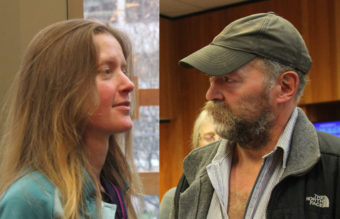
Kathleen Turley and John Forrest
A photo composite of hiker Kathleen Turley and trapper John Forrest. (Photos by Lisa Phu/KTOO)

In a small claims case between a trapper and a trap springer, a judge found the trap springer liable, but didn’t award any damages to the trapper.

Trapper John Forrest sued hiker Kathleen Turley for springing his lawfully set traps on Davies Creek Trail in Juneau. Turley had made headlines in January for also freeing a bald eagle from two traps.

In his decision, Judge Thomas Nave addresses each trap Kathleen Turley admitted to springing last December.

Nave wrote that Turley was justified in springing the marten trap closest to the unintentionally caught eagle she was freeing.

Regarding the other trap near the trailhead that she sprung twice over two days, the judge didn’t find Turley justified. In her concern for dogs and other hikers, Nave wrote, “Other alternatives existed.”

Even though Nave found Turley liable, he stated John Forrest failed to prove his damages during the small claims case that took place over two days. Forrest had testified he was owed up to $750 but Nave wrote he offered no evidence, like a weekly log of what animals he traps.

Forrest’s lawyer Zane Wilson asked for an additional $500 in punitive damages. That was denied as well because he didn’t prove Turley sprang the traps out of malice.

Turley saw the decision as a win-win. She was relieved because she doesn’t have to pay anything toward what started out as a $5,000 complaint. And she hopes it’ll make Forrest and other trappers happy.

“They wanted to make a point that it’s not OK to spring people’s traps and they’ve made that point because they won as far as that goes,” she said. “And for me, it’s more important that I didn’t have to pay anything.”

Turley said the whole experience has been frustrating and stressful and she’s glad it’s over. She stands by what she did, but said, “I definitely don’t condone springing traps. (The) situation I did it in were extreme circumstances but I don’t condone springing traps just because they’re inconvenient to you or because you feel like they shouldn’t be there.”

Her lawyer Nick Polasky, who took the case pro bono, called the judge’s decision “splitting the baby” and wrote in an email “each side has something to be pleased with.”

Neither Forrest nor his attorney Zane Wilson returned calls for comment. Pete Buist, a spokesman for the Alaska Trappers Association, was pleased with the decision, “As a trapper, as a guy who occasionally speaks for trappers, I think it’s pretty good.”

Buist said it’s unfortunate Forrest didn’t get an award for damages, but he calls the decision fair.

“The bottom line was this was not about an eagle, nor was it about money. It was about showing the defendant–and the DA for that part–that we’re a country of laws. There’s a law that you can’t do those sorts of things and she ignored the law and went ahead and did it,” Buist said.

Alaska Wildlife Troopers originally cited Turley for illegally hindering lawful trapping, but the district attorney asked for the judge to throw out the case.

Buist said the whole situation has spurred interest for trappers in Juneau to organize.

“They held a little meeting in Juneau about forming a formal trappers association or a chapter of ATA in Juneau so people could sort of stick together,” Buist said.

He says it would help trappers to communicate with each other, help coordinate efforts to work with other trail users, educate trappers about where they should and shouldn’t trap and educate the public about the law that says you can’t just go around springing traps.

Editor’s note: A separate, earlier story on KTOO.org was updated with a similar headline. 

Teachers’ union, school district reach tentative contract agreement

handshake
(Creative Commons photo by Flazingo.com)

The Juneau teachers’ union and the school district Wednesday night reached a tentative agreement on a one-year teachers’ contract. It includes a 2 percent pay increase, though the district won’t say what the budget impact would be.

Sara Hannan is a teacher at Juneau-Douglas High School and the bargaining representative for the Juneau Education Association. She said the 2 percent pay increase isn’t that much, but she hopes it’s something the union members will be happy to see.

“I’m pleased that the district recognizes that when you are in the business of educating people and your biggest cost is your professionals, you have to keep them moving forward even if it’s a little tiny bit because that negativity translates into people leaving and underperforming. So, it’s not a huge increase, but it still makes them feel like we’re moving forward,” Hannan said.

Of the 2 percent increase, 1 percent applies to the pay schedule and 1 percent is temporary for this fiscal year.

Hannan said the tentative agreement also includes a change in how years of experience are counted for certain specialists, like school psychologists and physical therapists–positions the district has trouble filling.

The district’s pay schedule for teachers is based on years of experience–the more experience, the more pay.

“But we only counted years of experience in a school setting. So if you worked at the hospital and been a speech pathologist, that didn’t count, and now it will. So we do think it’s going to make us a much more competitive district,” Hannan said.

Another change will affect teachers of students with Individualized Education Programs, or IEPs. These teachers have to attend many meetings, often outside of the work day. Now, they’ll receive some compensation for that time.

“For many, many years when we’ve discussed it with the district, the dialogue has surrounded, ‘This is your professional responsibility,’ and we’ve all acknowledged that, but what we’ve come to find is that it’s not an equal responsibility. There are some people who it’s not a once in a while kind of thing, it’s a very regular, perhaps weekly kind of obligation,” Hannan said.

Something the union wanted but did not get was more class prep time for elementary teachers. High school teachers get up to 75 minutes, middle school teachers get 90. Elementary teachers only get 30.

“No elementary teacher is only preparing 30 minutes a day. They’re preparing hours and hours each day. They’re only being compensated for 30 minutes of it and the rest of it is coming out of their sleep time. I go to the pool every morning between 6 and 6:30 a.m. and when I drive by Harborview Elementary School, there are classroom lights on,” Hannan said.

To negotiate, the district and the teachers’ union used a new process called interest-based bargaining, or IBB, which is more collaborative and discussion-based. Hannan said it’s too soon to say if it went well, since she doesn’t know yet if the teachers will be happy with the tentative agreement. Ted VanBronkhorst, human resources director for the Juneau School District, said he liked the process and hopes to continue it when bargaining starts again in the spring.

“It’s been a while since JEA and the school district have been able to come to an agreement without the assistance of an outside mediator. So I think the IBB process worked for us. We’re very pleased with how that was successfully implemented in this case and we’re hoping to build on it in the future,” said VanBronkhorst.

VanBronkhorst did not say how this contract would affect the school district’s overall budget. He said that information could prejudice the union’s vote.

Members of the teachers’ union will see the tentative agreement next week and they have one week to look at it. If the union votes it through, it then goes to the school board for approval.

Editor’s note: A previous version of the story had inaccurately stated the tentative agreement was reached Tuesday night; it was actually reached Wednesday night. 

Update: Judge sides with trapper, but doesn’t award damages

Editor’s note: A separate, standalone story on the decision has been published with a similar headline at KTOO.org.

Update | 12:57 p.m.

Judge Thomas Nave has sided with the trapper John Forrest in the small claims case against a woman who sprung his traps. While he sided with the trapper, he didn’t impose any cash award. Nave wrote that Forrest failed to prove any damages.

The trap springer, Kathleen Turley, was pleased with the outcome.

Each side is responsible for their own attorneys’ fees.

Original story | 12:00 a.m. 

A Juneau judge heard closing arguments in a small claims case between a trapper and a trap springer Thursday afternoon.

John Forrest sued hiker Kathleen Turley for springing his lawfully set traps on Davies Creek Trail last December. Forrest, Turley and a state wildlife trooper testified during the first day of the trial Monday morning.

On Thursday, only the lawyers spoke. Forrest is being represented by Fairbanks attorney Zane Wilson. Turley’s lawyer is Juneau-based Nick Polasky.

Wilson questioned Turley’s honesty; Polasky questioned whether Forrest’s traps were set in a safe manner. Both had a different interpretation of the statute on hindering lawful trapping.

An opinion by District Court Judge Thomas Nave is forthcoming.

“When you read it, no matter who you are, please keep in mind the fact that it will represent what the law requires. It will not represent any notions of approval or disapproval on my part of trapping or any passion or particular point of view consistent with Ms. Turley’s. It will be a strict application of the law and I hope that when you read it, it will be self-evident that it’s objective and fair,” Nave said.

Turley has admitted to springing a total of three traps. She said she did it out of safety for hikers and dogs. She also freed a bald eagle that was caught in two other traps belonging to Forrest.

Alaska Wildlife Troopers had originally cited Turley in January for hindering lawful trapping, which carries up to a $500 fine and 30 days in jail, but the state dropped its case.

Forrest is asking for an award of $1,000-$1,250 in damages.

Nave says he’ll have the written opinion out around noon Friday.

Thane Campground closes for winter, displacing homeless

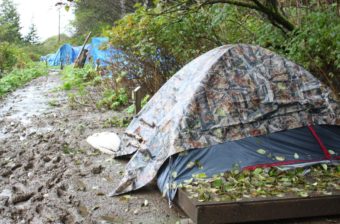
The Thane Campground is primarily used for housing, not recreation. It closes for the season Oct. 15. (Photo by Lisa Phu/KTOO)

Several of Juneau’s homeless live at the city-run Thane Campground. For $25 a week, it may be the cheapest rent in town. Today, the campground closes for the winter, leaving some occupants wondering where to go.

Elliot Scott spent this past month living at the Thane Campground. (Photo by Lisa Phu/KTOO)

Elliot Scott, 33, moved from his hometown of Bakersfield, California, to Juneau in April.

“It’s a good place to get a new start, to be able to better your life,” Scott said.

In 2004, Scott was arrested for a felony in California. After serving three years, he found himself in and out of jail more than 20 times for parole violations, “It just happens over and over and over and over and over, until you finally get out of the system.”

Scott got off parole in April. He took a job with Alaska Canopy Adventures and lived at the Prospector Hotel for an employer-subsidized rate of $450 a month. When the tourist season ended, so did the housing.

With a tent, a tarp and a sleeping bag, Scott moved to the Thane Campground about one and a half miles from downtown Juneau.

Scott works at Western Auto Marine, takes a marine transportation class at University of Alaska Southeast and wants to get his captain’s license. He’s paying out of pocket because the course doesn’t qualify for financial aid.

“Going back to school cost me $1,100 and being homeless,” Scott said.

On top of tuition, Scott is paying off criminal fines in California.

“If you add that into the equation of housing and gas and food, it’s like a house payment,” Scott said.

He does laundry and takes showers at the downtown laundromat.

“When I go to work, I’ll go take a shower and I get nice and cleaned up. Nobody ever knows,” Scott said.

At about $8 for a load of laundry and $2 a shower, “It adds up quick, but you got to do what you have to do.”

When the Thane Campground closes, Scott isn’t sure where he’ll live.

The City and Borough of Juneau leases the Thane Campground land from AJT Mining Properties, owned by Avista. According to the lease, the purpose of the campground is to provide campsites with proper facilities for seasonal housing during the temperate months of the year. Its primary goal is to provide housing, not recreation.

Thane Campground facilities include portapotties, a covered dining area, trash cans and a food shack. (Photo by Lisa Phu/KTOO)
Thane Campground facilities include porta-potties, a covered dining area, trash cans and a food shack. (Photo by Lisa Phu/KTOO)

“It’s kind of a placement for those that don’t really have anywhere else to go. Just somewhere that they can stay temporary where they know that if they’re able to follow the rules that they can stay at a relatively good price,” said Chris Day, administrative assistant for Juneau Parks & Recreation, which runs the campground.

On its last night before closing, seven of the 18 available camp spots were occupied. Day says three people have stayed at the campground the entire season. Others stay for one or two months. From mid-April to mid-October, he says the campground is usually more than 80 percent full.

Besides the Thane Campground, there aren’t other options in Juneau for long-term camping with facilities on public run land. State and federal campgrounds limit stays.

U.S. Forest Service Recreation Program Manager Ed Grossman said the campgrounds are not for permanent occupancy, “We’re in the recreation business. We’re not in the seasonal housing business, no matter what your situation, whether you’re homeless or low-income job or whatever.”

Mariya Lovishchuk, executive director of Juneau’s shelter and soup kitchen, gets worried when the Thane Campground closes. She says some who live there are considered at risk of dying prematurely, including a 65-year-old man she recently interviewed as part of a homeless survey.

“What closing the campground will mean is that he won’t be in one place. He’ll have to move several times because he’ll camp somewhere and then somebody will inevitably find the camp,” Lovishchuk said. “It’s so hard to set up a camp in the winter and to find stuff. In the summer, it’s less critical because you have more time and resources and body energy to survive the elements and in the winter, you really don’t.”

For Elliot Scott, he has a month left in his marine transportation course. If he doesn’t find proper housing by the time that ends, he may leave Juneau.

In the meantime, he’s looking for another place to camp.

Alaska Safe Children’s Act task force begins work

Four legislators, including Senators Anna MacKinnon and Berta, sit on the Alaska Safe Children's Act task force. The 10-member group met in the Anchorage Legislative Information Office Tuesday. (Photo by Mike Mason)
Four state legislators, including Sen. Anna MacKinnon, left, and Sen. Berta Gardner, sit on the Alaska Safe Children’s Act task force. The 10-member group met in the Anchorage Legislative Information Office on Tuesday. (Photo courtesy by Mike Mason/Alaska Independent Democratic Coalition)

The task force created to help implement the Alaska Safe Children’s Act met for the first time in Anchorage on Tuesday.

The act, also known as Erin’s Law and Bree’s Law, requires school districts to provide age-appropriate prevention curricula on sexual assault, teen dating and youth suicide. The task force’s job is to make recommendations to the Department of Education and Early Development on that curricula by June 30.

Anchorage Rep. Charisse Millett is a nonvoting member of the committee. She said the task force should create a menu of options for districts to choose from.

“We’ve got so many different school districts, making sure that it’s applicable to a different school district – one in rural, one in urban, one in a large school, one in a small school setting – so school districts aren’t tasked with the burden of going through and dissecting all that information,” Millett said.

Chair Trevor Storrs is executive director of the Alaska Children’s Trust. He said he hopes the 10-member task force can have honest conversations around topics like human development and understanding one’s body.

“Unless we have those conversations and be willing to have those and be able to listen on both sides, we’re going to potentially just present something to meet the requirements, but not really achieve,” Storrs said.

Eagle River Sen. Anna MacKinnon, another member, wants the curricula to create a strong foundation.

“I hope that we don’t just pull curriculum from places. I hope that we’ll go through the curriculum and have the right people read the curriculum, specifically for language,” she said.

MacKinnon wants to ensure the curricula aren’t offensive, culturally insensitive or victim-blaming.

During the meeting, the task force heard information and costs of various programs, some already taking place in Alaska schools, like The Fourth R, Green Dot and the Great Body Shop.

The task force plans to meet once or twice a month through June. Schools have until 2017 to comply with the Alaska Safe Children’s Act.

Trapper and hiker take the stand in first day of small claims trial

In the lobby of the Dimond Courthourse Monday morning, attorney Nick Polasky hands trapper John Forrest court documents before the trial. Polasky is Kathleen Turley's lawyer. (Photo by Lisa Phu/KTOO)
In the lobby of the Dimond Courthourse on Monday morning, attorney Nick Polasky hands trapper John Forrest court documents before the trial. Polasky is Kathleen Turley’s lawyer. (Photo by Lisa Phu/KTOO)

Monday’s small claims case between a trapper and a trap springer was supposed to last an hour, but after about two and half hours in District Court, it’s stretching into a second day.

Juneau trapper John Forrest is suing hiker Kathleen Turley for springing his lawfully set traps on Davies Creek Trail.

On the witness stand, John Forrest said he’s suing Kathleen Turley because the state dropped its case against her in January.

“I want her to realize she did something wrong that was against the law. My thoughts are if the prosecutor had done his job on the first go-around, we wouldn’t be here wasting our time and more money. What she did was wrong. She had good intentions,” Forrest said.

Alaska Wildlife Troopers had originally cited Turley for hindering lawful trapping, which carries up to a $500 fine and 30 days in jail.

Forrest, a 55-year-old Juneau resident, makes his living chopping firewood and, less substantially, trapping. Forrest estimates he’s owed $500 to $750 in damages.

He’s been trapping for about 45 years and said his traps have been destroyed or stolen numerous times.

“Kind of puts a sour taste in your mouth when you put all this time and effort into something and somebody comes along and fools around with it,” he said. “It’s kind of like going out and setting your string of crab pots and going out a week later and two of the pots are gone and the crabs have been taken out of the rest. It’s like, what the heck am I doing out here?”

Forrest has a 3-mile trap line near Davies Creek trail. On Dec. 27, he said three of his marten traps were sprung–two boxed traps on the ground and one trap that was in a bucket hanging in a tree. He reset them. On his way out, he found one of the ground traps and the one in the tree had been resprung.

“And never in my life have I had to reset the same traps twice in a day due to human interaction. That yanked my chain,” Forrest said.

Kathleen Turley encountered this eagle stuck in two traps Dec. 24, 2014. She freed the eagle and tampered with other legally set traps in the area. She's now being sued. (Photo courtesy Kathleen Turley)
Kathleen Turley encountered this eagle stuck in two traps Dec. 24, 2014. She freed the eagle and tampered with other legally set traps in the area. (Photo courtesy Kathleen Turley)

Aside from these three traps, two others targeting wolverine had been sprung as well. These two had caught a bald eagle. Forrest calls that the ugly side of trapping.

“It’s kind of like fishing. Most of the time you catch what you want, sometimes you catch something that you don’t. It’s not something I look forward to, but it happens and it’s part of the whole trapping thing,” Forrest said.

Turley had come across the eagle three days earlier when she was scouting the trail with three dogs. The eagle was still alive and she attempted to save it. She tied up the dogs and sprung another trap that she said was 10 feet away.

“When you set off that marten trap right there, what was going through your mind? What were you thinking about?” Turley’s lawyer Nick Polasky asked.

“That I didn’t want one of my dogs to get caught in that trap while I was working on getting the eagle out,” Turley said.

It took Turley an hour to free the eagle out of the two traps. As she was walking out with the eagle, she said she sprung another trap on the ground.

“I grabbed a stick as I got close to it and then leaned over and tossed the stick in the trap as we went by, because I knew I could easily keep my dogs under control as I was doing that, but I didn’t want to go past the trap and have one of them break control 20 feet later and run back to it. I didn’t want to deal with trying to get another animal out of a trap that day. It was almost dark by then,” Turley said.

Three days later, Turley was back on Davies Creek Trail leading a group of hikers. She said she sprung this same trap as she was walking out because it was dark and she didn’t want her dog or other hikers to stumble into it.

On both days, Turley said she saw a trap hanging from the tree, but didn’t spring it. She said another group of hikers was also on Davies Creek Trail on Dec. 27.

Nick Polasky talks with his client Kathleen Turley before trial Monday morning. (Photo by Lisa Phu/KTOO)

Turley is an avid outdoors person and a hunter. She raises rabbits for food and is not opposed to trapping.

As Forrest’s lawyer Zane Wilson questioned Turley over the phone, she admitted springing two different traps, one on two separate days.

“Did the thought ever cross your mind about the impact you’d be having on a trapper when you’re out there springing their traps?” Wilson asked.

“No,” Turley replied.

“‘Cause you don’t care about the impact it had on the trapper?” Wilson said.

“Safety of my dogs and my group were foremost on my mind. I didn’t think about what effect it would have on the trapper,” Turley said.

“And the safest thing for your dogs would be for you to leave them at home, correct?” Wilson said.

“Safest thing for any of us would be to stay at home all the time and never go anywhere,” Turley said, which drew a subtle reaction from the roughly 20 people sitting in the audience. Most appeared to be there in support of Turley.

The trial is scheduled reconvene Thursday afternoon.

Site notifications
Update notification options
Subscribe to notifications