"As Managing Editor, I work with the KTOO news team to develop and shape news and information for the Juneau community that's accurate and digestible."
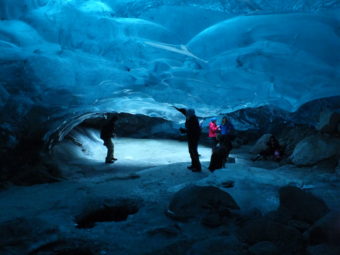
The Mendenhall Glacier ice cave in March 2014. This view shows daylight streaming in from the moulin. (Photo by Matt Miller/KTOO)
Smithsonian Magazine has listed Juneau’s Mendenhall Glacier ice caves on a list of “25 Great New Places to See.”
It’s number six on the “life list” or “bucket list,” beaten out by the largest cave located in Vietnam, gorilla trekking in East Africa and the Alma Telescope in Chile.
Because the Mendenhall Glacier is melting, the magazine says there’s “less time to see one of the most breathtaking visions available.”
It says the melting also “reveals astonishing ice caves where blue water runs over blue rocks, creating surreal lava-lampish images.”
Director of the glacier’s visitor center John Neary says images of the ice caves have gotten a lot of media attention in the past few years causing more and more visitors to seek them out.
“People are drawn to the beauty of those photos and they want to experience that. The only disappointment is that 99 percent of them can’t. It’s not feasible in the time frame or the skill or the athletic ability needed,” Neary says.
Hiking to and from the ice caves can be an all-day affair and Neary recommends going with a guide.
The ice caves were heavily photographed in the earlier part of 2014. That particular one has since collapsed and is a remnant of what it was, but other smaller ones have formed.
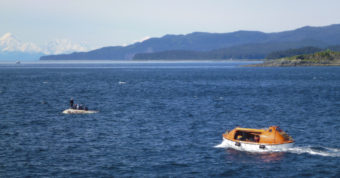
The LeConte state ferry launches a lifeboat to rescue six men from an overturned boat. (Photo courtesy Janet Neilson)
The LeConte state ferry recently rescued six men that were stranded in the water.
Last Thursday afternoon, the LeConte was returning from Gustavus to Juneau. Department of Transportation spokesman Jeremy Woodrow said as the ferry was going around Point Couverden near Rocky Island, “One of the crew in the bridge of the ferry noticed there was a (boat) that was overturned and individuals that needed rescuing. They deployed one of their life boats and were able to rescue the individuals that were in the water.”
A passenger on the ferry, Janet Neilson, captured video of part of the rescue:
Woodrow said the rescue slowed the ferry down, but didn’t put passengers too far off the anticipated arrival time.
“It’s fortunate that the ferry was there at that time. I’m not sure what the outcome would’ve been otherwise. Seems that the ferry system is involved in one or two rescues across Alaska’s waters every year,” Woodrow said.
Last year, the Alaska ferry Tustumena helped tow a fishing vessel to safety. On another occasion, the Malaspina rescued a Canadian fisherman who was on board a sunken vessel.
Editor’s note: The headline, photo caption and comment by Department of Transportation spokesman have been corrected. They previously referred to the overturned vessel as a “skiff.” The vessel was more substantial than a skiff and had an enclosed cabin.
Karuna Jaggar wants to provide a counter narrative to the pink ribbon culture, also known as the “tyranny of cheerfulness.” Jaggar is executive director of Breast Cancer Action, a national education and advocacy organization. She was part of a panel that toured Alaska called “What the Pink?!”
“Every fall an avalanche of pink-ribboned products hits the shelves. Americans can eat, drink, freshen their breath, pepper spray each other and shoot stuff — all to raise money and awareness for the fight against breast cancer. But Karuna Jaggar of Breast Cancer Action “isn’t buying it,” says Samantha Bee, a fake news correspondent on “The Daily Show.”
The segment continues as Bee eats fried chicken out of a pink bucket and dips it into pink yogurt.
Standing at a venue in Juneau, Jaggar told the small audience where the pink ribbon came from. She said it originates with a woman in California named Charlotte Haley, “who was upset that so many women in her family and community were diagnosed with breast cancer and she was outraged that so little money went to research and prevention.”
Haley started a peach-colored ribbon campaign from her living room. She sent out postcards with five ribbons attached, calling on the National Cancer Institute to allocate more money to breast cancer prevention. The peach ribbons caught on. It was early 1990s. The AIDS awareness movement was being propelled by the red ribbon.
Haley got a lot of national attention.
“SELF Magazine and Estée Lauder, the cosmetics company, heard about this and they had begun to do some breast cancer work and they approached her, wanted to partner, and she said, ‘No.’ They were too corporate for her,” Jaggar said.
The magazine and the cosmetic company went with pink instead. It was then, Jaggar said, that the focus on prevention turned into a focus on awareness.
In this video still from a 360 North production, Breast Cancer Action Executive Director Karuna Jaggar speaks in Juneau as part of a panel, “What the Pink?!”
She said the pink ribbon has been used by the corporate world to sell products,
“It really binds together the cancer industry where the corporate polluters are bound together with many of the nonprofit organizations in a really vicious profit cycle,” Jaggar said.
She said the pink ribbon culture tends to celebrate survivors and perpetuate the idea that women can beat breast cancer, “We’re all told to be positive and fight and keep a smile on our face and look good, do those makeup tips, stay positive.”
Jaggar says using the term survivor implies that those who died did something wrong.
“Are we telling them they didn’t fight enough? Are we telling them they didn’t have a good enough attitude?” she said.
One woman at the panel discussion said Jaggar changed her mind. “Up until an hour ago, I identified as a breast cancer survivor but I guess I’m going to change that. But when I would say that to people, they’d say, ‘Oh congratulations!’ and I didn’t do anything.”
Despite pink ribbon awareness, the rates of breast cancer haven’t decreased — they’ve increased. And its cause is still largely unknown.
“The biggest risk factor is being a woman and getting older,” Jaggar said.
Jaggar wants to flip the pink ribbon on its head and bring the focus back onto breast cancer prevention and not merely awareness.
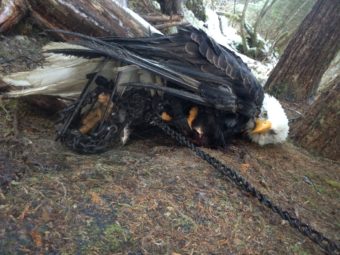
Kathleen Turley encountered this eagle stuck in two traps Dec. 24, 2014. She freed the eagle and tampered with other legally set traps in the area. She’s now being sued. (Photo courtesy Kathleen Turley)
The woman who freed a trapped eagle and was cited for springing other traps is heading back to court. In January, the State of Alaska dropped its case against Kathleen Turley. Now, the trapper is suing her for damages in small claims court.
Pete Buist is a past president and board member of the Alaska Trappers Association. He’s now its spokesman. Buist doesn’t know the Juneau trapper, John Forrest, but understands why he’s suing. He says if it were him, he’d do the same thing.
“I say bravo for the trapper. The state won’t do what’s right. He should do what’s right,” Buist says.
Forrest, who’s suing Kathleen Turley for at least $5,000, declined to comment.
In January, Turley (formerly Kathleen Adair at the time of the events) says she sprang three traps on two separate days out of concern for the safety of dogs and hikers. She also freed an eagle that was caught in two traps. Despite her efforts to save the eagle, it was later euthanized.
Alaska Wildlife Troopers cited Turley for tampering with traps that Forrest had legally set, not for freeing the eagle. Hindering lawful trapping is a violation of state law that carries up to a $500 fine and 30 days in jail.
Buist says members of the trappers association weren’t happy.
“I can fully understand why the lady rescued the eagle. I don’t have any problem with that whatsoever. And I think if she had just rescued the eagle, the trappers would’ve supported that. But she didn’t. She went back and tampered with the traps and broke the law,” Buist says.
Shortly after the State of Alaska dropped its case against Turley, Buist says several members of the trappers association complained to the attorney general’s office.
“And basically we were summarily dismissed as the fringe element and it fizzled after that,” Buist says.
Forrest has a lawyer, though it’s not required in small claims court. Attorney Zane Wilson is no stranger in the trapping community. He helped win a high profile case involving wildlife biologist Gordon Haber who freed a wolf from a snare in Tok in 1997. The biologist was being funded by an international animal advocacy organization. The trapper sued and the Tok jury awarded him $190,000.
Wilson is with Fairbanks firm Cook Shuhmann & Groseclose. He relayed through an employee he was “not authorized” to speak to me. Wilson is a lifetime member of the trappers association. Buist says Wilson’s uncle is Dean Wilson, a well-known trapper and fur buyer who’s been called the state’s patriarch of trapping.
A fellow Juneau trapper and a state wildlife biologist have said Forrest partially relies on trapping for income. The most targeted species in the Juneau area is marten. In the 2012-2013 season, the average price for raw marten fur was about $140. A state report says one even fetched $1,300. In Southeast, trappers also target mink, otter, wolf and beaver, among other animals.
Kathleen Turley in the Dimond Courthouse after the State of Alaska dismissed the case against her. (Photo by Lisa Phu/KTOO)
Turley, who freed the eagle and sprung the traps, doesn’t think she owes Forrest anything. She says she’s never been contacted by him. Until she received the complaint in the mail in July, she didn’t even know his name.
“I was very surprised and confused. … I hadn’t heard anything about it. I had no idea that he felt there was money owed,” Turley says.
Turley is Alaska-raised and has lived in Juneau for 30 years. She grew up fishing and hunting and shot a bear at age 16. As an avid outdoors person, she’s seen traps before, but had never tampered with any before the eagle incident. Turley says she’s not against trapping, but thinks it’s better suited for other parts of the state.
She says she didn’t damage the traps when she sprung them. Turley hasn’t been on the Davies Creek Trail where she found the eagle since.
“I’ve completely avoided that area, which is a beautiful area, a very nice trail, but I haven’t gone anywhere near it. I don’t want anything do to with it,” Turley says.
She says the whole incident and the lawsuit have caused her a lot of stress and grief.
The trial is scheduled for Oct. 12. Turley doesn’t have a lawyer yet.
Belongings and litter under the Gold Creek overpass. (Photo courtesy The Glory Hole)
Three years ago, a group of volunteers hit the streets and interviewed some of Juneau’s most vulnerable homeless, those at the greatest risk of dying prematurely. An estimated 60 individuals fall into that category.
Juneau’s shelter and soup kitchen, The Glory Hole, is trying to find out what has changed by doing another survey.
“How many people who were on our Vulnerability Index Survey in 2012 are still on the survey? How many of them are still alive? And what happened to their lives since then?” said Mariya Lovishchuk, director of the shelter. “Also, it’ll be interesting to see if new people are now part of Juneau’s chronically homeless population,”
Many surveyed this year will likely be residents of Juneau’s 32-unit Housing First facility, which is scheduled to open June 2017.
The Glory Hole needs 40 volunteers to help conduct the survey. That entails going to where homeless people sleep in the wee hours of the morning.
“It really helps to have good manners because we are waking people up. And then the interviewers ask folks very intrusive questions about their income levels, about their history, about demographic factors, criminal history, health,” Lovishchuk said.
The experience can be profound, she said. Lovishchuk helped survey homeless people in 2012 and said it was eye opening, even for her.
“A lot of people who worked a lot of their lives lost everything and just were never able to recover. And I know those people as people who are patrons of The Glory Hole who are chronically homeless and I never pictured their life before, as not homeless,” she said.
Lovishchuk said several of the people who were surveyed in 2012 have died. But the survey also helped connect vulnerable people to social services. She hopes it can do that again.
“Winter is coming and last winter I think we had four people die, and so we really want to create this connection prior to the cold coming so people know that we are there,” Lovishchuk said.
This year’s Homeless Vulnerability Index Survey is on Sept. 29 and 30. To volunteer or for more information, contact Trevor Kellar at The Glory Hole, email tghoutreach@gmail.com or call 907-660-7466.
Leonora Florendo and Nora Marks Dauenhauer. (Photo courtesy Juneau Public Libraries)
The Juneau Public Library system is collecting Alaska Native stories on educational experiences as part of an oral history project.
In this edited interview, Leonora Florendo speaks with her mother 88-year-old Nora Marks Dauenhauer, who left school in sixth grade but went on to become a prominent Tlingit scholar, poet and writer. She’s published many books with her late husband Richard Dauenhauer as well as her own.
Leonora Florendo: Did you go to school in Douglas?
Nora Marks Dauenhauer: Yes, I went to Douglas school after I was in fourth grade, I think. We got bused over from Juneau. I got picked up at the end of the bridge and we were taken over to Douglas.
Leonora Florendo: And the school is where the Montessori School is now. That was the government school.
Nora Marks Dauenhauer: These teachers were paranoid. They’re afraid that my hair might have bugs, so they sprayed every one of our hair and clothes with kerosene. At sixth grade I dropped out. That was no good for me. It does something for your self-esteem being a kid and having somebody spray you because you might be full of bugs, although I didn’t have any.
Leonora Florendo: I know you worked as a fish slimer, as a shrimp picker, a crab shaker, ‘cause I’ve done those things, too.
Nora Marks Dauenhauer: Chamber maid…
Leonora Florendo: At the Baranof. Oh, and you did housekeeping for people in the community
Nora Marks Dauenhauer: Oh yeah. I went from house to house.
Leonora Florendo: You taught at Juneau High School for a while. You were teaching Tlingit.
Nora Marks Dauenhauer: Yes, there was 14 in my class. Two of them were non-Tlingit. They still come and say hello and we talk.
Leonora Florendo: And they let you go because you weren’t certified.
Nora Marks Dauenhauer: I got halfway through the school teaching and then I got called by the principal and she told me that I am no longer going to teach and that was it.
Leonora Florendo: You got your GED.
Nora Marks Dauenhauer: I went to GED because working with the high school kids I discovered that I needed help.
Leonora Florendo: And then you went to college.
Nora Marks Dauenhauer: I majored in anthropology and some students asked me, “What are you going to do with anthropology? You’re going to study yourself?” And that’s exactly what I did. I worked on my language. People thought of Tlingit as being simple and your stepdad Dauenhauer discovered it’s one of the hardest languages he’s ever encountered. Dick and I have numerous books. I haven’t counted lately.
Leonora Florendo interviewed Nora Marks Dauenhauer at the Juneau Public Library downtown in July. Their conversation was recorded as part of the national oral history project StoryCorps.
Close
Update notification options
Subscribe to notifications
Subscribe
Get notifications about news related to the topics you care about. You can unsubscribe anytime.