"As Managing Editor, I work with the KTOO news team to develop and shape news and information for the Juneau community that's accurate and digestible."
Without any leads or suspects, the Juneau Police Department has closed an investigation on a vandalism case that involves racial slurs.
Spokeswoman Erann Kalwara says the department received at least three reports of graffiti on Mendenhall Loop Road on Wednesday morning. The Juneau Empire reports the vandalism began on Haloff Way and continued toward the Mendenhall Glacier to Back Loop Road.
Kalwara says there were 10 separate instances of words and phrases found on fences, electrical panels and other private and public property.
“Some of them were racially influenced. Some of them, honestly, I don’t know what they mean. They were a little bit nonsensical, perhaps initials. But a few of them were definitely racially influenced,” Kalwara says.
Kalwara says officers responded to the scene, took photographs and interviewed multiple people in the neighborhood. No one came forward with any information on suspects.
“It’s pretty common for this to be activity that’s conducted by teenagers. There can be different motivations for it – someone looking for attention, someone who’s bored, acting out. There are times when it is racially motivated and there’s times when it’s just somebody with nothing better to do with their time,” Kalwara says.
The graffiti totaled more than $900 in damage. Kalwara says most of it has been cleaned up by the homeowners and the state Department of Transportation.
Kalwara says JPD will further investigate the case if any new information comes forward.
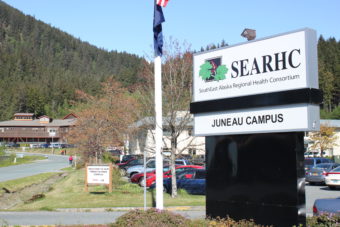
SEARHC’s new paid parental leave policy went into effect Aug. 1. (Photo by Lisa Phu/KTOO)
A Southeast health provider has adopted what may be the most progressive parental leave policy in Alaska. At least two experts say they don’t know of another employer in the state with a comparable benefit.
Ann Stepetin is due to deliver her fourth child in February. She and her husband had already decided she’d only take two weeks off from her payroll job at SEARHC.
“Because I didn’t think we could afford to be off any longer,” Stepetin says.
Then, she went into work one day and that plan drastically changed.
“You can see me getting emotional, I was like, ‘Oh my God.’ It was such a blessing,” she says.
SEARHC’s new parental leave policy lets Stepetin take eight paid weeks off instead of using her accrued leave.
“Having that in place does give me more of a relaxed feeling to prepare emotionally more or less for the baby rather than stressing about the finances,” Stepetin says.
And that’s exactly what SEARHC executives hoped the new policy would do.
“We want that family to be really focusing on the new child, the new addition to their family, and to not have to worry about any of the other issues,” says Peggy Kadlec, SEARHC’s interim head of human resources. “It’s an important time of bonding.”
SEARHC employee Ann Stepetin says the new policy gives her a sense of job security. (Photo by Lisa Phu/KTOO)
SEARHC has about 650 employees in communities throughout Southeast Alaska; most are concentrated in Juneau and Sitka. Kadlec says the health organization wants its employees to have work-life balance.
“We believe our employees that are healthier, happier, will be here at work more frequently, provide the better kind of service into our community and at the end, (it) saves money,” Kadlec says.
She says people who take an active role in health and families have less health issues.
“If our employees are out less for medical reasons, our costs are reduced and we can transfer those dollars to programs to help them as well.”
Kadlec is excited about the new parental leave policy. So is Joy Lyon.
She says it’s critical for the time after childbirth to be as stress-free as possible.
“When you add the extra stress of trying to get back to work, find childcare, figure out your feeding schedule, that just adds such a layer of stress,” Lyon says. “Babies are little sponges for stress, so they’re going to be feeling that stress. Continuous stress inhibits the child’s ability to learn and grow so it has a really long-term impact.”
Ironically, AEYC does not offer paid parental leave to its employees.
The federal Family and Medical Leave Act requires most employers with 50 or more workers to guarantee up to 12 weeks of unpaid time off for a new child, among other reasons.
AEYC only has 10 employees, but follows these guidelines, like many other employers.
“Being a small nonprofit we just don’t have the ability to pay the extra the whole time,” Lyon says.
Most state and municipal employees are entitled to up to 18 weeks of unpaid leave for a new child. People who take family medical leave often use accrued time off to get paid.
Dan Robinson, head of research and analysis for the state Department of Labor, says the agency doesn’t have any research on paid parental leave in the state. That could change. The department has applied for a federal grant to look into it.
“It’s very possible that there will be state legislation, that a legislator will say we want to require employers to pay for parental leave, we want to make that paid. In that case, those questions could likely come our direction,” Robinson says.
At SEARHC, parents of new children can still access 12 weeks of Family Medical Leave after the eight weeks of paid parental leave. Ann Stepetin isn’t sure if she’ll dip into it.
“I haven’t thought that far yet. Eight weeks is a blessing compared to the two that I was planning on doing,” Stepetin says.
She says she’ll start with that and see how it goes.
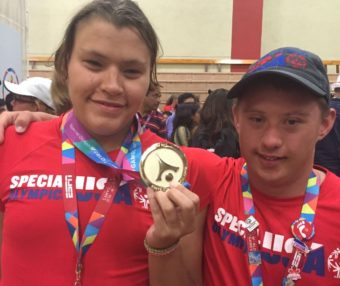
Christine Quick, 23, and CJ Umbs, 21, competed in the Special Olympics World Games in L.A. (Photo by Michelle Umbs)
Two Juneau swimmers returned from the Special Olympics World Games in Los Angeles with five medals. CJ Umbs and Christine Quick competed alongside 6,500 athletes with intellectual disabilities from around the world.
Juneau swimmer Christine Quick says Michael Phelps is taller than she thought he was. The most decorated Olympic athlete of all time took pictures with Special Olympians and jumped in the pool for a swim.
“What was that like?” I asked.
“Happy,” Quick says. “Our team was crazy to see him.”
Quick earned two gold medals and a seventh place finish in backstroke and freestyle events. She says the cheering from the crowd helped motivate her. She’s never received so much attention.
“Everybody said, ‘Yay!’ People took pictures of us,” Quick says.
CJ Umbs is another Juneau swimmer. He received gold, silver and bronze medals, and a fourth place ribbon in backstroke and freestyle events. His mother Michelle Umbs is a coach for Juneau’s Special Olympics program.
“The finish on the fourth place ribbon and the finish on the silver medal, he was just as happy as a clam both times,” Umbs says. “It didn’t matter. He was just so glad to finish.”
Umbs was in L.A. for the games with her husband and other family members. She watched every event her son and Quick competed in.
“The whole week was amazing watching both of them act independently and responsibly. But to see them both as young adults get up on a stage, accept their medals in an environment where they were treated with a lot of respect is over the top for me,” Umbs says.
CJ Umbs and Christine Quick were part of Team USA with fellow Alaska athletes Garrett Stortz from the Mat-Su and Brittany Tregarthen from Kodiak. Stortz competed in golf and Tregarthen in powerlifting.
All four Alaska athletes medaled, but Jim Balamaci says competing in the Special Olympics isn’t about winning.
“It’s really about doing your personal best and really performing and training,” says Balamaci, president and CEO of Special Olympics Alaska.
Prior to 1968, people with intellectual disabilities didn’t have a sports organization.
“Now, almost 50 years later, we transcend the world,” Balamaci says. “People with intellectual disabilities can achieve and that through sports, there’s no better way of gaining friendships and confidence that come back to your community and to your school.”
Both Juneau athletes get to take a short break from training as they enjoy the afterglow of the World Games. Quick will start swimming again in the winter and Umbs will start bowling in a few weeks.
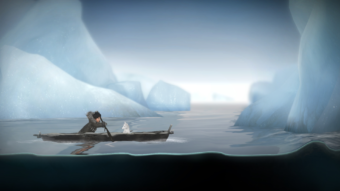
In “Never Alone: Foxtales,” Nuna and Fox navigate on an umiak. They start in the Kotzebue area and eventually find themselves on the Noatak River. (Image courtesy Upper One Games)
Its success has led to the follow up “Never Alone: Foxtales,” released on July 28. Juneau writer Ishmael Hope relied on his uncles, Alaska Native elders from Kotzebue, to write the game’s narrative.
Willie Goodwin Jr. narrates the videogame Foxtales. In Iñupiaq, he tells the story of two friends who emerge from their sod homes after a long winter.
“At springtime,” Goodwin says, “everything comes alive.”
Goodwin is an elder from Kotzebue. He’s also the uncle of Ishmael Hope, the game’s writer.
Hope says the two friends, Nuna and Fox, start chasing a little mouse.
“And then suddenly, in the middle of their chase, they’re stranded out in the ocean. They find themselves in an old umiak, a boat. They’re just out, and then they have to navigate their way all the way through,” Hope says.
In Nuna and Fox’s journey, “They get a little too exuberant, like young people will,” Hope says. “They’ll make little mistakes, but then they have to learn a lesson about how to respect all things, the values of being Inuit, Iñupiaq. It’s something that they had to learn.”
Ishmael Hope wrote “Never Alone: Foxtales.” (Photo by Lisa Phu/KTOO)
Foxtales is based on a story told by Hope’s late grandfather, Willie Panik Goodwin. It’s a story about fighting a giant mouse. Goodwin told the story “The Two Coastal Brothers” during an archaeological trip with a team of scholars, including Wanni Anderson who transcribed it in a short story collection, “Dall Sheep Dinner Guest.”
Hope used a lot of his grandfather’s direct words when writing the game’s script. He also collaborated extensively with his uncles who live in Kotzebue, where Foxtales begins.
The game, like its predecessor “Never Alone,” is narrated in Iñupiaq with English subtitles.
“Even if people are absorbed in the game, there’s something really special about the elder’s voice, them speaking in the language. So even if you’re not following everything, you’re getting a sense of that world and that spirit,” Hope says.
Hope says it’s that spirit that gives identity. Hope is Iñupiaq and Tlingit. He says his uncles Elmer Goodwin, Willie Goodwin Jr. and John Goodwin taught him a lot about Iñupiaq culture. Hope says working with them was key to making Foxtales.
“They know how to hunt, they know how to fish, they know how to be in the land. They have so many stories of survival, of reading the landscape, observing the landscape, sensing the spirits and the life of everything around us. They have that knowledge and they were able to impart that a little bit with us,” Hope says.
Foxtales is a celebration of Iñupiaq culture, something Hope thinks young people playing the game need.
“It’s one instance where they get a positive image of themselves reflected back on them. And when you’re in pop culture and you have almost no images or it’s all horrible stereotype, it’s really nice to kind of break through just a little bit,” Hope says.
Videogames have been seen as separating the young generation from the old, but Hope wants Foxtales to do the opposite.
“For young people everywhere, it allows them to create the bridge to their mom and their dad and their uncles, their aunties and their grandparents who may tell them, ‘Oh you know I know a story just like that, so let’s sit down and let me tell it to you,'” Hope says.
Hope doesn’t know if Nuna and Fox will go on any more adventures, but he says with the title Foxtales, there’s a possibility for more.
“Never Alone: Foxtales” is available for the Xbox One, PS4 and PC and Mac. It requires the original “Never Alone” to play.
The 15-year-old survivor of a plane crash near Juneau was recognized by the U.S. Coast Guard Thursday for helping to save the other three passengers despite his own injuries.
Jose Vasquez and U.S. Coast Guard Rear Admiral Dan Abel on Thursday. (Photo courtesy U.S. Coast Guard Alaska)
Jose Vasquez was on the Wings of Alaska Cessna that crashed into a mountain 18 miles west of Juneau, killing the pilot. Vasquez lives in Puerto Rico and was in Juneau visiting his godparents. All three and another passenger were traveling to Hoonah.
Coast Guard spokesman Grant DeVuyst says Vasquez used survival skills he learned as a Boy Scout.
“He had multiple injuries but he still went through many steps to make sure the other passengers got the help they needed,” DeVuyst says.
Vasquez had broken ribs and a collapsed lung, according to his godfather.
Vasquez put layers of clothing around his godmother Sandra Herrera Lopez to preserve body heat. He lifted cargo boxes that had fallen on another passenger, Ernestine Hanlon-Abel of Hoonah.
DeVuyst says Vasquez then found three cell phones and called 911. He used a phone app to determine the latitude and longitude of the crash site and passed them on to emergency operators.
“When he heard one of the first helicopters from Temsco nearby, he started using smoke signals and then later when the Coast Guard helicopter arrived on scene, he started waving a silver thermal blanket to attract attention and that successfully vectored them in for what was the rescue of the passengers,” DeVuyst says.
He says Vasquez’s efforts accelerated the search and rescue.
“There was the emergency beacon aboard the aircraft, but without his precise location, because of how heavily wooded everything was, it would’ve taken longer for rescue crews to locate them,” DeVuyst says.
The Coast Guard honored Vasquez during a ceremony closed to media at Juneau’s Federal Building. DeVuyst says about 50 people were there, including family and friends, and Coast Guard personnel. His godfather Humberto Hernandez, another passenger on the flight, is a Coast Guard doctor.
Hernandez says he’s getting physical therapy. He has a swollen leg, back pain and will have to have some teeth removed. Wife Sandra Herrera Lopez had been medevaced to Harborview Medical Center in Seattle. He says she had several fractures to her head, arm, ankle, collarbone and ribs. She’s since been transferred to another hospital in Seattle.
Hoonah resident Ernestine Hanlon-Abel is still at Harborview. Her husband Tom Abel says she’s undergone multiple operations and has both legs in casts. He hopes she’ll be able to leave the hospital soon, but will likely stay in an assisted living facility before returning to Hoonah.
Vasquez is awaiting clearance from his doctor before going home to Puerto Rico.
Editor’s note: The U.S. Coast Guard mistakenly identified the first helicopter on scene at the crash site as being from Temsco Helicopters. In fact, the helicopter was from Coastal Helicopters. We regret the error.
Wings of Alaska flight 202 crashed into a mountain about 15 minutes after departing Juneau on its way to Hoonah, killing the pilot Fariah Peterson. All four passengers survived.
Chris Shaver is the NTSB investigator in charge. He says there were no reported problems at takeoff.
“In the only communication that the pilot had with air traffic control, which would’ve been at takeoff, she didn’t relay any issues,” Shaver says.
The plane is certified to fly under visual flight rules, which means it has to stay out of the clouds and maintain a visual reference with the ground for navigation. Shaver says weather conditions at the Juneau and Hoonah airports at the time fit visual flight rules. To determine what conditions were like in between, he says he’s pulled images from seven weather cameras.
Shaver says the plane’s electronic system had a feature that gives visual and audio warnings if the aircraft is approaching terrain. The plane split in two when it hit a large spruce tree at an elevation of about 1,300 feet above sea level.
“Where the separation happened probably played some factor in the survivability of the passengers,” Shaver says.
The engine is being sent to Anchorage for further inspection and the plane’s visual display units are being sent to NTSB headquarters in Washington, D.C. A chip inside the display units will hopefully offer flight data, like air speed and altitude.
“We hope that we’ll get data all the way up until 1 to 2 seconds before the accident,” Shaver says. “It’s not going to answer the question of why did something happen, but it’s going to give us a much clearer picture of what exactly happened, at least, with the flight path of the airplane. So it’s another piece of the puzzle.”
Shaver says the final report determining probable cause of the Wings of Alaska crash won’t come out for another 12 to 18 months.
Close
Update notification options
Subscribe to notifications
Subscribe
Get notifications about news related to the topics you care about. You can unsubscribe anytime.