Lisa Phu

Managing Editor, KTOO

"As Managing Editor, I work with the KTOO news team to develop and shape news and information for the Juneau community that's accurate and digestible."
Teachers’ field trip: Lessons from the Mendenhall Glacier

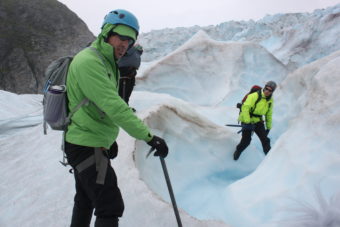
Thirteen educators participated in Discovery Southeast's Teacher Expedition on the Mendenhall Glacier. (Photo by Lisa Phu/KTOO)
Thirteen educators participated in Discovery Southeast’s Teacher Expedition on the Mendenhall Glacier. (Photo by Lisa Phu/KTOO)

“Teacher training” usually means spending time in a library with textbooks and PowerPoints. But for 13 Alaska educators last week, it meant hopping on a helicopter, donning crampons and toting an ice ax on top of the Mendenhall Glacier as part of Discovery Southeast’s Teacher Expedition. I was invited to tag along.

From the Juneau airport, less than 10 minutes fly by before the helicopter lands on the ice of the Mendenhall Glacier.

Bev Levene, who works at the glacier’s visitor center, says she look at this glacier every day, “But now I’m actually seeing it, touching it, being on it, and it’s really cool and kind of surreal in a way.”

(Photo by Lisa Phu/KTOO)

The glacier expedition is just one of several teacher trips that Discovery Southeast offers in the summer. Teachers pay tuition to learn in an outdoor classroom for a week and can get continuing education credits from the University of Alaska Southeast.

Richard Carstensen is one of the founders of the outdoor education nonprofit and an instructor.

“This is our backyard in Juneau,” Carstensen says. “And they’re going to bring this back to their classes, even if they can’t actually the walk the kids around on the ice. It’s going to just give them a much more full body understanding of what this glacier is doing.”

Teachers were outfitted with crampons, helmets and ice axes. (Photo by Lisa Phu/KTOO)

Cathy Connor is a retired geology professor at University of Alaska Southeast and another expedition instructor.

“If you teach teachers, you teach the world. If you just teach kids, that’s just a flash in the pan. They’re the parade moving, but teachers are your pivot point. They’re the railway station that all the trains come through,” Connor says.

During the expedition, teachers were supposed to spend three days on the Juneau Icefield. Due to weather, ice time was limited to the day on the Mendenhall Glacier. Matt Potter says the days spent off the ice were just as rewarding. Potter is in the process of moving from Anchorage to Circle, where he’ll be the lead teacher.

“We hiked up somewhere and there was this gravel pile and we had a bunch of 5-gallon buckets and we dumped water down it just to look at what the effect of concentrated run off is, how it sorts out the rocks from the gravel from the silt,” Potter says. “It was a really good hands-on activity to show in real time the processes of erosion. That’s something that no matter how old you are, you’re going to have fun dumping water down a hill, right?”

(Photo by Lisa Phu/KTOO)

But it’s the glacier that draws the most awe.

“There’s just nowhere else on Earth like this,” says Allie Smith, a teacher at Juneau’s Auke Bay Elementary School.
“And the one thing that I’m so amazed with today is watching all the melt streams on the surface of the glacier. I always knew there was melting but there’s just a lot more channels and dynamics to see up here than I realized,” she says.

Throughout the day, the instructors pose this question to the group of teachers:

“Do you guys have any ideas on what you might take to your classrooms about the process that’s happening out here?”

The teachers have some ideas, like using algebra to predict snow accumulation and ablation cycles, nature walks in areas where the glacier once was, experiments that model how ice carves away at cliff sides. But they have weeks before school starts, so while they’re on the glacier, they might as well goof off for a few minutes.

Palmer teacher Nicolas Owens stands over a small glacial river.

“It’s a very technical thing we’re doing here. We’re going to drop the orange in. We should probably measure something off or eyeball a measurement and then we’re going to calculate how fast the water’s flowing,” Owens says.

Discovery Southeast Naturalist Steve Merli drops the orange. (Photo by Lisa Phu/KTOO)

“On your mark, get set, go.” The orange is dropped into the flowing glacial water.

“Oh no,” Owens says, as someone laughs. “It’s in the eddy,” he says. “The orange is stuck in the eddy.”

Downed aircraft was split in two, wreckage now in Juneau hangar

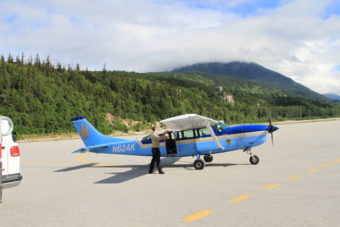
This is a photo of the Wings of Alaska plane servicing flight 202 from Juneau to Hoonah that went down earlier this afternoon. (Photo by Murray Lundberg)
The Wings of Alaska plane that went down Friday flying from Juneau to Hoonah. (Photo by Murray Lundberg)

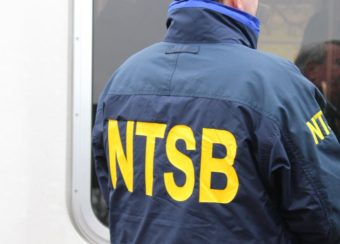
National Transportation Safety Board inspector Chris Shaver says two of the passengers from Friday’s Wings of Alaska plane crash were able to get out of the aircraft on their own.

“I believe two passengers made it outside the airplane afterward and then they helped a third passenger get out.”

Shaver says he’s so far interviewed two of the four survivors.

Shaver was able to see the crash site Saturday with the help of a U.S. Coast Guard helicopter basket. He says the Cessna 207 is in two pieces.

“The airplane separated basically just forward of the wing, so the cockpit area and the engine separated and it was its own piece. The rest of the fuselage and the wings and the tail all remained as one piece.”

He said the forward piece of the plane was sitting about 20 feet in front of what he thinks is the initial impact point, a large spruce tree. The second piece was inverted at the base of the tree. Shaver says some of the seats had broken out during the impact.

The wreckage from the crash is being kept in a private hangar at the Juneau airport. Shaver says the investigative team will spend about two days looking over it. The engine will be sent to Anchorage for inspection.

Shaver anticipates the preliminary accident report will come out early next week.


NTSB investigates ‘man, machine, environment’ in Friday’s plane crash near Juneau

(Creative Commons photo by Matt' Johnson)
(Creative Commons photo by Matt’ Johnson)

Wreckage of a plane that went down Friday afternoon 18 miles west of Juneau was being picked up Sunday for further investigation by the National Transportation Safety Board.
Wings of Alaska flight 202 from Juneau to Hoonah crashed into a mountain north of Point Howard on the mainland, killing the pilot. The Cessna 207 was carrying four passengers who survived the crash.

The purpose of the National Transportation Safety Board is to perform an in-depth investigation to determine probable cause of the crash. Clint Johnson, chief of the Alaska Regional Office in Anchorage, describes it as a process of elimination.

“We look at three main areas when we get on an accident site – man, machine, environment. Man being the human performance portion, machine being the mechanical and the environment is obviously the weather. So right now, none of those three areas have been discounted at this point,” Johnson says.

NTSB investigator Chris Shaver spent Saturday at the crash site, which is steep and tree-covered.

Johnson says the investigative team for the wreckage includes representatives from the airframe manufacturer, Cessna Aircraft Co., and the engine manufacturer, Continental Motors. That process takes a few days.

Johnson says Shaver is also working closely with Wings of Alaska.

“That is a part of the investigation. Chris will probably be in town for the next 2 to 3 days, if not longer than that, conducting a number of interviews as far as management personnel, other pilots that knew this pilot, dispatch personnel, there’s a host of people,” Johnson says.

Wings flight 202 departed Juneau on Friday around 1 p.m. for what was supposed to be an 18-minute flight to Hoonah. The Juneau Police Department received a 911 call from someone on the plane around 1:20 reporting the crash.

The pilot was 45-year-old Fariah Peterson of Birmingham, Alabama. Her body was recovered Saturday afternoon and will be sent to the State Medical Examiner Office for an autopsy.

The four surviving passengers are 64-year-old Ernestine Hanlon-Abel of Hoonah, 57-year-old Humberto Hernandez-Aponte and wife 60-year-old Sandra Herrera Lopez of Juneau, and 15-year-old Jose Vazquez of Puerto Rico. They were all initially brought to Bartlett Regional Hospital in Juneau. Hanlon-Abel and Herrera Lopez were medevaced to Harborview Medical Center in Seattle. As of Sunday afternoon, both were in serious condition in the intensive care unit.

The weather near Point Howard Friday afternoon was similar to the weather in Juneau – low clouds, light rain and patchy fog, according to a meteorologist at the National Weather Service.

Wings of Alaska cancelled all flights on Saturday, the day after the crash. Service resumed on Sunday.

Johnson says a full NTSB investigation takes 9 months to a year. He says a preliminary accident report will come out sometime this week.

Passengers survive, pilot dies after Wings plane crash near Juneau

Update | 6:25 p.m.

The Coast Guard and Juneau Mountain Rescue have recovered the body of pilot Fariah Peterson from the crash site, according to an Alaska State Troopers dispatch.

Peterson’s body was flown to Juneau and will be sent to the State Medical Examiner’s office for an autopsy. The National Transportation Safety Board is investigating the crash.

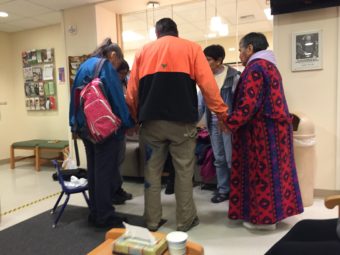
Family and friends of plane crash survivor Ernestine Hanlon-Abel of Hoonah pray together at Bartlett Regional Hospital Friday night. (Photo by Lisa Phu/KTOO)

Update | 3:40 p.m.

A National Transportation Safety Board investigator is at the scene of the plane crash today, according to an Alaska State Troopers spokeswoman.

Investigator Chris Shaver is from the NTSB Alaska Regional Office in Anchorage. He arrived in Juneau on Friday, says NTSB spokesman Eric Weiss.

“We’re basically on scene in Juneau with one investigator. He’s coordinating with the commander in the Anchorage office,” Weiss says. “And we’re going to send some people up from our Transportation Disaster Assistance program to help with the survivors.”

Two staff members from the disaster assistance program are arriving in Juneau today from Washington, D.C., says Weiss.

The Coast Guard is helping transport the investigator as well as members of Juneau Mountain Rescue to the crash scene. Troopers spokeswoman Beth Ipsen says the rescue crew is trying to recover the body of Wings pilot Fariah Peterson.

The four passengers involved in the plane crash all survived. Juneau’s Sandra Herrera Lopez and Hoonah’s Ernestine Hanlon-Abel were both medevaced to Harborview Medical Center in Seattle. They’re both in serious condition in the intensive care unit, says Harborview spokeswoman Barbara Clements.

Hanlon-Abel’s husband Tom Abel says Wings of Alaska parent company SeaPort Airlines is arranging travel to Harborview for himself and close family members.

The two other plane crash survivors Humberto Hernandez-Aponte of Juneau and Jose Vazquez of Puerto Rico are in stable condition at Bartlett Regional Hospital.

Update | 2:40 p.m.

Wings of Alaska has cancelled all flights today “out of sensitivity to employees,” according to a company press release. Service is scheduled to resume tomorrow.

Wings pilot Fariah Peterson, 45, of Birmingham, Alabama, died yesterday after the Cessna 207 she was flying went down 18 miles west of Juneau Friday afternoon. All four passengers survived.

“All of us at Wings of Alaska and SeaPort Airlines are deeply saddened by the accident, and the confirmation of the loss of pilot Fariah Peterson,” said Rob McKinney, Wings President and CEO in the release. “We have lost a member of our work family, and our thoughts and prayers continue for everyone involved and touched by this tragedy.”

The Wings release says a counseling professional will be available in Juneau this afternoon after 2:00 p.m. to provide information and support to families and friends of those involved in the accident. For information on counseling services, friends and family can call the Wings assistance line at 407-362-0632.

The National Transportation Safety Board and other special assistance teams are investigating the accident.

Update | 12:10 p.m.

A plane crash survivor from Juneau and one from Hoonah were medevaced to Harborview Medical Center in Seattle, according to a Saturday morning press release from Bartlett Regional Hospital.

Sandra Herrera Lopez of Juneau, listed in serious condition, along with Ernestine Hanlon-Abel of Hoonah, who was reported in critical condition, were transported to Seattle. Hanlon-Abel is now stable, says husband Tom Abel.

Humberto Hernandez-Aponte of Juneau and Jose Vazquez of Puerto Rico are in stable condition at Bartlett Regional Hospital.

Original story

A Wings of Alaska pilot is dead after the plane she was flying went down 18 miles west of Juneau Friday afternoon. Flight 202 from Juneau to Hoonah crashed into a mountain north of Point Howard on the mainland around 1:20 p.m. The Cessna 207 was carrying four passengers, all of who survived.
The pilot was 45-year-old Fariah Peterson of Birmingham, Alabama, according to the Alaska State Troopers. Her family has been notified. The U.S. Coast Guard and Juneau Mountain Rescue will continue efforts to retrieve Peterson on Saturday.

The surviving passengers are Hoonah resident Ernestine Hanlon-Abel, 64, Juneau residents Humberto Hernandez-Aponte, 57, and wife, Sandra Herrera Lopez, 60, and Jose Vazquez, 15, of Puerto Rico. With a Jayhawk helicopter, the U.S. Coast Guard hoisted the passengers from the crash site and transported them to Juneau. They were all taken to Bartlett Regional Hospital.

Irene Knudsen is Hanlon-Abel’s cousin.

“She’s pretty severe right now. She’s got a big gash on her head and it looks like she has a broken nose. She was in the front of the plane with the pilot,” Knudson says.

Hanlon-Abel, who is in critical condition, was in Juneau visiting her mother at the Wildflower Court nursing home. Friend Mary Tarr had dinner with Hanlon-Abel Thursday, the night before the crash. Tarr says Hanlon-Abel was supposed to leave Juneau Thursday night, but changed her flight to leave Friday afternoon.

Husband Tom Abel of Hoonah thanks the Coast Guard for saving his wife’s life.

“They, of course, did their usual good job and rescued my wife and for that I’m eternally grateful,” Abel says. He says his wife has several fractures and is being medevaced to Harborview Medical Center in Seattle.

Bartlett Regional Hospital spokesman Jim Strader says another crash survivor in serious condition is also being medevaced. The other two passengers are in stable condition.

Flight 202 took off at 1:06 p.m. and was scheduled to land at 1:24 p.m. The Juneau Police Department received a 911 call from someone on the flight around 1:20 p.m. reporting the plane crash.

The Coast Guard launched an MH60 Jayhawk helicopter out of Air Station Sitka and sent the cutter Liberty to assist in the rescue. The Alaska State Troopers, Juneau Mountain Rescue and Temsco Helicopters were also involved in the search and rescue. The site of the crash was at 1,330 feet above sea level.

The weather near Point Howard had been similar to the weather in Juneau — low clouds, light rain and patchy fog, according to National Weather Service Meteorologist Tom Ainsworth.

The National Transportation Safety Board is investigating the accident and will fly to the crash scene Saturday, according to state Troopers. An NTSB representative was at Bartlett Regional Hospital Friday night.

Hoonah mayor Ken Skaflestad says the plane crash is devastating.

“We rely on air travel so much being from an island out here that it concerns us whenever we hear of plane crashes anywhere. This is very close to home and the whole town is curious and anxious to know more,” Skaflestad says.

Wings of Alaska operates scheduled flights to Gustavus, Haines, Hoonah and Skagway. The company is owned by SeaPort Airlines based in Portland, Oregon.

View KTOO’s live coverage of flight 202 here.

Editor’s note : July 18, 2015 8:00 a.m.: A previous version of this story listed one of the Juneau survivors as Humberto Herrera. His name is actually Humberto Hernandez-Aponte. The Alaska State Troopers dispatch for July 17, 2015 had listed the incorrect name. We apologize for the error. 

Inside Gastineau Apartments

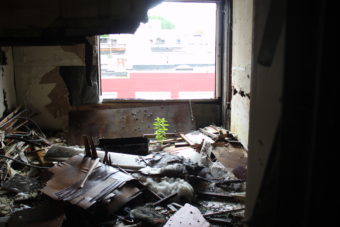
From the outside, Gastineau Apartments is a crumbling eye sore. After a large fire in November of 2012 and a smaller fire in March, the buildings in the heart of downtown Juneau continue to deteriorate.

Inside, it’s actually worse. Dave Lane does construction work for Gastineau Apartments owners James and Kathleen Barrett. He offered me a hard hat and a safety vest Monday, and invited me inside the apartment buildings. Here’s what I saw.

The Barretts have missed several deadline sets by the city to repair or demolish the buildings.

The city is moving forward with its own demolition plans. On June 29, the city solicited proposals for demolition plans. Bidding closes Thursday.

DOT gets go ahead to finish environmental review of Juneau Access

The end of the road, May 25, 2015. (Photo by Jeremy Hsieh)
The end of the road on May 25. (Photo by Jeremy Hsieh)

The state Department of Transportation is moving forward with its environmental review of the Juneau Access Project. The governor’s state budget director wrote a memo last week giving the department the go-ahead to finish the document that lays out the state’s case for where the road should or shouldn’t be built.

Last December, the governor ordered DOT to stop all discretionary spending, not incur new expenses or change existing contracts. Now, the administration is allowing DOT to spend up to $900,000 of general fund money and associated federal funds to finish the supplemental environmental impact statement.

DOT spokesman Jeremy Woodrow says part of completing the environmental review is responding to public comment.

“Last fall we held a public comment period and we received about 44,000 comments. Of those comments, about 2,400 of those are unique in a way that were going to require some additional work,”

DOT has laid out 8 alternatives for improving access to Juneau. Its preferred alternative involves extending Juneau’s highway system about 50 miles north to a new ferry terminal on Lynn Canal. From there, shuttle ships would complete the link to Haines and Skagway.

The other alternatives include another road option, ferry options or no action. After completing the environmental review, the state will submit its final preferred alternative to the Federal Highway Administration; Woodrow expects it to support the state’s choice.

In the memo, budget director Pat Pitney wrote that reaching that milestone ensures the state won’t have to repay nearly $27 million in federal investments. Around the New Year, then-DOT Commissioner Pat Kemp had raised the issue and was asked to resign.

Pitney also wrote the fed’s decision is expected in January. Woodrow says it could take longer.

“We did have to shut down some of the progress on moving forward with the EIS, so therefore, right now is what we call ramping up stage, getting the contractors back on, deciding what the next logical steps are in moving forward with the EIS,” Woodrow says. “We’re definitely shooting for that January 2016, but it’s too early to tell if that’s a deadline that we can meet with the work that needs to be done.”

So far, Woodrow says about $41 million has been spent studying the Juneau Access Project.

Site notifications
Update notification options
Subscribe to notifications