"As Managing Editor, I work with the KTOO news team to develop and shape news and information for the Juneau community that's accurate and digestible."
The Juneau School District offices. (Photo by Heather Bryant/KTOO)
The Juneau School District’s proposed budget maintains current class sizes, decreases funding to high school activities and cuts half the instructional teaching coaches at elementary schools.
One of the biggest unknowns is whether the district will get the $1.1 million in one-time state funding that was in last year’s education bill. The proposed budget assumes it’ll get half.
Director of Administrative Services David Means says that assumption may be unwise.
“We have very uncertain state funding right now. We try to compromise between where we should be in theory based on last year’s legislature and probably where we’re going to end up. I think maybe we’re very optimistic on state legislature,” he says.
Means says changes may have to come later, but the administration’s optimism allows the district to propose maintaining current class sizes instead of increasing them.
Of the $2 million worth of budget cuts, the largest is almost $700,000 for high school activities. Those funds ordinarily go toward coaches and travel. Means isn’t sure how the cut will affect activities.
“It could be a combination of fees. It could be a combination of reduced activities, reduced student travel,” Means says.
The proposed budget cuts one support, one information technology and three instructional teaching coach positions. There will be one coach for every two elementary schools. It also eliminates the drug testing program and an intramural program at the high schools.
The district plans to ask the Juneau Assembly for the maximum local contribution allowed by state law, almost $25 million. Another $700,000 will be requested for activities and other items that the state limit doesn’t apply to.
The public has two more opportunities to comment on the budget as the school board considers the district’s proposal at 6 p.m. during a regular meeting and again on March 24.
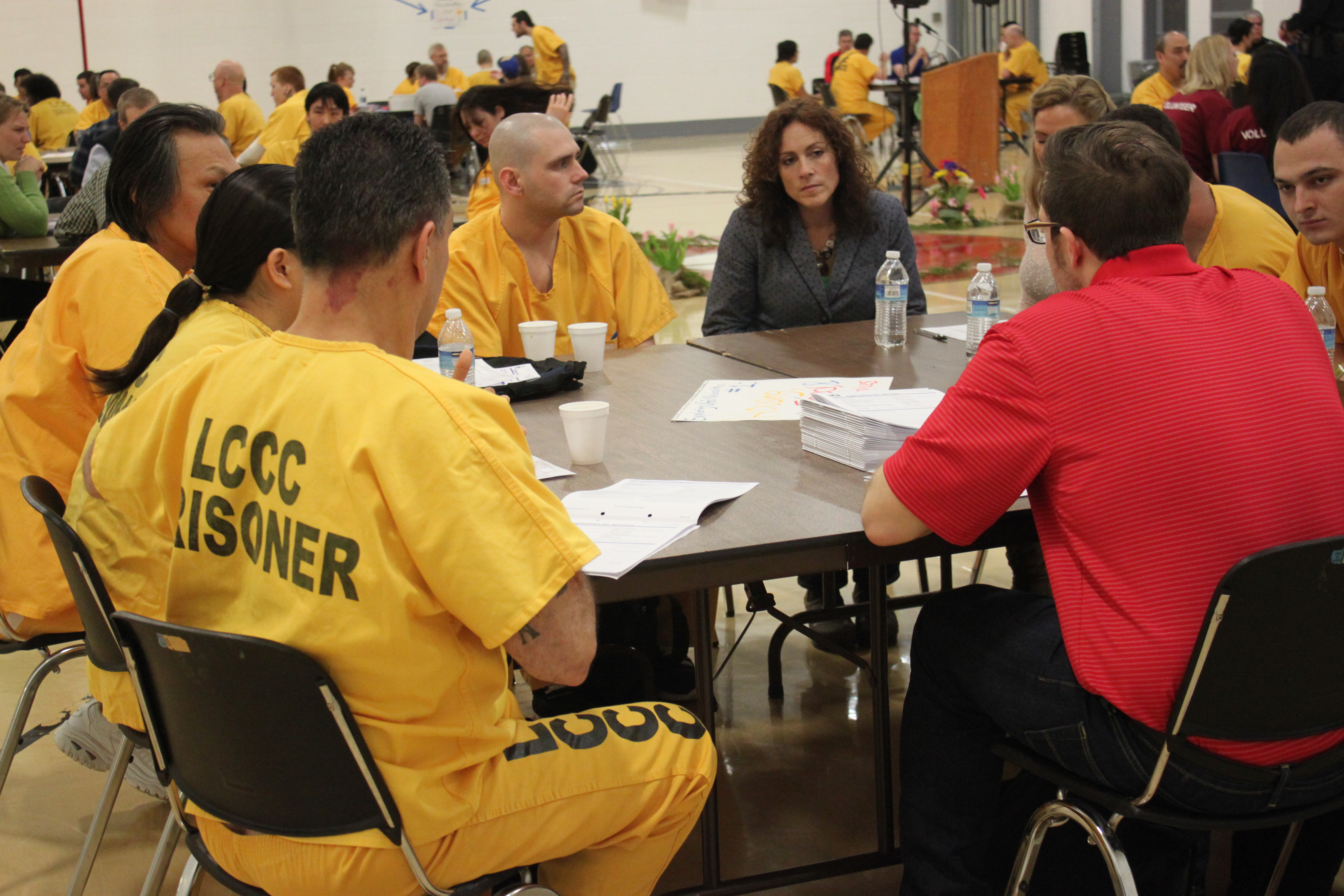
This is the eighth year Success Inside and Out has been held at Lemon Creek Correctional Center. The day’s events took place inside the prison gym. (Photo by Lisa Phu/KTOO)
On Saturday, 43 people rotated through tutorials in a basketball gym on topics like finding employment, how to open a bank account and reconnecting with family.
All the participants were wearing yellow jumpsuits. It’s Lemon Creek Correctional Center’s eighth annual Success Inside and Out event, which offers resources to soon-to-be-released inmates.
James Luckart has been in jail for more than eight years. According to court records, Luckart was convicted for three counts of assault, one for attempted sexual assault. He’s due to get out of Lemon Creek Correctional Center next February.
“I feel ready and I think I am ready, but it’s just I’m scared. It’s going to be a big test,” Luckart says.
James Luckart says Success Inside and Out makes him believe he has a chance to make it once he’s released. (Photo by Lisa Phu/KTOO)
This is his first time at Success Inside and Out. He’s just come from a session on addiction and mental health. He’s gotten information about counseling once he’s out and a number to call even while he’s still in jail. Luckart thinks it’s cool.
“There’s people out there that actually care. I mean people in this environment are like, ‘Nobody cares about us. They just want to let us rot.’ But there are people that actually care, so it feels pretty good,” Luckart says.
His favorite part of the day has been hearing from former inmates who have succeeded on the outside – people who are sober, have jobs or go to school and are part of healthy relationships. These stories give him hope.
“We all have a chance to make it out there. Yeah, we’ve made some mistakes in our life but there’s a chance that we can make it out there in the community,” Luckart says.
Marcos Galindo is one of those people who made it. Most of his life was shrouded in violence, he says. He was part of a gang in California and was in and out of jail. He came to Juneau in December 2011 to visit his mother. That next April, he assaulted someone and ended up at Lemon Creek Correctional Center. While there, he took a class taught by Sol Neely, assistant professor of English at University of Alaska Southeast.
Now, Galindo is a senior at UAS and radiates positivity.
“My whole day when I wake up in the morning is about being positive, about how can I better my life and how can I better the person next to me’s life. And I learned a lot of that through Sol’s classes,” Galindo says.
So far, he’s helped four former male inmates get into UAS.
“Three of them are success stories. One of them started using again and went back. So we lost one and I took it a little personal but what can you do, right?” Galindo says. “But the three superstars we got now, they don’t need any help at anything. They’re knocking out essays on their own. They got higher GPAs than me.”
Juneau District Court Judge Keith Levy has been organizing Success Inside and Out for the past few years. The program was founded in 2006 by Alaska Supreme Court Chief Justice Dana Fabe for incarcerated women at Hiland Correctional Center near Anchorage. The program still takes place there.
Levy says the court system has a great interest in seeing inmates thrive when they’re released.
“People think of judges as punishing people and our role is not punishment. Judges, especially in Southeast Alaska, what we want to have happen is to recognize what gets people into jail and to deal with those things and help them not come back,” he says.
Levy isn’t sure how successful Success Inside and Out has been over the last eight years, but he says if it helps even a handful of people, it’s worth it.
The transgender community is finding a foothold in the capital city. A support and social group for transgender and gender questioning people had its first meeting in February with about 12 participants and has its second tomorrow. It follows a trend happening elsewhere in the state.
Zeif Parish, 30, was born a female, but for as long as he can remember, he’s identified as masculine. He says he grew up in Juneau viewed as an unusually masculine girl.
Zeif Parish is a transgender man. (Photo by Lisa Phu/KTOO)
“Half the people I met for my entire life until the last couple years would meet me and be like, ‘What’s her problem?’ and ‘What’s up with her? She’s weird.’ And it wasn’t my choice and I doubtless experienced more social rejection and stigma and negativity just based on that,” Parish says.
He started identifying as transgender when he was 20 and physically transitioned two years ago when he began taking testosterone. Parish says he’s had a supportive family, a strong Bahá’í faith and found happiness in his life, but he never had a community of gender variant friends.
Parish hopes a monthly support and social group in Juneau may change that. He’s one of the group’s organizers.
“I want to reach people who feel alone in their differentness whether it’s like totally a secret thing in their heart or if they express it, but still don’t like feeling alone,” Parish says.
Drew Phoenix, who’s also transgender, says having a support group is incredibly important. He’s the executive director of Identity Inc, a statewide lesbian, gay, bisexual and transgender organization based in Anchorage. Phoenix says transgender people or people questioning their gender are an at-risk population.
“Many people in Alaska know of someone who is gay or lesbian or bisexual. They’re not as familiar with people who are gender nonconforming or transgender. So transgender people are in a much higher risk of physical violence and discrimination than the broader LGBT population,” Phoenix says.
In Anchorage, the Veterans Affairs center runs a weekly transgender group. Identity organizes three – two for adults and one for teenagers. The first one started January of last year. Phoenix says Identity will offer additional groups in April.
“More and more I’m getting calls from parents of children, like first graders, third graders, fourth graders, who the children need a play group to be part of with other gender questioning kids. And then the parents need the support of other parents,” Phoenix says.
Phoenix says the climate around being transgender is slowly shifting, encouraging people to come out. TIME Magazine featured transgender actress Laverne Cox from “Orange is the New Black” on its cover last June. Identity recently received a $10,000 grant from the Alaska Mental Health Trust Authority to allow Alaskans in remote areas to videoconference in to transgender support groups. Phoenix says many organizations and businesses in Anchorage have reached out for LGBT cultural competency training.
Juneau’s transgender support group meets downtown Saturday, March 7 at 2:30. For more information, contact SEAGLA on Facebook or email seagla.lauren@gmail.com.
Transgender or gender questioning individuals can also meet up prior to SEAGLA’s weekly Friday social at The Imperial Bar at 5:15.
But he says society still has a long way to go.
“I’m so aware of the discrimination that still occurs both in places of employment, public accommodations, like use of locker rooms and restrooms. I’m concerned about policies not being in place in local schools for young people who are transitioning,” Phoenix says.
Lauren Tibbitts is a board member and outreach coordinator of SEAGLA, the Southeast LGBTQ alliance group based in Juneau. She’s been helping Juneau’s transgender group get off the ground. Tibbitts is also part of it and identifies as gender non-binary, which means she doesn’t consider herself woman or man. You don’t have to be transgender to be part of the group, she says.
“It is welcoming anyone who considers themselves outside of gender norms, whether you consider yourself or identify as gender nonconforming, non-binary, or transgender or agender – anyone who doesn’t strictly identify with heteronormativity when it comes to gender,” Tibbitts says.
The group also welcomes allies of the transgender community and people who want more information.
Editor’s Note: The story has been updated to correct the number of participants at the first meeting – there were about 12, not 20.
The Juneau Assembly and School Board discussed the school budget Monday night. (Photo by Lisa Phu/KTOO)
During a meeting of the Juneau Assembly and School Board Monday night, Superintendent Mark Miller asked the city to fully fund K-12 education next year.
“Let’s just be flat out honest. I believe what the board is asking, what we’re asking is to fund to the cap and see if we can get some of those activities funds back. I know that’s a hard ask. We’re all hurting,” Miller said.
Last year was the first time anyone can remember the Assembly not funding schools to the maximum extent possible, opting instead to shave $500,000 from its contribution. It also reduced funding for activities by almost $400,000.
Miller said trimming the budget over the years means putting more kids in each classroom. Compared to districts in Anchorage, Fairbanks, Kenai and the Matanuska-Susitna Borough, Juneau anticipates having some of the biggest average elementary and middle school classroom sizes with 28 to 29 students.
“When you have to decrease your funding, the only real way to make real significant difference is to take the same number of kids and have less teachers,” Miller said.
Assemblywoman Mary Becker wants to explore how feasible it is to give schools additional money from the city’s current budget.
“I think it would mean one more teacher, two more teachers. It would mean something that we could help, so I would like to ask that we consider that in the Finance Committee,” Becker said.
Finance Committee Chair Karen Crane questioned where the money would come from.
“If we do that out of funding this year, it’s that much less money we have to meet the deficit next year,” Crane said.
The city faces its own $7 million deficit for the coming fiscal year.
The school district’s budget is due to the Assembly at the end of the month. Administrative Services Director David Means said the district could be asking for a local contribution upwards of $25.5 million, or about $900,000 more than what the city gave last year.
A Juneau doctor says a child’s brain develops the interconnections that have to do with memory and language learning during the first years of life. (Creative Commons photo by Jonathan Warner)
Proposed cuts by Alaska lawmakers to early education programs could cost the state a lot more in the future. Program proponents say supporting parents and children from birth to age 5 is crucial to a child’s and the state’s development.
Juneau resident Sabrina Nelson says she was a mess when she had her first child.
“You’ve just given birth, you’re dealing with postpartum depression. You don’t know what resources you have for you even though you’ve been given a bunch of handouts at the hospital or the birth center, and do you have time to read those things when you have a newborn? No. You’re just trying to keep up with sleep,” Nelson says.
Her doula told her about the free program Parents as Teachers. New parents get support and guidance from an educator who visits the home once a month.
Sabrina Nelson and son Rylan, who’s now 3. (Photo courtesy Sabrina Nelson)
Nelson joined the program when her son was two months old. She says it helped her profoundly. She learned activities catering to different aspects of her son’s development that she wouldn’t have known on her own. The program connected her with other families.
“Networking with the other families, I can say, ‘Hey, my child is having trouble with this. Have you gone through something similar?’ I wouldn’t have had the confidence to approach someone and ask those questions or go on playdates and things like that. I don’t think I would’ve been as actively participating in his development,” Nelson says.
Parents as Teachers is just one of the programs the state could eliminate funding for completely. A House Finance subcommittee also proposes cutting pre-kindergarten grants and money for Best Beginnings. The Anchorage-based organization supports early learning groups around the state and leverages private funds to help bring free books to thousands of Alaska children through the Dolly Parton Imagination Library.
“All indications that I’ve seen previous to this are that there are more and more people that understand the importance of early childhood, that by supporting children when they’re young, they’re going to be a stronger workforce in the future, we’re going to have a stronger economy. So having a strong stable family will lead to a stronger, more stable state,” Lyon says.
Retired Juneau pediatrician Dr. George Brown says a child’s brain develops the interconnections that have to do with memory and language learning early on.
“When children are in situations where their parents play with them, they talk to them, they hold them, they touch them, particularly during the first year or year and a half, they are increasing those connections amazingly fast,” he says.
Programs like the Imagination Library and Parents as Teachers encourage and provide support for parents to do these things and create safe environments during that early time period, Brown says.
Conversely, children who spend those years in unhealthy homes don’t develop those brain functions as successfully. Brown says that will likely lead to disadvantages later in life.
“If we invest as much as we can during the first three or four years of a child’s life, supporting those families, you are going to be saving a huge amount of money later in life in criminal cost, in court cost, in medical cost and in death cost. So it’s a no-brainer investment,” Brown says.
“It’s better from an economic perspective for the state to maintain funding as much as possible than to cut it at this point,” he says.
With the state suffering from declining oil prices, Calvin says parents of young children need support more than ever.
Juneau residents can weigh in on the state’s operating budget, including cuts to early education programs, today at 1 p.m. at the State Capitol Building.
The next solicitation period for development to the North Franklin Street parking lot will last at least two months, says City Lands Manager Greg Chaney. (Photo by Casey Kelly/KTOO)
The Juneau Assembly is not moving forward with the sale of a downtown parcel of land currently used for parking. Instead, the city will re-solicit proposals for development of the North Franklin Street lot. The Assembly decided this during a committee meeting last night.
A group of local investors, called Juneau Legacy Properties, wants to turn the parking lot into a mixed-use building that combines parking, retail and 29 units of housing.
City Lands Manager Greg Chaney says the land is appraised at $530,000. The city solicited proposals last spring and Juneau Legacy Properties was the only one that came in.
The group wants to buy the land without a reversion clause. The clause obligates the investors to fulfill their plans. Juneau Legacy Properties says it cannot obtain funding with that condition.
Chaney explains what that would mean for the city.
“If we sell it, we will have no control. The next day, they could sell it to somebody else. They could build exactly what was proposed, could be completely different; we just don’t know. If the Assembly is comfortable with that, I’ll pursue that and work that arrangement out and negotiate that sale,” Chaney says.
Assembly members weren’t comfortable with it. Instead, they passed a motion to solicit proposals again, this time for mixed-use housing and parking. Karen Crane was the only Assembly member to vote no. Members Jesse Kiehl and Debbie White recused themselves from the discussion due to possible conflicts of interests.
The first solicitation period lasted only a month. Chaney says this next one will last at least two.
Close
Update notification options
Subscribe to notifications
Subscribe
Get notifications about news related to the topics you care about. You can unsubscribe anytime.