Lisa Phu

Managing Editor, KTOO

"As Managing Editor, I work with the KTOO news team to develop and shape news and information for the Juneau community that's accurate and digestible."

AWARE to expand Girls on the Run statewide

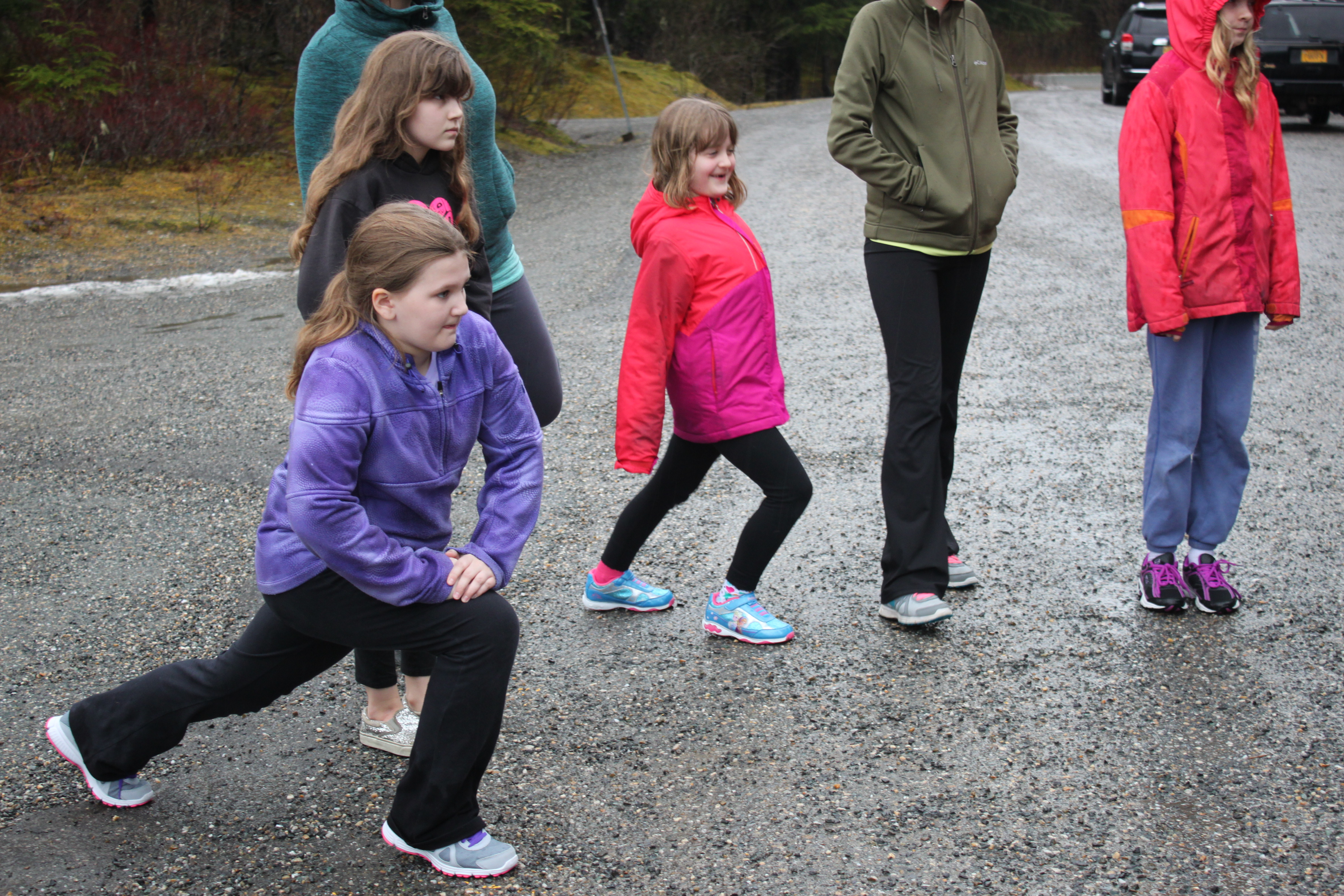
Fifth grader Dani Witt (left) stretches before running. This is her third year doing Girls on the Run. (Photo by Lisa Phu/KTOO)

Juneau’s sexual assault and domestic abuse prevention non-profit is expanding Girls on the Run, an after-school program that aims to empower elementary and middle school girls to be healthy and confident.

AWARE has grown the program in Southeast and wants more communities to join in the movement.

Dani Witt, 10, used to think she was terrible at sports. She compared herself to her friends who she thought were more flexible and athletic.

Now, in her third year with Girls on the Run at Mendenhall River Community School in Juneau, Dani doesn’t have those negative thoughts anymore.

“It has shown me that I have a lot of different techniques about myself that I love and like, and my friends are different and they don’t always have the things I have,” Dani says.

The program has made Dani feel better about herself and teaches her to focus on her positive traits.

“I’m really creative, I make people really happy and I smile a lot,” she says.

Dani is one of about 300 girls from all over Southeast that participate in Girls on the Run each year. AWARE first started the program in 2008 with only 20 participants in Juneau.

Before running, the girls at Mendenhall River Community School sit in a circle for a lesson on positive self talk. (Photo by Lisa Phu/KTOO)

The program targets elementary and middle school girls. Over a three-month period, they discuss life lessons and practice running with female coaches. Each program session culminates in a five kilometer run.

AWARE recently established Girls on the Run of Greater Alaska and wants to partner with other abuse prevention agencies around the state to bring the program to more communities. There’s also a Girls on the Run of Southcentral Alaska.

Julie Walker is a Girls on the Run coordinator for AWARE. She says the program addresses issues, like healthy relationships and standing up yourself, that help prevent girls from becoming victims of abuse.

“We talk about this thing called the ‘girl box.’ It’s basically that girls should fit in this specific box of they should be pretty and they should focus on their looks and they should be in the kitchen, or whatever these traditional gender stereotypes may be that they’re hearing – we challenge those and we try to get girls outside of the ‘girl box,'” Walker says.

The state Council on Domestic Violence and Sexual Assault is helping to fund the expansion of Girls on the Run.

Executive Director Lauree Morton says the council looks for ways to reach different age groups. It funds other prevention efforts like Coaching Boys into Men, Green Dot and recently finished a three-year evaluation of a new adolescent program called The Fourth R, which started in Canada.

Morton says the council is thoughtful and methodical about what programs to get behind.

“We’re bringing them in and we’re pilot testing them through a broad array of communities, so we have urban tests, we have rural tests, we have remote tests to see if they actually will work, and as we see that they work then we’re investing in trying to get them infused into other communities,” Morton says.

Morton says the council is working with AWARE to identify communities that are ready to have a Girls on the Run program. She says the council has start-up funds for a few communities.

Girls on the Run meets twice a week. After discussing the day's lesson, they run laps around the school, working towards completing a 5K. (Photo by Lisa Phu/KTOO)
Girls on the Run meets twice a week. After discussing the day’s lesson, they run laps around the school, working towards completing a 5K. (Photo by Lisa Phu/KTOO)

At the end of a Girls on the Run session at Mendenhall River School, about 20 girls are running laps. Each time they pass a coach, they hear something positive about themselves that they have to repeat. It’s part of the day’s lesson on using affirmative language to describe yourself and others.

Faith Kellar, 10, says Girls on the Run has made her more confident. She feels equipped to handle all sorts of situations, like when she’s confronted with comparing herself to girls pictured in a magazine.

“And you just feel bad about it. And your mom’s like, ‘What’s wrong?’ It’s like, ‘Well, I feel bad that I don’t look like these girls.’ Don’t think that,” says Faith. “Think, like, maybe that’s not the real them. It’s probably just a costume.”

She hopes more girls around the state can experience Girls on the Run. Besides learning about herself and how to interact with others, Faith says it’s just fun.


Juneau delegation plans to introduce bill naming SLAM, outlines budget effects

Sam Kito addresses a full audience at the Central Council  of the Tlingit and Haida Indian Tribes of Alaska's Native Issues Forum. (Photo by Lisa Phu/KTOO)
Sam Kito addresses a full audience at the Central Council of the Tlingit and Haida Indian Tribes of Alaska’s Native Issues Forum. (Photo by Lisa Phu/KTOO)

Juneau legislators plan to introduce a bill to name the State Libraries, Archives and Museum building after Father Andrew P. Kashevaroff.

Of Russian and Native descent, Father Kashevaroff became the first librarian and curator of the Alaska Historical Museum and Library in 1919. He was also the Russian Orthodox priest of Juneau’s St. Nicholas Church.

Rep. Sam Kito III says he and Sen. Dennis Egan will be prime sponsors of the bill.

Both lawmakers, along with Rep. Cathy Munoz, spoke at a Native Issues Forum in Juneau yesterday.

Egan says the SLAM building downtown will be completed spring of next year.

“It’s a huge project. It’s a statewide facility, but thank heavens it’s based here in Juneau. It’s a $140 million structure,” Egan says.

Egan says a lot of funding was secured last year for other capital city projects – $1.7 million towards modifying the berth at Auke Bay for day boats, $3.5 million for repairing the dock facility in Gustavus and about $5 million toward road work on Egan Drive and Glacier Highway. Egan says capitol building renovations are fully funded at $32.7 million.

In the governor’s proposed budget, he says there’s $3 million for the year-round use of Salmon Creek Reservoir, $3 million in deferred maintenance on state buildings, many of which are in Juneau.

Munoz says the proposed budget cuts 329 jobs, including about 50 in Juneau. That included closing the Alaska Public Offices Commission in Juneau and moving two of its three employees to Anchorage.

“The governor just announced that that would not happen and in part, it was due to the advocacy of the Juneau delegation,” Munoz says.

Munoz says there are now four state department heads living in Juneau, up from two when the new administration first came in. At the end of January, Juneau lawmakers wrote a letter to Gov. Bill Walker expressing their concern on the issue.

At the forum, the lawmakers also presented Paralympian and Juneau resident Joe Tompkins with a framed citation from the Alaska Legislature. Tompkins is a four-time Paralympian for downhill skiing.

Joe Tompkins says he's happy to be recognized for his work. Besides skiing, Tompkins coaches high school baseball. (Photo by Lisa Phu/KTOO)
Joe Tompkins says he’s happy to be recognized for his work. Besides skiing, Tompkins coaches high school baseball. (Photo by Lisa Phu/KTOO)

Commercial fisheries commission chief reacts to being on chopping block

Bruce Twomley has been with the Commercial Fisheries Entry Commission since 1982. (Photo by Lisa Phu/KTOO)

The Commercial Fisheries Entry Commission is defending itself against a recent state report pointing out inefficiencies and legislation that could dissolve the agency.

Commercial Fisheries Entry Commission Chair Bruce Twomley is worried about the agency’s future, especially after a bill was introduced last week to dismantle the commission as a cost saving measure.

“We would like to get to the end of this session so that we can do what we can do at our end to try to suggest savings. We hope we’re still in a position to do that. We hope we’re still intact at the end of this session,” Twomley says.

The Department of Fish and Game released a report earlier this month that draws attention to backlogged permit application cases, a slow work pace by the three commissioners who head the agency, and alternatives to the agency’s organizational structure. The commission responded Monday to the report in writing and posted it on its website.

The commission doesn’t take issue with the whole report. Twomley recognizes it includes a lot of praise for the agency and he stands firmly behind one of the report’s recommendations to maintain the three commissioners until all the cases are complete.

“We think that is a very sound recommendation,” he says.

Since its creation in 1973, Twomley says the commission has been going through a deluge of thousands of applications to limited entry fisheries and is now down to the last 28 cases. The report recommends those be complete by the end of June. A more reasonable time frame, says Twomley, is by the end of 2016.

He defends why the commission takes so long to adjudicate cases.

“Some cases are more than 15 years old because we had more than 23,000 applications to work through and the reason is really the volume and complexity of the cases, and the fact that these huge caseloads arrive almost at the same time,” Twomley says.

Rep. Louise Stutes’ House Bill 112 would eliminate the commission by transferring duties to Fish and Game and a division of the Department of Administration.

Twomley says the survival of the agency is vital. He says the commission will likely limit one or more fisheries in the near future, but wouldn’t name them. He says the work the commission does is complicated and specialized.

Twomley has been a CFEC commissioner since Gov. Jay Hammond appointed him in 1982.

“The only reason I’m sticking around is because I think there is some critical work to be done, but if someone wants to force my retirement, that would not be the worst thing that could happen to me. It would not be good, however, I think for the agency or the task and the remaining employees at the agency,” Twomley says.

CFEC has 28 full-time employees including the three commissioners.

The House Fisheries Committee on Tuesday heard an agency overview from the CFEC commissioners. Committee chair Stutes said the Fish and Game report wouldn’t be discussed, but committee members alluded to details in the report through their questions, like the slow pace of adjudication.

Stutes says her bill to eliminate the CFEC will get its first committee hearing March 5.

University of Alaska to launch sexual assault survey next week

After a several month delay, the University of Alaska will launch a survey March 2 that deals with sexual assault on campus.

University of Alaska has this flier about the survey. (Courtesy University of Alaska)

The Campus Climate Survey will go to 15,000 randomly selected students, faculty and staff members. It starts with questions about sexual assault awareness training and asks how well the university deals with reports of sexual misconduct.

The survey then moves on to more explicit questions about sexual harassment and assault. Here’s an example: “Since the start of the school year has someone had sexual contact with you when you were unable to provide consent or stop what was happening because you were passed out, drugged, drunk, incapacitated, or asleep?”

University attorney Michael O’Brien says results of the survey will remain completely anonymous and won’t be published.

“This is a way for the university to get a sense of how big a problem sexual assault and sexual harassment are on our campuses, how good a job are we doing at getting out the message about sexual assault and sexual harassment prevention and whether our training is getting out to our community,” O’Brien says.

It’s been the university’s goal to offer training on sexual assault to everyone in the school community. Incoming freshmen learned about rules surrounding sexual misconduct and where to go for help during orientation last August, staff and faculty were trained before the school year started, and Residential Life has been offering sessions. O’Brien says those are just a few examples.

He says the Board of Regents was trained for the first time during its meeting last week in Anchorage.

“We cannot guess who’s going to receive a report of sexual harassment or sexual assault. It could be you, it could be me, it could be a member of our custodial crew and it could be a Regent and we want them to know as well what they can do if something like that happened,” O’Brien says.

Last May, the U.S. Department of Education put the University of Alaska system on a list of about 60 colleges nationwide being investigated as part of a compliance review or for mishandling sexual assault complaints. That list is now at more than 90.

Federal auditors from the Office of Civil Rights visited campuses in Anchorage, Fairbanks, Juneau and Bethel last October as part of a compliance review, which remains ongoing. O’Brien says the auditors are still going through the more than 10,000 pages of documents the university submitted last year and need to do more interviews.

This is the first time University of Alaska will conduct a campus climate survey. Back in April, the White House had recommended that all colleges do them and provided sample questions. Initially, the University of Alaska modeled its survey after the federal government’s, but O’Brien says there were some problems.

“Harassment online wasn’t addressed in the survey and because we have such a large online e-learning community, we did not want to do a disservice to those parts of our population.
The university planned on doing the survey at the end of last year, but didn’t want it to come out at the same time as finals,” he says.

At that point, the university had received more than 20 complaints of sexual harassment and about a dozen reports of sexual assault since the beginning of the school year.

With no snow, Eaglecrest sweetens season pass perks

Eaglecrest season pass holders can get discounted rates at the Augustus Brown Swimming Pool in downtown Juneau. (Photo by Kayla Desroches/KTOO)

With no snow in the forecast, Eaglecrest Ski Area is teaming up with Juneau’s Parks and Recreation Department to offer perks to season pass holders.

If you bought a pass that you can’t use, you can get a 50 percent discount on rates at the Treadwell Ice Arena, Augustus Brown Swimming Pool and Dimond Park Aquatic Center.

“That came about by many of our season pass holders not being able to use their season passes the way they intended to up on the mountain, so trying to give some recreational outlets for them,” says Jeffra Clough, sales and marketing director at Eaglecrest.

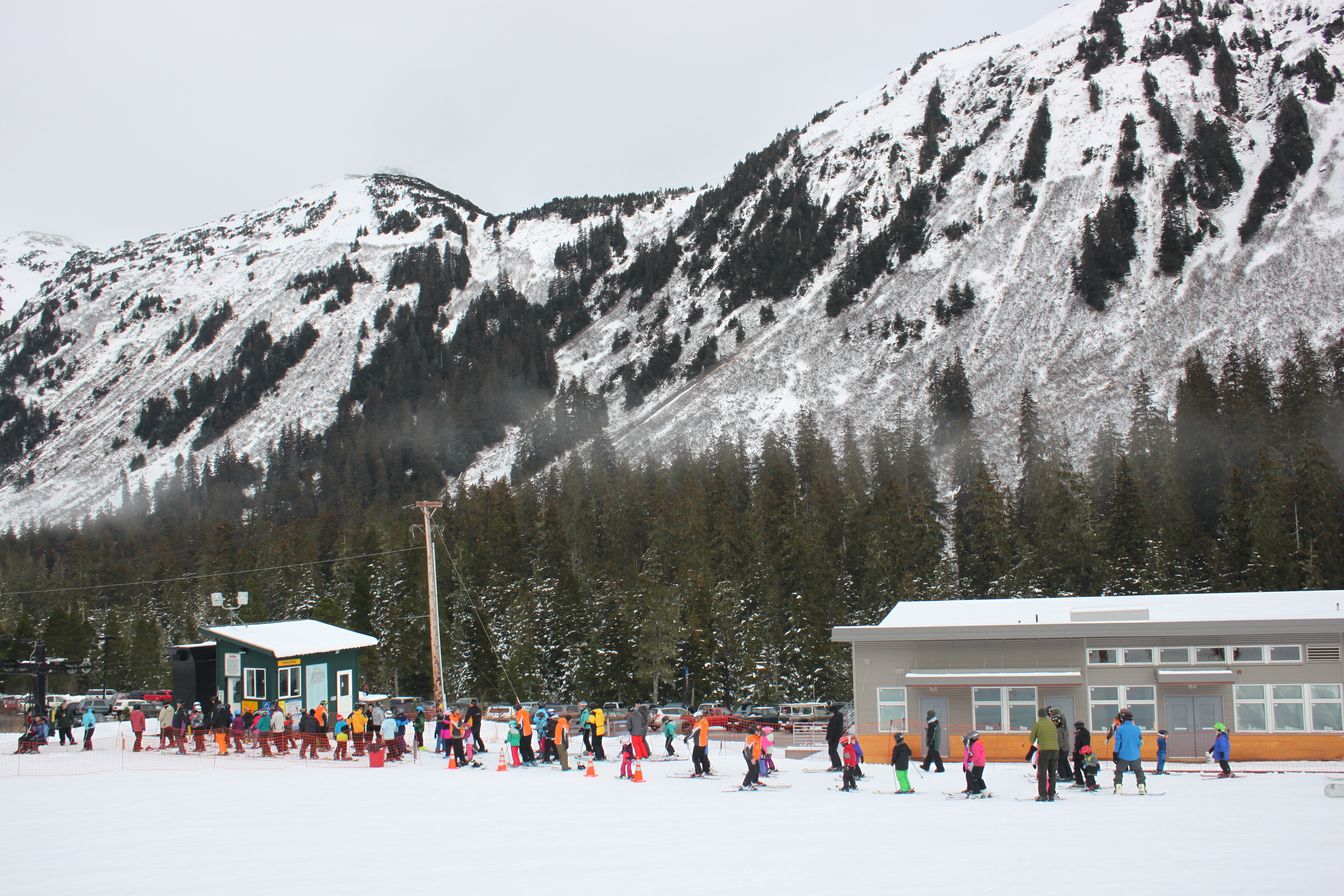
So far this season, the upper mountain has only been open for five days. The Porcupine Chairlift closed in mid-January due to no snow and reopened Feb. 14.

Clough says another bonus of being an Eaglecrest season pass holder is getting free or discounted rates at other ski areas around the country and British Columbia. Eaglecrest has reciprocal ticketing agreements with resorts listed on its website.

Eaglecrest Ski Area
A long line at Porcupine chairlift in early January. (Photo by Lisa Phu/KTOO)

“The closer ski areas are more likely to see some of our season pass holders than, say, the ski area that we have in Vermont,” Clough says. “But I think it’s a cool perk to have for season passes and I would just encourage people if they are interested in going to look for snow down south to kind of take a look at that page.”

Season pass holders also get a variety of discounts at various Juneau businesses.

Eaglecrest has sold about 2,100 season passes this year, similar to previous years. Unlimited season passes for adults ranged from $519 to $719.

Clough says the area is open this weekend and encourages people to utilize Porcupine. The snow sports school has lessons and instructors available.

Editor’s Note: The story was updated to specify what type of season pass ranged from $519 to $719.

House Bill targets Commercial Fisheries Entry Commission for elimination

The F/V Trejo pulls in its nets.
The purse seine salmon fishery in Southeast was designated as limited entry by the Commercial Fisheries Entry Commission. (Photo by Heather Bryant/KTOO)

State legislators are targeting for elimination an agency that limits commercial fisheries permits to conserve and maintain the economic health of Alaska commercial fisheries.

A report by the Department of Fish and Game flagged the Alaska Commercial Fisheries Entry Commission’s three highly paid heads, and their slow pace for adjudicating permit cases.

The Alaska Legislature created a system in 1972 to limit how many people can participate in commercial fisheries. The Commercial Fisheries Entry Commission, or CFEC, was established a year later to administer and regulate the program. Since then it’s opted to limit entry in 68 fisheries. The most recent addition was in 2004.

The report produced by the Department of Fish and Game questions the efficiency and organizational structure of the CFEC, including the need for three commissioners who head the agency of about 30 employees. The commissioners adjudicate cases as part of the process to determine who receives permits to the limited entry fisheries.

The report says the commission takes too long to do this, with the majority of the 28 backlogged cases more than 15 years old. The report says the commissioners adjudicated only three permit applications in 2012 and another three in 2013. In the 1990s, they were going through up to 100 permit cases a year.

Rep. Paul Seaton speaks during a legislative “Lunch and Learn”, Feb. 27, 2014. (Photo by Skip Gray/Gavel Alaska)
Rep. Paul Seaton (Photo by Skip Gray/Gavel Alaska)

This was part of the reason Rep. Paul Seaton introduced a bill at the end of last session to eliminate the commission. HB386 would’ve transferred duties to Fish and Game and a division of the Department of Administration.

“Since CFEC was originally established we’ve got a whole Office of Administrative Hearings. We didn’t used to have that,” Seaton says. “So now we have a whole team of lawyers or judges that look at solving all these cases and if we have a system where we’re not getting them solved or not getting decisions coming out of the current commission model, then maybe we ought to look at changing.”

The bill got one hearing before the session ended. Seaton then requested an audit of the CFEC with a focus on opportunities for consolidation. The Alaska Division of Legislative Audit says it may come out this summer.

Other issues highlighted in the Fish and Game report include the hiring of five retired state employees, some who work from home and are rarely seen in the office, and a lack of leadership and accountability in the agency.

The report lists six alternatives for the organizational structure of CFEC. One mirrors Seaton’s bill, which the report says would likely be the most cost effective. Eliminating the commissioner positions alone would save up to $600,000, mostly in salaries and benefits.

CFEC makes more than it spends. In fiscal year 2014, it had $7.8 million in revenue from commercial fishing permits and vessel licenses, and spent around $4 million. Some of the excess has gone to Fish and Game.

Kevin Brooks is deputy commissioner of Fish and Game. He says the report, initiated by former department Commissioner Cora Campbell, provides good background.

“I think there’s opportunities for some efficiencies and now we’re in a budget climate that’s far different than it was a year ago, too, so any way that we can find efficiencies and save money, that’s going to be helpful,” Brooks says.

But he says the department doesn’t plan on doing anything with the report, which cost about $40,000. He says Fish and Game has no authority over CFEC.

“I would hope that they would find some benefit of the report themselves because nothing is preventing CFEC from taking the initiative to say, ‘This is a good point, we should do that,’ or ‘We don’t agree with that.’ It’s going to have to be a collaborative effort going forward whether that’s driven by legislation or something else,” Brooks says.

On Wednesday Rep. Louise Stutes introduced HB112, which is similar to Seaton’s bill from last year. She says the bill had been “on the radar” before the report came out.

“We are cutting costs in the state and I think every agency needs to be looked at. That’s what prompted it,” she says.

CFEC is scheduled to give an agency overview in House Fisheries Committee, which Stutes chairs. She says the Fish and Game report won’t be discussed. A hearing on her bill hasn’t been scheduled yet.

CFEC commissioner Bruce Twomley declined to comment on HB112, but says the agency will soon release a formal response to the Fish and Game report. He says a lot of issues highlighted could’ve been cleared up if CFEC had had a chance to weigh in before the report was finalized.

Site notifications
Update notification options
Subscribe to notifications