"As Managing Editor, I work with the KTOO news team to develop and shape news and information for the Juneau community that's accurate and digestible."
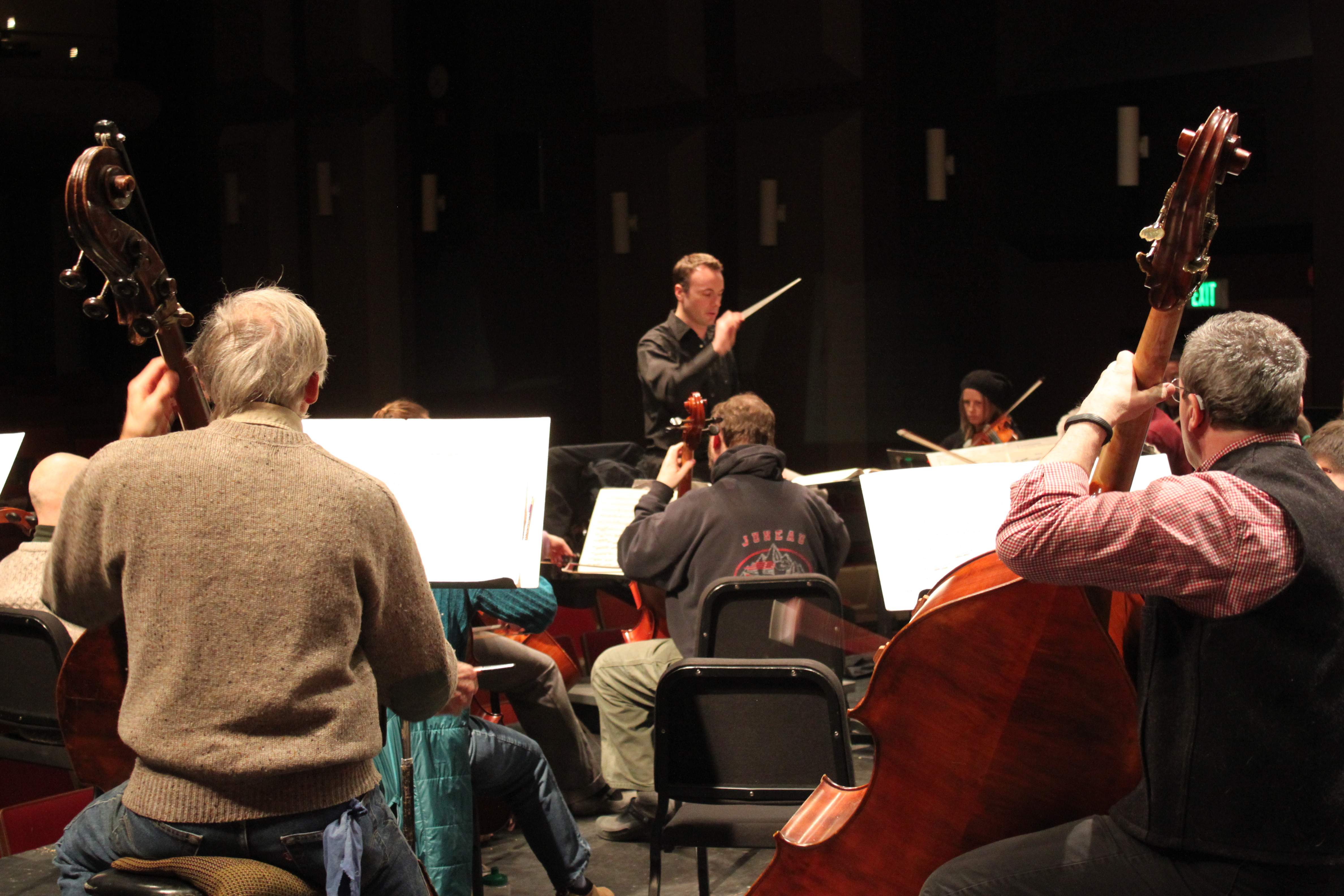
Wesley Schulz leads the Juneau Symphony during rehearsal Tuesday night. (Photo by Lisa Phu/KTOO)
Wesley Schulz is The Juneau Symphony’s second candidate conductor this concert season.
The symphony is trying out three conductors to replace Kyle Wiley Pickett, who was musical director for 14 years.
Schulz will lead the orchestra this weekend through a program called “American Brilliance.”
Wesley Schulz (Photo from The Juneau Symphony website)
Wesley Schulz began his musical life at the age of 3 when he started playing the cello. Later on he picked up percussion and went to Ball State University in Indiana to pursue a career in music.
“It was sort of a moment in the middle of my undergraduate career where I was a performance major and I happened to be in Vienna and I was taking lessons with the timpanist of the Vienna Symphony and I was sitting on stage behind him at a concert and listening and watching and just feeling what it was like to be there,” says Schulz.
“And it just sort of hit me, like, you know what, I want to conduct. I want to be the guy with the stick.”
Schulz got a doctorate degree in orchestral conducting from the University of Texas at Austin. Now, he’s based in Seattle and is the music director of the Bainbridge Symphony Orchestra, Seattle Festival Orchestra and the Bainbridge Island Youth Orchestra. He’s also the conducting fellow at the Seattle Symphony.
“Part of that job allows me to sit in the seats during the rehearsals of the Seattle Symphony and see all these guest conductors come through the door,” Schulz explains. “They’re doing music sometimes that’s familiar but what’s different is their view on it and how they work with the orchestra and how they inspire them and what they unlock within the music, and for me that’s the greatest inspiration.”
The Juneau Symphony performs at Juneau-Douglas High School Saturday at 8 p.m. and Sunday at 3 p.m. There will be a concert conversation with Wesley Schulz an hour before each performance.
He says his job is leading an orchestra in a way that breathes life into the sheet music. He says the Juneau Symphony has been engaged and receptive to feedback.
“What I always try to convey, first to the orchestra and then beyond that to the audience, is what is the composer’s intent – what message is trying to come across in the music, where is this piece going, what is the overall mood of the piece, how can we begin it and end it and take the audience on a journey?”
This weekend, Schulz will guide the Juneau Symphony through five pieces starting with Kevin Puts’ “Millennium Canons” and ending with Tchaikovsky’s “Capriccio Italian.”
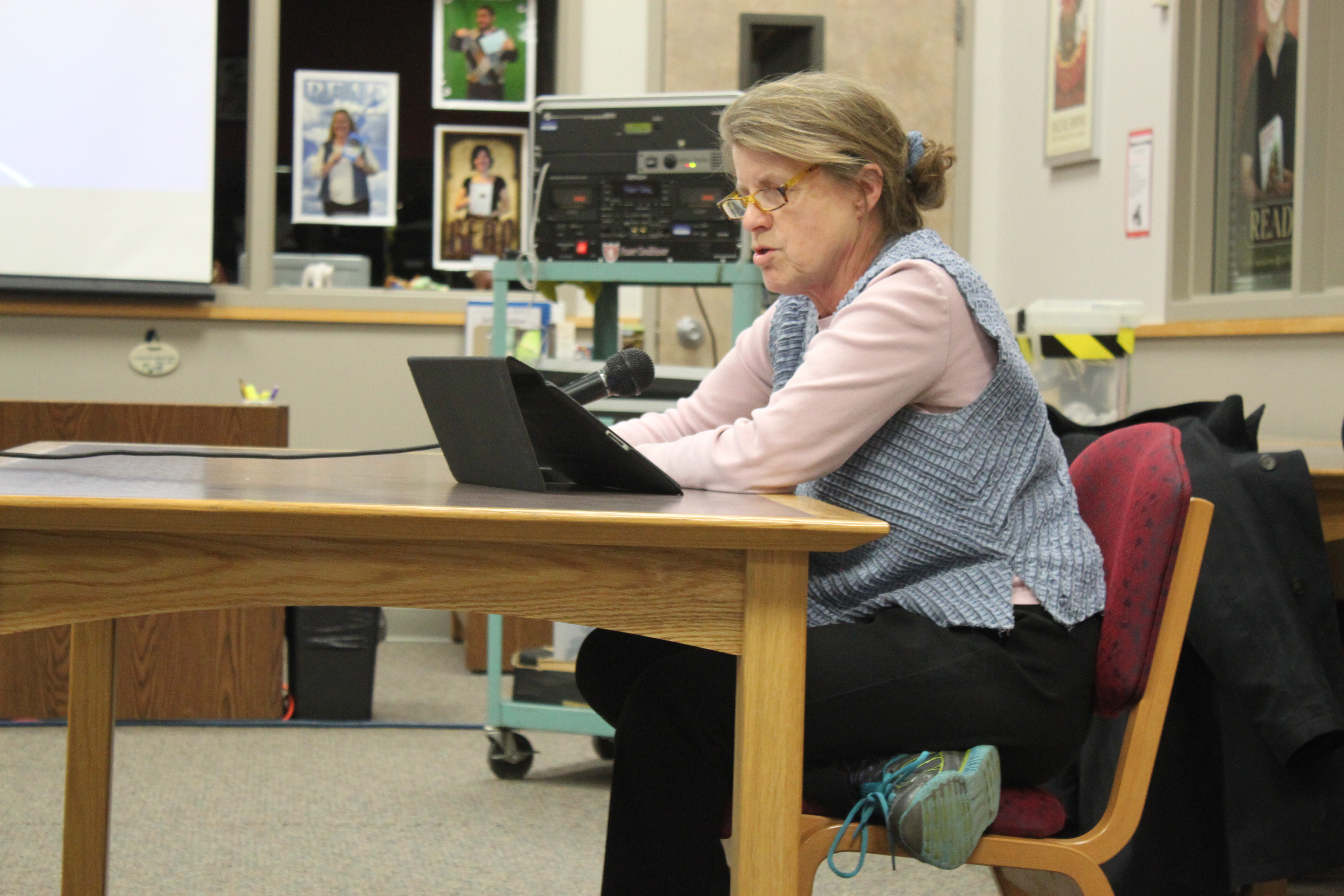
About 20 people attended the school district’s public forum on the budget, but only one person testified. (Photo by Lisa Phu/KTOO)
Only one person from the public signed up to comment during the Juneau School District’s 2-hour budget forum Tuesday night.
Laurie Berg brought up the district’s plans to expand the Montessori Borealis program into its own school, and the extra money the district is likely to gain. Through the change, the district could receive another $800,000 a year or more from the state and city.
Berg said some of that money should go to struggling students at other schools and not just to bulking up Montessori’s staff.
Laurie Berg (Photo by Lisa Phu/KTOO)
“The allocation formula that the board developed was never developed with a high preforming alternative school in mind. A policy call for the board in reviewing their goals should be to revisit the formula,” Berg said. “You’re never going to reduce this achievement gap if you’re going to give your high performing school at a needy time all this additional staff. It just doesn’t make any sense.”
A few principals also reported on what site councils prioritized in cutting and saving.
Gastineau Elementary School Principal Brenda Edwards said her site council advocated not to increase class sizes and thought the best use of instructional coaches was to work directly with students.
In her own comments, Edwards expressed different priorities. She said her school’s instructional coach is an integral part of professional development.
“She was able to provide teachers an opportunity to reflect on their teaching, which we know is the best way to grow as a person and a professional. I would advocate for increasing PTR in order to keep our current instructional coach model,” Edwards said.
PTR means “pupil-teacher ratio.”
The district has six instructional coaches and is looking to cut three.
There will be another opportunity for the public to weigh in on the school budget on Feb. 9.
Open enrollment ends Feb. 15 (Photo by Lisa Phu/KTOO)
People without health insurance have only 11 days left to get it under the Affordable Care Act.
“Feb. 15 is the last opportunity for folks to get enrolled on healthcare.gov. That’s the drop dead date,” says Cherise Fowler, enrollment coordinator with Alaska Primary Care Association, a membership group of community health centers. “If you don’t get enrolled by Feb. 15, then you’re subject to not having coverage all year and you might be subject to a fine next time you file your taxes.”
The organization is holding three outreach events in the capital city this week with the goal of answering questions and signing people up for health insurance, including veterans and people eligible for Medicaid and Denali KidCare.
“We’ve identified a few thousand people that are uninsured in Juneau. They run the risk of having a catastrophe in their life and needing insurance,” Fowler says.
The Alaska Primary Care Association has already done outreach events in Fairbanks, Barrow and Bethel, and plans to visit Ketchikan and Petersburg next. The organization has 15 navigators throughout the state helping people enroll.
Information and enrollment sessions are taking place Wednesday from 4 to 6 p.m. at the downtown public library, Thursday 11:30 a.m. to 3 p.m. at the downtown public library and Friday 4 to 6 p.m. at Heritage Café on 2nd Street.
Participants of the Tlingit Language Learners Group point to the ceiling during an exercise called Total Physical Response. (Photo by Lisa Phu/KTOO)
A group of people in Juneau spend an hour every Monday practicing Tlingit. They bring dictionaries and flashcards, look at handouts and do language exercises. But this isn’t a class.
An informal group that meets at the Downtown Public Library was started by Tlingit language students who understand that learning the language also means teaching it to as many people as possible.
Richard Radford (right) is one of the founding members of the Tlingit Language Learners Group. (Photo by Lisa Phu/KTOO)
Seventeen people sit around a table practicing sounds of the Tlingit language. They’re watching a YouTube video made by X̱’unei, or Lance Twitchell. He teaches Tlingit at University of Alaska Southeast and is a vocal proponent of language revitalization.
But Twitchell’s voice over the speakers is the only trace of a Tlingit language teacher in the room.
The group was formed last spring, a result of a brainstorming session on how to bring Tlingit language and culture to the community in an accessible way. One of its founders Richard Radford has been studying Tlingit for two and a half years.
“We’re all learners and so it is kind of like a class of students getting to sort of call the shots,” Radford says.
Which means the group can go in many different directions.
“Anybody can share pretty much anything. We learned how to introduce ourselves in Persian a little while ago from someone coming in. We’re really open to that. Multiculturalism is a really a big part of this,” he says.
Radford says the group relies heavily on books, dictionaries, YouTube videos and handouts made by more experienced Tlingit speakers.
“There are elders and linguists and artists and culture bearers and professors and other language learners and all sorts of people from all over the place who provide us with so much. We’re just standing on the shoulders of giants,” Radford says.
The group is made up of regulars and others who drop in because they’re curious.
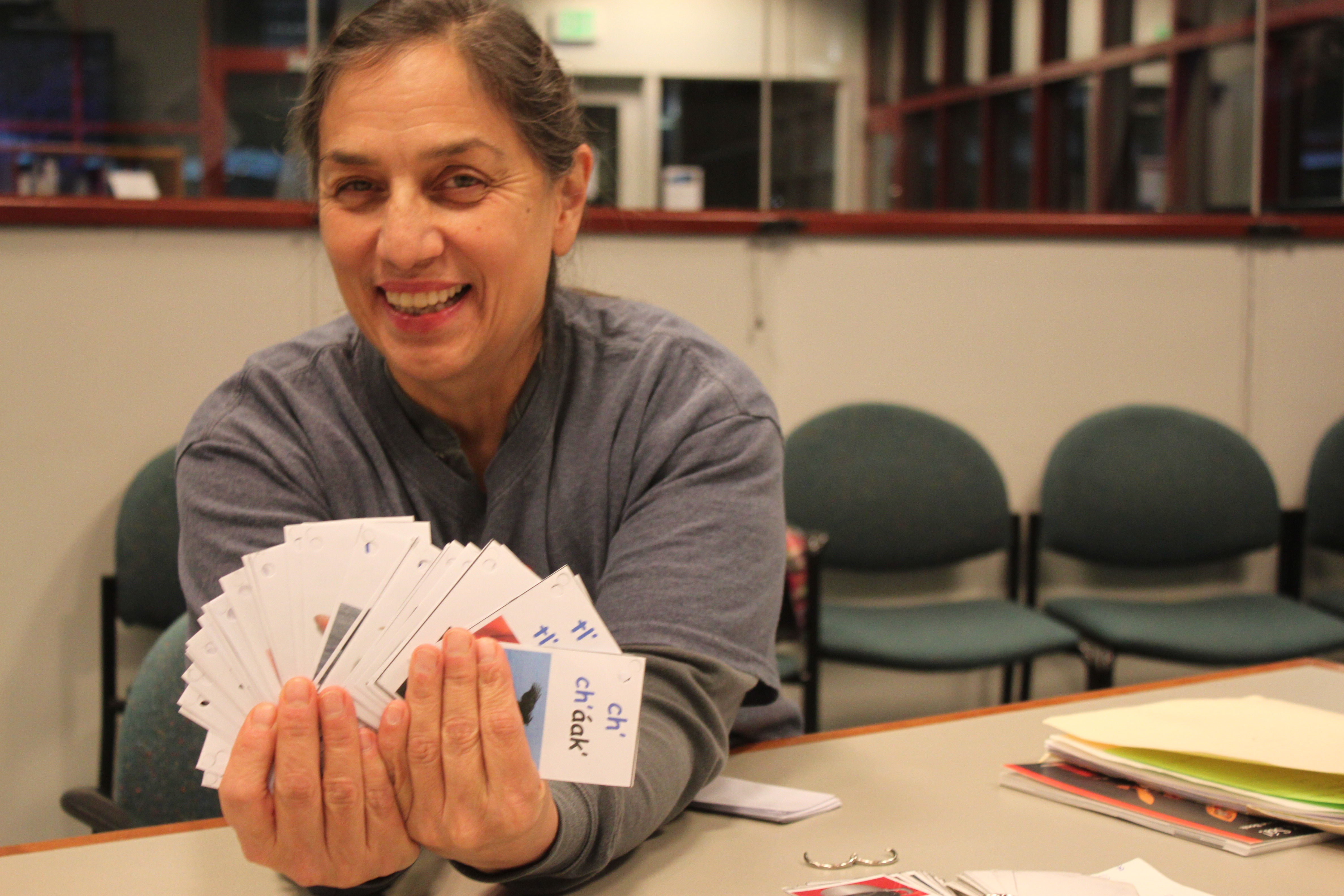
Nancy Keen holds out Tlingit flash cards. (Photo by Lisa Phu/KTOO)
At age 56, Nancy Keen has made it a goal to learn Tlingit. Her grandfather was fluent, but her mother never spoke a word. Keen’s been drumming and singing clan songs with Southeast dance groups for five years and that’s spurred her interest.
“You have to want to know what you’re singing about. And you have to want to know that you should pronounce this stuff correctly because the language is just so subtle in nature that it’s really easy to say something wrong when you don’t mean to,” Keen says.
Tlingit is a tonal language. Similar sounding words that mean drastically different things are distinguished by an inflection of the voice. The group practices these similar sounding words:
“Eech” means reef while “éechʼ” describes something compact and heavy.
Keen says she can’t put full sentences together yet so she’s working hard on memorizing sounds and pronunciations.
She appreciates the group’s passion for making the Tlingit language so available.
“There was a lot of talk about building language nests and now it’s starting to actually come to light, and so that’s how we’re going to make sure we can continue and nurture this language,” Keen says.
The end of the hour comes quickly. A group participant suggests another activity.
“So if anybody wants to stick around and do some extra stuff for another 5 minutes or so, there’s some stuff that we can do that’s kind of more interactive,” says David Sheakley. He’s running an exercise called Total Physical Response, or TPR.
“Instead of just listening to the words and saying them back, you actually have to act them out with your body. It makes connections between your muscles and muscle memory with what you hear and also with what you say,” Sheakley explains.
Sheakley’s family on his father’s side is all Tlingit. Many of them spoke the language and helped spread it. Now, Sheakley sees it as his responsibility.
Like Keen and Sheakley, some in the group are Alaska Native. Radford is not one of them
“I’m definitely European descended. There’s a term dleit káa that gets used sometimes,” he says.
But, as someone living in Alaska, he feels a responsibility to learn the local language.
“We live in a very multicultural state and sometimes people lose sight of that, myself included. I mean we live in Lingít Aaní and I think that we should be learning the language of this place,” Radford says.
Outside of the learners group and class, Radford says he speaks Tlingit “mostly to my cats. I talk to them a lot. I’ve branched out to humans, too.”
Most of the time, he speaks to other learners.
“When we see each other in public it’s pretty much required. We do things online, there are a lot of things on social media. Not as many public events, like we’d like to do this, ideally, every night of the week in town, have this keep going. This is just a Monday,” Radford says.
After the TPR exercise, the group session ends, but the conversation carries on.
The Tlingit Language Learners Group meets 6 p.m. tonight, and every Monday night, at the Downtown Public Library.
The Juneau School District anticipates a deficit ranging from $1.3 million to $3.3 million. (Creative Commons photo by Tax Credits)
As the Juneau School District looks to figure out its budget next year, the biggest obstacle is not knowing how much money it’ll get from the state and city. So it’s come up with four scenarios, ranging from the best case to the worst.
The Juneau School District anticipates a deficit ranging from $1.3 million to $3.3 million. One of the variables is how much the state will give, which is determined during the legislative session. It could affect how much the city can contribute.
The district’s budget is due to the Juneau Assembly by the end of March, about three weeks before the legislature is scheduled to adjourn. .
“So we’re going to have to kind of guess what the legislature will actually do,” says David Means, the district’s director of administrative services. “But we have another two months almost to watch the legislature and usually sometime in there we’ll have some kind of sense of what their thinking is.”
In the past four years, district spending has been almost flat – one time retirement funding aside – while costs continue to rise. This has forced the district to scale back. Just last year, the district eliminated about 19 jobs.
“Special education took a huge cut last year and then classroom teachers also took a cut,” Means says.
In the best case budget scenario for next year, the district would get $65 million from the state and city. Superintendent Mark Miller says the district likely wouldn’t have to cut teachers. In other budget scenarios, it would.
“You really can’t solve multimillion dollar budget crisis by cutting $5,000 here or $4,000 here, you really have to look at the big ticket items when you have to make reductions that right now we’re being asked to make,” Miller says.
In the other scenarios, classes would get bigger in grades three to 12 and high school activities would take a hit, calling for student participation fees. District level expenses, like professional development for teachers and recruitment, would be reduced. Kindergarten to second grade classes would only grow in the worst case budget scenario.
Miller says it’s important to take a balanced approach when making cuts.
“Can I say we’re keeping our activity budget exactly the same, while at the same time putting more kids into a kindergarten class? And I don’t think realistically, you can do just one or the other,” Miller says. “I think realistically you have to try to balance your reductions between elementary, middle, high school and district to do what’s right.”
The district has already explored options suggested by the public, like closing an elementary or high school; Means says neither would save money.
The community gets to weigh in on the school budget during two public forums – one on Feb. 3 and another Feb. 9.
Leading up to the Super Bowl, Genevieve Carson practices with an instrument from the Earth Harp Collective. (Photo courtesy Genevieve Carson)
Former Juneau resident Genevieve Carson is performing at the Super Bowl. The 29-year-old grew up dancing in the capital city and will be sharing the stage with musician William Close & The Earth Harp Collective during the NFL’s Super Bowl Tailgate Party in Arizona.
It’s not the Super Bowl Halftime Show, but it’s still a pretty big gig. Thousands will attend the invitation-only event just outside the University of Phoenix Stadium, where the Seattle Seahawks will face off against the New England Patriots.
“Everything has been kind of just so go, go, go that I haven’t really had time to get nervous,” says Genevieve Carson, a professional modern dancer born and raised in Juneau. She’s choreographed pieces for four dancers, including herself, for a 3-hour performance prior to the big game.
“I’m more just, like, trying to get the job done and be levelheaded about everything because anxiety never helps me. So I’m just trying to stay focused,” she says.
In past years, Lenny Kravitz and The Fray have performed at the NFL Tailgate Party. This year it’s country singers Dierks Bentley and Gavin DeGraw, as well as William Close & The Earth Harp Collective.
Close is an installation artist and musician. His giant harp has strings that span hundreds of yards and fill the space he performs in. Carson and the other dancers will integrate into the band through dance, sometimes playing instruments.
Carson collaborated with designers to create costumes that she describes as epic and ethereal.
“They’re kind of like Burning Man chic, but also like elegant football warrior-esque type costumes. We have these shoulder pads that are also wings, and then we have crazy goggles that make us look like warrior bug creatures. Everything just makes us look larger than life,” Carson says.
Besides dancing, Carson will play the drum orb during the NFL’s Superbowl Tail Gate Show. (Photo courtesy Genevieve Carson)
She started dancing at age 4 in the Janice D. Holst School of Dance. In middle school, she traveled out of state for Scottish Highland dance competitions. She was further trained at Juneau Dance Unlimited, now Juneau Dance Theatre, and was a member of the dance team at Juneau-Douglas High School. Carson got a degree in dance performance from Chapman University in Southern California.
She joined the Los Angeles Contemporary Dance Company in 2009. She’s choreographed several pieces for the company and performed at the Oscars last year.
For the tailgate party, Carson only had two weeks to get everything together.
“I like working like this, like in a pressure cooker. It’s exciting and I feel like the energy never dies,” Carson says.
While performing at the Super Bowl is a milestone in her career, Carson will soon start her dream job as artistic director of the L.A. Contemporary Dance Company.
She isn’t sure if she and fellow dancers will get the opportunity to watch the Super Bowl from inside the stadium on Sunday. But no matter where she’s viewing the big game, Carson says she’ll be rooting for the Seahawks.
Close
Update notification options
Subscribe to notifications
Subscribe
Get notifications about news related to the topics you care about. You can unsubscribe anytime.