"As Managing Editor, I work with the KTOO news team to develop and shape news and information for the Juneau community that's accurate and digestible."
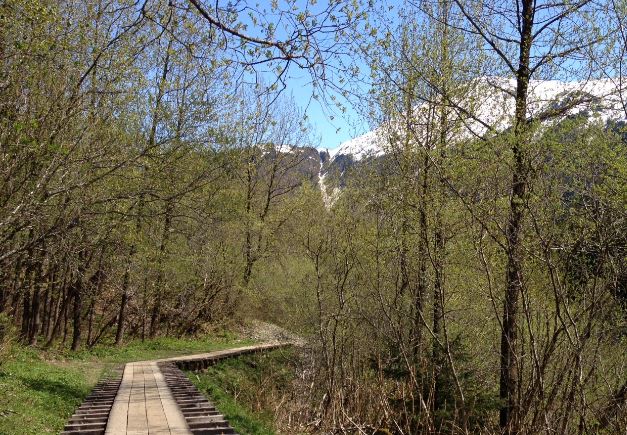
Juneau resident Peter J. McKay, 63, was found unconscious on the Flume Trail on Saturday afternoon. He was pronounced dead after passersby and first responders administered CPR.
McKay was found about a half mile from the Basin Road trailhead.
Juneau Police Department received a call around 4:30 p.m. Saturday.
“The dispatcher heard from the caller that there was a male who had collapsed possibly while hiking and they initiated bystander CPR with that caller,” says Juneau Police spokeswoman Erann Kalwara.
Capital City Fire/Rescue and two downtown police officers arrived at the Basin Road trailhead about 4:50 p.m. The caller met them and directed them to McKay.
“While they were doing that two other individuals who had been walking the trail continued with CPR until the fire department arrived on scene,” says Kalwara.
CCFR assistant chief Brian Long says McKay was declared dead at 5:34 p.m.
This is not the first-trail related death this season. In early May, a 61-year-old Juneau woman was found unconscious off Salmon Creek Trail and was, shortly after, pronounced dead.
Long says trail-related deaths are unusual, but not surprising.
“We have very active trail use here and it’s inevitable at some point somebody’s going to suffer a medical or traumatic incident on one of our trails,” Long says.
McKay’s family has been notified and his body has been sent to the state medical examiner.
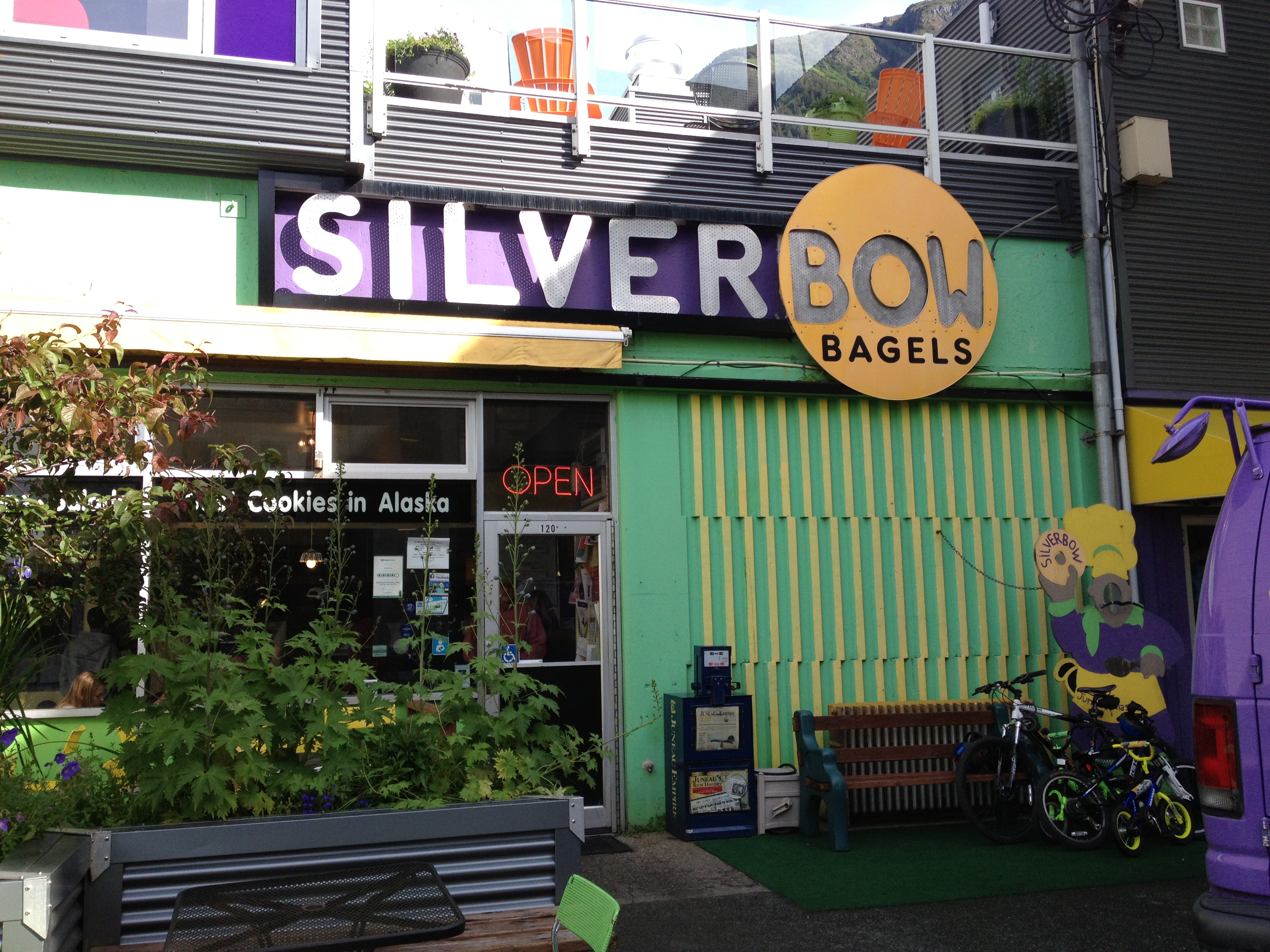
More than a hundred people watched the USA-Germany match of the FIFA World Cup Thursday morning at Silverbow Bakery. (Photo by Lisa Phu/KTOO)
During this time of year, they both can be found at Juneau’s Silverbow Bakery at 8 o’clock in the morning. For the FIFA World Cup, the bagel eatery turns into a community gathering space. Sometimes, only a handful of people are watching. Other times, like Thursday morning, more than a hundred people can be found glued to the game.
It’s half-time during the USA-Germany World Cup match. In Brazil, it’s about two in the afternoon. In Juneau, it’s 9 a.m. Most of the more than 100 spectators in the backroom of the Silverbow should be at work.
“You know, I should be, but I’ve forgiven myself these two hours and I’ll just stay late tonight,” says Juneau’s deputy city manager Rob Steedle.
He’s watching the soccer game with his daughter and son.
“My kids grew up playing soccer since they were five or so and I played, myself, in high school very, very badly,” Steedle says.
Chairs fill up quickly during some World Cup matches at Silverbow Bakery. (Photo by Lisa Phu/KTOO)
Silverbow is packed. Every seat is taken and many people are standing up, lining the walls. That doesn’t stop more people from filing in and finding a few inches of free space to watch the big screen.
Steedle says World Cup exemplifies Juneau’s close knit community.
“A lot of these people, I believe, could be watching at home, but they come here to be together,” he says.
Adults aren’t the only ones playing hooky.
“We got to skip swim practice and watch the game because it’s so important,” says 15-year-old Aidan Seid.
Aidan is part of Glacier Swim Club and practices three hours a day, six days a week. Even if he hadn’t skipped practice, Aidan made sure he wouldn’t miss the big match.
“I had the game recorded at home and I was planning on watching after, but this is much better, watching it live. It’s good to see a lot of people from Juneau in the same room all rooting for the same team,” Aidan says.
Marla Berg got to Silverbow around 7:30 for the 8 a.m. start time. She scored a table but says most had already filled up by then. She’s fiddling with her phone.
“I have a good friend who’s down in Brazil. I just texted her and she said she wasn’t at the game today. She was out in the Amazon eating fried piranha, watching the game on TV,” Berg says.
Silverbow Bakery is a gathering space for World Cup fans. (Photo by Lisa Phu/KTOO)
Watching World Cup at the Silverbow Bakery started eight years ago when some Juneau residents approached owner Jill Ramiel about showing the matches on a big screen ordinarily used for artsy movies. In 2006, World Cup was in Germany and games started at 6 a.m.
“And none of the bars were open, and they knew that we had this big screen and they asked us and I honestly thought maybe four people would show up and then there was like a hundred people there,” Ramiel says.
Back then, Ramiel and her husband lived in the space right above the backroom where the games were showing.
“And my husband and I would wake up to ‘Gooooaaaaaaal!'”
Since 2006, Ramiel has capitalized on Silverbow being a local hot spot to watch the games. For the USA-Germany match, she doubled the staff from four servers to eight. And they’re all needed to serve bagels, muesli, coffee, among other items.
“Our beer sales at 8 a.m. have never been higher,” Ramiel says.
Germany won by one goal and dominated the match. In the final minutes of the game, USA got in a couple solid shots. When neither materialized into goals, the crowd let out screams and exclamations of disappointment. But at least everyone was disappointed together.
This was a normal sight for June. (Photo by Heather Bryant/KTOO)
National and local climatologists had predicted a drier and warmer than normal Juneau June. But meteorologist Rick Fritsch with the National Weather Service says this month has been neither.
So far, the airport has received 7.48 inches of rain, more than doubling what’s normal. Fritsch says this breaks the record for June rainfall.
“The maximum precipitation before this month was 6.69 inches and that was in 2012. We’re already at nearly seven and a half inches so we kind of stomped all over that record. Wettest June on record since at least World War II,” Fritsch says.
High temperatures in June normally average 62 degrees. Fritsch says it’s been about 3 degrees cooler than that.
It reached 69 degrees on June 16, the warmest day of the month. There’s a good chance Juneau will see even higher temperatures during the last few days of June.
“But with only four days left in the month, we’re not going to change those averages very much, so we’re going to end the month cooler than normal,” he says.
Looking ahead, the National Weather Service and Climate Prediction Center forecast a warmer and drier than normal July for all of Southeast Alaska.
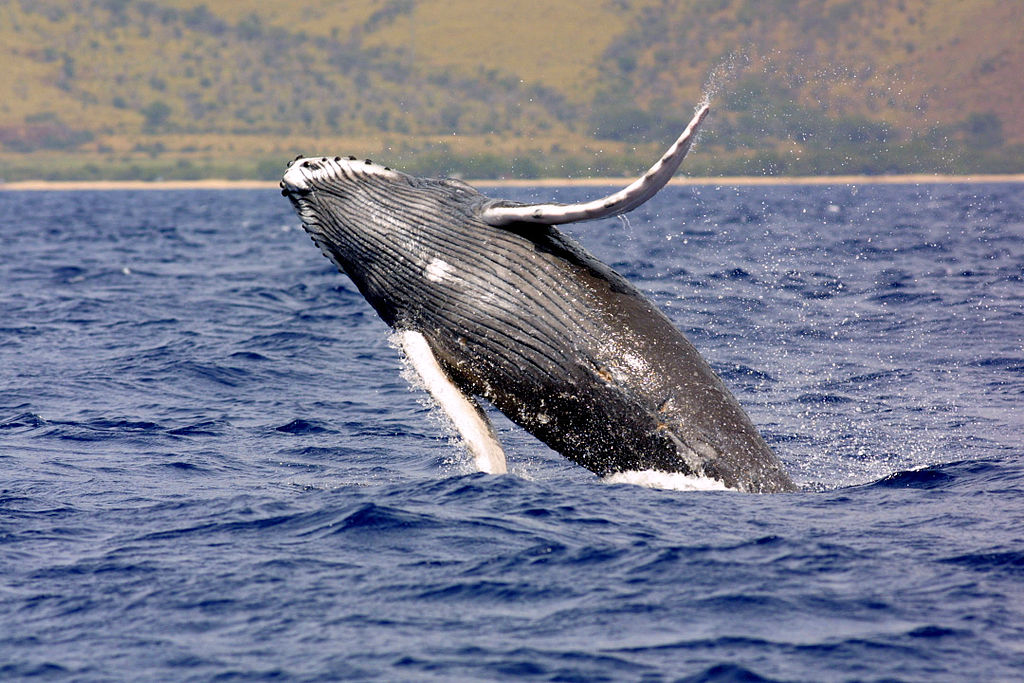
The National Oceanic and Atmospheric Administration is studying whether the Central North Pacific humpback whale should be removed from the endangered species list.
The State of Alaska submitted a petition to remove the whale from the list at the end of February. NOAA announced today it has enough information to warrant further research. This is the second petition NOAA has received to take the endangered status away from humpback whales.
Julie Speegle, public affairs officer for NOAA Fisheries, Alaska Region, says Central North Pacific humpback whales migrate between Hawaii and Alaska.
Now that NOAA is looking deeper into the state’s petition, the agency will study if these whales are distinct from the rest of the population.
“And if so, then whether or not to keep it listed as it is, endangered, or to down-list it to threatened or to delist it altogether,” Speegle says.
In April 2013, the Hawaii Fishermen’s Alliance for Conservation and Tradition Inc. submitted a petition to take the entire North Pacific humpback population off the endangered species list. NOAA determined it had enough information to warrant further research. In response, the state put in its petition.
Doug Vincent-Lang is director for the state Division of Wildlife Conservation.
“Some of the information is less clear about the recovery of whales in the Western Pacific, including in the Asian area, but we thought the evidence was very clear for the primary Alaska population that occurs in the North Central Pacific area,” Vincent-Lang says.
NOAA scientists estimate there are a minimum of 5,833 humpbacks found in the Central North Pacific area. Whales in the larger North Pacific are numbered at 22,000. About 50 years ago, due to commercial whaling, that figure was less than 1,400.
Vincent-Lang says the state’s petition argues the threat of extinction for the North Pacific humpback whale is gone.
“The primary threat was whaling. Whaling’s been dealt with and it’s now regulated as a species under the Marine Mammal Protection Act, so we think, when that threat of extinction has been removed for the foreseeable future and the threats that led to its listing are gone, it’s time to get that off the list,” he says.
NOAA started an in-depth review of the global population of humpback whales in 2010, prior to both petitions.
Marta Nammack is NOAA’s Endangered Species Act listing coordinator.
“We look at things like abundance, spatial distribution, productivity and diversity just to try get an idea of how the species is doing and we look at threats to see what threats the species might be facing,” Nammack explains.
NOAA is also looking for distinct populations.
“If we can separate populations out because they are different enough from each other, then we can list species by population instead of the entire species,” Mannack says.
NOAA is including both the State of Alaska and the Hawaii Fishermen’s Alliance petitions in the larger status review. The agency has already missed the one year deadline to make a decision on the Hawaii Fishermen’s petition. Nammack says NOAA is working as quickly as possible but doesn’t have an estimate for when decisions will come out.
In 2010, the state petitioned to remove the Eastern Stellar sea lion from the threatened species list, which NOAA did last October.
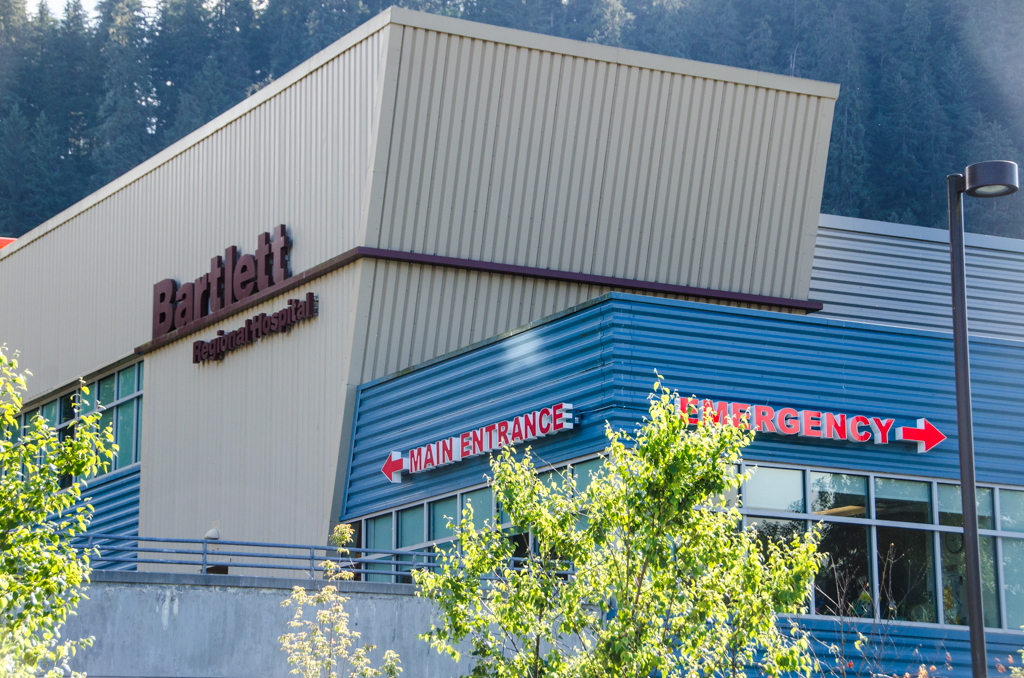
Bartlett Regional Hospital (Photo by Heather Bryant/KTOO)
A Bartlett Regional Hospital survey shows employees think the atmosphere of trust in the organization is adequate – not excellent, not poor, but leaning towards needing improvement. This comes one year after the city hired an investigator to look into complaints of a hostile work environment.
During a regular meeting Tuesday night, the hospital board heard results of an organizational culture survey measuring areas like morale, information flow and customer service.
An organization conducts a culture survey to explore some key questions.
“When you come to work, how much of yourself do you really bring to work? How engaged are you?” asks Mila Cosgrove, human resources director at Bartlett Regional Hospital.
She says an organization with engaged employees has high rates of retention and low rates of workplace accidents and sick leave.
The survey information, she says, is good for management and leadership teams.
“Leaders tend to view their organizations more positively than line workers, so when you go out and you ask your employee population, ‘Hey, what do you think about working here?’ you get a different view, potentially, of how you might view the organization and I think there’s a lot of value in that as well. It helps us ascertain what we’re doing well, what we could be doing better,” Cosgrove says.
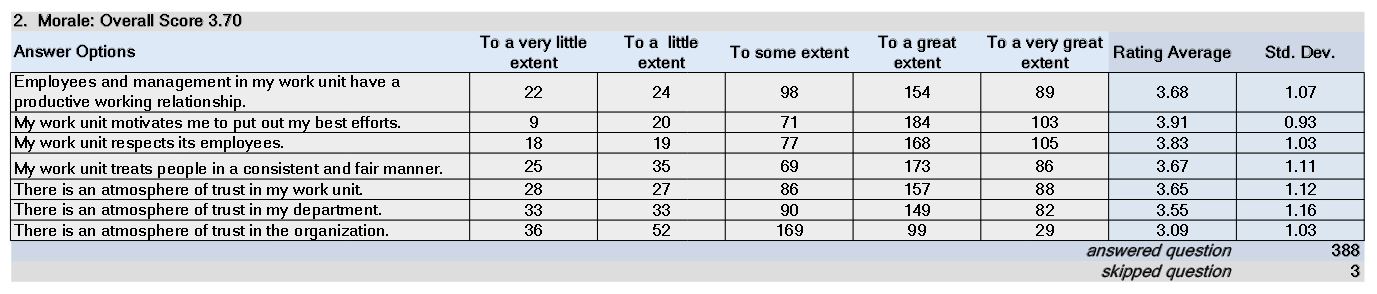
Scores ranged between one and five – one indicating serious problems and five indicating excellent performance. Of the seven questions in the morale category, the one on atmosphere of trust in the organization scored the lowest with an average of just under 3.1.
Morale is considered a critical area of the organization’s culture. (Chart courtesy of Bartlett Regional Hospital)
New Bartlett CEO Chuck Bill says that’s an area he’s paying attention to and something he was asked about during interviews before he joined the hospital in mid-May.
“My intent obviously is to build a culture of trust and a culture of mutual support and I think we’re well down that pathway with the employees. I mean, we’ve got to focus on taking care of the patient. We obviously need great, engaged employees who love to come to work to do that do well,” Bill says.
One year ago, the hospital conducted a personnel investigation into allegations of a hostile work environment created by senior leadership officials. Bill says he hasn’t felt any remains of that sentiment.
“If it was out there, I think people did a really good job of putting that behind them and saying, ‘Let’s move forward enthusiastically together,'” he says.
Bill says it’s challenging to join a team that had leadership problems, but says outstanding personnel issues have been resolved and the hospital is moving forward productively. He did not identify what the issues were.
Of the roughly 500 employees at Bartlett, about 80 percent participated in the survey over a two week period in the spring. It was distributed though work email and employees filled it out online. Participation was anonymous.
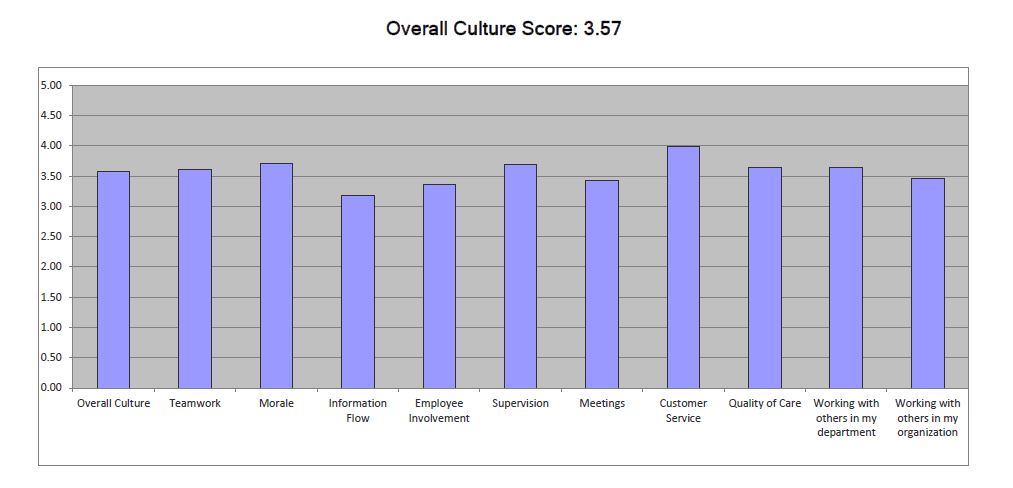
Hospital employees were surveyed on various categories of work culture. The scores ranged from a low of 1.0 to a high of 5.0. (Graph courtesy of Bartlett Regional Hospital)
The category with the highest score was customer service, which, Cosgrove says, doesn’t surprise her, “because people are really rating their own care for others. That one always is higher on surveys that I look at, and that’s a good thing. You want people to take pride in their work.”
The category with the lowest score was information flow.
“Not surprising,” says Cosgrove. “It’s difficult in any organization to make sure that there’s enough communication.”
Following last summer’s personnel investigation, the board directed the CEO at the time, Chris Harff, to communicate better with employees and to the community.
The City and Borough of Juneau started doing culture surveys in 2002 and has done one annually since 2007. Cosgrove says the hospital conducted one a year and a half ago through Press Ganey, a patient experience improvement firm. This is the first time the hospital is doing one based on the city’s model. Cosgrove says it’s more cost effective and a better fit overall. This year’s results will establish a baseline.
Most of the eight categories scored above a 3.5, like teamwork, supervision and quality of care. The overall culture score is 3.6. This figure leads Cosgrove to think employees are generally happy.
“I think if you stopped a random employee in the hall and said, ‘Why do you come to work?’ I think they would be able to tell you that, that they value what they do and they make a difference,” Cosgrove says.
The survey results are useful but, Cosgrove says, what’s most important is how that information is used to move organizational culture from good to excellent.
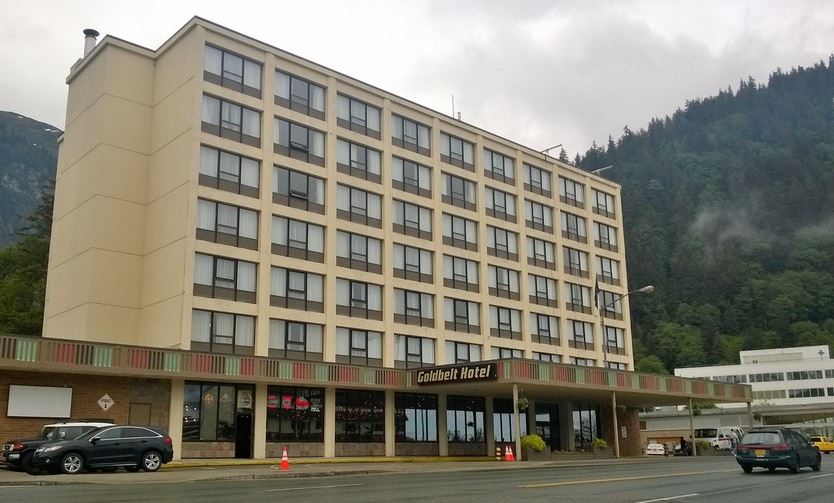
Goldbelt Inc. owns the 104-room Goldbelt Hotel. (Photo by Jeremy Hsieh/KTOO)
The president and CEO of Goldbelt Inc. is retiring at the end of the year.
Bob Loiselle made his announcement during a board of directors meeting June 17. He joined the Juneau-based Native corporation in January 2012 and will finish out his three-year contract obligation.
“At this point, my wife and I have decided that we want to have more free time to be able to go out and do other things. I’m at retirement age, if you will, and with the requirements of this position, it’s time for me to move on and hand the baton to the next CEO,” Loiselle says.
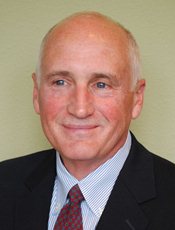
Bob Loiselle (Photo courtesy Goldbelt Inc.)
At age 66, Loiselle has had extensive experience with Native corporations in Alaska. He previously lived in Juneau for 16 years working in several positions for Klukwan Inc., including CEO. Loiselle also led Sitka’s Shee Atika Inc. for 10 years, and was general manager of Orca International Management, an Eyak Corp. subsidiary.
Of his two and half years with Goldbelt so far, Loiselle says he’s most proud of helping to move forward a Goldbelt Ancestral Trust. Shareholders voted in favor of establishing one at a June 7 annual meeting. Loiselle says it’ll be made of three subtrusts.
“There’s a distribution trust which ultimately will pay cash distributions and then we have a scholarship subtrust which will provide scholarships and then finally, there’s a burial benefit or funeral benefit, which will provide death benefits for deceased shareholders and their families,” Loiselle says.
Goldbelt is in the process of buying a FedEx distribution center in Dickinson, N.D. Profits from that will go into the Ancestral Trust.
Locally, Goldbelt owns the Mount Roberts Tramway, Goldbelt Security Services, the Goldbelt Hotel and the downtown docking facility Seadrome Marina. It also has 10 active government contracting subsidiaries. The corporation has about 3,500 shareholders, a third living in Juneau.
Goldbelt’s board has formed a three-person CEO search committee. Loiselle says he’s sure there will be a long list of candidates for the job.
Loiselle plans to sell his Juneau home and move to Roy, Wash., near Tacoma.
Close
Update notification options
Subscribe to notifications
Subscribe
Get notifications about news related to the topics you care about. You can unsubscribe anytime.