
Lisa Phu

Managing Editor, KTOO

"As Managing Editor, I work with the KTOO news team to develop and shape news and information for the Juneau community that's accurate and digestible."
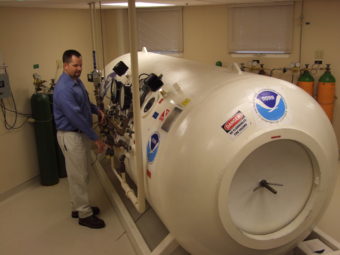
Southeast divers must travel far for emergency care

Scuba diving emergencies can no longer be treated at Bartlett Regional Hospital in Juneau. After more than 30 years, the facility discontinued its hyperbaric chamber program and recently removed the 13-foot chamber.
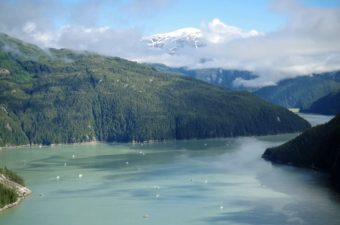
Now, the closest chambers for public use are in Anchorage or Seattle.

Recently retired physician William Palmer remembers when the hyperbaric chamber came to Juneau.

“I was diving with some of the divers from the NOAA lab and it came up in discussion that if there was a dive accident of any significance in the local waters, there was no backup whatsoever,” Palmer recalls.

Palmer was sent to Florida in the late 1970s to study undersea medicine and hyperbaric chamber operation. The National Oceanic and Atmospheric Administration signed a memorandum of understanding with the city and borough of Juneau in 1980, and loaned a chamber to Bartlett Regional Hospital.

Douglas Schleiger is the dive center manager for NOAA.

“Our interest was to have a chamber there so if something were to happen, our people could get treated there, that was our own vested interest in it. It was also a service to the community and local divers,” he says.

Scuba divers are at risk of decompression illness, also known as the bends, which can be caused by a fast ascent, a deep dive, or a long dive. Pressurized oxygen is pumped into a hyperbaric chamber to recreate the underwater environment. Over a period of time, pressure in the chamber is brought to a normal atmospheric level.

Without immediate treatment, a serious case of decompression illness could lead to paralysis or death.

Over the decades, the chamber at the hospital was also used for carbon monoxide poisoning and healing wounds. Dr. Palmer says within the first six months of its arrival, the chamber was used to treat ten cases of monoxide poisoning.

Robyn Free is the director of diagnostic imaging and respiratory therapy at Bartlett Regional Hospital. She says in recent years, use of the chamber dropped. It was last used in December 2011 for wound care, which requires 20 sessions in the chamber.

“And prior to that it was 12 months since they had anyone in the chamber.”

That’s one of the reasons the hospital decided to discontinue the program. Another is cost.

The federal agency Centers for Medicare and Medicaid Services surveyed the hospital last June and said a fire suppression system had to be put in place to continue running the chamber.

“That was going to be $30,000 to $50,000,” Free explains.

The hospital was in charge of maintaining the chamber. But regulations changed, requiring the work be done by NOAA-certified technicians three times a year. Each visit would cost the hospital $3,400.

“We tried to talk to NOAA and say, ‘Hey, it’s your chamber. If you want it compliant and run a certain way, then we need some help from you,’ and they were like, ‘Well, we can’t do that,’ so there was nowhere to go with that,” says Free.

Dr. Alan McPherson works in Bartlett’s Emergency Department. When the program was still running, he was the main provider of hyperbaric care. He says running the chamber required a crew of five individuals.

“There would be the doctor who had some training or experience in hyperbaric medicine and that generally would be me. There would be the dive supervisor. You’d have a time keeper. You’d have an outside tender to run the levers, and an inside tender to watch the patient.”

Dr. Palmer worked at the hospital when the chamber program started and when it ended.

“I thought it was really, really sad to see, even though infrequently used, this very high tech, unusual emergency facility just fall away,” he says. “The point is really that when you need it, you need it.”

NOAA dive center manager Schleiger says he would prefer to keep the chamber in Juneau.

“If there was a way to work it out where it could be up there and operated by trained, certified folks, and liabilities issues are all worked out, certainly I would do that if it’s feasible because our divers have not gone away. They are still there.”

Currently, there are seven NOAA divers in Juneau. State of Alaska agencies have about 30 divers in southeast. According to the state’s Commercial Fisheries Entry Commission website, there are over 430 active permits for Southeast dive fisheries. And there’s diving for recreation, commercial work, and search and rescue.

Kyle Hebert is the dive safety officer for the department of fish and game. Bartlett’s chamber was once part of the state’s safety plan. Now that includes a flight transfer to Virginia Mason hospital in Seattle. Hebert doesn’t know how much money that would cost the state.

“We’re probably more concerned about the cost in terms of likelihood of serious injury or death,” Hebert says.

The hyperbaric chamber was moved out of Bartlett Regional Hospital three weeks ago, and now sits in NOAA storage in Juneau waiting to be shipped to Seattle.


35,000 sockeye caught in first six hours of Snettisham fishery

Gillnet boats had three days to fish in the Port Snettisham and the Speel Arm special harvest area. More than 100 boats showed up for the first day. (Photo by Dave Harris/ADF&G)

50,000 sockeye salmon is the early catch estimate for a 3-day gillnet opening at Port Snettisham and the Speel Arm near Juneau, with 35,000 of those fish caught in the first six hours.
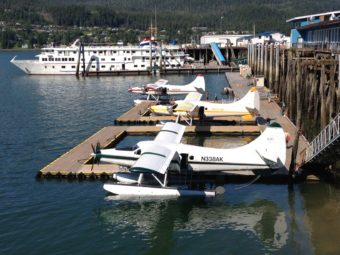
The fishery is targeting sockeye salmon from the Snettisham Hatchery.

The fishery opened 6 am Tuesday, with more than 100 gillnet boats showing up for the first day. By Wednesday afternoon, only a handful of boats remained.

Dave Harris is the commercial fisheries area management biologist for Fish and Game. He says the weekend rain helped at least 4,000 sockeye reach the glacial Speel Lake, which is the minimum escapement goal.

“They hone in on their key stream, the scent of their stream draws them in. They’ll get close and they’ll sort of hold and just sort of wait for conditions to get them, so they get a big blast of fresh water and it just gets them all excited and away they go,” Harris explains.

Harris describes the fishing area in Speel Arm as deep and narrow with depths between 400 and 600 feet deep.

The Snettisham Hatchery was originally developed by the state in 1980 and operated by Fish and Game. Douglas Island Pink and Chum – or DIPAC – took over operation in 1996. The hatchery is located right next to the hydro-electric facility that serves most of Juneau.

“The water that comes out of the plant, that’s kind of their water source, and so it’s quite cold. Sockeye definitely like the cold water,” Harris says.

DIPAC expects a total return of 240,000 sockeye to the hatchery.

The average weight of a hatchery sockeye is around 5 pounds, and the fish are being sold at $1.70 per pound. Harris says that’s the best price he’s seen in a while.

Gillnetters have until noon Thursday to fish in the Snettisham area. Harris anticipates opening the special harvest area for the next several weeks concurrently with the normal gillnet fishery.

CBJ noise ordinance still in the works

Floatplanes are often the source of loud noise downtown near Marine Park. (Photo by Lisa Phu/KTOO)

The assembly is not happy with the draft noise ordinance that would amend the disturbing the peace code.

“It is still in my opinion way too cumbersome and I would argue almost unenforceable the way it’s written, and unrealistic,” said assembly member Jerry Nankervis.

The latest version dictates what times are considered ‘day-time’ hours versus ‘night-time’ hours.

It also defines noise level in terms of decibels, which CBJ attorney Amy Mead says is hard to enforce. She recommends keeping the current code standard, which is defined as a “reasonable person of normal sensitivity.”
“There’s a long and continuous noise that’s going on at 3 am and it’s woken up six neighbors and the officer stands on the street corner and can hear it very loudly coming from this particular house. That’s something that the court and jury can easily understand. You don’t have to prove that this device was tracking the sound properly at the time that the officer wielded it and the officer wielded it properly,” Mead explained.

Assembly member Jesse Kiehl said it’s worthwhile to have an objective standard to go with the “reasonable” standard.

“The increase above ambient noise would be the best approach because it keys off what’s going on in the neighborhood. If you live right next to the highway, the increase above ambient noise is going to be louder than if you bought a place on Sleepy Court, which is ably named.”

Kiehl said this will protect neighborhoods at night.

Assembly member Loren Jones wanted to know how an ordinance without decibel levels would define what’s “reasonable” in residential areas with construction noise. He used the example of improvements at Statter Harbor.

“Does this ordinance the way it’s written or the way you’re proposing to write it make a difference in the way the condo association can argue about construction noise versus what the planning commission might do in terms of construction noise?” he asked.

Mead says it’s up to the assembly, “We can define what the standards to be considered when we’re defining what’s unreasonable in any way that we choose to do so.”

But Mead also made it clear when the assembly has little power over certain activities; for example, in the case of barges.

“We have very limited ability to be able to dictate when they can come in and how loud they can be. We just don’t have the authority to do that. We can’t set decibel levels that are different than would be authorized under the very specific and large federal regulatory scheme.”

Mead will make changes to the current disturbing the peace code before bringing it back to the committee of the whole. She says she’ll add a clear objective to the ordinance, which is to prohibit unreasonable noise. Other changes include outlining standards considered “unreasonable”, and adding “ambient noise” as an objective standard.

Closed door meetings planned to hear report on personnel investigation

Juneau City Hall
CBJ assembly will hold a special meeting to hear a report on the city’s investigation into hospital personnel issues. (Photo by Heather Bryant/KTOO)

The CBJ assembly and hospital board hold separate executive sessions today to discuss a confidential personnel investigation at Bartlett Regional Hospital regarding allegations of a hostile work environment.
CBJ attorney Amy Mead says the hospital board approached the law department at the end of May.

“They were aware of some stories that were going on and complaints. They wanted to look into that and I recommended that they do an investigation.”

The city hired Deborah Schorr of Schorr Advocacy & Investigative Service in early June to conduct an investigation.

CBJ’s human resources director Mila Cosgrove says Schorr has been interviewing hospital employees. “I believe she is just about done with the interviews that she’s been asked to do so we’ll make a report out to the Bartlett board of directors.”

Schorr is still on contract with the CBJ. Cosgrove says it’s uncertain if the investigation is complete.

“It may or may not be depending on what the board decides they wanted to do with the information, or if they would like us to gather more information. That decision has yet to be determined.”

Hospital board officers meet at noon today and plan to go into executive session to hear Schorr’s report.

This evening, it’s the assembly’s turn to hear the report on the investigation, also behind closed doors.

Celebration highlights the reversal of DOMA

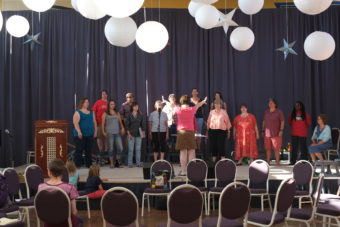
Members of the Juneau Pride Chorus rehearse for Friday night’s Equality for All celebration. The group is one of many live acts scheduled for the event. (Photo by Lisa Phu/KTOO)

A celebration in the Capital city called Equality For All, which centers around the recent Supreme Court’s landmark reversal of the Defense of Marriage Act, is more than an awareness event for equal rights.

“This is basically a giant wedding party,” explains Maureen Longworth, one of nine organizers of the event.

Since DOMA was struck down in June by the US Supreme Court allowing same-sex married couples equal treatment under federal law, Longworth has been celebrating, and wants the rest of Juneau to join in.

“It’s a big deal.”

Fellow event organizer Kimberly Crawford recognizes Alaska still has a long way to go.

“Things are changing but we still don’t quite have the rights that we deserve yet – the full, full rights.”

Longworth knows that change takes time.

She and her partner Lin Davis were one of several couples involved in a 1999 lawsuit against the state of Alaska, filed right after the state amended its constitution to define marriage as only between a man and a woman. The American Civil Liberties Union demanded the state offer domestic partner benefits to employees in same sex relationships.

Six years later, the ACLU won. It was another three years before benefits were actually given.

“It’s been incremental change all the way along. At this point, I really do envision being able to be equal, completely equal, in our state. I’m not sure how long it’s going to take,” says Longworth.

Joshua Decker is interim executive director of ACLU Alaska. Since DOMA was reversed, he’s been traveling around the state conducting informational sessions and having what he calls a “happy conversation.” Juneau is his next stop.

“This is a new area of the law that same sex couples are now being recognized under and so it’s important that Alaskans know what their rights are so they are able to fully enjoy the benefits of being a citizen,” Decker explains.

One example of these rights pertains to the military and federal government employees who’ve been married.

“Civilian and military employees are now going to be eligible for all the spousal benefits in terms of health insurance, dental, life insurance. If you’re a military service member, you’ll be able to live on base, you’ll be able to move off base with the spouse, you’ll be able to get command-sponsored visas. It’s the US government fully recognizing the fact that those individuals are married,” he says.

Crawford is excited to hear about other rights and changes to law at the Equality For All celebration.

“I think we’re coming into a new age where people do realize that equal rights are just that – they’re equal rights – and everyone deserves them.”

Crawford says the recent Supreme Court decision is a big step forward and is optimistic more changes are to come.

The Equality For All celebration at the JACC, featuring local entertainment, food, drinks, and a silent auction, starts Friday at 7 pm. Saturday’s 1 pm event is a Q&A session at McPhetres Hall with a panel of experts discussing how recent Supreme Court decisions will impact same-sex couples in Alaska.


Filing period opens for October election

Nominating petitions must be filed at city hall by Monday, August 12 at 4:30 pm.

The filing period for three assembly and two school board seats starts Friday for the October 1 election.

Assembly positions up for election include a district one seat, currently held by Mary Becker; a district two seat, currently held by Karen Crane; and an area-wide assembly member, currently held by Johan Dybdahl. Two school board seats, presently filled by Barbara Thurston and Lisa Worl, are also up for election. These are all three-year terms.

A person interested to run for election must file a nominating petition signed by at least 25 registered voters.

CBJ’s deputy clerk Beth McEwen says, “There’s 50 lines on the petitions so that people can get additional signatures. We always recommend that they get more signatures than the 25 minimum.”

All candidates must be qualified voters and residents of Juneau.

McEwen says being on assembly and school board is a big commitment.

“They’re the decision-making body for the local government so they have to have the time and availability.”

Nominating petitions must be submitted by Monday, August 12 at 4:30 pm. Petitions are available at city hall or online.

McEwen also reminds residents to register to vote or to change voter registration by September 1 in order to participate in the October 1 election.

Update:

Becker has already filed for reelection on the assembly. Bill Peters submitted a petition for the area-wide assembly seat, and Thurston and Worl have filed for school board seats.

Site notifications
Update notification options
Subscribe to notifications