"As Managing Editor, I work with the KTOO news team to develop and shape news and information for the Juneau community that's accurate and digestible."
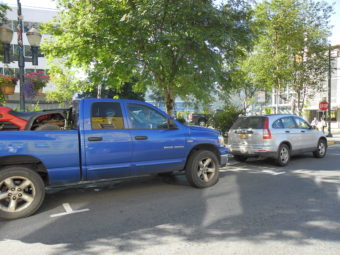
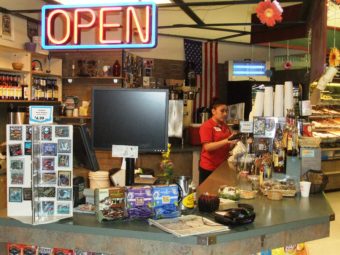
A motorist follows the parking rules and registers her car at the Downtown Transportation Center parking garage. (Photo by Lisa Phu/KTOO)
CBJ parking enforcement begins again today.
An Alaska Supreme Court decision earlier this year nullified citations not delivered in person. That meant parking enforcement couldn’t serve tickets to vehicles; instead a ticket had to be served to the violator.
Issuing a parking ticket in person just isn’t efficient says Community Service Officer Bob Dilley, “A good use of a person’s time is not waiting for one person to come back to their car to issue them a simple parking ticket for being parked, let’s say, 12 inches from the curb.”
The CBJ assembly passed an ordinance in May allowing the city to handle its own parking violations, and community service officers stopped issuing citations on a wide-scale.
The transition is now over and the city will resume leaving tickets under car windshield wipers.
Deputy city manager Rob Steedle says parking violation appeals will go before a CBJ hearing officer, “We haven’t experienced a lot of appeals in the past, so we don’t think the volume will be great.”
Appeals can only be made for citations issued starting today.
Construction began on a True North Federal Credit Union branch inside Foodland IGA, which will feature an exterior ATM. (Photo by Rosemarie Alexander/KTOO)
Work began yesterday on a new downtown True North Federal Credit Union branch inside Foodland IGA. Next in line is welcoming Heritage Coffee Roasting Company.
The credit union will be located in front of the grocery store’s check stand area where the service center used to be.
True North’s Juneau area branch manager Jacob Parrish says the new location will offer a parking lot, better hours, and more services.
“It’ll be a full service branch so everything that was available at the previous one will still be available to members. Only this time, we’re also going to be putting a brand new ATM that’s going to have the ability to receive checks and cash for deposit.”
The current Court Plaza branch has three employees, which will likely increase to four at the new location. Construction completion is scheduled for late-September and new hours will be Monday through Saturday, 10 am to 6 pm.
Foodland owner Tyler Myers says his Washington-based company, Myers Group, also just signed a sub-lease agreement with Heritage Coffee Roasting Company to run an in-store café.
When Heritage Coffee opens up in Foodland, the grocery store will no longer run its current espresso department.
“It was just a matter of who was going to run the coffee shop and I felt that they could do a really, really good job and they felt it would be a great location for them and it seemed to make sense for everybody so we’ll focus on selling groceries and they’ll focus on being great at coffee,” Myers explains.
The existing coffee stand at Foodland IGA will be eliminated once Heritage Coffee Roasting Company moves in to run an in-store cafe. (Photo by Rosemarie Alexander/KTOO)
Myers says the current coffee stand employees have been given the option of either working for Heritage or staying with Foodland in a different department.
Heritage Coffee president Grady Saunders says the in-store café will occupy 700 square feet, a larger area than what the coffee stand is in now.
“It’ll just be mostly drinks and it’ll have its own seating. I think three tables and a bar with five or six seats in it. They’re putting windows in to look out into the parking lot. We’ll have wireless like we do in all our cafes and our basic design.”
This will be Heritage Coffee’s ninth location in Juneau.
Next to Foodland is 6,000 sq. ft. of empty space, which used to be part of Foodland Super Drug.
Gary Rosenberger is president of Foodland Inc., the company that owns the Foodland shopping plaza. He says Myers has expressed hopes of using the empty space to expand Foodland into a “one-stop-shop” that would include a pharmacy, the liquor store located next door, and the hardware store on the other side of the plaza.
“I’d almost rather have it vacant and wait for his stuff to come up than to give it away just willy-nilly, ’cause if he doesn’t have the room, he can’t do the work. I think his ideas are nice. They’re good layouts. I’ve seen what he wants to do. When you walk into the store you just got this freedom to go from one to the other without going into the weather,” Rosenberger says.
Myers says it’s undetermined whether he will lease and expand into the vacant space, although he says he is working on bringing a pharmacy into the store.
Open house visitors learn about a spiny dogfish tagging program during the tour. (Photo by Lisa Phu/KTOO)
All ages were welcome at the open house in honor of Ted Stevens Day. (Photo by Lisa Phu/KTOO)
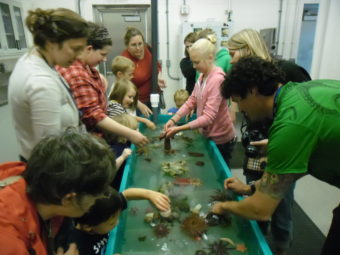
The touch tank was a popular part of the open house. (Photo by Lisa Phu/KTOO)
A young visitor looks through a microscope at a fish otolith. (Photo by Lisa Phu/KTOO)
Kids pose with a sea otter during the family-oriented open house. (Photo by Lisa Phu/KTOO)
Parents and children explore inter-tidal creatures at NOAA's touch tank. (Photo by Lisa Phu/KTOO)
The Ted Stevens Marine Research Institute opened in 2007 and cost $51 million. (Photo by Lisa Phu/KTOO)
This is the first time the Ted Stevens Marine Research Institute has held an open house to celebrate Ted Stevens Day. (Photo by Lisa Phu/KTOO)
The view from the Ted Stevens Marine Research Institute at Lena Point. (Photo by Lisa Phu/KTOO)
NOAA fisheries biologist Wyatt Fournier explains what goes on in the necropsy lab during an open house tour. (Photo by Lisa Phu/KTOO)
Hundreds of people poured into Juneau’s Ted Stevens Marine Research Institute, or Auke Bay Laboratories, on Friday, a day set aside to honor its namesake and his legacy in Alaska.
The late Ted Stevens served the state in the U.S. Senate for 41 years and left a major mark on fisheries protection laws.
Stevens was killed in a plane crash in 2010 and the next year the Alaska Legislature made every fourth Saturday in July “Ted Stevens Day.”
It was July 27th this year, so the National Oceanic and Atmospheric Administration hosted an open house the day before at the Auke Bay laboratories.
Nine-year-old Blake Plummer is holding a sea anemone.
“It’s really sticky. It’s like squishy and it’s like really clear. If I put my finger on the tentacle, it like sticks a little bit,” she describes.
The kids and parents hover over the touch tank. Inside are inter-tidal organisms like sea stars, urchins, sea cucumbers, and hermit crabs.
Lucky for them it happens to be a special day.
This is the first time the Ted Stevens Marine Research Institute has held an open house to celebrate Ted Stevens Day.
The 69-thousand square foot facility opened in May 2007 and cost $51 million.
Director Phil Mundy says naming the facility after the senator was obvious.
“Ted Stevens was responsible for a lot of the legislation that’s protected our fisheries and brought the fishing industry into our ports and onto our shores. We just wouldn’t have any sort of fisheries nowadays without the efforts that Ted Stevens put in when he entered the Senate in 1968.”
Congress passed the Magnuson-Stevens Fishery Conservation and Management Act in 1976. It’s the primary law governing marine fisheries in the United States.
“Senator Stevens really had vision and also he had tenacity. He could really get in there and slug it out for what he wanted, so he not only got the Fishery Conservation and Management Act passed, he also developed this over a period of nearly 30 years into the legislation that it is today,” Mundy says.
Wyatt Fournier is a NOAA fisheries biologist at the Auke Bay labs. On this day, he’s also a tour guide. He guides a group to the necropsy lab.
“So if we find a marine mammal that’s washed up on shore and we don’t know how it died, this is the only place in Juneau you can bring it,” Fournier explains.
NOAA public affairs officer Julie Speegle says the Ted Stevens Day open house brought a lot of people to the research institute, including the late Senator Stevens’ wife, Catherine Ann Stevens.
“She took the tour, looked around at things, and really liked what she saw. She also took the time to speak to the employees here and told them how she’s very interested in their work and really supports what we do here.”
Research taking place at the labs on the status of fish stocks, fish habitats, and marine ecosystems helps develop policy for fishery management.
Cara Rodgveller works in the marine ecology and stock assessment program. She says she loves watching how excited the children get at the touch tank.
“‘Cause I remember being like that when I was little and seeing fish, and growing up fishing, and that’s why we got into this business,” she explains.
Blake Plummer contemplates her favorite thing in the touch tank, “Uh, probably that sea cucumber.”
Who knows, perhaps one day Blake will be working at the Ted Stevens Marine Research Institute.
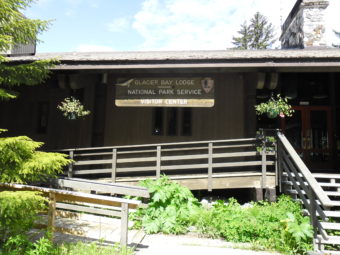
A 2-year extension to the current concession contract would keep Glacier Bay Lodge and the Fairweather Dining Room open after this year. (Photo by Lisa Phu/KTOO)
The National Park Service and Aramark are negotiating a two-year extension for a concession contract at Glacier Bay Lodge.

Aramark and Huna Totem Corporation, in a joint venture, hold the current 10-year concession contract which expires at the end of this year. Glacier Bay National Park and Preserve put out a prospectus for a new concession contract in January but received no bids.
Now Glacier Bay National Park superintendent Susan Boudreau says the park and Aramark are looking for an agreement that provides a business opportunity for the company and protects taxpayers’ interest.
“I’m very hopeful that a resolution will soon be forthcoming. Absolutely. The conversations remain fruitful and constructive,” Boudreau says.
Aramark is taking the lead on discussions with the national park, but Huna Totem CEO Larry Gaffaney says the corporation will remain a joint-venture partner if a two-year contract is negotiated.
Glacier Bay Lodge contains 56 rooms, which accounts for about half the rooms available in all of Gustavus, a town of 450 residents.
Gustavus’s “economy is threatened” by the potential closure of Glacier Bay Lodge, says Senator Lisa Murkowski. (Photo by Lisa Phu/KTOO)
During a U.S. Senate Energy and Natural Resources committee hearing Thursday, Sen. Lisa Murkowski pushed National Park Service Director Jon Jarvis for a resolution.
“The people of Gustavus are notably anxious and stressed. If the concession doesn’t move forward, you really do have a situation where the town’s economy is threatened,” Murkowski said.
Boudreau says a two-year contract extension would make it possible for the lodge to stay open for 2014 and 2015, and allow the park to conduct a feasibility study for a new 10-year prospectus.
A layout of the arts and culture complex within the Willoughby District. (Image courtesy of James Bibb/North Wind Architects)
A future performing arts complex is essential to the development of what’s known as the Willoughby District, according to a local architect.
The Juneau Arts and Humanities Council and Perseverance Theatre are teaming up to create a Willoughby Performing Arts Complex.
North Wind architect James Bibb at Thursday’s Chamber of Commerce luncheon speaking on the development of the Willoughby District. (Photo by Lisa Phu/KTOO)
North Wind architect James Bibb says the collaboration is critical for how the rest of the district grows. Bibb spoke at the Chamber of Commerce luncheon yesterday.
“If the buildings around the arts and cultural district are developed, it starts to build a neighborhood, build an identity. It creates a campus.”
The complex would be the new home for Perseverance, containing the theater, rehearsal space, offices, and costume shop.
Perseverance artistic director Art Rotch says the current theater building is nearing the end of its life. Being part of the Willoughby Performing Arts Complex would mean moving from Douglas, which has been the theater’s location since it was founded in 1979.
“That’s tough, but the theater serves the whole community, in fact the whole state, so we have to think about how to do that best,” Rotch says.
A Willoughby Performing Arts Complex will be an expansion of the current JACC building. (Photo by Lisa Phu/KTOO)
Nancy DeCherney is executive director of the Arts and Humanities Council. She says the new arts complex will also have a second theater for public use, a restaurant and bar, apartments, offices, and a potential dance studio.
“The apartments and offices would offer both mixed use in the neighborhood and give us operating income to support the facility.”
The goal, says DeCherney, is to expand the JACC by building into the parking lot. This would take away 55 parking spots, an idea she’s gotten unfavorable reaction to.
“The parking in this area is a problem whether we build it or not, and maybe we can use this project as a way to have community conversations about ways to solves the issues in the Willoughby District with regard to that,” she says. “That’s how I’m approaching the parking – yes, it’s a problem. Let’s fix it.”
The State Library Archives Museum (SLAM) project is being built within the Willoughby District. (Photo by Lisa Phu/KTOO)
Last year, voters approved an extension to Juneau’s 1% sales tax allocating $1 million towards a JACC expansion.
DeCherney says the current estimate for a new performing arts complex is around $18 million. DeCherney hopes to see the project started within five years.
Thousands of chum salmon return to DIPAC's Macaulay facility where they were released 4-5 years ago. (Photo by Lisa Phu/KTOO)
Fish ladder at DIPAC. (Photo by Lisa Phu/KTOO)
Eggs pour out of a female chum in the DIPAC eggtaking room. Each fish has about 2,000 eggs. (Photo by Lisa Phu/KTOO)
Milt from at least eight male chum go into a bucket full of eggs. (Photo by Lisa Phu/KTOO)
Male chum wait for their turn to give sperm. (Photo by Lisa Phu/KTOO)
The eggs are rinsed with water several times before being put in the incubators. Cleanliness is essential, says DIPAC executive director Eric Prestegard. (Photo by Lisa Phu/KTOO)
The incubators are stacked and kept in the dark throughout the winter. (Photo by Lisa Phu/KTOO)
DIPAC's Macaulay hatchery on Channel Drive sees a lot of visitors, both locals and tourists. (Photo by Lisa Phu/KTOO)
The presence of chum salmon at DIPAC in July is overwhelming. (Photo by Lisa Phu/KTOO)
Chum salmon at DIPAC. (Photo by Lisa Phu/KTOO)
Commercial fishermen catch salmon at Amalga Harbor in 2013. Commercial openings begin Thursday. (Photo courtesy of Dave Harris/ADF&G)
Eric Prestegard is executive director of DIPAC. (Photo by Lisa Phu/KTOO)
For the first time since it started in 1976, Douglas Island Pink and Chum – better known as DIPAC – is operating in the black. The salmon hatchery recently finished paying back 42 million dollars of loans and interest, and is getting more salmon to the commercial fishing fleet than ever before.
DIPAC rears and releases chum, coho, sockeye, and chinook, but chum salmon is the organization’s main species for recovering operational costs. KTOO News recently visited DIPAC’s Macaulay facility to watch the process of chum salmon egg taking.
Thousands of chum salmon are swimming up the DIPAC fish ladder this week. They began their life at this facility four to five years ago.
“We release fish here so they come back here,” explains Eric Prestegard, DIPAC’s executive director.
The fish are returning from years in the open ocean. Once they make it to the top of the ladder, they enter an assembly line.
“Next box is electro-anesthesia machine. We just literally put a charge in there, and it stuns the fish and then down they go.”
The fish spill out, down a short metal slide where they are sorted by gender. The females go to a room where an egg taker gaffs each fish under its lower jaw and slits the belly. Eggs pour out in a steady stream of pink.
“There’s about 2000 eggs per female. We go through a lot of fish. We probably go through 150,000 to get our full needs,” says Prestegard.
The males are waiting for those eggs. A fish handler holds a male chum with two hands, bending it in such a way that sperm shoot about two feet into a bucket of eggs. Sperm from at least eight males will go into each bucket.
“We want to make sure we get fertilization and we want to make sure that we’re having full genetic diversity,” Prestegard says.
Buckets full of eggs and milt are transferred upstairs to a spacious dark incubation room.
“He’s stirring it up, stirring just to make sure it’s nice and mixed, then adds water,” Prestegard explains. “He’ll stir them again, and that way hopefully the water activates the sperm, so we should have massive fertilization taking place right now.”
The eggs are rinsed with water and poured into an incubator.
“We put about 200,000 eggs in each incubator, five incubators to a stack, so about a million eggs per stack.”
DIPAC has 650 incubators that fit 125 million chum salmon eggs. Prestagard says the goal is 94 percent survival. “They’ll hatch out in probably October. Then they’ll come out in March and we move them out to the release locations.”
Earlier this month, the seine fleet harvested an estimated 650,000 fish at Amalga Harbor, making it the second biggest seine catch of chum salmon in a single opening in Southeast Alaska.
Ron Josephson is Fish and Game coordinator and section chief for the hatchery program. He recalls going to Amalga last year, the first time DIPAC made the chum available to the commercial fleet. One opening saw almost one-hundred seine boats.
“DIPAC was kind of the product of one person’s inspiration. That was Ladd Macaulay. And many of his children were out there seeing that fishery when I was out there and they were all just happy. They realized that that was part of their dad’s dream, was to see things like that happen.”
Chum salmon released at Amalga Harbor were once intended solely for recovering DIPAC costs. Now that the hatchery has broken even, it’s able to give commercial seine boats a piece of the action.
DIPAC had a total return of four million chum salmon last year. Already, DIPAC’s Prestagard says this year’s chum return has surpassed that.