Lisa Phu

Managing Editor, KTOO

"As Managing Editor, I work with the KTOO news team to develop and shape news and information for the Juneau community that's accurate and digestible."
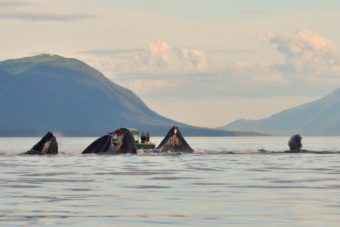
Is whale watching crowding humpbacks in Alaska?

Is the North Pacific humpback whale no longer endangered? The National Oceanic and Atmospheric Administration could decide as early as today whether to pursue taking the whale off the Endangered Species list.
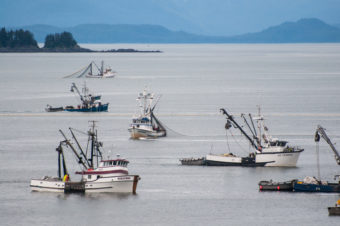
A group of Hawaiian fishermen submitted a petition to de-list humpbacks in April and the agency will determine if it has enough credible information for further review.

Removing the North Pacific humpback from the Endangered Species list would require NOAA to revisit an important regulation specific to watching humpback whales in Alaska waters.

The rapid growth of Juneau’s whale watching industry may be causing some vessels to overlook regulations and guidelines.

“There’s probably eight to ten whales that I can just look at and say, ‘That’s Willy,’ or, ‘That’s Sasha,’ or, ‘That’s Sheila,’ or ‘That’s Monty.’ Flame is out here, you can recognize her very quickly. Spot’s out here, so we recognize her,” explains Larry Dupler, better known as Captain Larry. Dupler started conducting whale watching trips with Dolphin Tours in 1994, back when there were only a handful of local companies on the water.

“Sasha has a scar across her back and down her right side, and on her backside of her tail, she’s got the initials AK on the bottom left fluke,” he says.

Dupler helped start Orca Enterprises in 1997 and has been with the company ever since.

“Some of these whales I know and I know they know me, almost have a personal relationship with some of them.”

But, he says, not all captains feel the same way.

“If you watch the way some of the captains handle their boats around the animals, they’re not worried about the animal itself. They’re more worried about their customers and making them happy, getting them a good show, and some of them even violate the guidelines and regulations that we have in place.”

By 2001 it was clear to NOAA that humpbacks in Alaska were particularly vulnerable to pressure and potential harm from increased vessel traffic and whale watching. The Protected Resources Division came up with the “hundred yard rule” making it unlawful to approach within 100 yards of a humpback whale in Alaska waters.

While establishing the regulation, NOAA considered a permitting system for the whale watching industry, but concluded it didn’t have sufficient infrastructure.

No permitting system exists for vessels that want to enter the industry.

Weather Permitting owner and captain Greg Brown says whale watching should be more tightly regulated, “There is a lot of abuse and a lot of whales getting run over and pressured. That can be avoided if we changed the rules a little bit.”

NOAA’s Enforcement Division received 42 reports of harassment to humpbacks statewide in 2012. While the agency has patrol boats, including one in the greater Juneau area, most complaints come from the general public.

“We really encourage everyone to consider themselves a steward of this animal,” says Marine mammal specialist Aleria Jensen.

Humpbacks are in Alaska May through September, and most spend the rest of the year in Hawaii. “Alaska is the kitchen. It’s completely the time for foraging, for feeding, for bulking up,” explains Jensen.

She says regulations and guidelines are meant to limit disturbance to the whales’ natural behavior.

Gauging a hundred-yard distance for whale watching requires training. Allen Marine Tours, for example, has a range finder on every boat, according to Juneau general manager Eric Majeski.

“In the training week, we’ll go out to an island or a reef, somewhere where we can have a hard surface to get a digital read from, and have all the captains stand at the helm and see how far away that is. They can use every tool they can to make sure they’re staying at least a hundred yards away,” says Mejeski.

Allen Marine started offering whale watching tours in 1995. “We started off with just three boats and now we’re up to 13 boats based in Juneau.”

NOAA Enforcement Division special agent Ron Antaya says the number of humpback harassment complaints has not varied over the years despite the growing number of tour boats. He believes the industry polices itself.

“Given the volume of tour activity out there and the volume of complaints we get, I think that speaks for itself. They’re doing a pretty good job.”

Last month, NOAA fined Alaska Yacht Charters $5,000 for coming within 30 feet of a pod of breaching whales in 2010. The company’s owner Geoffrey Wilson was found liable under the Marine Mammal Protection Act and the Endangered Species Act.

NOAA will look at abundance trends as it considers the petition to de-list. Alaska Fisheries Science Center director Doug DeMaster says the number of North Pacific humpback whales has increased, “We went from what may have been as few as a thousand or so animals in the 1960s to more than 20,000 humpback whales today.”

Orca Enterprises Dupler worries the industry has grown past the point of saturation.

“Today there’s like three or four humpbacks in the general area and it’s not uncommon now to go out and see 15 to twenty-some boats sitting around one animal.”

The Alaska Visitor Statistics Program indicates more than 50 percent of visitors engage in wildlife viewing, including whale watching, making it one of the most popular tourist activities in the state.

Chum catch down during second day of DIPAC fishery

Fishing slowed down for the eighty-five boats that participated in yesterday’s purse seine fishery in the Amalga Harbor special harvest area. This was the second opening for returning DIPAC chum salmon.

While the effort was similar to last week’s, commercial fisheries area biologist Dave Harris says the catching wasn’t as robust.

“Kind of all depends on the timing of the chums coming back and it appears that the chum have been early this year. The peak was actually in last week’s opening, so we did catch that peak period.”

During last week’s July 4th opening, 84 boats harvested 645,000 chum salmon.

DIPAC executive director Eric Prestegard says the fish are selling for 55-60 cents a pound.

“Last week, they caught almost 5 million pounds so that’s almost $3 million in six hours.”

This is only the second year this fishery has been open and Prestagard hopes DIPAC can continue to do it every year.

Update: Union files class action grievance over office space

Department of Administration plans to unveil new space standards on the 7th floor of Juneau’s State Office Building July 17.

The Alaska State Employees Association has filed a class action grievance over the state’s new Universal Space Standards policy.

ASEA executive director Jim Duncan says the space standards are creating major changes in working conditions for its members.

“I’m getting many calls and emails from members who are being impacted by this, and each and every one of them indicate that it’s causing disruption in the work site making it very uncomfortable for them.”

Changes caused by the new space standards include putting workers into 6-by-8-foot cubicles and restricting what items are allowed within a work space. Duncan says the state failed to negotiate with the union prior to implementing the space standards, which violates the collective bargaining agreement.

In a July 1 letter sent to Administration commissioner Becky Hultberg, Duncan outlined the concerns and asked the state to stop the implementation of the space standards.

Deputy Administration Commissioner Curtis Thayer responded on July 3 disputing Duncan’s claim about violating the collective bargaining agreement. He said space standards fall under “Management Rights.”  Thayer also urged Duncan “to not make assumptions about declining productivity or service to the public,” claiming the new spaces are “spacious, inviting, and exciting places to work.” Thayer did not indicate the state would cease implementation of the new standards.

ASEA filed the grievance on July 10.

“You go to work, you expect to have some good type of good work area to perform your job, and this really is a step backwards for the state. I think it shows a real lack of respect for the employees and for what they do for the people of the state of Alaska, so we’re clearly going to pursue this aggressively,” says Duncan.

The state has 20 days to respond to the grievance. If the state denies the union’s request to bargain over the space standards before implementation, ASEA will ask for arbitration.

Meanwhile, the Department of Administration is planning to unveil the new space standards on the 7th floor of the Juneau State Office Building next Wednesday.

* Editor’s note: The update reflects Department of Administration’s response to Jim Duncan’s letter.

Airport seeks public input on concession program

The Juneau International Airport
The airport is hoping to start design work for a substantial remodel soon, but first wants to hear what Juneau residents want for concessions. (Photo by Heather Bryant/KTOO)

The Juneau Airport is conducting an online survey to find out what food, beverage, and retail services Juneau residents want. Airport architect Catherine Fritz says this is a crucial step before the airport moves forward with designing an upcoming remodel.
“We just want to encourage people to go online, take that survey, give us your thoughts, or send a quick email, or give us a phone call and talk to us more about their airport. This airport is owned by the city and borough of Juneau. It belongs to the people of Juneau and those are the customers we’re trying to serve.”

Currently, the airport has one retail shop, Hummingbird Hollow. Food and beverage services include a restaurant, bar, and coffee shop run by ESS out of Anchorage, a contract that expires at the end of this year. Those spaces occupy 8,000 square feet, or 9 percent of the whole building.

“It’s just not how airport food and beverage concessions are run in this day and age. So we’re trying to find a model that will work better for a concessionaire, for someone who wants to run that business, as well as still serve the travelers and the Juneau public,” Fritz says.

Fritz expects a future food and beverage program to be substantially different than what it is now, and hopes it will lead to more activity and an increase in revenue.

Another change the airport is looking into is offering more “real” food in the area after security. Right now the only option in the secure area is food and beverages from vending machines.

The effort to find out what airport users and Juneau residents want started in June. As of last week, 250 online surveys were completed, but Fritz hopes that number will increase.

An estimated 1 million people use the Juneau Airport each year.

“200-year-old fish” is actually only 64

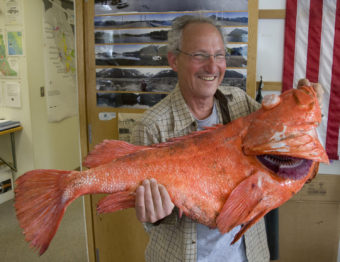
The rockfish caught near Sitka last month was not 200 years old, but a different fish caught near Ketchikan was over 100 years old.

The Department of Fish and Game lab in Juneau received two otoliths from two different fish. An otolith is a bone found within a fish’s ear that contains annuli, similar to rings on a tree. Scientist use otoliths to determine the age of fish

The shortraker caught off Kruzof Island near Sitka last month was suspected to be 200 years old, which is five years shy of the record age for a rockfish.

Kara Hilwig is the lab supervisor for the age determination unit. She says the 41-inch, 39-pound rockfish was not that old.

“This particular specimen was interesting in that it represents what we typically see as what we call a ‘fast growth specimen,’ so even though it was really long, it was quite young, so it grew very, very rapidly. We aged that fish to be 64,” Hilwig says.

The circumference of the otolith from the hexagenarian Sitka shortraker was the size of a quarter, but it wasn’t thick. Hilwig compares that otolith to the one found inside another shortraker caught in West Behm Canal near Ketchikan last month.

“It was a smaller circumference on the otolith but it was really thick and heavy. It sounded like a glass marble when you dropped it on the table, whereas the otolith of the fish that came out of Sitka sounded more like a paper clip.”

The otolith from the Ketchikan shortraker revealed the rockfish to be 120 years old.

That fish was 39 inches and nearly 30 pounds – two inches shorter and ten pounds lighter than the Sitka fish half its age.

Learn more about rockfish and how to release one at depth.

Anchorage resident wins Mt. Robert’s Tram Run

An Anchorage resident, a JDHS high school student, and a novice runner from Juneau were the three fastest in Saturday’s Mt. Robert’s Tram Run.

Forty-eight race participants took off from the Mt Roberts Tram building at 9 a.m. They continued up Franklin Street, took a right at 6th Street, a left onto Gold, followed Basin up to the trailhead of Mt. Robert’s, and kept running, and running, and running.

The Mt. Robert’s Tram Race starts at sea level and ascends three and a half miles to approximately 2,000 feet altitude.

Thirty-three minutes and 56 seconds after the race started, Anchorage-resident Allan Spangler touched the cross, the race’s finish line. Race timers cheered on the first place runner.

Twenty-six-year-old Spangler was in town with his girlfriend for the July 4th weekend. Shortly after hitting the trail, Spangler took the lead and felt pretty sure he could maintain it, “but you never know. It’s a mountain race,” he said.

Coming in two minutes and 25 seconds later was JDHS cross-country runner Riley Moser. The 16-year-old had run the race twice before but never broke the top three, until Saturday.

Moser says he’s been practicing a lot for the upcoming cross-country season. “I’ve been putting on more miles lately, a lot more miles. I’ve been doing a lot more mountains than I probably should be doing. We were told not to run as many mountains and do more flats and speed.”

24-year-old Gabe Wechter just started running a month ago, but says he’s an avid skier and climber. The hardest part of the race for Wechter was not knowing how fast to go during the road portion.

“Turns out I should’ve run faster,” Wechter, the third place finisher, said.

Anchorage resident Laura Fox was the first female runner to cross the finish line at 41 minutes and 19 seconds. “I’ve never been up here before so I didn’t know when it was going to stop,” Fox said.

The two youngest runners were 12-year-old Connor Norman and 11-year-old Aidan Hopson, who have run together in ten races this year. Before the race began, Hopson explained what it’s like to run with Norman, “He’s normally kicking my butt.”

But at 54 minutes and 32 seconds Hopson and Norman touched the cross at the same time. When asked what the most difficult part of the race was, the boys replied, “Everything. The whole thing.”

Spangler and Fox will be added to the Mt. Robert’s Tram Run trophy, but everyone who ran the race took home a free tram ride pass to use in the future. To get excited for redeeming this prize, the runners all took the tram down the mountain.

The next race of the Southeast Road Runners is the Governor’s Cup on Saturday, July 13.

Site notifications
Update notification options
Subscribe to notifications