"As Managing Editor, I work with the KTOO news team to develop and shape news and information for the Juneau community that's accurate and digestible."
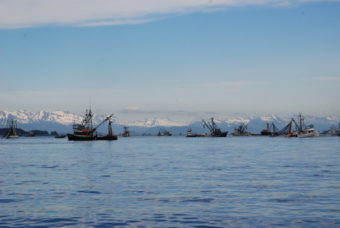
Last year’s Amalga Harbor DIPAC seine fishery had two openings – 45 boats participated in the first, 95 boats in the second. (Photo courtesy of Dave Harris/ ADF&G)
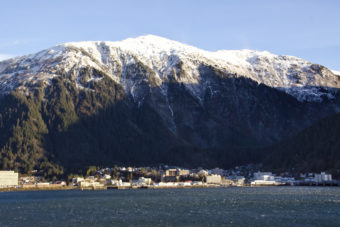
The Department of Fish and Game is holding a purse seine opening in the Amalga Harbor special harvest area on July 4th for returning DIPAC chum salmon.
Fishing will occur between 9 am and 3 pm tomorrow.
This is the second year Fish and Game is managing the fishery. Dave Harris is the commercial area management biologist for ADF&G. He says last year’s effort was strong with as many as 95 boats participating in an opening.
“Last year, that was really the only fishery happening at the time. This year we have some other areas available for purse seiners in the general vicinity so we’re hoping the effort won’t be quite as big,” Harris says.
“I would expect to see at least 50, if not more, boats out there.”
A DIPAC representative will be at the high-use Amalga launch ramp to inform boaters of the potential heavy traffic of seiners.
“It should work out just fine if everybody is aware and pays attention,” says Harris.
The seine fishing area will extend south from the southern portion of Eagle Beach to the arboretum, and extend west to Gull and Bird Islands.
The updated comprehensive plan changes chapters on housing, economic development, and energy. (Photo by Heather Bryant/KTOO)
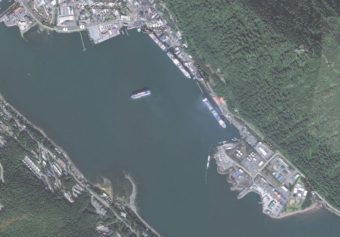
The CBJ assembly is on its way to adopting an updated comprehensive plan. During last night’s committee of the whole meeting, Community Development Director Hal Hart introduced the new update, which has been in the works since 2011. The document contains 123 policies that guide and direct public and private land activities within the CBJ.
Hart says most of the changes are technical and are found in the chapters on housing, economic development, energy, transportation, land use maps, and utilities. Sections of the plan were substantially rewritten by the Affordable Housing Commission and the Juneau Economic Development Committee.
Between the 2008 plan and the current update, Hart says significant changes have been made to maximum residential density making it easier for developers to put more units in certain areas, “We’ve said where you have sewer and water and the kinds of things that support growth, you can get a little higher density.”
This is the first time the Assembly is seeing the update. Hart plans to work with the body in interpreting the changes, especially to the chapters on housing, economic development, and energy.
Juneau residents may see a thousand-foot extension to the sea walk being built as soon as this winter. During last night’s Committee of the Whole meeting, the Assembly gave Director of Engineering Rorie Watt approval to move forward with the project.
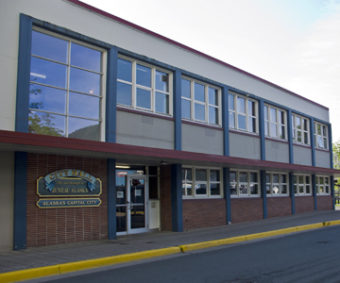
The planned extension would go south from the Miner’s Cove building past the South Franklin Dock to the edge of the rock dump.
Watts says the project will extend the sea walk along the waterfront.
“It’s a good project for the users of the Princess Dock because it will widen out their staging area, it will allow the separation of passengers getting on and off busses and pedestrians that are just walking through the area, and it’s ready.”
Watts says the engineering staff has reached a land deal with representatives from Princess Cruises and AJT to secure an easement to build the extension.
“We have all the land issues resolved. All of it is permitted. The engineering and design is done. It’s been to the planning commission. It’s a complete project and with the assembly consent, we could put that project out to bid and build it this winter.”
Watt says the cost of the 1000-foot extension would be $4 million, which would come out of the $15 million that the city has secured for sea walk projects.
Amy Mead is the new city attorney for the city and borough of Juneau. She was appointed to the job late Friday by the CBJ assembly. Since 2010, Mead has been the assistant city attorney.
She takes over for John Hartle who retired last week after 20 years in the CBJ law department.
“His institutional knowledge of the city and borough of Juneau is enormous. I learned a lot from him while I was here,” Mead says.
Mead was selected from a pool of four finalists. Her appointment came after the assembly interviewed each candidate on Friday.
“The assembly had a lot of really qualified candidates in front of it. I’m really honored that the assembly was confident in my ability and is supporting me in this way,” she says.
Originally from Boston, Mead got her undergraduate degree from Boston University, and her law degree from Tulane Law School in New Orleans.
Prior to joining CBJ’s law department, Mead was in private practice and was an assistant attorney general and assistant district attorney for the state. Mead was also city and borough attorney for Wrangell.
“My time there solidified my desire to return to public sector work and really made it clear for me how much I do enjoy municipal practice. I really like it. I’m just so excited about this appointment,” says Mead.
Mead begins her new position as city attorney Monday. She’ll receive a salary of $130,000, plus standard benefits.
Jane Sebens will continue as CBJ’s deputy city attorney.
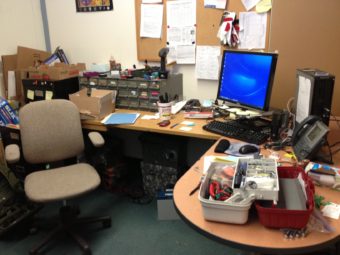
Dylan Rhea-Fournier's office space is also a workshop, enabling him to maintain sensitive field equipment. (Photo by Lisa Phu/KTOO)
Many Fish and Game offices in the Douglas building contain a lot of gear and equipment. (Photo by Lisa Phu/KTOO)
Shelving this tall, found in Dylan Rhea-Fournier's work area, would likely not be allowed under the state's Universal Space Standards. (Photo by Lisa Phu/KTOO)
Long hallways will be a thing of the past under Universal Space Standards, which create an open work environment. (Photo by Lisa Phu/KTOO)
The State of Alaska is implementing new work areas in Juneau and Anchorage office buildings. Officials claim new universal space standards will save money and create a better work environment, but some state employees think otherwise.
Dylan Rhea-Fournier works on the Southeast Alaska bat monitoring project. “It’s a network of these passive detectors that turn on at night and record the bats echolocation, their bio-sonar, and from that we can get an idea of their abundance and activity and timing as well as species composition,” he explains.
Rhea-Fournier works for the Alaska Department of Fish and Game in the Douglas office. His work space isn’t your typical office. Shelves are stacked to the ceiling with equipment like bat detectors, battery boxes, solar panels. A metal locker has laptops and climate recorders. Rain gear hangs from various hooks. He’s also in charge of making sure the equipment works in all types of weather, which takes more stuff.
“You got cards, all these download cables, microphones, all these little various parts that we need for the detector and the rain guard that we use in the field – hardware. It’s kind of a little workshop here,” Rhea-Fournier says.
All of this fits into a 9-by-10-foot work space, but the state wants to put Rhea-Fournier and his equipment into a 6-by-8 cubical, reducing his work area by about half.
The state’s Universal Space Standards impose guidelines on who gets an office and who doesn’t. Senior management and administrative positions, like attorneys or physicians, get an office. Those below get 6-by-8-foot cubicles or ‘workstations’ grouped into ‘neighborhoods.’
The standards also dictate the type and color of the workstation furniture. “A cherry wood finish,” says Deputy Administration commissioner Curtis Thayer. Capital Office won the bid to supply the new office furnishings, with the average cost of installing a new cubicle at $6,500.
Thayer says the space standards will save the state $125 million over the next 10 to 20 years, beginning with the Robert Atwood building in Anchorage, and state office buildings in Nome, Juneau, and Douglas.
“They’re actually going to have 97 bodies on the floor where previously there had been 60,” Thayer explains of the Atwood Building.
He says enough space will be freed up to lease to other government agencies which are paying higher rent in the private sector.
Work areas filled with gear are more the norm in the Douglas building – firearms, darting guns, tracking equipment, immobilizing narcotics, coolers.
“We’re not an office where you come in and sit down and look at a computer all day and have a couple of file drawers,” says Fisheries tech Iris Frank, who spends most of her time analyzing sockeye fish scales.
She wonders how space standards will go with the Fish and Game model.
“One size does not fit all. It was kind of a draconian way how it all came about. We were just told. There was no input from the employees and if there had been maybe we could’ve come up with some suggestions that might’ve helped facilitate our needs and the administration’s need,” Frank says.
Frank has been with Fish and Game since 1977 and is planning on retiring in two years. “I can retire tomorrow and it might be my option if this kind of comes about without any input from us.”
Employee retention and recruitment are big issues for the State of Alaska. Health and Human Services program manager Robert Sewell says putting everyone in cubicles is not the right move. “There are huge costs to turnover in terms of recruitment, in terms of loss of institutional memory, in terms of disruptions of customer or client contact.”
Thayer says moving people into cubicles means more conference and break rooms, as well as private telephone booths, better ventilation, and the “right to light.” He cites the Banking and Securities Division in the Atwood Building, “They went from all private offices into an open work environment into what we call pods of four employees. You go up there now, they don’t want to go back into their offices. They’ll say this is better. We have more light, we talk to each other, we collaborate with each other.”
Thayer says the State’s move to an open work environment is behind the times and other agencies have already made the shift. “General Services for the federal government, has gone to an open work environment; the NANA building, one of the Native corporations; BP has gone to an open work environment,” he lists.
With new space standards, Thayer says Nome offices will have more conference rooms and Douglas will be able to house an additional 20 employees.
“We’re trying to save money, and if we can’t do it in space, it comes out of programs, and if we take money out of programs, it could come out of employees.”
New workstations are being installed on the seventh floor in Juneau’s State Office Building, commonly known as the SOB. The official unveiling is July 17.
Sport and personal use shrimp fisheries in the Juneau area will be closed starting Monday. The commercial shrimp fishery, which opens in October, will also be closed.
Closure applies to section 11-A, which includes Lynn Canal and Stephen’s Passage from Little Island Light to Point Bishop and Point Arden. This is the first time the area has been closed to shrimp fishing.
Dave Harris is area management biologist for commercial fisheries. He says the Department of Fish and Game has documented a decreasing catch-per-unit effort indicating that serial depletion of shrimp is occurring.
“That’s where fishing in one area depletes the stock and then the focus moves to another area and it kind of depletes that stock and then it can move and so on and so the net result is a major impact on an area.”
Creel census data from 2003 to 2007 on shrimp catches in the area show personal use and sport harvest was equal to commercial harvest.
Commercial shrimp fishing will be closed for three years, which Harris says is a good portion of the shrimps’ life cycle, to give the stock a chance to rebound. After three years, the Department hopes to have a sustainable level and offer limited openings. Personal use and sport fishing will be closed until further notice.
Close
Update notification options
Subscribe to notifications
Subscribe
Get notifications about news related to the topics you care about. You can unsubscribe anytime.