
Lisa Phu

Managing Editor, KTOO

"As Managing Editor, I work with the KTOO news team to develop and shape news and information for the Juneau community that's accurate and digestible."
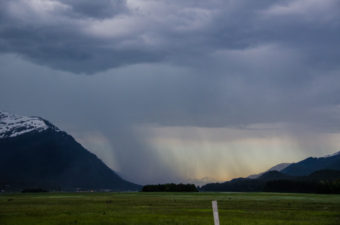
Heat wave sets record temperatures, causes thunderstorm

A thunder and lightning storm hit Juneau Monday a little before 5 pm.
The National Weather Service in Juneau says it was caused by a strong disturbance in the mid-levels of the atmosphere that moved down from the north. The last thunder and lightning storm in Juneau was on September 10 of last year.

Juneau also saw record-breaking hot temperatures this past weekend.

Rick Fritsch is a meteorologist with National Weather Service in Juneau. He says the heat wave started on Saturday.

“Eighty-three degrees on Saturday, and that record was last set in 1969, so that was a fairly long record. And yesterday at the Juneau Airport, old record was 82 degrees set way back in 1948 and we beat that record by a full three degrees, so the high temperature at the airport was 85 degrees.”

Fritsch says the hot weather was caused by an inverted trough stationed over western Canada. It shifted to the west bringing the warmer pool of air closer to Southeast Alaska and finally over the coast mountains. Clear skies this weekend in conjunction with the inverted trough and fairly calm winds allowed the temperatures to rise.

According to Fritsch, the warmest of the weather is over, but temperatures today and tomorrow are still going to be significantly higher than normal.

“We’re expecting temperatures to once again get into the upper-70s and possibly into the low-80s if you find an open area like Eagle Beach. For tomorrow, temperatures are starting to come down. We have a forecast right now for temperature ranges in the Juneau area from 70 to 75, so there’s a little bit of reduction, but still well above normal for this time of year.”

Records were broken throughout Southeast this weekend, from Ketchikan to Yakutat, which saw a high of 74. The highest recorded temperature was along the Haines highway at 92-degrees.

Main Street improvements making progress

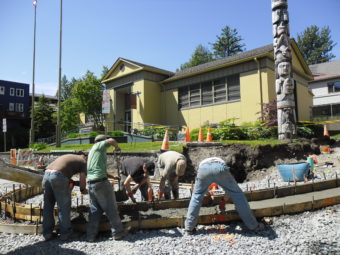
Paving on Main Street will begin Tuesday.
Improvements on the busy street began mid-April shutting down two blocks of downtown Juneau. Originally, the road was scheduled to be open Saturday, but the cold spring weather caused some delays.

Superintendent with Arete Construction Travis Seibel says Main Street will open for traffic as soon as this week.

“The buses are going to start around the 24th and we’ll have one way traffic downhill as soon as they’re done paving.”

This current phase of Main Street improvements includes replacement of the water, sewer, and storm drainage systems between 2nd and 5th streets, as well as the addition of new traffic islands, landscaping, and a sidewalk canopy.

“All the underground utilities are in. Once pavement’s in, we’ll start working on the sidewalks, canopy, traffic islands.”

Seibel says the project has been going well overall and the finish date is still set for August 15th.

Airport reverses fuel fee increase, runway rehabilitation underway

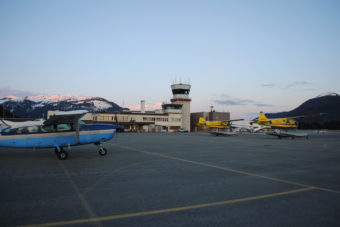
Juneau Airport tower
The airport is facing higher costs of deicer, fuel, supplies and security. (Photo by Rocky B/Flickr Creative Commons)

Fuel fees for long term tenants at the Juneau Airport will stay the same.

Rate and fee increases at the Airport were approved by the CBJ Assembly earlier this month. But after discussions with airport tenants and users, the airport board decided Wednesday night to reverse some of the increases.

Airport tenants include local helicopter companies and small commuter airlines.

Airport manager Patty deLaBruere says the board was able to maintain current fuel fees for non-transient users, “We did still have some Airport Fund Balance that we could use to help offset some of the expenses without raising all the rates.”

Reversing the fuel fee increase for non-transient users will mean taking $135,000 from the Airport Fund Balance.

Rate increases are still set for other areas like landing fees for larger aircrafts, land lease rates, and terminal lease rents. A significant increase to aircraft parking fees, which will double for some users, will be phased in over two years.

“It is a jump and one of the things we looked at was there’s been a lot of improvements. There’s a lot of maintenance that goes on down there and it’s been a number of years since these rates were raised,” says deLaBruere.

Money generated from the fee hikes will go toward airport budget increases, including new security personnel from the Juneau Police Department, an additional cost of $300,000.

Also discussed at Wednesday night’s airport board meeting was runway rehabilitation. According to deLaBruere the runway surface is deteriorating. SECON started temporary patching of cracks and potholes Wednesday night.

DeLaBruere calls the temporary patches a band-aide until the entire runway pavement is redone, something the FAA says is necessary.

“We are currently working with the FAA on some funding for the project to try to get this done next summer. It’s a very aggressive design and plan and funding but it’s got to be done, and it really truly is a safety measure.”

Current runway work should take about a week, weather depending, and is being done after-hours between 10:30 pm and 6 am.

Positive outlook for SE commercial net fisheries

Part of the purse seine fleet outside of Juneau’s Amalga Harbor last July. (Photo by Dave Harris/ADF&G)

Traditional commercial net fisheries in Southeast Alaska will kick off the season Sunday.

Bill Davidson is Fish and Game’s regional coordinator for commercial fisheries in Southeast. He says he’s looking forward to a productive year for both gillnetters and seiners.

“It should be a high value fishery for the fleet and the industry participating in the fisheries if runs come in as expected and prices hold up as strong as they’ve been recently,” he says.

This year’s pink salmon harvest forecast is 54 million, which is double last year’s forecast. Since 2006, Davidson says pinks have established an every-other-year cycle of strong and weak runs.

“Last year was the weak cycle and this year’s going to be the strong cycle. But there’s always curve balls thrown at us from Mother Nature so we don’t really know until we actually get into it. We’ll be ready and industry will be ready.”

Estimates for chum salmon are higher than last year’s. The majority of chum come from hatchery programs and Davidson expects a considerable fishing effort for the species.

In contrast, the king salmon forecast is low. And Davidson isn’t sure about the sockeye run.

“The parent year for sockeye was very weak, however that really doesn’t tell us what’s going to happen this year. It could be better than it was five years ago this year, and that will just be known in season,” he says.

2011 was the highest value total salmon fishery on record in Southeast with commercial fishing boats getting $200 million. Davidson’s hopes are high and thinks this season could surpass that.

Alaskans rally for salmon protection

About 30 adults and children called for equality and greater subsistence fishery protection Wednesday morning in the ‘Idle No More’ rally in downtown Juneau. Several wore Native regalia, chanted songs, and danced as people took turns talking over a megaphone.

“The Pollock industry is coming into our water and has been for several years taking the fish away from our children and from our elders and our fish are dwindling in great numbers now and our people are struggling to try and get the fish to feed their children and to survive,” George Pletnikoff says through the megaphone.

Pletnikoff is with Greenpeace and Alaska Inter-tribal Council. He wants to spread awareness of the importance of  subsistence which entails the spiritual lives of Native Alaskans, their customs and tradition. Pletnikoff highlights the Bering Sea Pollock fishery which results in high numbers of chinook salmon by-catch.

Rally participants cited ongoing subsistence fishing problems in western Alaska due to recent restrictions placed on the Yukon River by state and federal agencies, and last year’s closure on the Kuskokwim River. Susettna King is a Juneau resident and member of ANS Camp 70.

“I think it’s time they leave the land to us. We’re not going to go in there and slaughter thousands and thousands of fish. We’re going to take what we need and leave the rest so nature comes back and we’ve done that for years. And they should let us better regulate what is leaving our land and what is coming back.”

Other rally concerns include tribal representation, decline of salmon stocks, environmental stewardship, and cruise ship waste water.

Pletnikoff said the rally was organized by the AVCP, ANB Camp 70, Kawerak Inc in Nome, and supported by Green Peace. Rally organizers were in Juneau to attend parts of the week-long North Pacific Fishery Management Council meeting, which concluded yesterday.

Cruise ship tourists stopped to take photos of the march through downtown Juneau. The ‘Idle No More’ rally ended in front of Centennial Hall where a joint meeting was held yesterday between the North Pacific Fishery Management Council and Alaska Board of Fish.

Editor’s Note: In a previous version of this story we mistakenly identified George Pletnikoff as Timothy Andrew. The story has been amended to correct this error. We’re sorry for the confusion. 

Juneau sends dancers around the country and beyond

Several Juneau teenagers are heading to the nation’s best dance programs this summer – one is even going to Russia. Within the next few weeks, five students from Juneau Dance Unlimited will leave Alaska to practice their techniques and expand their horizons in New York City, Pittsburgh, Boston, Houston, and Moscow.

14-year-old Marissa Truitt has been dancing for ten years.

“You just get such a great feeling when you dance, a really good feeling that I don’t get from doing anything else.”

For 16-year-old Maire New, dance is discipline.

“You’re always striving towards perfection in dance, so for me that’s really a fun thing to work on every day.”

Summer for most teenagers is the time to relax and spend time with friends. For these girls, summer means dancing in some of the country’s most competitive and rigorous programs. Truitt is heading to the Pittsburg Ballet Theater. New will start with a 3-week program at the Bolshoi Ballet Academy in New York City, then travel to Moscow for further intensive dance study and language acquisition.

15-year-old Gabrielle Duvernay says dance is a priority.

“It always comes first, I mean my family of course, but it definitely comes before friends. It’s mainly in the front of my mind all the time.”

In January, Duvernay traveled to Seattle to audition in front of artistic directors and ballet masters from the country’s best dance companies. She applied for five programs, got into two, was waitlisted for one, and finally decided on the Boston Ballet School.

All three girls dance up to 7 days a week. On at least three of these days, they’re at JDU’s studio taking classical technique ballet class with artistic director Philip Krauter.

Krauter describes his teaching style as demanding yet kind.

“The ones that are serious about their training usually are self-critical themselves; they don’t need any more from me. I try to give them as much positive, correct information as I can to train them properly and then it’s up to them to take it and do something with it.”

Truitt says there is a lot of pressure from other girls associated with dancing in these summer programs, “especially during auditions, like weird eye looks at people and like, ‘Am I better than her?’ and all this really unnecessary pressure.”

When asked how she deals with that, Truitt says, “You just have to ignore everything and focus on you and the teacher and the music and know what you’re doing and realizing that you love ballet, you’ll do it no matter what, even if people are judging you.”

Despite the stress and self-criticism, the girls see the upside of working hard and pursuing their passion. For New, ballet has opened doors to the Russian language. When she studied dance at the Bolshoi Ballet Academy in New York City last year, her teachers taught in Russian.

“If you would be going across the floor and they’d yell, ‘Khorosho’. That would mean good, so that was nice to hear, and then if you were doing something wrong, they might say, ‘Net’, which means no, but they might say it multiple times; that’s really bad.”

As a recipient of a competitive scholarship through the US Department of State, New will spend six weeks this summer in Moscow studying Russian language, culture and ballet at the Bolshoi Ballet Academy.

Dancers at this level rely on their families for emotional and financial support. Tuition and housing for the summer dance programs cost around 5-thousand dollars; airfare is separate. Truitt worked as a dance assistant at JDU and saved 8-hundred-dollars to help pay program fees. New has applied for fine arts scholarships through the Juneau Arts and Humanities Council.

Dancing is a family affair. New’s father is a veterinarian and her mother, Diana Ross-Miller, works at his clinic. She says being a supportive parent involves endless encouragement and sacrifices.

“Certainly the time involved in just simply having her be at the studio so much dancing and training is very intense and takes away from other possibilities. Like for example, on this beautiful day, we might not be going to the beach for a long walk with our dog because we’re taking her to the studio to go dance, so there are definitely trade-offs but we think in the long run it’s really worth it.”

The girls, including Duvernay, hope all the sacrifices, training, and auditions will lead to a dance career, “but I also am going to college. That’s one definite that I’ve always kept through my life. I’m going to college because if I get a career crushing injury then I have to have something to fall back on. I can’t just rely on my body for my whole life. I think I’m going to get a business degree,” Duvernay says.

Truitt says if she can’t be a professional dancer, she’d like to attend college and become a nutritionist or physical therapist. New’s ultimate dream is to join a professional ballet company after high school and get her college degree while dancing.


Site notifications
Update notification options
Subscribe to notifications