Matt Miller

Morning Host & Local News Reporter

I’m up early every weekday morning pulling together all the news and information you need to start your day. I find the stories unique to Juneau or Southeast Alaska that may linger or become food-for-thought at the end of your day. What information do you need from me to give your day some context?
Humpback unbound

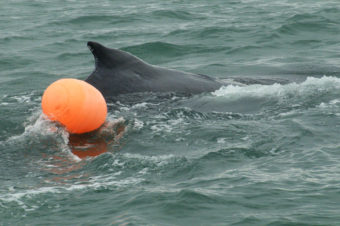
Humpback calf with line wrapped around it
Humpback calf with line wrapped around it - Photo courtesy NOAA

A humpback whale calf has been disentangled from fishing gear near Juneau.

National Oceanic and Atmospheric Adminstration spokeswoman Julie Speegle says the calf and its mother were spotted Wednesday morning by a charter fishing boat near Halibut Cove on Shelter Island. The whales appeared to be heading up Lynn Canal at about 5 knots. Other whale-watching boats monitored the pair until a NOAA team could arrive on-scene.

“The calf was trailing a bouy and it was entangled in the line, said Speegle. “Our whale disentanglement team did spend several hours observing the lines and how they were wrapped around the calf to figure out exactly which lines to sever in order to free the calf.”

The five-member, specially-trained disentanglement team also attached a transmitter to track the calf in case it raced away before they could return in a separate boat to free it.

“Mama was nearby and she was very protective of her calf throughout this whole operation,” said Speegle. “At times, she tried to position herself between the rescuers and the calf to protect her calf.”

Speegle said the calf was freed from the fishing lines Wednesday evening just west of Berners Bay.

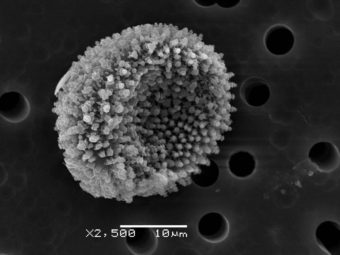
Orange goo is mass of fungal spores, not microscopic eggs

Scanning electron micrograph of fungal spore
Scanning electron micrograph of fungal spore - Photo courtesy NOAA
Not eggs, after all.

Scientists have done a more detailed examination of that mysterious orange goo that showed up recently in a lagoon near Kivalina earlier this month.

They are fungal spores.

National Oceanic and Atmosopheric Adminstration spokeswoman Julie Speegle says samples were sent down to one of their labs down in Charleston, South Carolina. Researchers there used an electron scanning micrograph to examine the tiny orange balls seen in earlier pictures.

“With the equipment that they have at the South Carolina lab, you can really get a very, very close-up, in-depth, detailed view off the spores,” said Speegle.

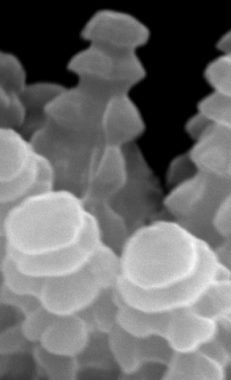
Close-up of spines on surface of spore
Close-up of spines on surface of spore - Photo courtesy of NOAA

The researchers at the National Ocean Service Center for Coastal Environmental Health and Biomolecular Research says the spores are consistent with a fungi that causes rust, or the discoloration that appears on plant leaves and stems. But there are 7800 types of rust fungi. Determining which type is the Kivalina goo is difficult without first observing the spore’s fruiting body.

“I’ve beeing doing oceanographic work on red tides for 20 years,” says Doctor Steven Morton at the National Ocean Service Center for Coastal Environmental Health and Biomolecular Research in Charleston, South Carolina. “This is the first one that I’ve ever seen that’s caused by a fungal spore.”

Orange goo undermicroscope, beleived to be copepod eggs
Orange goo undermicroscope, originally believed to be copepod eggs - Photo courtesy NOAA

Orange goo made up of spores

Picture from an electron scanning microscope of Kivalina spore
Picture from an electron scanning microscope of Kivalina spore - Courtesy NOAA

Not eggs, after all.

Scientists have done a more detailed examination of that mysterious orange goo that showed up recently in a lagoon near Kivalina.

They are fungal spores.

Samples were sent down to the NOAA’s National Ocean Service Center for Coastal Environmental Health and Biomolecular Research in Charleston, South Carolina. Doctor Steve Morton, a research oceanographer there, said they used an electron scanning micrograph to examine in greater detail the tiny orange balls that were seen in earlier pictures.

Close-up of spines on surface of spore
Close-up of spines on surface of spore - Courtesy NOAA

“It was just a very interesting, unusual event,” said Morton. “I’ve been during oceanographic work on red tides for 20 years now. This is the first one I’ve ever seen that’s caused by a fungal spore.”

Morton says the spores are consistent with a fungus that causes rust, or the discoloration that appears on plant leaves and stems. But it’s still unclear which of the 78-hundred types of rust fungi is the Kivalina goo.

Initial analysis by NOAA’s Ted Stevens Marine Institute at Auke Bay showed what appeared to be a concentration of microscopic eggs, possibly of an invertebrate like a copepod.

Photo taken from a microscope of the Kivalina goo that were believed to be eggs
Photo taken from a microscope of the Kivalina goo that were believed to be eggs - Courtesy NOAA
Site notifications
Update notification options
Subscribe to notifications