
Pablo Arauz Peña, KTOO

SEARHC offers additional doses for Juneau’s next mass vaccination event

Maria Rogers registers for her second dose at Juneau’s COVID-19 vaccine clinic at Centennial Hall on Friday, Jan. 15, 2021. (Photo by Rashah McChesney/KTOO)

A nonprofit health organization is giving some of the COVID-19 vaccine supplies it gets from the federal Indian Health Services to the City and Borough of Juneau for its next mass vaccination clinic in March.

City Emergency Manager Robert Barr says the Southeast Alaska Regional Health Consortium, or SEARHC, is partnering with the city to help make sure that a larger portion of the Juneau area’s eligible population can be vaccinated. 

“I think due to the progress that SEARHC has made throughout Southeast Alaska, they have some vaccines in the IHS allocation that can be delivered via these clinics,” Barr said.

The city’s next vaccine clinic is scheduled for March 12th and 13th. Appointments will become available on Feb. 25th at noon. The public is encouraged to sign up online, but anyone without internet access can also register by calling 586-6000.

Up until now, vaccine eligibility was limited to frontline medical workers and people who were 65 and older. But now, many educators and childcare workers, people aged 50 and up, people who live in crowded facilities like prisons, shelters or psychiatric facilities and pandemic response workers are eligible.

“Our estimate is that includes somewhere around 7,500 people, most of whom haven’t been vaccinated yet because it just opened up last week and we haven’t had any vaccine to administer to them but that will, of course, change in March,” Barr said.

According to a media release, SEARHC still has plenty of supplies for its patients, Alaska Native beneficiaries and their families. Those people can register at COVID19.searhc.org.

Juneau health officials reported two new COVID-19 cases on Friday. Both are people who caught the virus through community spread. There are 22 active cases in Juneau, and one person with the virus being treated at Bartlett Regional Hospital, according to a city media release.

Newscast — Thursday, Feb. 18, 2021

In this newscast:

  • Alaska recorded 40 new coronavirus infections on Wednesday, the lowest daily case count since September.
  • Winter cold snaps aren’t just causing frozen pipes and power outages in the lower 48.
  • Gov. Mike Dunleavy has quietly appointed an unknown real estate executive to an agency tasked with regulating commercial fishing permits.
  • Alaska’s Emergency Disaster Declaration for COVID-19 lapsed on Sunday — but that hardly means the end of the statewide effort to combat the ongoing pandemic.

Newscast – Tuesday, Feb. 16, 2021

In this newscast:

  • Today is Elizabeth Peratrovich Day in Alaska, marking the anniversary of the signing of an anti-discrimination bill passed by Alaska’s territorial legislature in 1945.
  • Faced with the prospect of another canceled cruise season, Ketchikan’s borough is projecting a multimillion-dollar deficit.
  • Seal oil has been a staple in the diet of Alaska’s Inupiat for generations.
  • A federal appeals court has sided with conservation and Indigenous groups by ordering work to stop at a major oil project on Alaska’s North Slope.

Newscast – Friday, Feb. 12, 2021

In this newscast:

  • Help is on the way for Juneau residents who need financial relief.
  • Six people have been chosen to lead a new Systemic Racism Review Committee in Juneau.
  • Sitka has become a hot spot for landslide research since a deadly landslide hit the town in 2015.
  • The state of Alaska’s investment authority board has agreed to put $35 million towards the controversial Ambler Road project.
Juneau picks finalists for systemic racism review committee

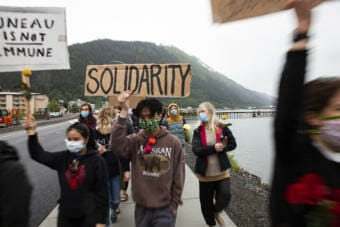
More than 400 people attended a rally in Juneau on the 11th day of protests against police violence and systemic racism following the death of George Floyd in late May. After marching from Marine Park to the roundabout on Douglas Island, demonstrators threw hundreds of flowers into Gastineau Channel on June 6, 2020. (Photo by Rashah McChesney/KTOO)

Six people have been chosen to lead the City and Borough of Juneau’s new systemic racism review committee. The Juneau Assembly picked the final members on Thursday.

The committee will review proposed laws and advise the assembly if they include a policy or implication that is racist.
This comes eight months after the Assembly approved the creation of the committee following local protests inspired by nationwide anti-racist demonstrations.

Out of 16 applicants, six people were chosen by the Human Resources Committee:

  • David Russell-Jensen and Kelly Patterson for three-year terms.
  • Grace Lee, Lisa Worl and Gail Dabaluz for two-year terms.
  • Dominic Branson and Carla Casulucan for one-year terms.

The motion to approve the committee passed unanimously, with a 7-2 vote. In a separate motion, assembly members Michelle Hale and Greg Smith objected to the start date.

Editor’s note: This story has been updated to clarify the committee was approved unanimously by the Juneau Assembly and assembly members Michelle Hale and Greg Smith objected to a separate motion.

Juneau approves more cash relief for low income residents

CBJ Pandemic relief checks
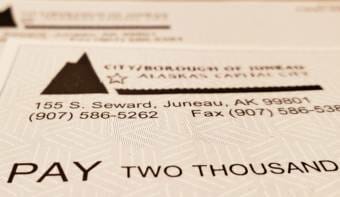
The City and Borough of Juneau cut checks like these to locals financially impacted by the pandemic in 2020. (Photo illustration by Jeremy Hsieh/KTOO)

Help is on the way for Juneau residents who need financial relief.

On Thursday, the Juneau Assembly voted 7 to 2 on an ordinance to pay out more individual grants in addition to those paid out last year. Assembly member Michelle Hale said the money is for Juneau’s lowest income residents.

“Those people often fall through all the cracks, they don’t qualify for unemployment often, they’ve been impacted by having to take care of children,” Hale said. “So those are the people that I want to get that money to.”

One of the no votes was assemblymember Loren Jones. He said the $700,000 used to make the payments is the last of the CARES Act money that congress passed in the first round of pandemic relief.

“This is a tough one to object to,” Jones said. “There [are] still a lot of unknowns. This is money that was given to the city from the first round of federal CARES funding. The second round provided no additional monies for cities or municipalities. So this is spending the last of our money.”

The other no vote was mayor Beth Weldon, who said she would have liked the city to wait. She also said residents will soon have another opportunity for relief from state aid through the Alaska House Financing Corporation which opens up the application period on Monday.

Assembly member Alicia Hughes-Skandijs said it wasn’t just about facts and figures but prioritizing relief.

“I cannot let the individuals who are most economically vulnerable in our society, be the people that we say, ‘I will wait and see before I provide aid to you,’” Hughes-Skadijs said.

Instead of a first come, first served approach, the money will go directly to the lowest income earners who applied for the individual assistance program last year.

People who received the city’s housing assistance grant last year are ineligible for this round. Base grants range from $500 to $1,000 and an additional $300 for each dependent child.

According to the city, 2,348 people applied for the individual assistance grants and 1,180 people are eligible for this added round of payments.

Correction: An earlier version of this story misspelled assembly member Alicia Hughes-Skandijs’ last name.

Site notifications
Update notification options
Subscribe to notifications