Pablo Arauz Peña, KTOO

Newscast – Thursday, Feb. 11, 2021

In this newscast:

  • Hundreds more Juneau residents with applications pending for individual assistance grants may get paid soon.
  • Gov. Mike Dunleavy warned Alaskans away from “misinformation” regarding the pandemic and his administration’s response to it.
  • Petersburg, like other communities in Southeast Alaska, saw next to zero tourism last summer.
  • Alaska Native tribes are awaiting word on scores of wireless broadband licenses at no charge by the Federal Communications Commission.

Newscast – Wednesday, Feb. 10, 2021

In this newscast:

  • State officials announced today that the next tier of people eligible for vaccination against COVID-19 opens tomorrow.
  • When Gov. Mike Dunleavy’s pandemic disaster declaration expires this weekend, the state will lose a wide range of special powers to respond to COVID-19.
  • Several million dollars in pandemic relief money is still available to Tlingit and Haida tribal members.

Newscast – Tuesday, Feb. 9, 2021

In this newscast:

  • Since mid-January, a dozen staff and patients at a Juneau nursing home have tested positive for COVID-19.
  • Relief programs are starting to pop-up funded by the bill Congress passed at the end of the year, which included at least $200 million for rent relief for Alaskans.
  • The Anchorage Assembly will consider a resolution this week to formally recognize Assembly member Jamie Allard’s statements defending a pair of Nazi-themed license plates as a “breach of public trust.”
  • A disaster declaration intended to aid Alaska’s response to the COVID-19 pandemic is set to expire this weekend unless state lawmakers act to extend it.

Newscast – Monday, Feb. 8, 2021

In this newscast:

  • The entire Southeast Alaska panhandle will experience very cold temperatures this week, with wind chill warnings issued for upper Lynn Canal.
  • The parent company of the proposed Pebble Mine says it is cooperating with a federal grand jury investigation.
  • Inclusivity has always been an issue for scientific fields like paleogenomics — or the study of ancient DNA.
  • The United States and Russia have updated their plan for addressing pollutants across national boundaries in the Bering and Chukchi Seas.
Sealaska Heritage lecture series highlights need for more Native researchers

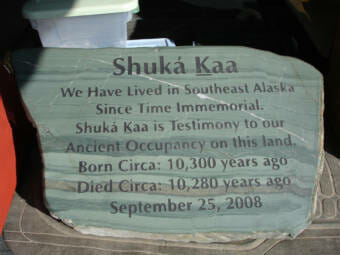
The green stone commemorative marker was commissioned by Sealaska Heritage Institute and marks the reburial of Shuká Káa’s remains. Photo by Terry Fifield, courtesy of Sealaska Heritage

Inclusivity has always been an issue for scientific fields like paleogenomics, which is the study of ancient DNA. Several academic researchers who document Southeast Alaska’s ancient history are highlighting the need to retain more Native researchers in a lecture series hosted by Sealaska Heritage Institute.

In 1996, the remains of a man now called Shuká Káa were found in a cave on Prince of Wales. James Dixon, an anthropology professor at The University of New Mexico, was a lead researcher in that excavation.

He said Shuká Káa — or “the man ahead of us” — brings to light the origins of Tlingit, Haida and Tsimshian people.

But what set this excavation apart from others isn’t just that Shuká Káa was found, but how the researchers treated his remains.

“There were a number of meetings, people listened to each other and worked together very cooperatively throughout the excavations and subsequent analysis and then reburial of Shuká Káa’s remains,” said Dixon.

These types of excavations — especially when they involve the ancestors of people who live nearby — haven’t always gone well.

Around the same time in Washington state, the remains of the so-called Kennewick Man were found. The almost complete skeleton of an ancestor was a big deal at the time, but the way it was handled by scientists was controversial.

“The Kennewick discovery was very adversarial. There was difficulty between the federal agencies involved with the scientists and the appropriate tribal governments,” said Dixon. “It was really quite contentious.”

Dixon said unlike the ancestor in Washington, the discovery of Shuká Káa was handled more respectfully by those involved in the research. He recalls the words of Clarence Jackson, an elder involved in naming Shuká Káa.

“He believed that Shuká Káa came to the people of Southeast Alaska at a time when they needed him because he had a story to tell,” he said.

Ripan Malhi has been working with Indigenous communities in Southeast Alaska for over a decade and is currently a paleogenomics researcher in Illinois.

He said ethical questions like the ones raised by the ancestor in Washington highlights the need for more Indigenous researchers in fields like paleogenomics.

“Anthropologists in the past as well as geneticists in the past, have approached their science in a way that was not inclusive and had colonial tendencies,” said Malhi.

But Malhi said the field has grown more collaborative in recent years.

“These days, at least in publications, there’s now usually a section on ethics and community engagement in the body of the paper, whereas that wouldn’t have existed even over five years ago,” said Malhi.

Malhi is also part of an effort to bring more Native researchers to study ancient DNA, called the Summer Internship for Indigenous peoples in Genomics or SING. He said what’s unique about the workshop is that all of the faculty involved are Indigenous researchers or work closely with Native communities.

Alyssa Bader, an anthropologist who is Tsimshian, was a student in the SING consortium studying the ancient DNA of ancestors in British Columbia.

Bader said that as a student with SING, she saw more Indigenous scientists in one place than ever before. But, there’s still room for more researchers like her.

“We need to include People with Indigenous backgrounds and, and ties to Indigenous communities in the work that’s being done with genomics and Indigenous communities now,” said Bader.

And what’s more, Bader says that while the ethics of research is more inclusive than it once was, it’s also about being welcoming.

“The piece that’s still growing in the academic community is not just attracting researchers with diverse backgrounds and perspectives but also retaining them by ensuring that their perspectives are appreciated and acknowledged,” said Bader.

Bader says it just makes more sense to have researchers from a variety of perspectives.

Editor’s note: The headline of this story has been changed to clarify Sealaska Heritage Institute, not to be confused with Sealaska Corporation, is hosting a lecture series on the history of the Indigenous peoples of Southeast Alaska. 

Newscast – Friday, Feb. 5, 2021

In this newscast:

  • During World War II, Native Unangapeople were forcibly removed from their home in the Pribilof Islands and interned at an abandoned cannery on an island in Southeast Alaska.
  • In pre-pandemic times, preparations for the summer season would already be underway for Alaska tourism businesses. But uncertainty about the 2021 season has left many in a holding pattern, especially those that rely on the cruise ship industry.
  • A limited number of criminal jury trials may resume in state courts starting March 17.
Site notifications
Update notification options
Subscribe to notifications