Pablo Arauz Peña, KTOO

Newscast — Wednesday, June 10, 2020

In this newscast:

  • On the first day a policy went into effect to test out-of-state travelers as an alternative to quarantine, a test caught a case at Juneau International Airport.
  • Another Alaskan has died from COVID-19 after more than a month of no fatalities linked to the disease in the state.
  • Activists in Juneau say police need to be more transparent with how they’re policing as there are clear racial equity problems in how laws are enforced in the state.
  • Just as COVID-19 circulates throughout the state, Alaskans are still being targeted in coronavirus-related scams and frauds.
  • More than 100 people protested Friday outside a Ketchikan flower shop that reportedly refused to sell flowers for a same-sex wedding.

Newscast — Tuesday, June 9, 2020

In this newscast:

  • Juneau’s mayor was sick with COVID-19 in late May.
  • Without parades of dancers and a packed convention hall, this year’s Celebration will look very different.
  • Juneau’s recent high school grads have had to navigate online classes, separation from their peers and teachers and a socially distant graduation ceremony without precedent.
  • Builders, homeowners and nonprofits are increasingly using their air-source heat pumps to keep homes in Juneau warm.
  • The state’s public university system is eliminating dozens of degree and certificate programs to help close a budget gap.

Newscast — Monday, June 8, 2020

In this newscast:

  • For the second week in a row, communities across Alaska held protests, marches and rallies demonstrating against police brutality and racism.
  • As coronavirus cases climb in the state, families are waiting for answers about what school will look like in the fall.
  • Public health officials from the state are investigating the latest COVID-19 case reported in Juneau today.
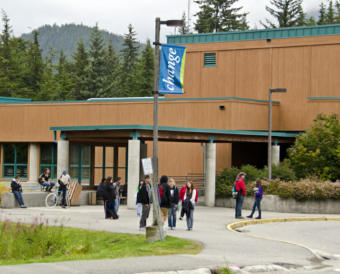
Southeast Alaskans consider what would be lost in UAS campus merger

A panel of women leads a discussion at the Men's Gathering in the Egan Library at the University of Alaska Southeast on June 30, 2019.
A panel discussion at the Egan Library at the University of Alaska Southeast on June 30, 2019. (Photo by Jeremy Hsieh/KTOO)

In Juneau, University of Alaska Southeast students, faculty and alumni spent much of last week debating a proposal to merge the university with one of the other University of Alaska campuses to cut costs. On Thursday, the university’s board of regents voted to delay moving forward with the merger and instead decided to look into how much it would cost.

There is a lot of opposition to the idea of the merger in Southeast Alaska. The city and borough of Juneau voted to publicly oppose it. In a special assembly meeting City Manager Rorie Watt said a merger would mean the loss of local leadership and it would make the university less appealing for students.

“I wouldn’t be in Juneau without the university, the attractiveness to it as prospective students,” assembly member Alicia Hughes-Skandijs said. “I can think of police, firefighters, business owners in our community that were all in my graduating class and so it’s a real magnet to bring folks to Juneau.”

After taking public testimony on the merger, city leaders in Ketchikan and university employees in Sitka — where UAS has satellite campuses — also objected.

This isn’t the first time the idea to merge UAS with another campus has come up.

Sage Logan is an accounting student at UAS in Juneau. He’s watched past efforts to bring up the merger. He says this time around it seems like the Board of Regents is willfully avoiding getting meaningful public comment from students and faculty.

“Just the way that they’re setting this up and continuing to propose it. Like, even through this pandemic, like, it feels like they’re taking advantage of the fact that we’re all separated,” he said.

There’s also clear opposition among some faculty at the university.

“I find it pretty outrageous,” said UAS sociology professor Lora Vess. “The loss of UAS would be such a loss to the state of Alaska and to the students of this region and to communities and to tribes to just have some of the regents seemingly tired of process want to push it through without actual consideration of what the role this university plays.”

As for cutting costs, Vess has one idea.

“What about those upper level administrative positions? Some of them have taken furloughs, which is a good important step. But, but perhaps it’s time to do a little bolder salary decreases as well,” she said.

Meanwhile, other stakeholders are proposing alternatives to the merger. Alaska Native leaders proposed two alternatives. One being that UAS becomes the centralized hub for rural campuses.

“I would suggest that the UA system let the rural campuses lead and own distance education because our rural campuses need the distance education,” said Joe Nelson, Sealaska Corporation’s board chair.

Nelson and others also suggested that the university could be designated a tribal college.

“From a Native perspective, I’m just trying to picture around the board of regents table there and then the core, you know, decision makers,” he said. “I don’t see a lot of folks that are closely tied to our 10,000 years of history that we’ve had in Southeast Alaska.”

But as the public continues to explore alternative options to merging the campus, the University of Alaska system is facing significant financial problems. There have been deep cuts to state funding, enrollment is down and the coronavirus pandemic has added to that burden.

On Friday, The UA board of regents voted to cut over 40 programs, including completely eliminating sociology. That would make UA the only public university system in the nation without a sociology program.

Hundreds attend Central Council virtual rally in support of Black Lives Matter

Central Council of the Tlingit and Haida Indian Tribes of Alaska hosted a virtual rally in support of the Black Lives Matter movement on Saturday.

The Central Council of Tlingit and Haida Tribes of Alaska held a virtual rally in support of the global protests against police violence and racism.

Black and native speakers led the event with a discussion on the intersecting struggles of black and indigenous communities.
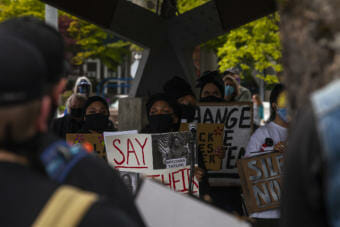
Patricia Allen-Dick identifies as Tlingit and mixed black and Native American. She said it’s important to recognize forgotten identities for people of mixed heritage.

“I felt like this was really important for us to open this space, and I really, really, really needed folks to understand how deep our roots are of our relationships as indigenous, native and our relationships recognizing the indigeneity of black communities as well,” she said.

Angola Dixon, a restorative justice healer in Seattle with roots in black and indigenous communities, said she shares the lived experience of native people.

“We’re actually in this fight together,” Dixon said. “Any time that I hear about an indigenous woman, a native First Nation woman that disappeared, and no one said anything and was murdered, and no one said anything, I feel that pain. It’s our pain. It’s not your pain. It’s our pain.”

The two-hour event drew around 200 people.

Juneau’s large anti-racist protest happened without any public advertising

Organizers read the names of black people who have been killed by police at a Saturday rally that drew more than 400 people in support of the black community in Alaska and nationwide. They stated a list of demands including that Juneau form a community oversight committee to monitor the Juneau Police Department. (Photo by Rashah McChesney/KTOO)

Alaska’s capital city saw its largest anti-racist protest in recent memory today in solidarity with actions for black lives worldwide.

Word of the protest spread through word-of-mouth and without public advertising. Overnight, the words Black Lives Matter were written in letters spanning several feet in front of the Governor’s Mansion and the State Capitol. Several hundred people turned out at Marine Park in downtown Juneau for the second large-scale demonstration since national actions began May 26.

The protest started at Marine Park with organizers, who withheld their names because they wanted the focus to be on their message, not individuals.

“We are not here for your entertainment. Hold space for us. We are mourning,” said one speaker. “We are here to recognize what kind of power we have within ourselves — the power to change things.”

Organizers read the names of black and brown lives lost to police violence. They also spoke about long-standing race issues in Juneau, namely in public education and the state criminal justice system. They repeatedly led the crowd in chanting “Juneau is not immune.”

They also announced a list of demands for local and state governments.

Following the speakers, protesters marched northward to the beat of tribal drums and the near-constant honking from passing traffic. They chanted as they crossed the Juneau-Douglas bridge and, upon their return, they dropped flowers in the Gastineau Channel to honor the memory of black lives lost.

After marching from Marine Park to the roundabout on Douglas Island, demonstrators threw hundreds of flowers into Gastineau Channel.  (Photo by Rashah McChesney/KTOO)

This is the 11th day of protests that have swept the nation following the death of George Floyd, a black man who was killed while being arrested by Minneapolis police. A widely circulated video shows a white police officer kneeling on Floyd’s neck for almost nine minutes while he lay facedown in the street, begging for his life and telling officers that he could not breathe.

Marie Johnson said she attended the protest because she believes the Minneapolis police were wrong in killing George Floyd.

“I just want to back everybody up,” she said. “We all live in a small community. There shouldn’t be any racism.”

The Tlingit and Haida Central Council also held a virtual rally this morning in solidarity with the statewide protests. The rally included black and native voices and discussions on the tribes’ standing with the Black Lives Matter movement.

Editor’s note: A previous version of this story was headlined “Anti-racist march draws largest Juneau protest in recent memory.” There have been other large protests in Juneau in the past five years, but no marches or protests related to the Black Lives Matter movement or other anti-racist causes have drawn such large crowds. We’ve updated the headline to clarify the nature of the protest and the fact that public awareness of the event happened word-of-mouth. The first line of the story has also been updated to reflect this.

Site notifications
Update notification options
Subscribe to notifications