I help the newsroom establish daily news priorities and do hands-on editing to ensure a steady stream of breaking and enterprise news for a local and regional audience.
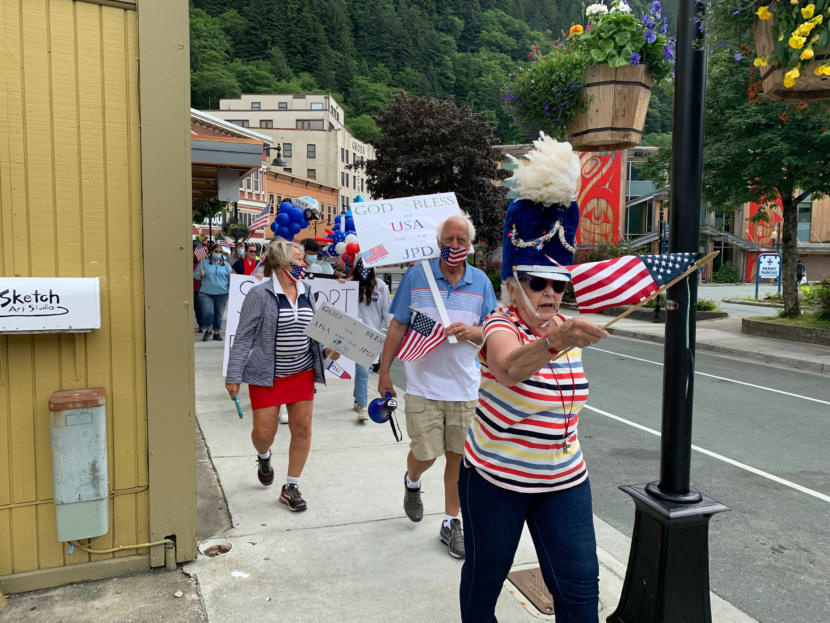
Bea Findlay leads a Back the Blue rally on Independence Day in Juneau. (Photo by Rashah McChesney/KTOO)
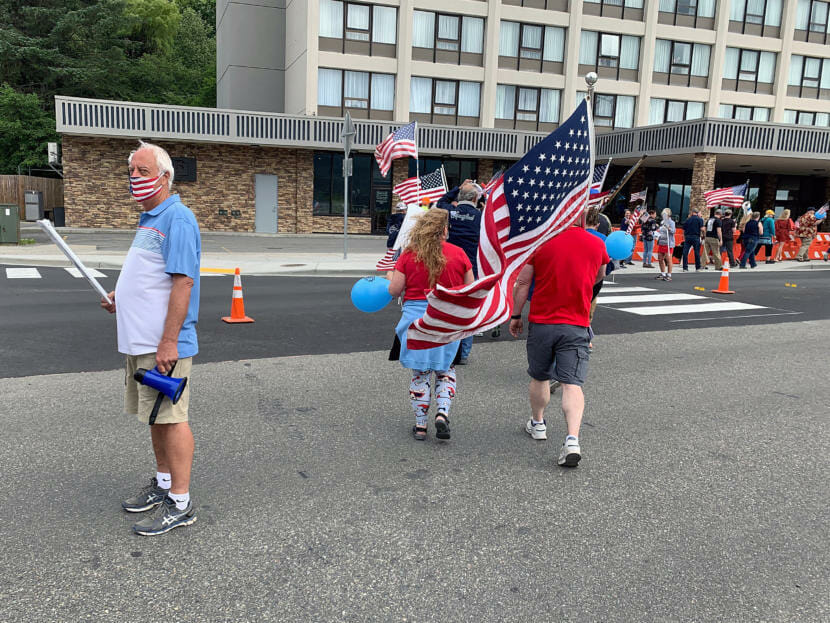
More than 50 people gathered in downtown Juneau to march in support of local and national police on Independence Day.
Many of them are part of a new group called Juneau Backs the Blue that formed via Facebook in the past few weeks.
“There’s a group of us that just didn’t like how police are being treated across the country, we understand there’s a lot of conflict and racial things going on but we don’t think the whole — all the police needs to be blamed for that and we don’t want them defunded at all. If anything, we think they should have more resources, we don’t want to have to be protecting ourselves. We want them to protect us,” said one of the organizers, Lisa Idell-Sassi.
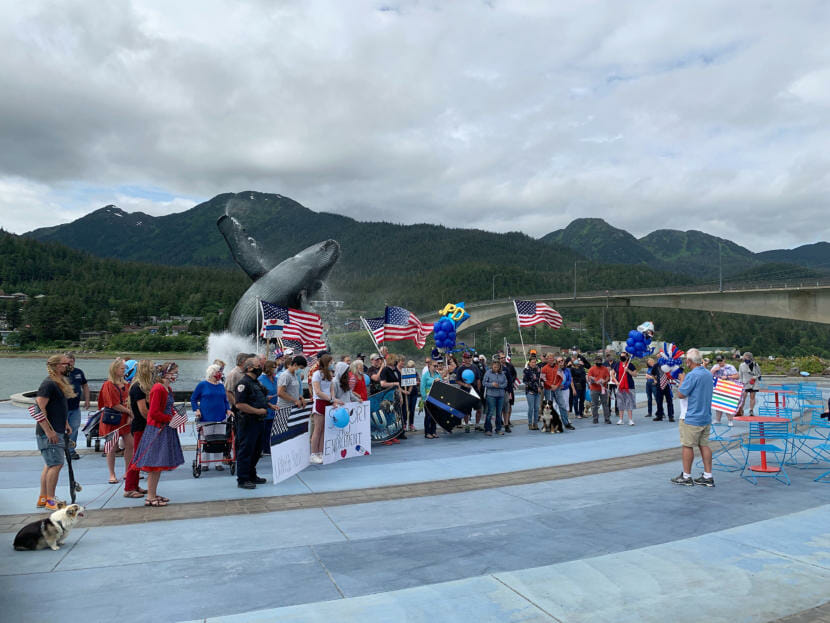
Idell-Sassi and several others carrying banners and American flags gathered near the whale statue in Overstreet Park before marching through downtown.
Former Juneau Mayor Ken Koelsch helps guide dozens of people who marched through downtown.
Former mayor Ken Koelsch was there, carrying a bullhorn – giving marching instructions and helping to stop traffic as the group walked along Egan Drive.
And, they got a lot of support from people in downtown.
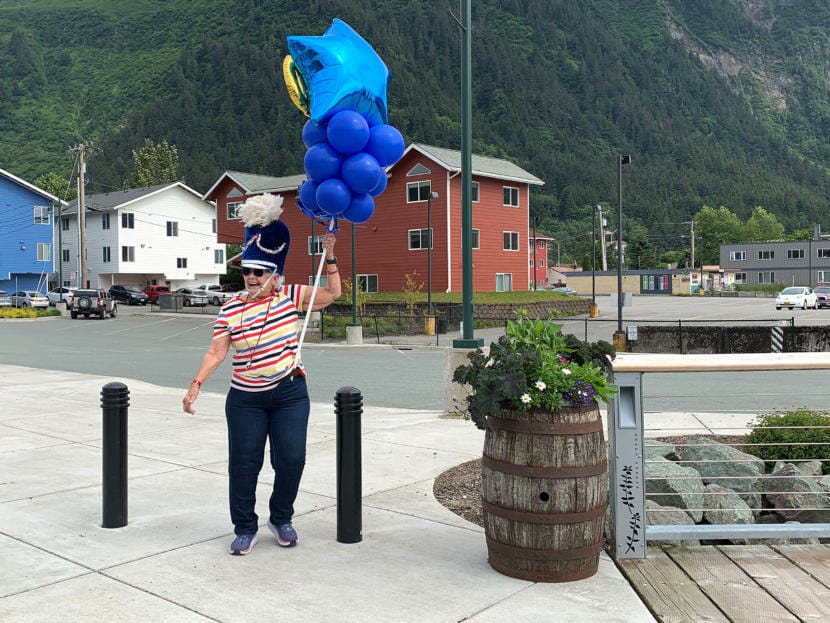
Longtime bandleader Bea Findlay helped lead the crowd. Findlay, who is 81, says this was supposed to be her last parade leading the Juneau band.
“And as it turns out, it will be but not in the way I thought,” she said.
The COVID-19 pandemic caused the City and Borough of Juneau to cancel its official Independence Day celebration — as did most other communities in Alaska.
Findlay thinks it would have been her 17th year leading the band in Juneau’s parade. But, this gathering means a lot to her too.
“I love my country and I love the police department for what they do,” she said.
Findlay says the rally was a grassroots effort, and it happened at the last minute.
“We’re tired of all the anti-police, anti-America, anti-USA,” she said. And, she’s not sure how much anti-police sentiment is going around the Juneau community, but says she’s seen some of it on social media. “We need them.”
After the group walked through town, stopping in a few places to sing “God Bless America,” they gathered in a parking lot near the Douglas Bridge for a final farewell.
More than 50 people gathered in Overstreet Park before marching through downtown in support of Juneau Backs the Blue on Saturday in Juneau. (Photo by Rashah McChesney/KTOO)
Idell-Sassi said the new group plans to continue holding these types of rallies — a few of them have also stood along roadsides in town with signs supporting the police in recent weeks.
She said, the idea isn’t to be political or confrontational. “We just want to show them as much love and support as we can right now.”
She echoes Findlay in that neither of them thinks there’s a lot of anti-policing sentiment in Juneau. But Idell-Sassi said she’s seen messaging about defunding the police and she doesn’t support it.
“I just want them to have the resources and money that they need to do their job and keep the current staff on board,” she said.
One thing she does support, is putting more money into social services rather than asking police officers to handle all of the public safety in town.
“I definitely think that’s needed. I mean, there’s a lot of hurting people and there’s a lot of homelessness and there’s a lot of drug addicts and there’s people that need help – you know. We’re not trying to take away from that at all,” she said.
Bea Findlay leads a Back the Blue rally on Independence Day, Saturday, July 4, 2020, in Juneau, Alaska. (Photo by Rashah McChesney/KTOO)
State health officials reported that by the end of the day on Friday, 55 new cases had been identified: 48 residents and 7 non-residents.
The majority of the new cases are in Anchorage where 32 residents have tested positive for the virus. Health officials there released a list of bars and other establishments where people who have had COVID-19 have been. They’ve asked people who have visited those places to monitor themselves for symptoms and get tested.
There are also new cases in residents from the Kenai Peninsula, Fairbanks, the Yukon-Koyokuk region, the Matanuska-Susitna Borough, Southeast Alaska in Petersburg and Southwest Alaska in the Bristol Bay Region and the Kulsilvak area.
Among the non-residents, two are in Anchorage, two are in Valdez, two are in Fairbanks and one is in Juneau. It’s unclear why most of them are visiting Alaska, though one of the Anchorage cases and the two in Valdez are related to the seafood industry
So far, 1,111 Alaskans have tested positive for COVID-19, and there are now more people currently sick than have recovered. So far, 230 nonresidents in Alaska have tested positive.
The state’s rate of transmission is still projected to be above 1, which means that on average each person who gets infected will pass COVID-19 onto more than one other person. At this rate, the virus is expected to spread quickly.
Another Alaskan has died as the state report again breaks its record for the highest single-day jump in new COVID-19 infections.
State health officials reported that by Thursday, 60 people had tested positive for the virus. That’s 46 people who are from Alaska and 14 non-residents who are in the state for work or as visitors.
Among residents, Anchorage saw the highest numbers of newly identified infections, with 19 new cases among residents. Fairbanks reported 11 new cases. There are also cases scattered along the Kenai Peninsula, the Valdez-Cordova area, the Matanuska-Susitna Borough, the Nome Census Area. In Southeast Alaska in the Juneau area and in Southwest Alaska in Bethel and the Kusilvak Census Area.
Among residents, case reporting reflects where people are from and not necessarily where they are currently located.
Cases among non-residents are identified by where they are when they test positive. Among those cases are two people in Seward — one is in the tourism industry and it’s not clear why the other is there. Two people are in Fairbanks, it’s also unclear why they are visiting there. Seven new cases are people in the seafood industry in the Bristol Bay and Lake and Peninsula regions — one of those is a visitor in the Dillingham Census Area.
That brings the total number of Alaskans who have tested positive for COVID-19 to 1063, just over half of them have recovered, there are 509 Alaskans who are currently sick. Since the beginning of the pandemic, 223 non-residents have tested positive while in Alaska — it’s not clear how many of them have recovered.
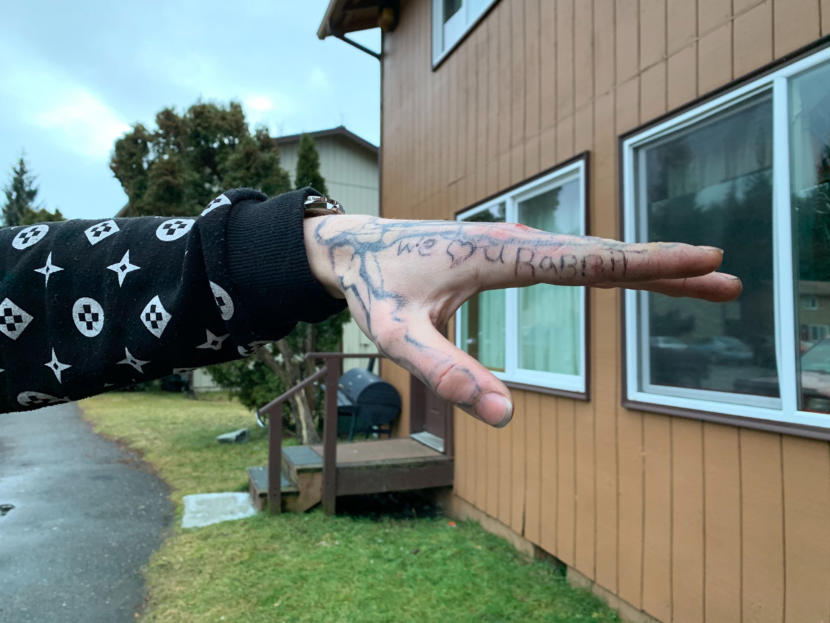
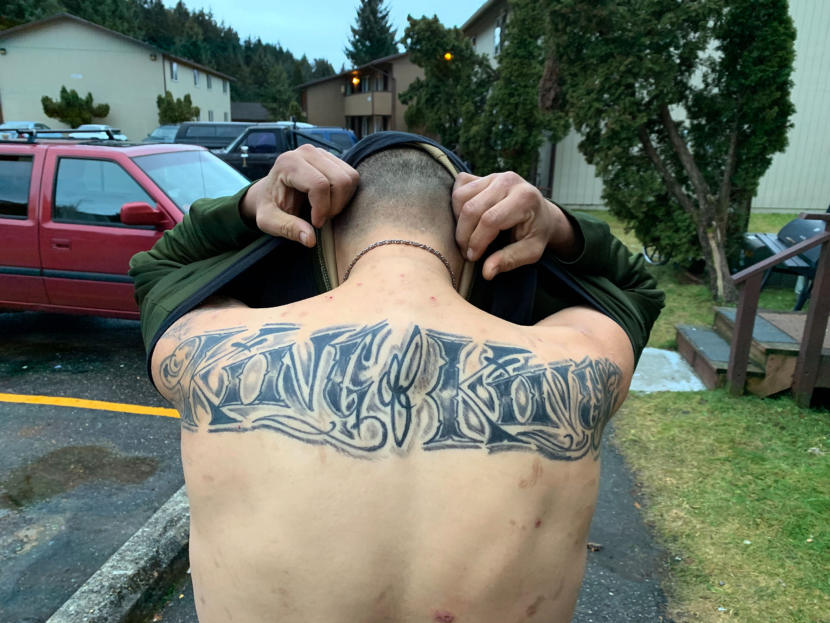
Residents and visitors at the Chinook apartment complex in the Mendenhall Valley show tattoos they were given by Kelly “Rabbit” Stephens on Dec. 29, 2019 in Juneau. Stephens was killed during an early-morning confrontation with Juneau police officer James Esbenshade. (Photo by Rashah McChesney/KTOO)
Last December 29, someone left a note on Virginia Stephens’ doorstep. It had a case number on it and a phone number for her to call. She said she had a hard time tracking anyone down, but finally got a phone number for Juneau police.
“I was told my son was dead and the one thing I asked is, did he suffer pain as he died. I wasn’t given any particulars of the incident and the guy told me that he didn’t have that information,” Virginia Stephens said. “I have since found out that he didn’t die easily, I mean he was in pain. Which hurts my heart.”
Virginia and Kevin Stephens, Kelly Stephens’ parents, have filed a wrongful death lawsuit in federal court. They’ve named Esbenshade, Juneau’s Chief of Police Ed Mercer and the City and Borough of Juneau. In it, they say that Kelly Stephens’ civil rights were violated and that he didn’t have to die.
They announced the lawsuit during a press conference with their attorneys on Wednesday. Those attorneys said they’ve been trying to get information from Juneau police for three months.
Juneau Police Chief Ed Mercer during a press conference after Kelly Stephens was killed, on Sunday, December 29, 2019, at the Juneau Police Department headquarters in Juneau, Alaska. (Photo by Rashah McChesney/KTOO)
“The Juneau police department, the authorities, are moving at glacier speed compared to the rest of the country in releasing this information” said one of the family’s attorneys, Los Angeles-based John Sweeney. “It’s very simple, if the parents have a question about how their son was killed, to release the bodycam video.”
Anchorage attorney Ben Crittenden said that has left the family without any closure.
“The video does not lie, it would tell us everything that happened,” he said.
KTOO has asked for audio and video from that night as well. Juneau police denied that request in January, saying the case was still being investigated.
But they later released several minutes of body camera video (Warning: This video includes video and audio of Kelly Stephens being shot. He later died of his wounds.) and dashcam from Esbenshade’s response to the 911 call late Thursday evening.
Chief Assistant Attorney General Jack McKenna with the state’s Office of Special Prosecutions described body-cam video, written reports, audio recordings, photos of the altercation and listened to recorded witness interviews. He also laid out why it would not be charging Officer Esbenshade with a crime.
McKenna’s report is based on his review of an investigation that Juneau Police did themselves.
The report starts with a description of an encounter at a local grocery store that happened hours before Stephens died. It describes Stephens approaching someone in the parking lot of the store, swinging what witnesses described as a grappling hook and shouting that he was going to kill the man.
Another witness is detailed in the report saying that Kelly Stephens told her to call the cops because he wanted to “commit suicide by police.”
Officer Esbenshade responded to that incident at the grocery store, but didn’t see Stephens. Later that night, he responded to a 911 call reporting that there had been a shot fired near an apartment complex on Cinema Drive.
In the video, it’s dark and difficult to see but there is clear audio from Esbenshade’s body camera. The video shows a shadowed figure walking quickly toward officer Esbenshade, followed by a dog.
The video shows Stephens advancing on Esbenshade, yelling that he was going to kill the officer — he also tells Esbenshade to shoot him. Officer Esbenshade told Stephens to stop three times. He asks what Stephens is carrying in his hands. Stephens keeps yelling “I will kill you,” at him.
Then, there’s a single gunshot and Stephens screams and falls down.
As officer Esbenshade steps toward him, Kelly Stephens comes into view, curled up, screaming on the ground. He keeps asking officers to kill him.
The state investigator goes on to conclude that officer Esbenshade was justified in his use of deadly force — that he was defending himself against the threat of serious physical injury. And that Esbenshade “could have subjectively believed that Mr. Stephens was going to assault him with the chain.”
Officer Esbenshade didn’t say that he believed he was in danger. Through his attorney, he declined to be interviewed during the investigation.
But even with the video, Crittenden said they would have sued anyway.
“We’re not going to depend on them to give us what they want to give us,” he said. “We’re entitled to get everything under the federal rules of civil procedure. We want to get everything so we can do our own independent investigation.”
The family asserts in the lawsuit that Stephens wasn’t armed. That the dog leash he was carrying wasn’t a threat to the officer.
One of the family’s attorneys, Steven Glickman, says Juneau police haven’t been forthcoming with information, so it has been hard for the family to piece together what happened.
He said because the family lives in Las Vegas, they had to rely on news reports to find out what happened. First, they hired a private investigator, who also wasn’t able to get much information. And, eventually they hired lawyers.
“The only way to get to the truth is to find out what happened,” Glickman said. “And the lawsuit’s filed so we can get to the truth and get the Stephens’ the answer that they deserve for what happened to their only son.”
Juneau police have not yet responded to the lawsuit.
Editor’s note: A previous version of this story stated that Juneau police hadn’t yet responded to the lawsuit. They responded late Thursday, releasing several minutes of video and photos of the dog leash that Kelly Michael Stephens was carrying the night he died. This story has been updated with those details. A previous version of this story also misattributed a quote to Anchorage attorney Ben Crittenden — it was one of the family’s Los Angeles-based attorneys, John Sweeney.
State public health experts gathered Wednesday to discuss the latest science and the medical response to COVID-19.
They talked about the mechanics of masks and how they help to prevent the spread of the virus.
State epidemiologist Joe McLaughlin explained that virus particles are very small, but they hitch a ride with a person’s larger respiratory droplets in order to infect someone else.
“So, what we know is that when I cough or I sneeze or even I’m talking or I’m singing into a mask, I’m going to catch a lot of those larger respiratory droplets and prevent transmission that way,” he said.
The state’s Chief Medical Officer, Dr. Anne Zink answered questions about how businesses can safely operate during the pandemic and what they can do when customers don’t cooperate.
“We get asked a lot of legal questions,” she said. “We’re not lawyers, but in general I can tell you that businesses have the ability to require shirt, shoes, pants before you come in and you have the ability to require a mask of someone coming in.”
Zink suggested that business owners talk to their staff and potentially to their lawyers about how to enforce mask policies.
The state reported 41 new cases of COVID-19 by the end of the day Tuesday: 38 Alaskans and 3 nonresidents. Cumulatively, 978 Alaskans and 198 nonresidents in the state have tested positive for the virus. More than 114,000 tests have been performed.
Of the new cases, 15 are Alaskan residents from the Anchorage area.
There are also cases among residents from the Kenai Peninsula Borough, the Interior, the Matanuska-Susitna Valley, the Northwest Arctic and Ketchikan Gateway Boroughs and Nome.
There are new non-resident cases in the seafood industry in Sitka and in a visitor to Anchorage.
Public health officials will be hosting call-in programs called “COVID-19 Science ECHO” at noon on Wednesdays. They’re being streamed live on Facebook or via Zoom. There’s also a form to submit questions.
Residents and visitors at the Chinook apartment complex in the Mendenhall Valley show tattoos they were given by Kelly “Rabbit” Stephens on, Dec. 29, 2019 in Juneau. Many said they didn’t want their identities known for fear of reprisal. Stephens was killed during an early-morning altercation with Juneau police officer James Esbenshade. (Photo by Rashah McChesney/KTOO)
City police officer James Esbenshade shot and killed Kelly Michael Stephens on December 29 near the Chinook apartment complex in Juneau; police say Stephens threatened to kill Esbenshade who was responding to a 9-1-1 call.
An Anchorage-based law firm, Ben Crittenden P.C. announced via press release that Stephens’ parents intend to file a wrongful death lawsuit and will discuss their efforts to seek reform of the Juneau Police department.
After the shooting, Juneau police put Esbenshade on leave and investigated the circumstances.They found that his use of deadly force was justified and the State of Alaska later decided not to bring criminal charges against him.
This is a developing story and will be updated as new information becomes available.
Close
Update notification options
Subscribe to notifications
Subscribe
Get notifications about news related to the topics you care about. You can unsubscribe anytime.