Rashah McChesney

Daily News Editor

I help the newsroom establish daily news priorities and do hands-on editing to ensure a steady stream of breaking and enterprise news for a local and regional audience.

Sharp increase in hospitalizations as COVID-19 case tally rises by 20 in Alaska

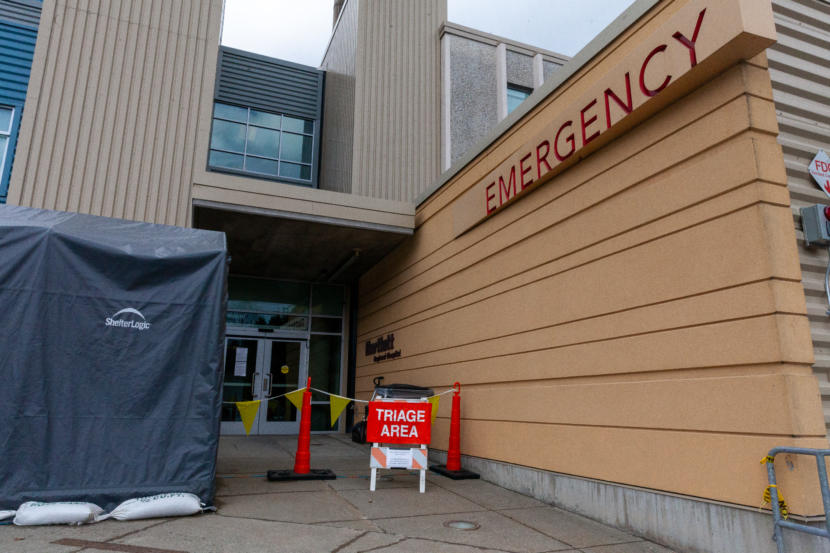
A triage tent is set up to screen patients for symptoms of COVID-19 outside on April 7, 2020 at Bartlett Hospital in Juneau. (Photo by Rashah McChesney/KTOO)

The number of people currently in the hospital with COVID-19 in Alaska nearly doubled between Monday and Tuesday.

State health officials reported that by Tuesday, 22 people were in the hospital. Three of them are on ventilators.

The state is reporting that another 20 Alaskans have tested positive for the virus, plus two more non-residents. Of those, nine are from Anchorage, nine from the Kenai Peninsula Borough, one from Sitka and one from the Matanuska-Susitna Borough.

That brings the total number of confirmed cases among Alaskans to 593. About 66% of Alaskans who have gotten sick with the virus have recovered. Eleven people have died.

The outbreak at the Providence Transitional Care Center continues. By Wednesday afternoon, the center had another confirmed case, according to Mikal Canfield, a spokesman for Providence Health & Services Alaska. It was not immediately clear if that case was included in the statewide count.

A total of 18 patients and 26 caregivers have now tested positive for the disease. That’s about a third of the center’s patients and nearly 20% of its staff. One of the patients diagnosed with the disease died on Sunday.

The center is the site of the state’s largest coronavirus outbreak. It shares a campus in East Anchorage with Providence Extended Care, a long-term care facility that serves mostly elderly people. One caregiver has tested positive there so far. Providence is doing a third round of testing on all patients, residents and caregivers starting tomorrow.

The state has also reported that nearly 68,000 tests have been performed, though some people have been tested more than once — so that’s not equal to the number of people in the state who have been tested.

Juneau’s mayor Beth Weldon recovered from COVID-19 this week

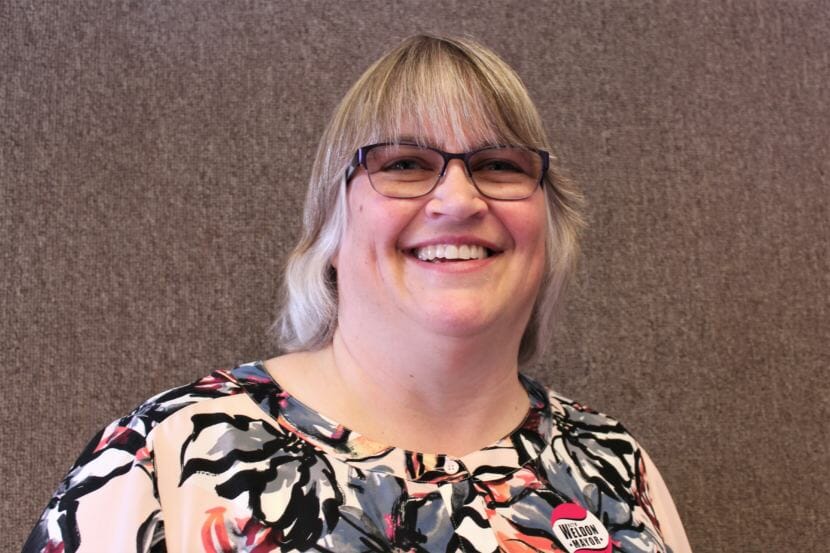
Beth Weldon, pictured on Sept. 11, 2018. (Photo by Adelyn Baxter/KTOO)

Juneau’s mayor was sick with COVID-19 in late May.

During Monday evening’s city assembly meeting, Mayor Beth Weldon said she traveled to the Lower 48 to move her son out of his college dorm. When she came back, she started her 14-day quarantine, and then started to feel sick.

Weldon says she took a test and became the 32nd person in the city to test positive for the virus.

“I’m sorry that I keep it a secret for so long,” she said. “But to be quite honest I didn’t want my mother to worry about me and I [waited until I] could tell her I had it and then was recovered,” she said.

Juneau public health nurses attribute the case to her travel outside of the state.

After talking to the state’s Chief Medical Officer Dr. Anne Zink, Weldon decided to share her experience publicly.

Weldon says her case was fairly mild. She says she took a lot of naps and was often tired. But, she never had a fever.

She encouraged community members to get tested for the virus if they develop symptoms saying that there’s a perception the test is extremely painful, but it isn’t.

“The reason I’m sharing my story now is that it’s a case in point that even the mildest of symptoms, you should opt to get tested,” she said.

As of June 4, Weldon says she’s been declared virus-free.

Members of the public can call Juneau’s COVID-19 hotline at 907-586-6000 from 8 a.m. to 5 p.m. daily.

New case of COVID-19 announced in Juneau; city starts screening airport arrivals

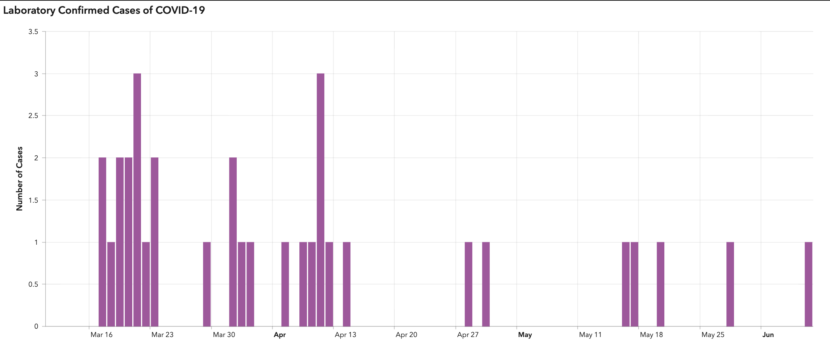
Screenshot from the Alaska Department of Health and Social Services June 7, 2020, showing Juneau’s 34 cases of COVID-19 since mid-March.

State health officials are reporting a new case of COVID-19 in the Juneau area. It’s not clear how the person — who lives in Douglas — contracted the virus.

To date, 34 Juneau residents have tested positive for the virus since March. According to city data 32 of them have recovered.

On Saturday, city employees in Juneau started screening some out-of-state travelers for COVID-19 at the city’s airport. According to a report from the city’s emergency operations center, they performed 76 tests.

Borough-wide, more than 2,500 tests for COVID-19 have been performed. But because some people have been tested more than once — it’s not clear exactly how many Juneau residents have been tested for the virus.

The Juneau resident was one of eight new cases the state health department identified by Saturday. Five of the other people came from Anchorage, one from Eagle River and one from the Kenai Peninsula.

To date, 544 Alaskans have tested positive for the virus; just over 70% of them have recovered. Ten Alaskans have died. State health officials also reported one more positive case in a non-resident this weekend. That person is a seafood worker who is currently in Anchorage. So far, a total of 46 non-residents who have tested positive for the virus while in Alaska.

Elsewhere in the state, a crew member on the Tustumena ferry tested positive for COVID-19 on Saturday. The ferry was in Unalaska on its first run after coming back in service on June 2. That person, and 16 crew members are now quarantined on board the ship, which is now sailing back to Homer and will not make any stops. The Department of Transportation has cancelled all of its scheduled sailings for now. According to the state, passengers who are currently on the vessel will be screened for the virus when they reach Homer.

‘Open never meant over’: Alaska announces new clusters of COVID-19 in Anchorage and Kenai Peninsula

Updated Post – by Rashah McChesney, KTOO

A dozen people in an extended care facility in Anchorage have tested positive for COVID-19.

Those infected with the virus are a mix of residents and caregivers at the Providence Transitional Care Center — a skilled nursing facility in Anchorage. They’re among 27 new Alaskans that state health officials announced had the virus on Sunday.

It’s the largest single day spike in cases since Alaska first started tracking the spread of the virus in March.

During a Sunday press conference, Providence Health & Services Chief Medical Officer Dr. Michael Bernstein said the hospital learned Friday that one resident had developed symptoms. So, over the weekend they tested all of the residents and staff in the facility.

Bernstein said it’s something that they had been working to prevent since mid-March. Staff have worn personal protective equipment, they’ve been cleaning high touch areas several times a day and there has been no visitation since mid-March.

“We were hoping we could prevent this from happening but we know this is a highly transmissible or contagious virus and the real challenge is that people can be very infectious when they’re asymptomatic or before their symptoms develop,” he said.

There are a few test results still pending. So the true size of the outbreak should become clearer in the next few days.

“As for now, our work focuses on caring for the residents who are positive, most of whom do not have symptoms at this time,” he said.

Outside of that healthcare facility, Anchorage had other cases. Natasha Pineda, Director of the Anchorage Health Department said city nurses are investigating all of them, but one is the contact of another known positive case in the state.

“So we’re really asking the community members in Anchorage, as you proceed forward in our reopening, to go slow. As you expand your bubble, keep in mind the critical importance of physical distancing,” she said.

That message is one that the state’s Chief Medical Officer, Dr. Anne Zink, reiterated as well. She said the virus continues to spread through Southcentral Alaska, particularly in Matanuska-Susitna Borough, Anchorage and on the Kenai Peninsula.

“As we’re doing interviews, it appears to be that these seem to be linked — at least some of the cases — into clusters relating to some large celebrations that happened,” Zink said. “It’s impressive when we see this disease, how sneaky it can be and it can really spread amongst larger groups of people — 20, 30, 40 people getting together for a celebration, spreading, and then people going to work sick and how it can spread from there.”

She said it’s important for Alaskans to remember to limit the number of people they come in contact with. Though, it’s inevitable that the virus will continue to spread.

“We always knew that open never meant over,” she said

Despite the jump, Gov. Mike Dunleavy said his administration doesn’t plan to change its trajectory in reopening the state fully.

“The fact is the virus is out there. We know it’s here in Alaska. We know it has been in many cities and communities in Alaska. We’ve done a pretty good job of keeping it at bay, we’re doing a pretty good job at testing. But we’ve always said, the numbers are going to go up,” he said.

This week, his administration plans to end a requirement that people traveling into the state quarantine for 14 days. Instead visitors and Alaskans returning to the state will be asked to take a test with 72 hours of boarding an Alaska-bound flight.

Original Post – by Jennifer Pemberton, KTOO

Gov. Mike Dunleavy will hold a press conference at 5 p.m. with the state Department of Health and Social Services, the Municipality of Anchorage and Providence Health & Services Alaska to discuss a surge in the number of COVID-19 cases.

On Sunday, state health officials announced that 27 new Alaskans have tested positive for coronavirus. That’s the most cases in a single day since the state identified its first case in March.

Dunleavy will be joined by the state’s Chief Medical Officer Dr. Anne Zink, Providence Health & Services Alaska’s Chief Medical Officer Dr. Michael Bernstein, and Natasha Pineda, Director of the Anchorage Health Department.

You can watch today’s press conference live on this post, the governor’s Facebook or Livestream pages, or on 360 North television.

Death of George Floyd sparks solidarity rallies across Alaska

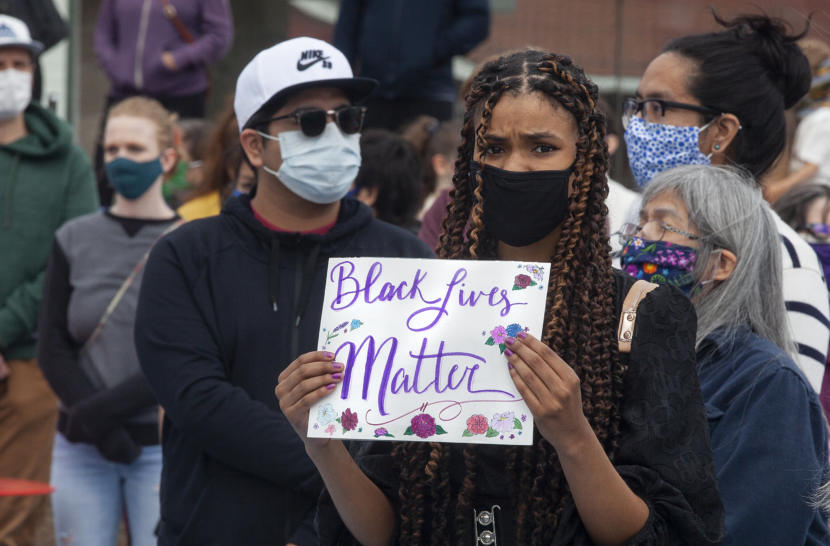
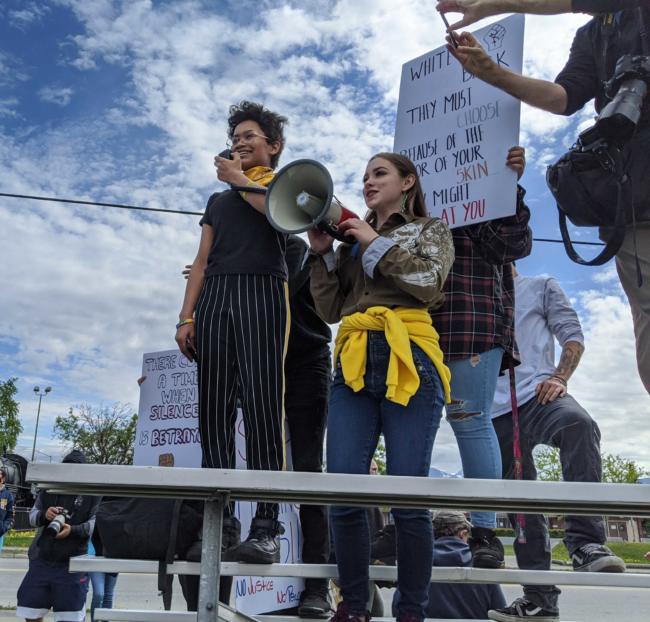
Lacey Davis joined about 250 people gathered for a public “I Can’t Breathe” rally protesting the death of a black man, George Floyd, who was killed after a white officer pressed a knee into his neck while taking him into custody in Minnesota. People held signs decrying violence against black people and calling out institutional racism, many supporting the Black Lives Matter movement on Saturday in Juneau and throughout Alaska. (Photo by Rashah McChesney/KTOO)

Alaskans in the state’s three largest cities took to the streets Saturday in response to the death of George Floyd, a black man in Minneapolis who died after a police officer pinned him to the ground with his knee on Floyd’s neck. In a widely shared video, Floyd can be heard saying “I can’t breathe,” while being arrested.

Four Minnesota Police Officers have been fired and one, Derek Chauvin, has been arrested and charged with third degree murder. 

Still, the viral video of Floyd on the ground has sparked protests in dozens of cities across the country, some of them becoming destructive and violent — though Alaska’s demonstrations were all peaceful.

Markus Vinson, 16, (left) speaks into a bullhorn at the march he organized in Anchorage on May 30, 2020. He says he was surprised at the turnout and hopes it inspires others. (Photo by Mayowa Aina/Alaska Public Media)

In Anchorage a march and a rally were organized in the span of just a few days. 

The noon march began in the city’s Town Square Park. It was organized by a 16-year-old East High School student, Markus Vinson. It’s the first protest that he had ever attended, let alone organized. 

“I wrote a Google Doc, screenshotted it, posted it on Instagram, and it took off from there,” he said. 

He figured about 20 people would show up. But about a hundred people showed up with signs and marched through a quiet Downtown Anchorage chanting slogans like “I can’t breathe” and “Black Lives Matter” for about 45 minutes. 

Vinson said he was blown away by the turnout and hopes it inspires more people.  

“I’m tired of seeing people tell us people of color how we need to protest,” he said. 

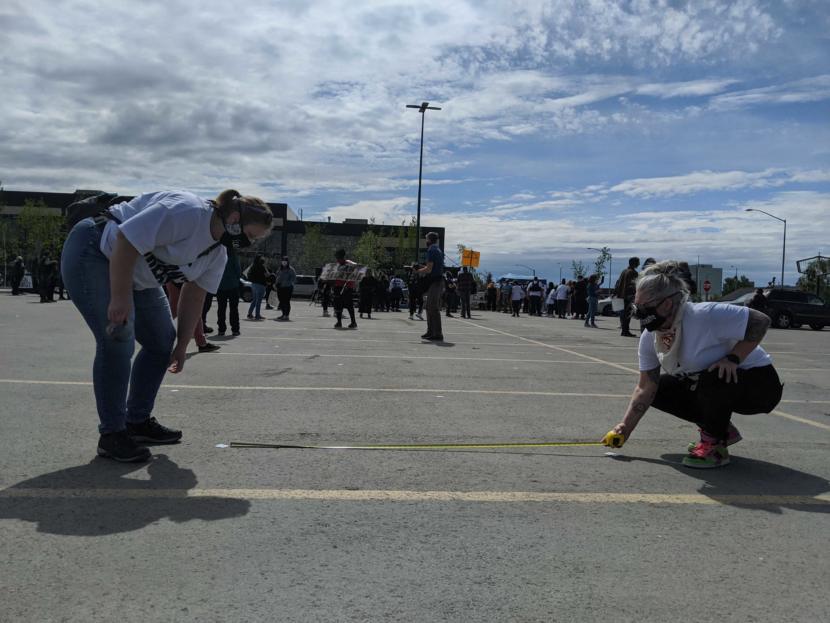
Volunteers at the “I Can’t Breathe” rally in Anchorage place duct tape lines 6 feet apart to guide people where to stand during the rally on Saturday. (Photo by Mayowa Aina/Alaska Public Media)

About an hour later a second rally was held in a parking lot in midtown Anchorage. That one featured several speakers including pastors and community activists from Alaska Native and Asian community groups, a moment of silence, a call and response, and poetry reading.

In an attempt to address concerns about the ongoing coronavirus pandemic, organizers placed pieces of duct tape 6 feet apart, to guide people as they stood. They also organized a spectator lot where people could stay in their cars and hear the rally broadcast through a radio station.  

One speaker, George Martinez said it was important for him to show solidarity with the black community and other cities around the country. 

“The residents of Anchorage are connected to people all across the country and cities everywhere so this really demonstrates the awareness that we have as a globally connected [and] nationally connected city even though we’re kind of far off in the corner,” Martinez said. 

“We have people from everywhere here. So this is a really great turnout because this demonstrates that we are watching, we’re aware, and we are in solidarity in the call for justice,” he said.

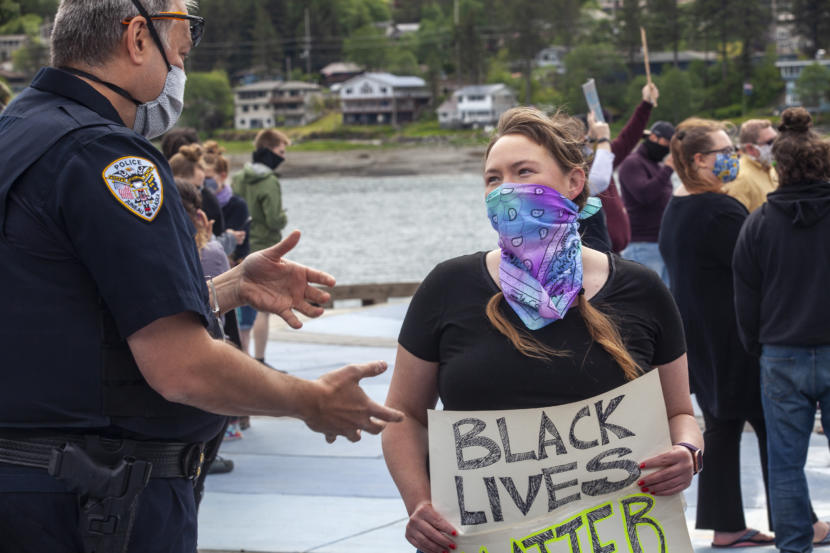
Juneau Police Department Deputy Chief David Campbell and Borough Assembly member Alicia Hughes-Skandijs talk amid a crowd of about 250 people gathered for a public “I Can’t Breathe” rally  on Saturday in Juneau. (Photo by Rashah McChesney/KTOO)

In Fairbanks, a rally and March organized by the NAACP of Fairbanks and Native Movement, drew hundreds.  The Fairbanks Daily News Miner reported the crowd chanting “Enough is enough. Black Lives Matter” as they marched through downtown.  

While in Juneau, about 250 people showed up for a mid-afternoon “I Can’t Breathe” rally – modeled after the one in Fairbanks – at a park in downtown. 

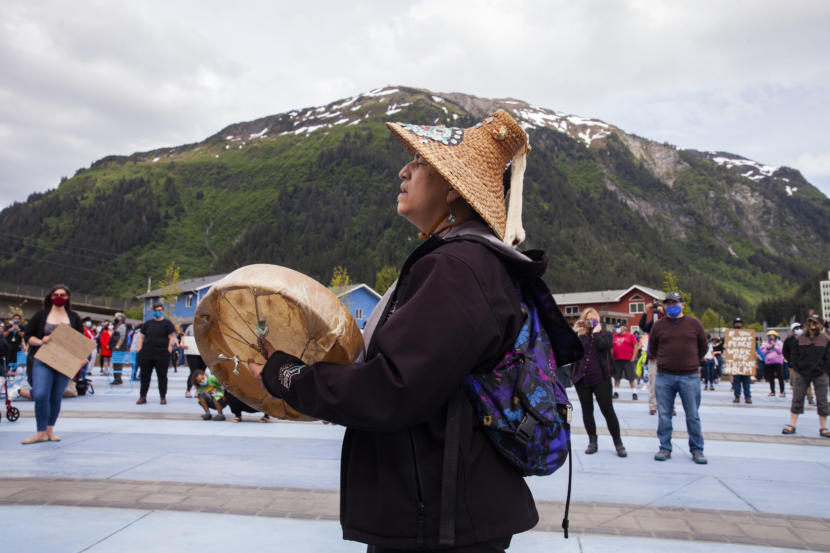
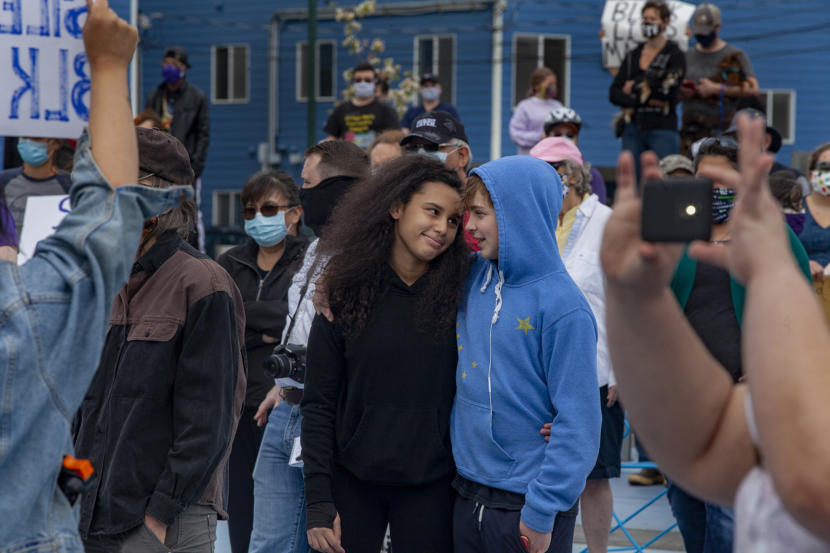
About 250 people gathered for a public “I Can’t Breathe” rally on Saturday,  in Juneau, Alaska. Similar protests happened throughout the state with hundreds turning out in Fairbanks and Anchorage, they’ve also erupted in dozens of cities all over the country. (Photo by Rashah McChesney/KTOO)

Juneau’s rally was quickly organized and initially intended to be a silent vigil, however protestors chanted and sang in support of the Black Lives Matter movement. 

Many had signs calling out acts of institutional and systemic racism and standing in solidarity with protests that are sweeping across the country. 

Chants of “Silence is violence,” and “If you see something say something,” urged white protestors and allies of the Black Lives Matter movement to take tangible steps toward preventing violence against black people.

About 250 people gathered for a public rally calling out systemic and institutional racism, and supporting the Black Lives Matter movement on Saturday in Juneau. (Photo by Rashah McChesney/KTOO)

Editor’s note: An earlier version of this story used the wrong pronouns to refer to Markus Vinson. It has been corrected.

Your questions about COVID-19 testing answered

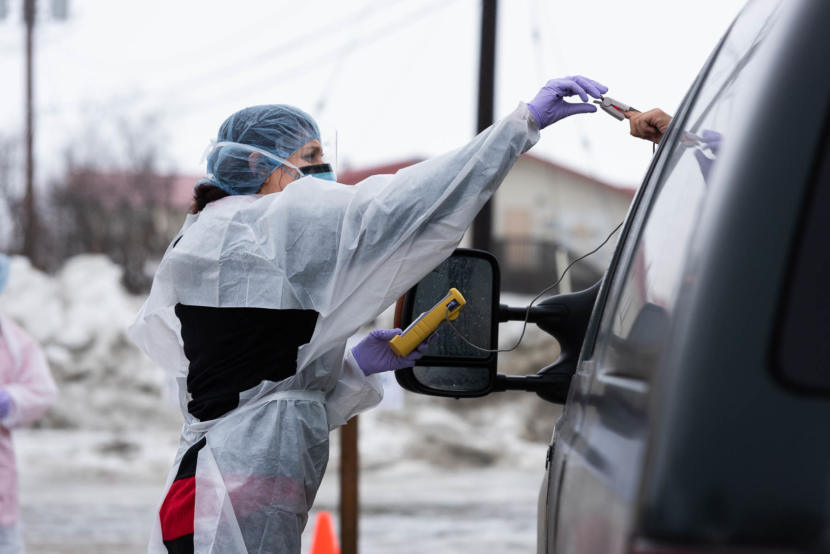
Dr. Elizabeth Bates does a run-through with a Yukon-Kuskokwim Health Corp. employee at a COVID-19 drive-thru test site in Bethel on March 25, 2020. (Photo by Katie Basile/KYUK)

There’s a lot to keep track of when it comes to COVID-19 and Alaska’s response to the pandemic. Reporters all over the state are talking to experts and local Alaskans every day about the impact the virus is having on our lives. And still, there are questions. Lots and lots of unanswered questions.

This post answers questions about testing for COVID-19. Rashah McChesney provided the reporting.

Q: How many COVID-19 tests are done on a daily basis? Who keeps and reports that? — Doug Mecum, Juneau

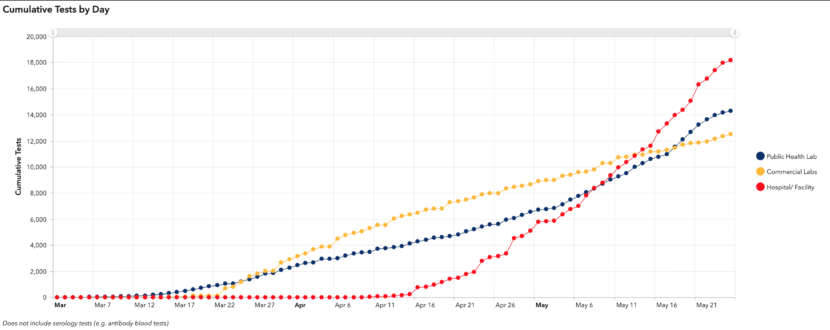
There is not a set number of tests that get done on a daily basis. There are tests being performed by commercial labs, the Alaska State Public Health Labs and hospital facility labs. Each doctor’s office, hospital, clinic and municipality is deciding who gets tested and when. Then when the lab gets those samples they perform the test and then send the data to the state.

The state Department of Health and Social Services gets that testing data and reports it on a COVID-19 case dashboard they update every day. As of the last update on May 25, 44,964 tests had been performed in the state. Generally, they report where the sample was taken — and what kind of lab tested it. It’s important to remember that some people get tested more than once — so that figure isn’t reflective of the number of people in the state who have gotten a test for the virus.

Screenshot from the Alaska Department of Health and Social Services COVID-19 dashboard, taken on May 26, 2020. (Data from https://coronavirus-response-alaska-dhss.hub.arcgis.com/)

Q: How long it takes to get results? — David Quisenberry, Juneau

There’s pretty wide variability here. Sometimes it’s dependent on the lab that does the test; sometimes it’s dependent on the type of machine used to process the sample. There are some machines, like the ABBOTT ID Now, that take as little as 15 minutes to return results, though there’s some data that shows those results can be less accurate than others. Some take several hours to return results. And, if a sample gets sent out of state, that can take days to return. Early on people were being told that it could take a week to get their results back. Now, it seems to take a few days.

Q: How much does getting tested cost?

It depends. There are free drive- up testing sites in some places in Anchorage, Ketchikan, Juneau, Fairbanks and Bethel. But that’s for people who have symptoms and are referred by a medical provider. There are people who want to be tested, but don’t meet the criteria. They’ve paid several hundred dollars out-of-pocket for tests. People without insurance have reported paying several hundred dollars as well. At least one dentist’s office in Juneau is asking people to take a $50 COVID-19 test before they can be treated.

But for people who do have insurance? It’s likely free. Alaska’s Division of Insurance has barred companies it regulates from charging for COVID-19 related testing — if it’s medically necessary. It’s also asking them to waive the office visit fee as well. At least two of the state’s insurers Premera and Moda are following that guidance.

Send us your questions — big and small, serious and trivial — about the pandemic in Alaska and we’ll send a reporter or expert out to find the answer.

Site notifications
Update notification options
Subscribe to notifications