I help the newsroom establish daily news priorities and do hands-on editing to ensure a steady stream of breaking and enterprise news for a local and regional audience.
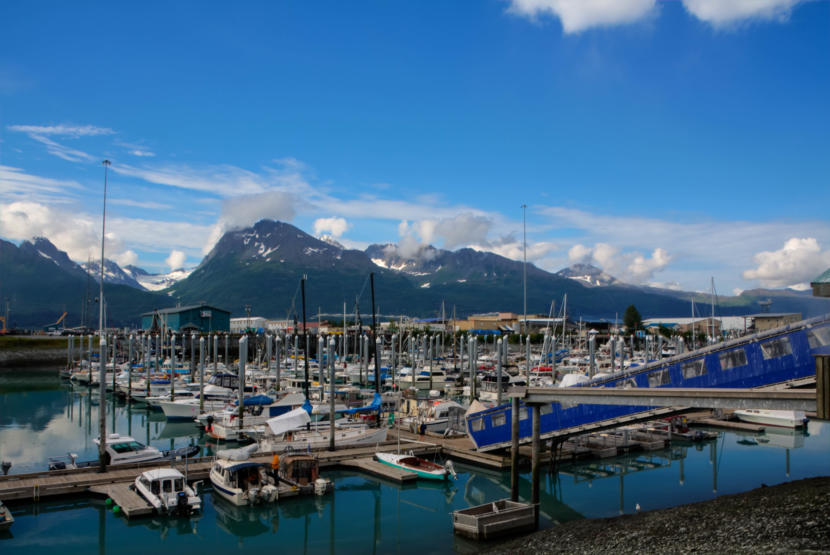
The City of Valdez harbor in 2014. (Creative Commons Photo courtesy Ronald Woan/Flickr)
A seafood worker in Valdez has tested positive for COVID-19. But state health officials say they aren’t sure how the man, who works for Peter Pan Seafoods, contracted the virus because he has been in the state for a month, went through quarantine and has not left the city.
This is the city’s first confirmed case of COVID-19.
“This is a case where everything was done right,” she said. The employer, the individual and the screening mechanisms were all in place.”
The man was asymptomatic when he arrived and doesn’t have any symptoms now. State epidemiologist Louisa Castrodale says he was tested on Wednesday — as part of a screening effort for workers there.
“It’s not clear the source of the infection, whether this was something that was picked up locally — since the person has been there for a month,” Castrodale said.
She said it’s possible that the test picked up “residual virus,” from an infection that he had in the past.
According to a city media release, the initial contact investigation indicates that the man has been on the Peter Pan Seafoods campus since he got to Valdez. So, they consider risk to the community to be relatively low.
Peter Pan Seafoods Director of Administration Dale Schiffler said the man was living in private quarters but they have since moved him into quarantine and have sanitized his living area and the places he worked.
“Anyone the employee has also been in contact with has also gone into quarantine,” Schiffler said. “We are anticipating retesting the employee and anyone he has been in contact with as soon as possible.”
The state reported four new coronavirus cases by Friday. Two from the Matanuska-Susitna Borough, one from the Nome area and one from the Northwest Arctic Borough. That brings the total number of cases among Alaskans to 408 and the total number of nonresident cases to 13.
So far, nearly 88 percent of Alaskas who have tested positive for the virus have recovered.
This scanning electron microscope image shows, in yellow, SARS-CoV-2 — the coronavirus that causes COVID-19 — isolated from a patient in the U.S., emerging from the surface of cells, in blue and pink, cultured in a lab. (Image courtesy of National Institute of Allergy and Infectious Diseases – Rocky Mountain Laboratories)
Health officials announced that another person from the Juneau-area has tested positive for COVID-19. According to the Alaska Department of Health and Social Services, the person is from Douglas.
It’s not clear if they are physically located in the city however, the state didn’t provide any further information.
To date, 31 Juneau residents have tested positive for the virus; the majority of them have recovered.
Most of the city’s cases came from an outbreak at the Lemon Creek Correctional Center. State officials began testing staff members and inmates there late last week. 165 people were tested, 44 people declined. A Department of Corrections spokesperson did not return emails seeking information on whether the city’s latest case is related to that outbreak.
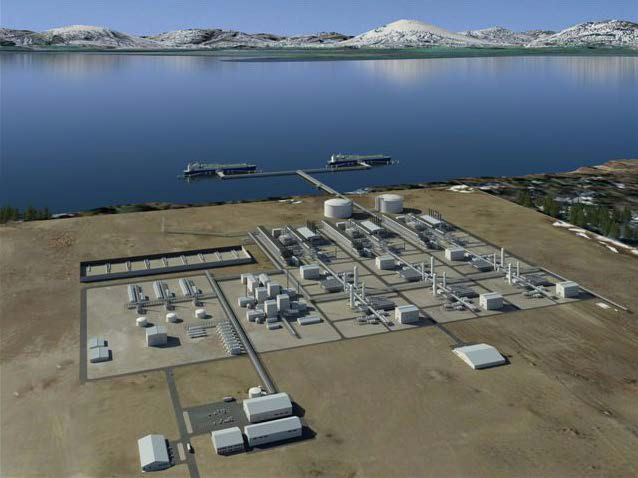
This illustration shows a rendition of what the liquefaction plant in Nikiski could look like if the Alaska LNG project is completed as planned. (Image courtesyAlaska LNG project.)
Alaska’s latest plan to get North Slope natural gas to market got environmental approval from federal energy regulators on Thursday.
Several state lawmakers, Gov. Mike Dunleavy and the state’s congressional delegation congratulated the state’s gas corporation for reaching the milestone.
In a news release Alaska Gasline Development Corporation president Frank Richards said that getting approval from the Federal Energy Regulatory Commission helps make the project less risky for investors and potential partners to consider — because it defines the environmental impacts.
But, there are still a lot of things that have to happen before the project gets off the ground. The state doesn’t have control of all of the land it needs, or the finances to get the $43 billion project built.
The state corporation is still working to make the project economically competitive. The markets the project is targeting are in Asia, where current prices aren’t high enough to make Alaska’s gas financially feasible to develop.
This version kicked off in 2014 as a partnership between the state and its big three oil producers BP, ConocoPhillips and Exxon Mobil. There was a fourth partner, TransCanada.
But, by 2016 those producers backed away from the project, saying the market conditions weren’t right. Then, the state took the lead.
But the state corporation’s board does not want the state to continue being the projects only sponsor. In April the board adopted a plan to bring on new partners to guide the project — the goal is to have those partners in place by January of 2021.
The environmental impact statement released today has its detractors.
Environmental groups like Earthjustice, The Center for Biological Diversity and Sierra Club say the environmental impacts outweigh its benefits.
And one of the four federal commissioners who heads up the regulatory agency shares those concerns. And disagreed with the decision. In his dissent, Richard Glick wrote that the commission is refusing to consider the impact the Alaska LNG project would have on climate change.
He wrote “claiming that a project’s environmental impacts are acceptable while at the same time refusing to assess the significance of the project’s impact on the most important environmental issue of our time is not reasoned decisionmaking.”
Editor’s note: This story has been updated with a change in the headline to reflect that the Alaska LNG project’s environmental impact statement was not significantly delayed, and to add further information from that impact statement.
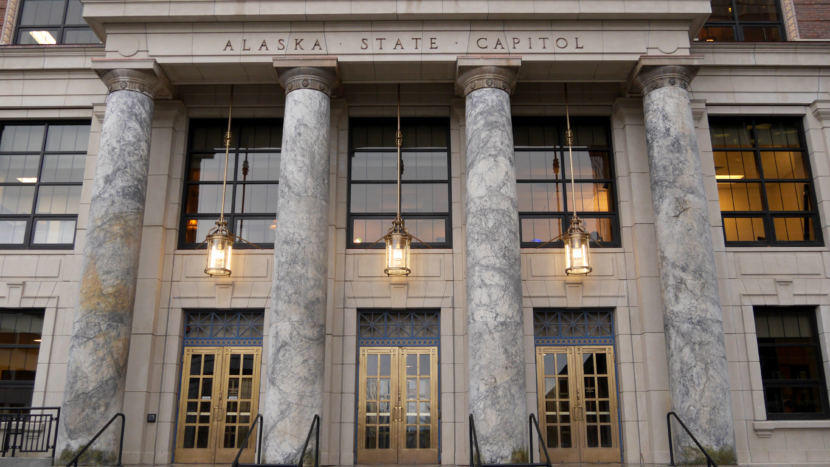
Alaska State Capitol Building, Juneau, January 23, 2017. (Photo by Skip Gray/360 North)
Dozens of lawmakers trickled into Juneau over the weekend. The state legislature is set to convene in Juneau on Monday.
Lawmakers are going to work through Gov. Mike Dunleavy’s plan for spending federal CARES Act funds. A legislative committee approved that plan last week, but a Juneau man sued, saying the whole Legislature needed to meet to approve the coronavirus aid.
That lawsuit threatens to delay distribution of more than $1 billion of federal funds into communities, businesses and non-profits. Now, lawmakers have given themselves until Wednesday to pass a bill that would allow the money to flow out into the state.
Sen. Jesse Kiehl, D-Juneau, said three days is just about the bare minimum amount of time needed to pass a bill.
“To do a bill in 3 days, you need a ¾ vote in each body to hustle it through,” he said. “It is the absolute fastest constitutionally that it could be done.”
If lawmakers don’t get it done by Wednesday, things could get complicated — they’re skirting close to the constitutional limit on session length. They might have to call themselves into a special session. Gov. Mike Dunleavy could also do it.
Juneau Assembly Member Rob Edwardson said he wasn’t surprised that lawmakers had to return to Juneau over the CARES Act funding and he’s not too concerned about the influx of people. Especially since most of the legislators won’t be bringing all of their staff with them.
“I think it’s going to be a smaller number coming into town than, say, snowbirds returning or people coming into town for commercial fisheries or fisheries processing,” he said.
Meanwhile, Legislative Affairs staff worked over the weekend to put a series of safety protocols in place so that 60 lawmakers and some staff members can work in the same building during the COVID-19 pandemic.
Capital City Fire/Rescue personnel will run screening stations at the entrances. They’ll ask lawmakers, staff and journalists a series of questions and take their temperatures. Once people get through that process, they’ll get a sticker indicating that they’ve been screened.
This is required for staff and media. Lawmakers can refuse — but they won’t be given a sticker. Everyone is required to wear masks or face coverings and practice social distancing. Only one person will be allowed in the elevators at a time.
Kiehl says that he’s kept in touch with his colleagues and most of them have been working from home and limiting social contact in their home communities.
“I’m sure there are exceptions,” he said. “But, as I’ve talked with my colleagues, the folks I’m talking to have been behaving responsibly, trying to minimize their chance of catching – their chance of spreading. ”
There’s been some blowback about the screening protocols. In an email exchange first published by Alaska Landmine, Nikiski Republican Representative Ben Carpenter sent a email to House lawmakers comparing the screening to Nazi Germany’s labeling of Jews.
House Minority Leader Lance Pruitt told the Anchorage Daily News that Carpenter’s emails were inappropriate and that he should apologize. Homer Representative Sarah Vance defended Carpenter. She told the Daily News that some people fear the virus and some people fear overreach and she thinks they should be sensitive to both.
Kiehl said that exchange is an indicator that legislators probably aren’t going to agree on everything.
“So, you know, probably won’t be universal love and snuggles — but people will come and do the job,” he said.
Juneau’s municipal leaders say they are hoping to get the CARES Act funding as quickly as possible. There’s a $34 million hole in the city’s budget and city leaders are grappling with how to fill it. They’re hoping to at least partially backfill it with the federal CARES Act funding. But that requires that the lawmakers pass a bill quickly and that the city figure out how to use the money legally.
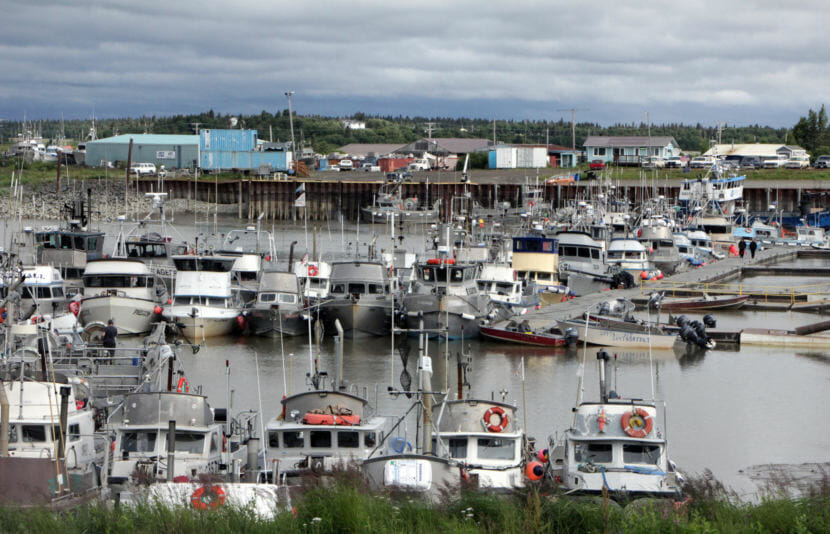
Boats tie up at Dillingham’s small boat harbor in 2018, with many waiting to be pulled from the water at high tide. (Photo courtesy Austin Fast/KDLG)
Dillingham has its first caseof COVID-19.
According to state data, the person is an out-of-state resident who works in the seafood industry. It’s the ninth case of an out-of-state resident testing positive for the disease, and it’s the fourth instance of someone testing positive who works in that industry.
The state said in a news release that the individual is a seasonal worker for Trident Seafoods. Trident is arranging for that worker to leave the community today. That person is asymptomatic, doing well and does not require hospitalization.
Trident doesn’t have processing facilities in Dillingham; it operates a barge for tender and vessel support in partnership with the Bristol Bay Economic Development Corporation. Five workers arrived via a Lake Clark air flight May 1, and were tested at the end of their quarantine.
“So we’re obviously really disappointed in the news. This wasn’t, obviously, intended by any means. But we never expected that we’d be able to prevent all of the asymptomatic employees from entering. So I think this really just highlights the importance of having a really strong quarantine protocol, and then also testing,” said Shannon Carroll, the associate director of public policy for Trident Seafoods.
Trident operates in 10 communities around the state. After the positive test, the company is changing the way it operates.
“Now, given that there’s been some revised local ordinances in Dillingham and state health mandates, all future employees that will be coming into Dillingham will be quarantined and tested in Anchorage, and then have secured transport to Dillingham,” Carroll said.
The other workers quarantining at the location tested negative, and will now quarantine for another 14 days because they were in close contact with the infected person. During that time, they will be observed by public health nurses.
To get out of quarantine they will need to satisfy the City of Dillingham’s ordinances and, according to Trident, receive a minimum of two negative tests, including one at the end of the quarantine period.
Public health nurses have completed a contact investigation and report that no one at that quarantine site had any outside contacts.
In a community meeting on Saturday, Dillingham Mayor Alice Ruby said that the response to this case demonstrates that Trident’s health protocols, as well as the local ordinances and state mandates, are effective.
“We’ve been working with partners, the state and tribal partners, federal and health care partners, to ensure that the plans we have in place work well and that they protect everyone. The discovery of this positive case, while they were still in quarantine, is just an indication of how our plan is working,” she said.
“They haven’t exposed the community because they haven’t been out in the community,” public health nurse Gina Carpenter said in the state’s news release. “This shows the benefit of these rules. These workers did everything right and followed the quarantine and testing requirements laid out in Trident’s industry plan.”
During the summer, processors bring in thousands of employees, while thousands of independent fishermen come to the region as well. The off-season regional population is around 6,700, which is spread out through many small communities. During the fishing season the population balloons up to nearly 22,000.
In Bristol Bay, the City of Dillingham, as well as several tribes and the regional health corporation, have asked the state to consider closing the fishery, citing the influx of outside workers and fishermen. In April, Gov. Mike Dunleavy released a series of guidelines for commercial fishermen and the state remains committed to keeping the fishery open.
The City of Dillingham passed several ordinances at recent meetings extending its travel permit and quarantine requirements for incoming visitors. Effective May 22, it is requiring testing for people quarantining in Dillingham in order for them to come out of quarantine.
There are two places to get tested for COVID-19 in Dillingham. Free testing is available at a Capstone Clinic center at the Dillingham harbor. That was set up through a partnership between the Dillingham Public Health Center, Bristol Bay Area Health Corporation, the City of Dillingham and Capstone Clinic. Dr. Cathy Hyndman, clinical director of BBAHC, said harbor’s testing center is for people who aren’t experiencing symptoms but might have been exposed.
People who are experiencing symptoms should call the hospital at (907) 842-9440 to set up an appointment. Once at the hospital a nurse will come to the car and administer an Abbot ID Now swab test.
Dillingham does not currently have testing set up at its airport. City Manager Tod Larson said that was partly because it would create crowding at the terminal.
“It takes quite a bit to put everything together. We have to kinda get a semi-windproof area that has to be built with a lab, fridge, freezer, that kind of stuff,” Larson said.
During the Saturday meeting, the state’s Chief Medical Officer, Dr. Anne Zink,said the state is working with the city and other local entities to minimize the risk to the community.
“One is to track the case and to make sure that we are looking at all the contacts, any possible exposure, and be able to try to break any chain of spread,” she said.
The case was announced two days after a delegation of state and federal officials visited four communities in Bristol Bay, including Dillingham. The group toured health facilities and seafood processing plants, and heard from community leaders about concerns and support ahead of the fishing season.
The Dillingham police force is currently making trips to the airport to check on compliance with state and local laws, according to Mayor Ruby, who said that the city requested additional assistance from the state during the visit.
“We’ll be following up next week to try to get more bodies that would help us with security, so that we can be in more places at once to enforce,” she said.
This is a developing story. Check back for updates.
It’s also expanding the number of people who are allowed to dine at restaurants. And, after seven weeks of being closed, bars are officially allowed to open their doors.
But the City and Borough of Juneau has opted out of reopening public facilities for now, and many business owners in Juneau say that while the COVID-19 closures have devastated their businesses, they’re not rushing to open their doors, either.
In part, that’s because there are new rules to operating. Restaurants must keep tables 10 feet apart to comply with social distancing requirements. There are also limits on the number of people who can be inside at any given time. For restaurants, they can operate at 50% capacity. For bars, it’s 25%.
Some business owners, like Rick Kasnick, are all in. Kasnick is the majority owner of the Island Pub, a gourmet pizza restaurant and bar.
Technically, restaurants were allowed to open for dine-in service two weeks ago — but at just a quarter of overall capacity. Kasnick said that didn’t make sense for his business.
“We’d have had like, four tables. And we’d have had to bring on basically our full staff to get, you know, janitors and dishwashers, the whole nine yards,” he said. “It was a losing proposition. Fifty percent, we can make a little bit of money off of.”
The Sandbar and Grill opened its restaurant for dine-in service two weeks ago, but even at a quarter-capacity, they haven’t had a lot of people choose to sit in the restaurant.
In downtown Juneau, many bar owners said they won’t be reopening right now — for a lot of reasons.
Rob Daniels at the Imperial Saloon said they need some time to turn on all of the utilities and finish some social-distancing remodeling.
David McGivney at the downtown McGivney’s Sports Bar and Grill said reopening is too risky for the health and safety of staff and customers, because it’s hard to tell who has COVID-19 and who doesn’t. And even at half capacity, it doesn’t pencil out financially for them to reopen.
Eric Forst at the Red Dog Saloon, a restaurant and bar in downtown Juneau, said they have to figure out if they can even get enough staff to reopen.
And money is a problem.
Tracy LaBarge owns three downtown Juneau restaurants: Tracy’s King Crab Shack; Saffron, an Indian cuisine restaurant; and Salt, a fine dining restaurant and bar.
When the restaurants had to close, she said they donated most of their food to keep it from going bad.
“For us, it’s having enough money to actually buy inventory to get back open. Not to mention pay rent and back rent and everything else. So until we get funding, there’s nothing I can really do,” she said. “It’s a pretty bad situation, to be honest.”
Many restaurants and bars have shifted their business models to allow for curbside pickup of food and alcohol and say they’ll keep doing that for now.