I help the newsroom establish daily news priorities and do hands-on editing to ensure a steady stream of breaking and enterprise news for a local and regional audience.
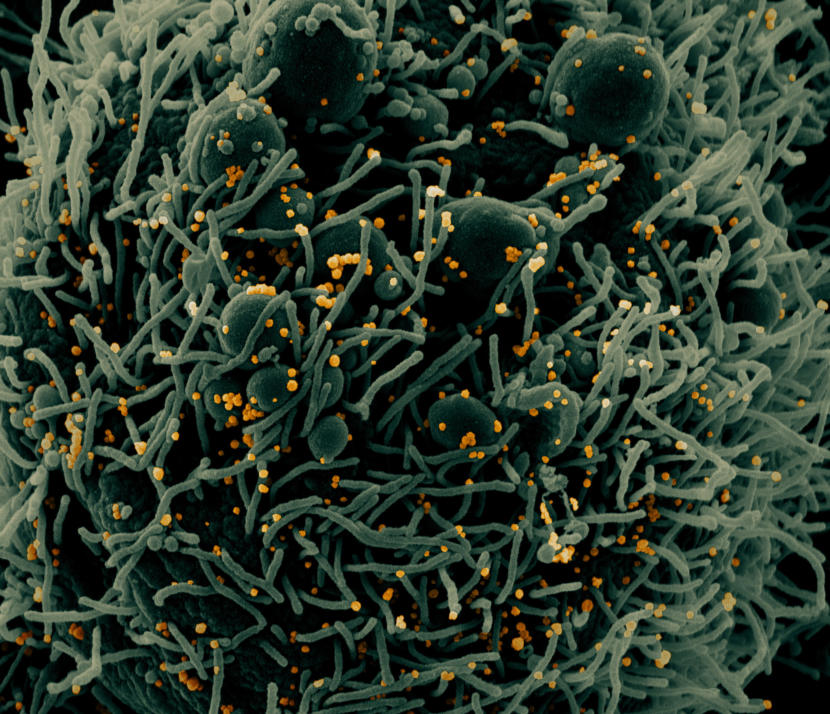
Colorized scanning electron micrograph of an apoptotic cell (green) infected with SARS-COV-2 virus particles (orange), isolated from a patient sample. Image captured at the NIAID Integrated Research Facility in Fort Detrick, Maryland (Photo courtesy NIAID)
State health officials are reporting that three women and two men tested positive for COVID-19 on Friday.
Two of them are from the Matanuska Susitna Borough, one from Anchorage and two from the Kenai Peninsula Borough.
That brings the total to 314 Alaskans diagnosed so far. But of those people, nearly half of them — or 147 — have recovered.
The state reported no new deaths or hospitalizations. And, so far, 9,655 tests have been done for the virus in the state. However, because some people have been tested more than once, it’s unclear exactly how many Alaskans have been tested for the virus.
Slightly more women than men in Alaska have been diagnosed with COVID-19. The state has also begun reporting the race and ethnicities of people who have tested positive in the state.
About half — or more than 160 — of the people who have tested positive for the virus in Alaska are white. In 85 cases, the person’s race is unknown. Nearly nine percent — or about 30 people — are Asian. Just below five percent, or 14 people, are Alaska Native or American Indian.
Nationally, more than 690,000 people have tested positive for the virus. By Saturday, 35,443 people had died, according to the Centers for Disease Control and Prevention.
Corrections officers wait outside of a cell during a weekly inspection at the Lemon Creek Correctional Center in Juneau on June 18, 2016. (Photo by Rashah McChesney/KTOO)
As of Wednesday evening, at least seven staff members at Lemon Creek Correctional Center have tested positive for COVID-19 since last week. Most of them are correctional officers. (Read more)
Original story
Two more people who work at Juneau’s jail have tested positive for COVID-19. That means six staff at the facility have the virus.
According to a Tuesday news release from the Alaska Department of Corrections, 40 staff members at the Lemon Creek Correctional Center have been tested to date.
Four inmates have been tested, and those results came back negative. While there are no pending tests for inmates, Lemon Creek has isolation cells to keep inmates who are being tested away from the general population. They’ve been given cloth face coverings, according to the release.
The number of positive cases has climbed rapidly since last week, when authorities became aware of the first confirmed case in a staff member. They informed inmates and staff on Thursday that they had been exposed to someone with COVID-19.
There have been restrictions in place at corrections facilities statewide due to the pandemic — visitors haven’t been allowed in for about a month. And copays for prison-based health services have been waived.
In late March, all facilities started screening employees and contractors for fever at the start of each shift.
As of Monday, the inmate population at the facility was 217 inmates. The facility also has about 85 staff working four shifts under normal circumstances.
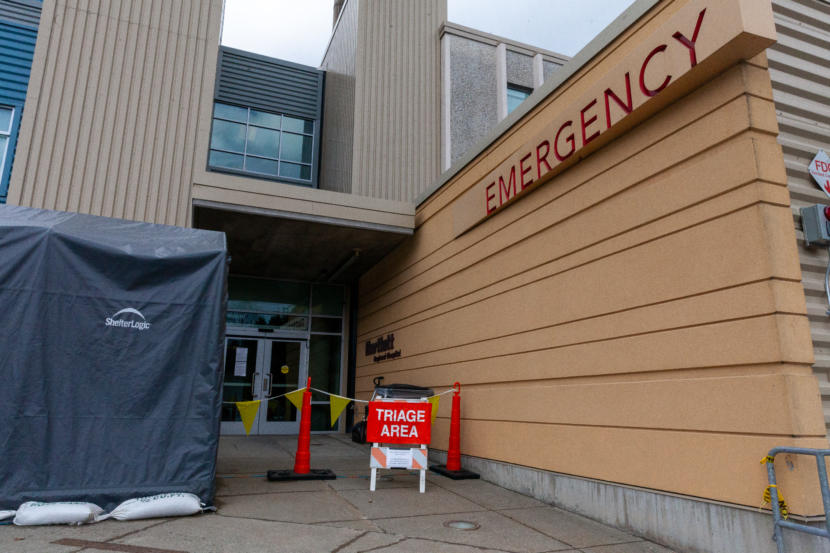
A triage tent is set up to screen patients for symptoms of COVID-19 outside on Monday, April 7, 2020, at Bartlett Regional Hospital in Juneau, Alaska. (Photo by Rashah McChesney/KTOO)
Bartlett Regional Hospital has also spent about $600,000 on equipment, supplies and labor preparing for the pandemic. Chief Financial Officer Kevin Benson said it’s not clear if and when the hospital will be reimbursed for that money, but it’s exploring options to recoup funding through FEMA, the newly-passed federal CARES Act or an insurance claim for business interruption.
“I think the bigger concern for us, from a financial impact, is the loss of revenue,” Benson told the hospital’s finance committee on Friday.
By the end of March, the hospital was short about $2.3 million in revenue, Benson said, and it’s lost about the same amount in the first 9 days of April. The total revenue shortfall for April is expected to be $4 million, he added.
The statewide ban on non-urgent and elective procedures extends through June 15.
Correction: This story has been updated to show that the hospital lost about $2.1 million in revenue in the first nine days of April.
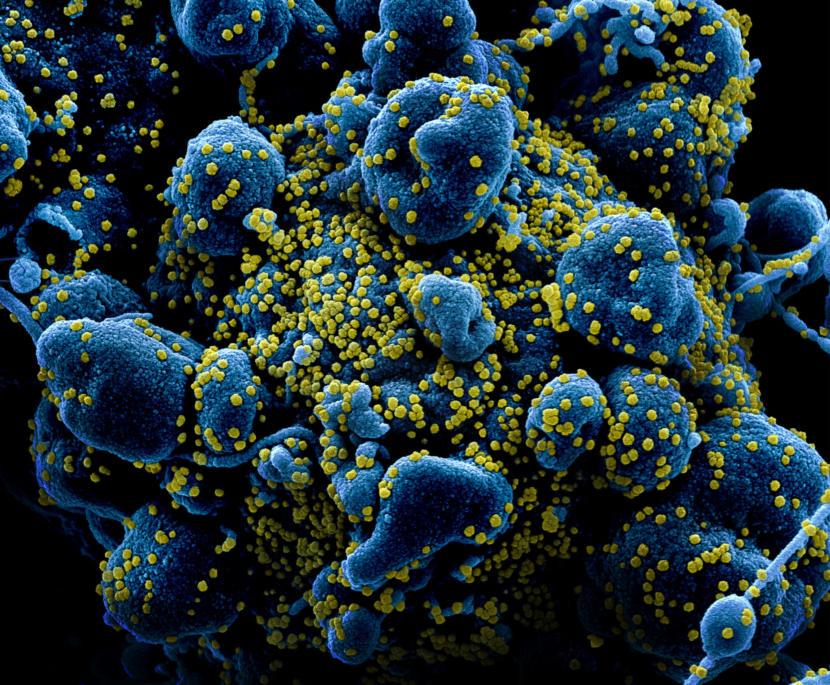
Colorized scanning electron micrograph of an apoptotic cell (blue) heavily infected with SARS-COV-2 virus particles (yellow), isolated from a patient sample. Image captured and color-enhanced at the NIAID Integrated Research Facility (IRF) in Fort Detrick, Maryland. (Photo courtesy NIAID)
Eleven more Alaskans were diagnosed with COVID-19 on Friday. The newly diagnosed Alaskans are nine people from Anchorage, and one each from the Matanuska Susitna Borough and Prince of Wales island.
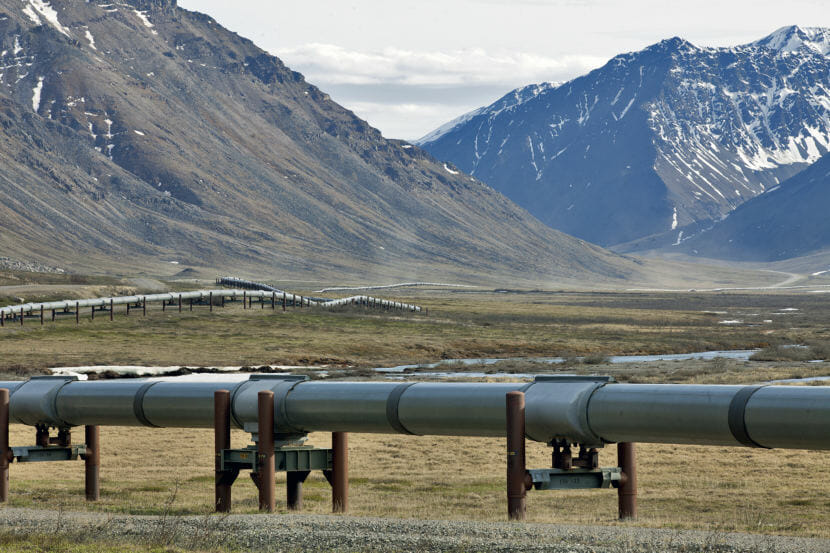
The trans-Alaska Pipeline runs alongside the Dalton Highway near the Toolik Field Station on June 9, 2017, in the North Slope Borough. (Photo by Rashah McChesney/Alaska’s Energy Desk)
Updated story — April 10, 2020
Pick one: a pizza or a barrel of Alaska North Slope crude. For less than $20, you could have had either one Tuesday.
Prices have rebounded since then– sort of. Now you’d have to buy a pizza and a cheap six-pack before you got into the $25-ish range where Alaska North Slope Crude is hovering now. None of this is exactly ideal for Alaska’s bottom line.
What happened? The $18.21 price per barrel was a mistake. The Department of Revenue has revised it’s report and that price bumped up to $24. But state analysts are expecting prices to drop into the teens next week.
Dan Stickel, Alaska’s chief economist, says there are a few reasons why prices are so low right now.
The first is supply: There’s too much oil on the global market. Russia and Saudi Arabia stopped limiting their production and the price war between the two countries has triggered a major drop in the price of oil.
The second is demand: The COVID-19 pandemic has upended everything. In a time of social isolation and quarantine people just aren’t driving or flying as much as they used to. The U.S. Energy Information Administration reported this week that gasoline consumption could go down by 25% in the next few months. And that it could take 18 months for domestic fuel demand to return.
And, there’s another wrinkle in the supply chain: There’s less demand on the West Coast refineries that process Alaska’s oil. But even if they wanted to produce more, Stickel says they have other problems.
“We’ve heard of coronavirus infections in the refineries that are reducing their ability to work,” he said. “Everyone’s sick with coronavirus; you can’t refine oil.”
There’s another reason for that sudden price drop, but is a bit tricky to pin down because there aren’t a lot of details about exactly what happened.
There is no spot price for Alaska North Slope Crude. Instead, the daily prices are estimated by comparing it to these other types of crude.
“The way that the oil market works is there’s benchmark crude which are widely traded crudes with a known location and quantity and quality,” said Stickel.
West Texas Intermediate has been the most followed benchmark crude in the Americas for a long time. Another one is Brent Crude, which comes from the North Sea. The state compares Alaska’s crude to that one a lot because they’re similar types of crude and they’re transported the same way.
So when people buy and sell Alaska’s crude they do it against these benchmarks. And there are assessment services that monitor all of the transactions and then they publish estimates of the prices for some of the lesser traded crudes like Alaska’s.
What happened when we ended up at $18 per barrel is that someone, somewhere sold some Alaska North Slope Crude at a huge discount, dragging the price down.
But, we’ll probably never know who did that, or why. Stickel says that information is typically held pretty tightly.
What is clear is that there is a ton of volatility in the oil markets right now and because Alaska North Slope Crude prices are estimated this way, it’s getting harder for assessment services to figure out the clear value of Alaska’s oil. So, we can expect to see prices jump up and down for a while.
Original story — Published April 9, 2020
Alaska North Slope oil prices tumbled to $18.21 a barrel on Tuesday.
On Wednesday, economists at the state’s Department of Revenue were working to identify what drove the price down and what they could expect going forward.
Chief economist Dan Stickel says there are a few reasons why prices dropped that quickly.
First, there’s a glut of oil on the global market. Russia and Saudi Arabia stopped curtailing their production. The price war between the two countries has triggered a major drop in the price of oil. That glut also means that Alaska North Slope crude is seeing new competition in the West Coast markets it traditionally serves.
Second, the COVID-19 pandemic has caused a huge drop in demand. In a time of social isolation people just aren’t driving or flying as much as they used to. The U.S. Energy Information Administration put out a forecast on Wednesday that showed a 25% decline in motor fuel use in the first quarter of 2020. That decline is expected to continue.
Stickel says refineries on the West Coast are also producing less, in part because many refinery workers are sick with COVID-19.
He hopes this is a temporary drop and that prices will rebound to what the Department of Revenue forecast on Monday. But that report has oil prices expected to stay under $30 a barrel through June.
This is a developing story. Check back for updates.
Correction: A previous version of this story said oil prices tumbled on Monday — they fell to $18.21 on Tuesday.
Corrections officers wait outside of a cell during a weekly inspection at the Lemon Creek Correctional Center in Juneau on June 18, 2016, in Juneau. (Photo by Rashah McChesney/KTOO)
A staff member of Juneau’s Lemon Creek Correctional Center has tested positive for COVID-19.
In mid-March, Lemon Creek had about 248 prisoners and 76 staff. In an evening media release, the state’s Department of Corrections says this is the first person working for the department who has tested positive for the virus.
Staff at the jail told inmates they had been exposed late Thursday.
Lemon Creek Correctional Center staff implemented a response plan and “took swift action to protect the health and welfare of inmates and staff at the facility.”
However, it’s not clear what that action is — no one from the jail, or the Department of Corrections answered afternoon and evening emails or phone calls seeking clarification on what specific actions they took to protect inmates, whether masks and gloves are available for inmates and staff, and whether inmates have the ability to socially isolate from one another.
There have been restrictions in place at corrections facilities statewide due to the pandemic — visitors haven’t been allowed in almost a month. And, they’ve waived copays for prison-based health services. In late-March all facilities started screening employees and contractors for fever at the start of each shift.
And, people at Department of Corrections facilities statewide — including at Lemon Creek — have begun sewing cloth face coverings for staff and inmate use.
According to state testing data, 17 inmates had been tested for COVID-19 as of yesterday. Of those, 11 tests were negative and 6 are still pending.
Alaska has more than 4,700 inmates statewide.
Close
Update notification options
Subscribe to notifications
Subscribe
Get notifications about news related to the topics you care about. You can unsubscribe anytime.