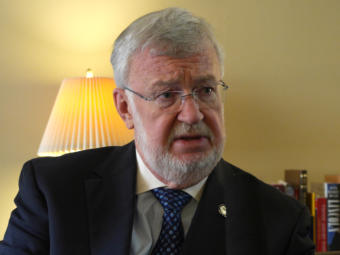
I help the newsroom establish daily news priorities and do hands-on editing to ensure a steady stream of breaking and enterprise news for a local and regional audience.
This scanning electron microscope image shows SARS-CoV-2 (in yellow) — the coronavirus that causes COVID-19 — isolated from a patient in the U.S., emerging from the surface of cells (in blue/pink) cultured in a lab. (National Institute of Allergy and Infectious Diseases – Rocky Mountain Laboratories)
Updated 03/22 at 2:45 p.m.
State officials announced Saturday that they have found eight new cases of COVID-19 in five communities across Alaska.
There is two cases in Anchorage, one in Fairbanks, three in Ketchikan, one in Sterling and one in Soldotna.
In a late evening media release, Department of Health and Social Services officials said some of the cases were travel related, but most were not travel-related.
A DHSS spokesperson said that means those people have not traveled out of state. So, it’s going to take time to investigate where and how they could have been infected — and if they had contact with any of the other people who have tested positive for the virus in Alaska.
There are now 22 people in Alaska who have tested positive for the virus.
Each of the adults who tested positive is currently quarantining in their own homes; none have been hospitalized.
According to the release, State Epidemiologist Joe McLaughlin said the biggest challenge to the state’s efforts to contain the virus is people continuing to interact with others when they have symptoms.
“I can’t underscore this point enough: if you feel even mild symptoms of a respiratory infection, you need to immediately go home and stay away from others until your symptoms are resolved,” he said.
Correction: A previous version of this story misstated the number of cases that are not travel-related. Five of the people who are sick have not traveled out of state.
This is a breaking news story that will be updated.
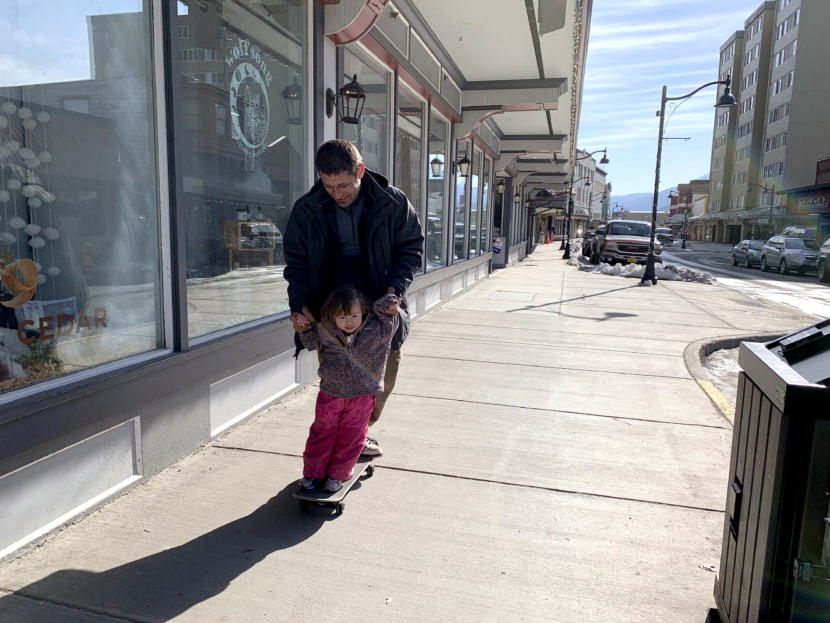
Tim Lopez skates with his daughter Samantha Lopez as a way to pass the time with her on March 17 in Juneau. Typically the 2-year-old would be at a child care facility in the middle of the day, but most in Juneau have closed. (Photo by Rashah McChesney/KTOO)
On a sidewalk in downtown Juneau, Tim Lopez balances on a skateboard with his 2-and-a-half-year-old daughter Samantha.
Normally the wiggly toddler would be in a child care program at Little Eagles and Ravens Nest.
“The coronavirus scare has her child care shut down right now,” he said.
In fact, most of the child care facilities in Juneau have shut down.
The Discovery Preschool is still open. Director Blue Shibler said it would have a big impact on parents if she closed, so she doesn’t want to do it without some kind of official guidance.
“We have parents here who are essential to the work of the Legislature, the work of the state. We have parents here who are essential medical providers,” Shibler said.
Right now, there isn’t any official directive to close. In fact, even though hundreds of thousands of schoolchildren were sent home until the end of March, the state put out a memo on Tuesday recommending that child care facilities stay open “if they can safely do so.”
But Shibler and others said it’s not clear what that means. The state’s guidelines pull from advice from the Centers for Disease Control and Prevention. According to those guidelines, no child who has been outside of the state should be allowed in. Neither should anyone one who has a fever or respiratory symptoms.
Those are things Shibler is already doing.
But she said other guidance is tricky. For instance, there should be fewer than 10 in a group. But does that mean students and teachers?
And the state suggests that child care facilities should stay open so that children aren’t at home with aging grandparents or elders while parents are at work. But Shibler said she has staff who are vulnerable — including an older person and two who are pregnant. She laid them off so they wouldn’t be exposed to the virus.
She said other guidance just doesn’t make sense to try with children.
“The notion that while the children are in a classroom, they should practice social distancing? I want someone to come here and watch me try to keep toddlers six feet apart from each other,” she said.
Shibler said she plans to stay open for now. But she is frustrated with the state’s guidance and feels that, with restaurants and bars closed, there are two different safety standards for adults and children. And she said she hasn’t had a lot of luck getting anyone at the state to respond.
But shutting down would come with its own set of problems. A lot of child care providers have slim profit margins. And that means the choice to close comes with a cost.
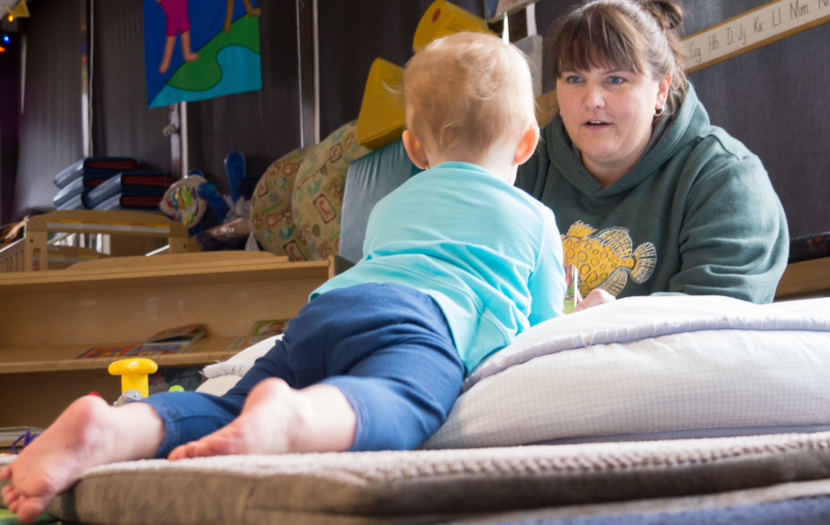
Gretchen Boone flips through a picture book for an infant at the Gold Creek Child Development Center in Juneau on May 11, 2018. (Photo by Jeremy Hsieh/KTOO)
“We have decided not to refund tuition for March, because we need to pay teacher wages,” said Gold Creek Child Development Center Director Colleen Brody. It closed earlier this week.
That decision was hard enough. But there are some uncomfortable questions left to answer. What if they have to stay closed? Child care facilities need to keep paying staff, so it’s easy to reopen quickly. But do they ask parents to front the cost of tuition and keep children at home?
“Especially if parents can’t work because there’s not child care, expecting them to pay that tuition is difficult,” Brody said.
Closing also puts staff at child care centers in a tough spot, according to a Rain Coast Data analysis — they generally make about half the average Juneau wage and have few benefits like health care or retirement.
Brody said there are otherproblems with closing too. Gold Creek has a number of low-income families that rely on state child care assistance funding to pay their tuition.
“We have to fill out attendance forms for them, and if they don’t meet a specific (attendance), then they might not receive their funding,” Brody said.
She doesn’t know if the state will make exceptions because they’re closed. Additionally, the facility relies on a grant that is based on attendance.
“If we’re closed for half of the month, then our grant will be halved,” she said. “So what kind of allowances will be made for that?”
No one from the state Department of Health and Social Services returned repeated phone calls and messages seeking answers to those questions.
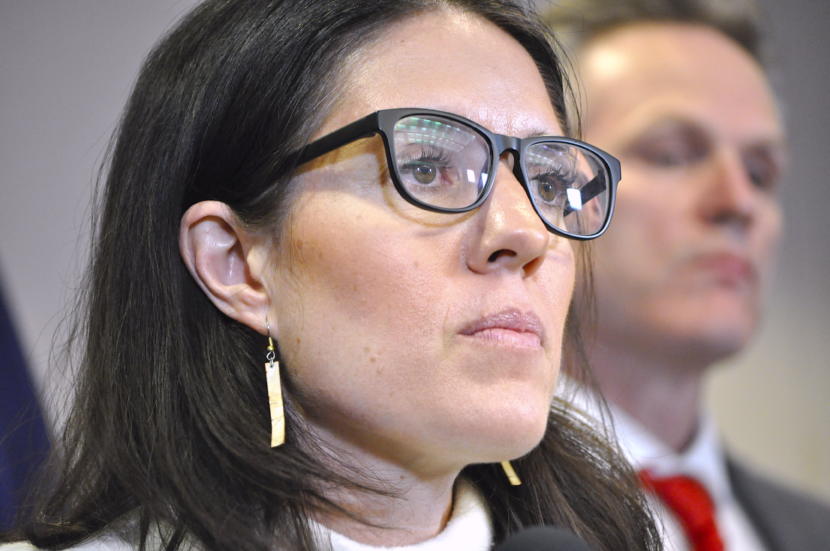
Dr. Anne Zink, chief medical officer for the state of Alaska, briefs reporters on the coronavirus at a news conference with Gov. Mike Dunleavy on March 10 in Anchorage. (Photo by Liz Ruskin/Alaska Public Media)
During a Wednesday press conference, the state’s chief medical officer, Dr. Anne Zink, talked about why the state chose to close schools but asked child care facilities to stay open.
Zink said they closed schools for until the end of March for two reasons: As a precaution to keep students who are coming back from spring break from mixing with other students; and to prepare for tele-education.
For child care facilities, Zink said the state wants them to follow CDC guidelines. According to those guidelines, in communities like Juneau, where there isn’t yet a case of the virus, it may not be time to close. The CDC recommends that before making the decision to close, child care providers should coordinate with local and state health officials.
“We do feel like child care is an important thing to be able to keep businesses up and running, hospitals up and running and to keep kids engaged ,and we know that we’re not as concerned about those kids itself,” she said.
Zink and others from the Department of Health and Social Services said that providers can reach out to a state email address — but it’s backed up and might take awhile to get answers.
An fighter jet taking off from Joint Base Elmendorf-Richardson during exercises in 2015. (Photo by Zachariah Hughes/Alaska Public Media)
Officials at Joint Base Elmendorf-Richardson (JBER) say an active-duty airman tested positive for coronavirus.
The airman is one of the state’s nine confirmed cases of the virus. According to a media release, the airman recently traveled overseas and is now self-quarantining at home.
Right now, JBER is at an elevated level of health protection for military members and those who access the base. That includes the same protocols seen in other parts of the state, like social distancing, extra hand-washing, and self-isolating.
In addition, JBER’s public affairs representative Master Sgt. Jonathan Foster says they’ve closed some facilities, cancelled youth services and sports events, and they’re taking other measures to reduce the risk of person-to-person transmission.
“Like, for instance the base gates,” he said. “We’re doing a no-touch ID Card procedure. You just hold up your ID card and the gate attendant will look at it and then scan it after you turn it over and show us the bar code on the back.”
Foster says the air force has also delayed physical fitness testing for the next several months to avoid having large groups of airmen in close quarters with each other.
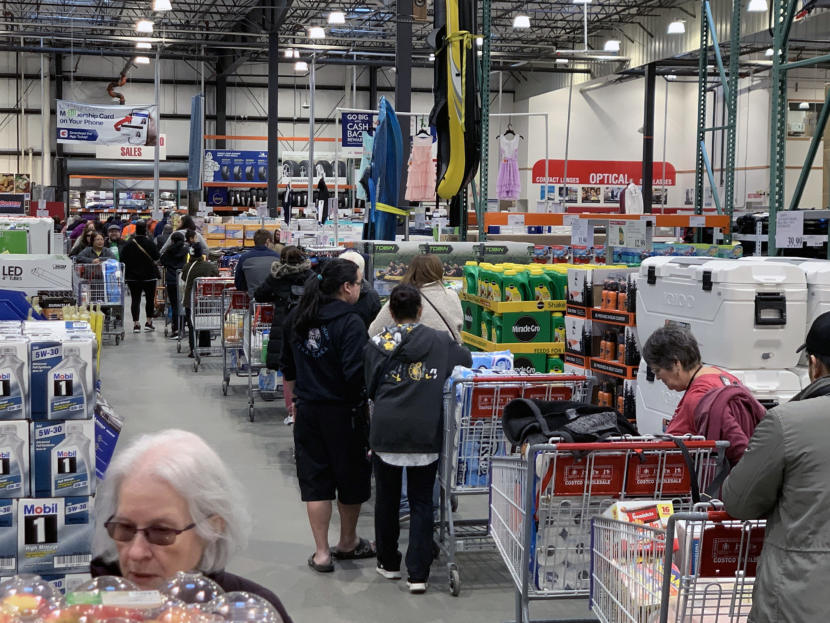
Hundreds of people stood in line to checkout in Costco on Tuesday in Juneau. (Photo by Rashah McChesney/KTOO)
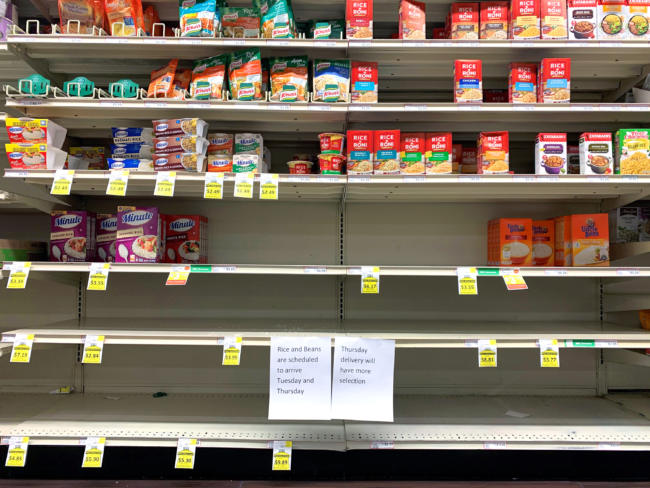
A lot of people have been posting photos of bare store shelves across Alaska. Toilet paper, rice and beans, hand sanitizer and baby wipes have been flying off of the shelves.
But store owners in Juneau say that while the coronavirus-induced panic-buying is straining their supplies, they’re confident nothing is going to disrupt their shipments, so overbuying is unnecessary.
Juneau’s Costco opens at 10 a.m. on weekdays. On Tuesday — the day many people had been waiting for the store’s shelves to be restocked — by 10:45 a.m. hundreds of cars were packed into the parking lot. The line of people waiting in the checkout line stretched from one end of the store to the other, and curved around the aisles at the back of the store.
But not everyone was in line to fill their carts — and homes — for weeks to come.
“We thought it wasn’t going to be busy,” said Kris Cole. “We were wrong.”
Cole, and Dani Cherian, like most others in the store, had a bulk package of toilet paper in their cart and a few other things. But it wasn’t full. Cherian said they were just buying a few things.
“We’re just picking up supplies for our church,” he said. They both belong to Valley Church. “We wanted to be able to help those who need toilet paper.”
But standing in line around them, there were people buying all sorts of things in preparation for being stuck in their homes. Some pushed multiple carts with toilet paper, canned and fresh food and generators in them.
Bare shelves at Foodland IGA on March 14 in Juneau. (Photo by Rashah McChesney/KTOO)
He addressed two groups of Alaskans: First, those who appear not to be concerned by the virus, who are still gathering in large groups. He said they should take it more seriously.
“The other group of Alaskans I want to address are the folks that are very very concerned about this virus,” Dunleavy said. “So much so, that they are shopping and buying things to prepare themselves for two-to-three months without additional shopping. We’ve been told that our supply chains will be maintained, that there will be enough goods to purchase in our markets, in our stores. So we don’t have to buy a large amount of items at one time.”
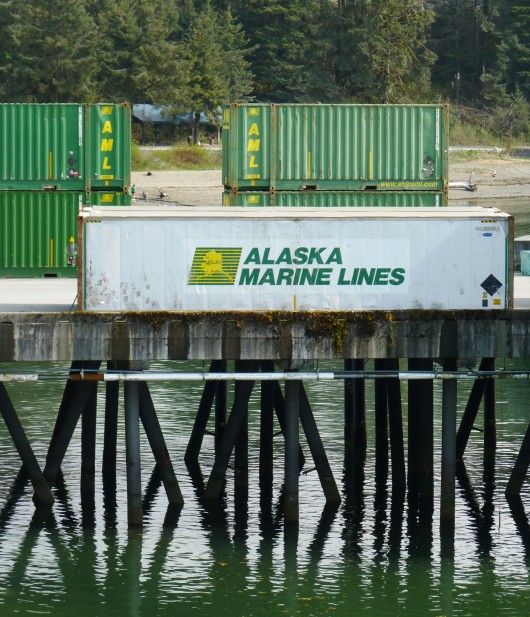
Alaska Marine Lines containers wait for loading on Yakutat’s dock. The company reports business-as-usual despite widespread disruption from COVID-19. (Photo by Ed Schoenfeld/CoastAlaska)
Alaska Marine Lines, or AML, is a transportation company that provides barge service twice a week to Southeast Alaska.
No one from AML was available to talk on Tuesday afternoon. But they did weigh in last week, when there was a similar rush in buying in Sitka. A company representative told Sitka’s public radio station — KCAW — that things are business as usual, and the company’s schedules are running normally.
Two of Alaska’s major maritime cargo companies, Matson Inc. and TOTE Maritime, told KTUU that they are confident the virus wouldn’t disrupt shipments.
Still, the run on supplies is putting a strain on local stores.
(Photo by Matt Miller/KTOO)
“We do not have a food shortage. We do not have any product shortage. We just cannot get the product shipped up here fast enough,” said Super Bear store director Tony DeMelo.
He said people are panic-buying, and he thinks it’s a cycle that will probably last for a few weeks. Because as people see fewer and fewer products on store shelves, they’ll be more and more likely to want to stock up.
DeMelo said if he could talk to each person that walked into the store, he’d tell them this: It’s OK to calm down.
“Just go back home and relax,” he said. “Your 14 packages of toilet paper, your 75 pounds of rice, your 40 pounds of orange juice — all of that will still be good a month from now.”
But it’s tricky to keep up with the current spike in demand. Grocery store owners in town order on a lag. For Super Bear, that means 10-to-12 days out. So when they ordered their last shipment, they didn’t know there was going to be a frenzy of buying.
DeMelo said, in response, stores try to bump up the volume of products in their current orders, but the distributors in the Lower 48 can’t keep up the pace, because the entire country is having this problem.
Rick Wilson, who manages Foodland IGA, said that’s what’s different about this surge in buying — because there’s usually a rush at the grocery store when there’s a local disaster, like a snowstorm or hurricane. But generally that’s not happening everywhere in the country at once, so distributors can rely on stockpiles from other areas to pick up the slack.
“So they’re able to pull from areas that weren’t affected. We can’t do that. Everybody is affected,” Wilson said. “Every retailer. I mean, I’ve talked to other managers down in Washington, and they’re just in worse shape than we are. So, you know, hopefully everything will settle down a little bit. Everybody’s got their pantries full now. And I’m sure we’ll be busy, and I’m sure we’ll have some out-of-stocks. Everybody is going to be busy.”
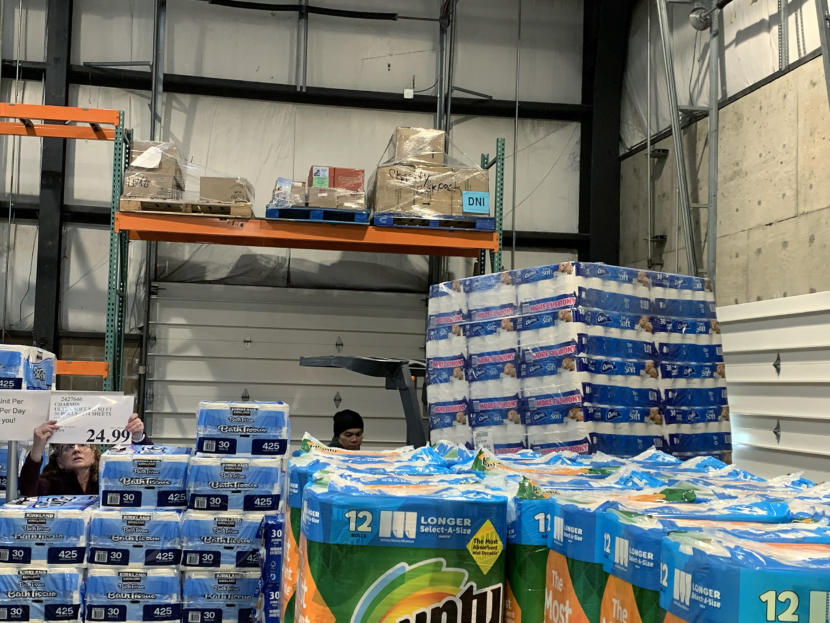
Employees restock toilet paper at Costco on Tuesday in Juneau. (Photo by Rashah McChesney/KTOO)
Wilson, and other store managers, wanted it to be clear that they are receiving a steady stream of goods, and it should be enough for regular shopping — but they won’t be able to keep up with the people panic-shopping all the toilet paper.
Aside from slimmer shelves and per-person limits on certain items, there may be other changes on the way for Juneau stores. Some stores are considering senior-only shopping hours. Safeway has already made the leap: On Tuesdays and Thursdays from 7 a.m. to 9 a.m., the store has asked that only seniors and other at-risk members of the community — such as pregnant women and those with compromised immune systems — shop in the store.
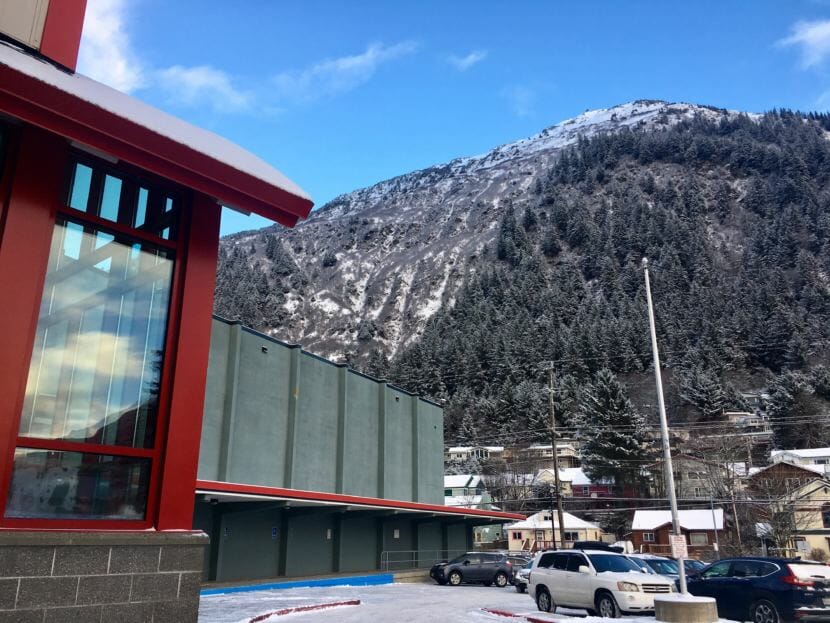
Juneau-Douglas High School: Yadaa.at Kalé sits at the base of the mountain from which it takes its Tlingit name, Jan. 8, 2019. (Photo by Zoe Grueskin/KTOO)
Every weekday from March 16 through March 27, First Student buses and staff will pass out prepackaged breakfasts and lunch in the parking lots at these locations:
Sayeik: Gastineau Elementary School • 8-10 a.m.
Cedar Park Apartments • 10-11 a.m.
Harborview Elementary School • 8-11 a.m.
Riverbend Elementary School • 8-11 a.m.
Dzantik’i Heeni Middle School • 8-11 a.m.
Glacier Valley Elementary School • 8-11 a.m.
Floyd Dryden Middle School • 8-11 a.m.
High school students from Juneau-Douglas High School: Yadaa.at Kalé and Thunder Mountain High School can pick up their meals at Riverbend and Harborview respectively.
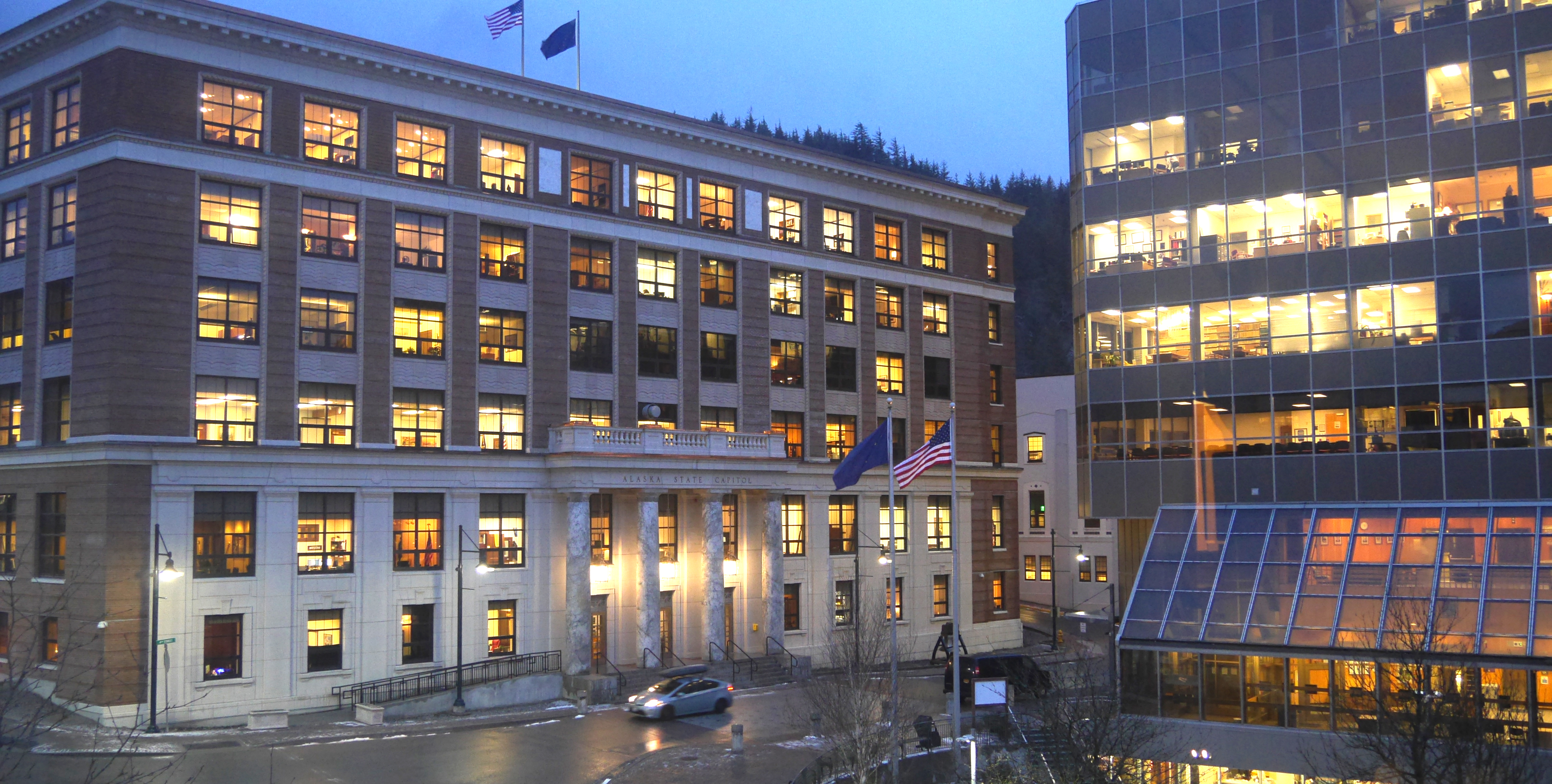
The Legislature said in the emailed announcement that it adopted a series of “initial actions” in response to the arrival of the coronavirus in Alaska.
Access to the Capitol will be limited to legislators, employees, members of the governor’s administration and journalists.
Sen. Gary Stevens, a Kodiak Republican, says the step was unprecedented, to his knowledge.
Sen. Gary Stevens, R-Kodiak, talks with a reporter in Steven’s office at the Capitol on March 13, 2020, in Juneau. They discussed the legislature’s closure of the Capitol to most members of the public in response to the coronavirus pandemic. (Photo by Skip Gray/KTOO)
“If there is a progression of this disease throughout Alaska, we will have further restrictions on who has access to the building,” he said.
Stevens chairs the new Legislative Council subcommittee on emergency response and preparedness, which recommended the changes.
The Legislature also enacted a temporary ban on state-sponsored travel by lawmakers and legislative employees. And anyone with access to the Capitol who travels out-of-state on personal business will be advised to stay away from the building for at least seven days after returning.
The announcement said legislative work will continue as normal, with Alaskans able to participate fully by following along on Gavel Alaska and the Legislature’s website, and through written and telephone testimony.
The Capitol closure will be effective as of 5 p.m. Friday.