I help the newsroom establish daily news priorities and do hands-on editing to ensure a steady stream of breaking and enterprise news for a local and regional audience.
However, an important caveat to this data is that the state reports new cases of COVID-19 among Alaskans by where they’re from, not necessarily where they are.
Among non-residents, new cases have been identified in
Delta Junction (2)
Dillingham (3)
Anchorage (2)
Valdez-Cordova (1)
Fairbanks (3)
Juneau (1)
Bristol Bay/Lake and Peninsula (1)
The state identifies non-residents by where they are and, generally gives a reason why they’re in Alaska. Among the new non-resident cases, are those who work in the seafood and mining industry as well as those who are either tourists or work in the tourism industry.
State health officials also reported that more than 108,000 tests for COVID-19 have been performed in Alaska. Some people are tested more than once so this number doesn’t reflect how many individual people have been tested in the state.
And, beginning next week, state health officials will no longer put out daily press releases detailing new cases. Instead, they’ll come out three times a week. New case data can be found each day at the state’s hub.
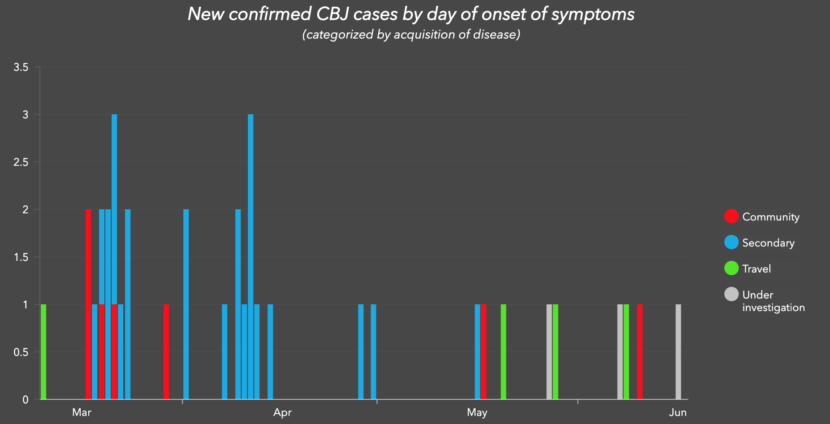
Screenshot, taken June 17, 2020, of the City and Borough of Juneau’s COVID-19 dashboard showing how people in Juneau have acquired the virus.
State health officials reported one new case Wednesday of COVID-19 in a Juneau resident.
They’re not sure yet how that person got the virus. Though, according to the city there may be community spread of the virus, because the state Department of Health and Social Services has not been able to identify the source of the virus for two cases that were reported on June 11.
In total, 38 people from Juneau have tested positive for the virus. Of those, three are active and 35 people have recovered, according to city data.
Juneau also has three active non-resident cases. All of them were identified in June. Two of them are tourists and the purpose of the third person’s visit is not clear.
Those people are in isolation and will stay there until cleared by public health nurses according to the city.
To date 3,142 tests have been performed in Juneau. However, some people get more than one test, so it’s not clear how many Juneau residents have been tested. Local officials expect that number to go up as they continue to see an increase in travelers coming through the airport and ferry terminal.
Juneau’s incident commander Mila Cosgrove reported Monday that the city’s test results have been delayed by at least a day due to personnel and supply problems at the state lab where Juneau’s tests are processed.
The Juneau case was part of 25 new cases reported Wednesday. To date, 696 Alaskans and 82 non-residents in Alaska have tested positive for COVID-19.
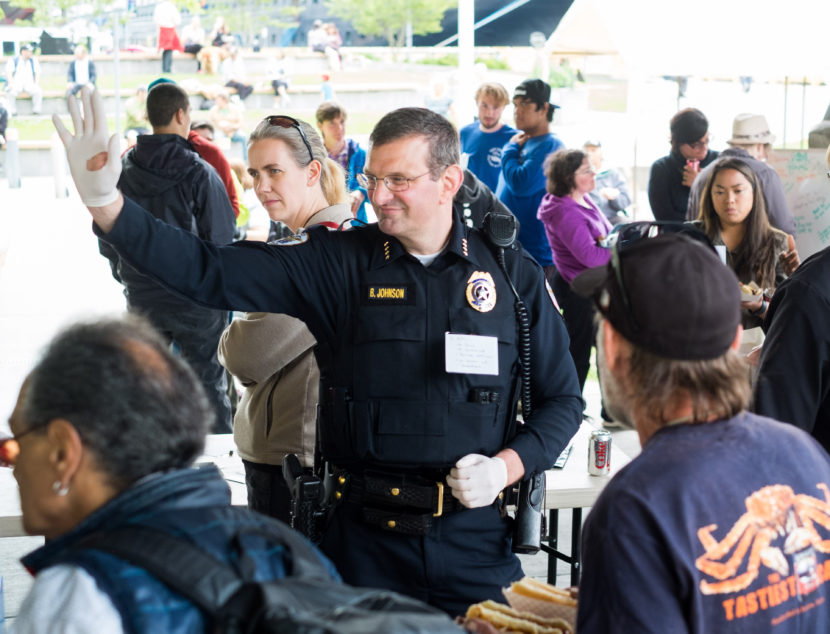
Former Juneau Chief of Police Bryce Johnson waves at a community barbecue it hosted in Marine Park to “be counted as a person against violence, against discrimination, and against hate” on July 20, 2016. (Photo by Annie Bartholomew/KTOO)
The department believes most of them were white men. But that data comes with significant limitations, because police in Juneau don’t ask people their race when responding to calls.
Deputy Chief David Campbell told the Juneau Assembly last week that, in an effort to avoid racial profiling, officers stopped asking people for their race in 2016. Officers will document race if someone discloses it, or they can sometimes pull data about a person’s race from other places — like the DMV database.
“But if that isn’t there, then the officer needs to take their best guess as to what race the person is and if they’re not sure, then they write down as ‘other’.” Campbell said.
In a later interview, Campbell said Juneau Police are open to talking about that policy with the community. He acknowledged that it does limit the department’s ability to track who officers are using force on.
“Maybe one of the benefits that might come out of this is maybe during this conversation, we’ll be able to say — you know it might offend someone in the field, but it’s ok for an officer to ask someone their race. Because this is a really important issue, you know? So maybe that directive will change because of all of this,” he said.
Campbell said he’s looking forward to a community conversation about policing.
He said Juneau has something that a lot of other communities don’t: officers who work here have to live here too.
“My god, that is horrible,” Campbell said. “But when you live in the same community that you police and you see people at Costco and at church and playing volleyball and just out and about, you know we’re neighbors. We’re held accountable.”
Residents of Juneau have been reaching out to the police department, the city and the Assembly with questions about how the community is policed. There will be a listening session on June 17 to hear those questions on policing, racism and social justice. The Juneau Police Department leadership, school district superintendent and school board have been invited to hear community members weigh-in.
The City and Borough of Juneau has step-by-step instructions for how to give public comment at the meeting which can be found here.
Additionally, the Juneau Assembly and city police will continue the discussion during a committee of the whole meeting on June 22 at 6 p.m. Questions can be sent to boroughassembly@juneau.org.
Editor’s note: A previous version of this story listed an incorrect date for the listening session — it is June 17. Additionally, it has been corrected to reflect that the purpose of the listening session is for community members to weigh-in, not for police and school district officials to answer questions.
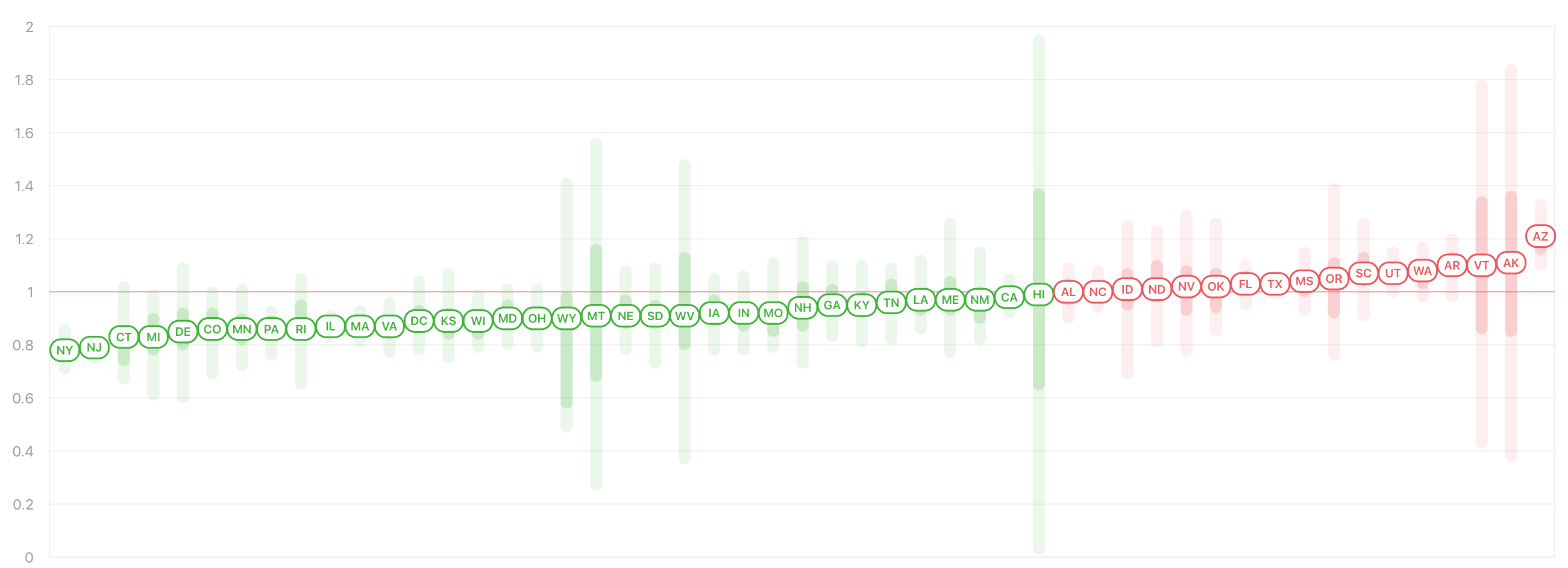
The metric being tracked here (Rt) represents the effective reproduction rate of the virus calculated for each locale. It estimates how many secondary infections are likely to occur from a single infection in a specific area. Values over 1.0 mean we should expect more cases in that area; values under 1.0 mean we should expect fewer. Case count data from the COVID Tracking Project. (Graphic courtesy Rtlive.com)
Alaska saw its highest jump in confirmed cases of COVID-19 in a single day on Friday.
State health officials reported that 29 Alaskans and five non-residents tested positive.
And, according to modeling the state is using, the rate that Alaskans are transmitting the virus is now the second highest in the nation. Only Arizona has a faster transmission rate.
The number of cases has been steadily rising since the state relaxed its mandates restricting movement and commerce. State officials have consistently said they expected the number of cases to grow, but believe Alaska has the healthcare capacity to handle it.
State modeling shows that the rate of transmission of the virus has jumped up to 1.1 — that means that each Alaskan who gets sick with the virus is likely to give to more than one other person. At that level, the virus is expected to spread quickly.
The Alaskans who were reported to have tested positive on Friday are spread out all over the state. The spike in cases in recent weeks has been driven largely by clusters of cases in certain communities.
Seven of the new cases are from Anchorage and one is from Eagle River. Health officials there have been trying to contain the state’s largest outbreak at the Providence Transitional Care Center. More than 40 of the center’s patients and caregivers have tested positive for COVID-19 so far.
Six of the new cases are from the Kenai Peninsula. The virus has spread quickly there in recent weeks — there are now 73 active cases as of Friday. State health authorities said earlier this week they were monitoring hundreds of people on the Kenai — that includes people who have tested positive for the virus and their close contacts. Other clusters of cases in the area have been linked to a seafood plant in Whittier and the Tustumena state ferry.
Three of the new cases are people from Fairbanks and North Pole. Two people in the Matanuska-Susitna Borough also tested positive on Friday.
And the virus continues to spread into remote communities.
Another case from rural Alaska has been confirmed in the Nome census area. The Norton Sound Health Corporation announced Saturday that the resident is from a village in the region. The health corporation is sending out a response team to test others in the community. It is the region’s fifth case.
In Southeast Alaska, there are three new cases from Ketchikan, two from Craig, two from Sitka and two from Wrangell.
The number of new cases in Alaska from non-residents also increased by five on Friday. Those cases include a seafood worker in the Kodiak area, a person in Fairbanks, two people in the Juneau area and one in the Wrangell area.
Alaska is among more than a dozen states that, since the start of June, have recorded their highest seven-day average of new coronavirus cases, according to the Washington Post.
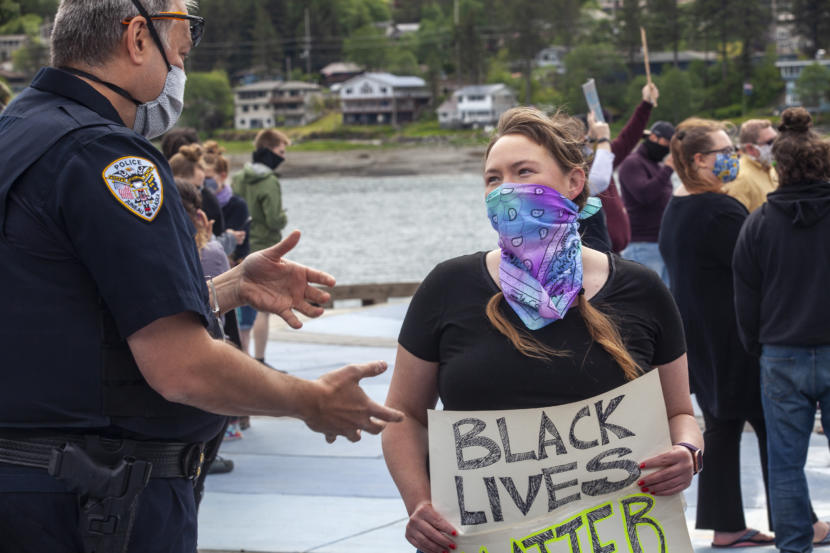
Juneau Police Department Deputy Chief David Campbell and Juneau Assembly Member Alicia Hughes-Skandijs talk amid a crowd of about 250 people gathered for a public “I Can’t Breathe” rally protesting the death of a black man, George Floyd, who was killed after a white officer pressed a knee into his neck while taking him into custody in Minnesota. People held signs decrying violence against black people and calling out institutional racism, many supporting the Black Lives Matter movement on Saturday, May 30, 2020 in Juneau. (Photo by Rashah McChesney/KTOO)
Earlier this week, Juneau Assembly asked to see the written policy and Chief Ed Mercer refused to turn it over without first consulting with the police department’s legal team.
Deputy Chief David Campbell said Thursday that using force is always something that’s going to be used in police work. But, it has to be justified.
During a lunch meeting with the city’s Chamber of Commerce, Campbell said that for people who aren’t used to seeing officers use pepper spray or a taser — it can be difficult to figure out what is justified.
“For people that aren’t used to living in this world, you can see something that might be reasonable and necessary and it might look really bad,” Campbell said.
During the chamber meeting, both Campbell and Mercer brought up the death of George Floyd at the hands of Minneapolis police. A widely shared video of Floyd’s death shows a police officer kneeling on his neck for several minutes during an arrest, even as Floyd repeatedly said he couldn’t breathe.
Campbell said what happened in Minneapolis was outrageous.
The City and Borough of Juneau will hold a digital listening session to hear community concerns on policing, racism and social justice on June 17 at 7 p.m.
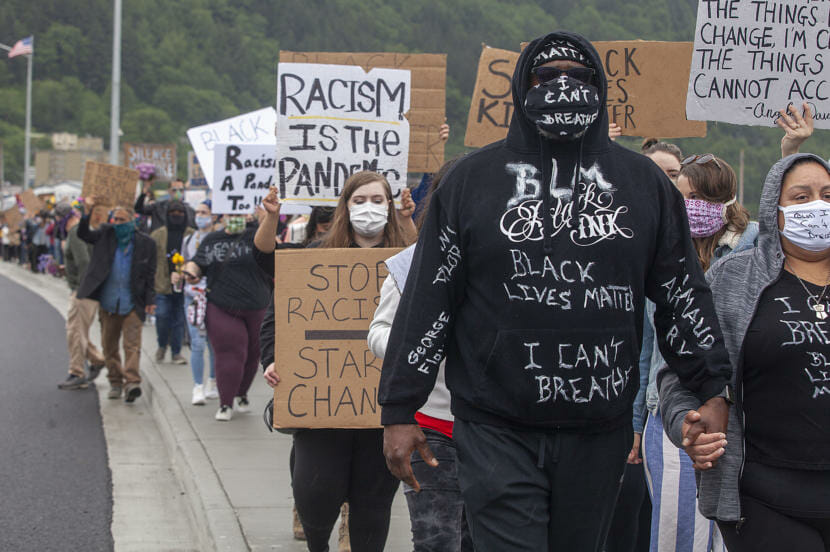
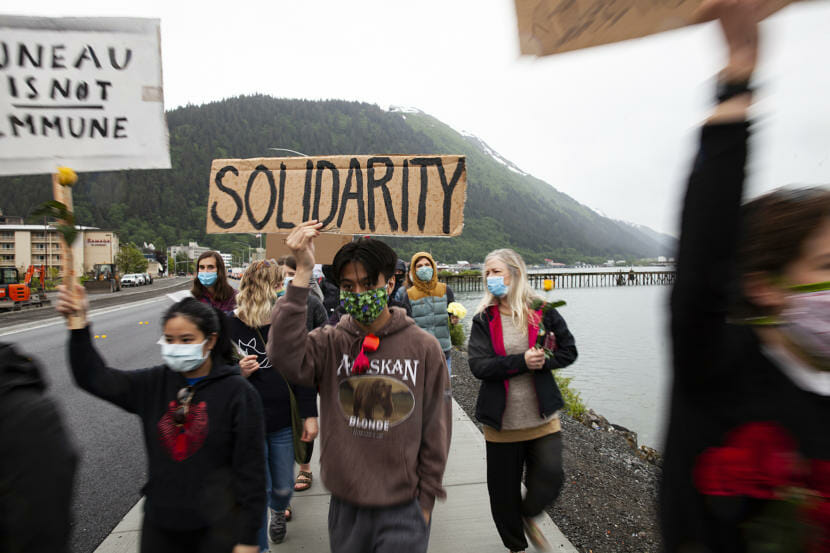
More than 400 people attended a rally in support of black community members and black people nationwide on the 11th day of protests against police violence and systemic racism following the death of George Floyd who was killed while being taken into custody by Minneapolis Police in late May. After marching from Marine Park to the roundabout on Douglas Island, demonstrators threw hundreds of flowers into Gastineau Channel during a rally on June 6, 2020, in Juneau. (Photo by Rashah McChesney/KTOO)
As protests over the death of George Floyd spread through communities across the state – some cities are questioning how and when their hometown police are using force.
From Utqiaġvik to Unalaska to Kodiak, Alaskans are protesting. It’s part of a massive social movement demanding police be held accountable, sparked in part by a video of the death of a black man named George Floyd who pleaded for air as a white Minneapolis police officer kneeled on his neck during an arrest.
His death and the deaths of many other black people in America has caused communities to consider radical changes to how police operate. In Minneapolis, the city council says it’s going to abolish its police department.
Anchorage’s Police Department released its written policy on Tuesday with a note that it has just been updated since Floyd’s death. Now, neck holds of any kind are prohibited unless they’re using deadly force.
But Juneau’s city police refused to release its written policy, at least, not without getting lawyers involved.
Activists in Juneau say police need to be more transparent with how they’re policing as there are clear racial equity problems in how laws are enforced in the state.
Over the past two weekends, several hundred Juneau residents have gathered in person, or online, to support Black Lives Matter and denounce police brutality and institutional racism. Protestors chanted “Juneau is not immune.” They spoke about their experiences at the hands of local police.
And, they demanded reforms to police oversight and what types of force officers can use.
They want changes to how local police — and staff at the Lemon Creek Correctional Facility — are trained on things like racial bias.
At Monday’s meeting of the Juneau Assembly ,Juneau Police Chief Ed Mercer said his officers stand with them.
“Since the killing of George Floyd for the past two Saturdays …members of our police department have attended rallies in Juneau to show our solidarity in denouncing excessive use of force by police departments,” he said.
Juneau Police Department Deputy Chief David Campbell and Borough Assembly member Alicia Hughes-Skandijs talk amid a crowd of about 250 people gathered for a public “I Can’t Breathe” rally on May 30, 2020, in Juneau, Alaska. (Photo by Rashah McChesney/KTOO)
Mercer told the Juneau assembly on Monday that what happened in Minneapolis shouldn’t be tolerated. And he laid out some ways that the Juneau Police Department has worked to avoid it.
He said the hiring standards are stringent. Deputy Chief David Campbell said they don’t hire people who have domestic violence in their backgrounds or can’t pass background checks. Juneau police have worn body cameras since 2017.
And Mercer laid out some statistics from last year. Officers have to file reports with him whenever they use force that exceeds a “firm grip.” In 2019, he said they reported using force 54 times against 38 people. The gap between those numbers is because each officer involved in the situation has to file a report
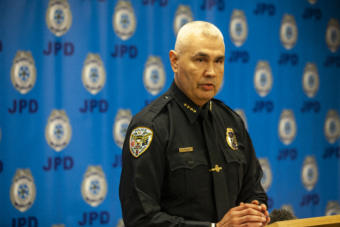
Juneau Police Chief Ed Mercer during a press conference after an officer shot and killed a man while responding to a 911 call, on December 29, 2019, at the Juneau Police Department headquarters in Juneau. (Photo by Rashah McChesney/KTOO)
To put that into context, Mercer said generally officers are using force when they’re arresting people. Last year, they arrested 1,815 people. Mercer said that means Juneau police used force in just over 2% of their arrests.
Broadened even further, Mercer said they had 32,000 contacts with people last year. So those 38 people they used force on are fewer than 1% of the people they came in contact with.
“So, over 99% of the citizens we have contact have no use of force,” Mercer said. “Simply put, the people of Juneau do not have to fear police force unless they are committing a violent act or resisting arrest.”
But when assembly member Rob Edwardson tried to drill down into specifics about how and when Juneau Police decide to use force, he ran into a roadblock.
“May I see the printed use of force policy?” Edwardson said.
After a pause, Mercer responded “At this time — no.”
But, he said he was open to having a discussion about how to release that information to the assembly.
Edwardson said he wanted to see the policy because he’s hearing complaints about officers using force that’s disproportionate to the situations they’re responding too.
“These aren’t, you know like kneeling on somebody’s neck or anything like that,” Edwardson said. “But placing hands on people. Manhandling people. Perhaps doing more dangerous than necessary maneuvers in cars to stop people.”
Edwardson said he has studied use of force policies as part of his professional career.
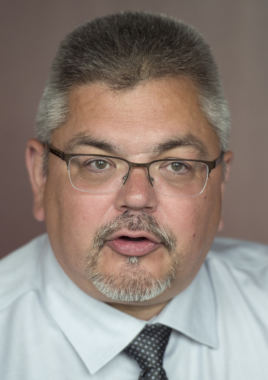
Assembly member Rob Edwardson. (Photo courtesy Michael Penn/Juneau Empire)
“I’m getting reports of people being stopped and asked questions with the police officers having their hand on the gun — which isn’t part of the interview position. Which is one of the reasons why I wanted to see the use of force policy,” he said.
Edwardson said he wanted to see complaints of use of force violations as well. But, like the use of force policy itself, Mercer said, they’d have to talk to their legal team before they released anything.
But beyond how city police are upholding laws and their own internal policies, some in the audience at that meeting questioned the basic philosophy behind how the city spends money on law enforcement.
Phillip Moser has been pushing the assembly to divert funds into things like rental assistance for people in Juneau who are struggling because the COVID-19 pandemic.
He linked it directly to how much money the city budgets for Juneau police.
“I’m saying that because, when it comes time to evict people from their homes, it’s going to be police — however nice they are — choosing to evict people and make them homeless, during a time when our need to have people in their homes is greatest and this is going to primarily affect people of color and minorities,” Moser said. “However nice police are in town — in Juneau. They are still going to be upholding the harassment of homeless people on the streets and they are going to be using funds to do that that have been proven — we’ve seen during our own efforts — would be better spent providing housing and support for those homeless people.”
Others said that if black community members are saying there’s a problem with how laws are enforced it’s the responsibility of the community to hear and address those problems.
“I think that there’s an attitude — and I’ve held it myself in the past — that our town is small enough and diverse enough and open-minded enough that racism and excessive use of force just isn’t a problem for us,” said Laura Steele. “But, having heard from the black community on Saturday and in conversations related to recent events, clearly that’s not the case. And it really pains me to say that far to often, black members of our community don’t feel safe, they don’t feel supported and they’re not made to feel welcome.”
Steele said she believes it’s the assembly’s responsibility to fix that.
More than 400 people attended a rally in support of black community members and black people nationwide on June 6, 2020, in Juneau. (Photo by Rashah McChesney/KTOO)
Sonia Ibarra told assembly members to look over the list of demands from the black community members who led Saturday’s rally and to lead uncomfortable conversations and challenge the white privilege that stands in the way of racial equity.
“I’m calling in because I’m hurting for our black, brown and Indigenous brothers and sisters. Because we need change across this country, across Alaska, across Juneau and this includes you. I ask you to hear the words of our community, of our people of color,” Ibarra said.
Assembly members plan to question Juneau police again in further detail later this month. They laid out some of the data that they want to see, such as a race-based breakdown of the situations in which police decided to use force and more information on the types of military surplus equipment the department has purchased.
The assembly is taking questions from community members at boroughassembly@juneau.org. The next meeting between the assembly and Juneau police is June 22.
Close
Update notification options
Subscribe to notifications
Subscribe
Get notifications about news related to the topics you care about. You can unsubscribe anytime.