I help the newsroom establish daily news priorities and do hands-on editing to ensure a steady stream of breaking and enterprise news for a local and regional audience.
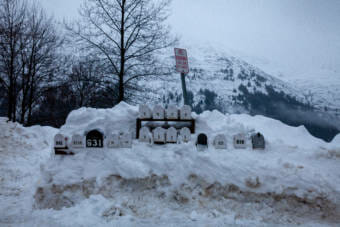
A row of mailboxes peek out from a snow berm on Tuesday, Jan. 11 in Juneau, Alaska. (Photo by Rashah McChesney/KTOO)
After a long weekend of damaging storms Gov. Mike Dunleavy has declared a disaster in some areas of Southeast Alaska. It includes the communities of Yakutat, Juneau, Haines and Skagway, and the boroughs where each city is located.
That disaster declaration opens a pot of money for communities, federally recognized tribal organizations and some private nonprofits to apply for reimbursement for funds they spent combating the storms.
Juneau Deputy City Manager Robert Barr said it also allows communities to formally ask for support from the state.
“I don’t know that we will in this case but in the event of a major avalanche, a major flood, that kind of thing,” Barr said. “Then we may seek some actual one the grounds, physical, hands-on support in addition to tapping into the public assistance funding that’s available.”
A good example of that type of support is happening in Yakutat where the city issued a local disaster declaration and asked the state for help. The state sent in the National Guard who are responding to help the community clear snow and ice from public buildings and roads.
In Juneau, Barr said city leaders are still trying to figure out exactly what can be reimbursed.
“We’ve hired contractors to help with trucking snow around and getting it out of places because it’s more than we can handle in-house. We’ve completely blown our overtime budget for, you know, our own staff,” Barr said.
The city has its own overtime budget, but Barr said costs that came from the storm may be eligible for reimbursement. And, they’ll also be looking at damage to public facilities – like the flooded Riverbend Elementary School.
This disaster declaration doesn’t cover individual needs – though there could be some trickle-down.
Juneau Emergency Programs Manager Tom Mattice said this disaster was declared because Yakutat reached out to the state for help.
“And the state said ‘well honor that request and we’ll even broaden that by including other jurisdictions that may also need help even though they haven’t raised their hands yet,” Mattice said. “… But once again, even in Yakutat, they’re not shoveling people’s roofs off. It’s a public assistance where they’ll helping the government, they’re protecting critical infrastructure and key resources and they’re doing things they need to do to keep the community on its feet.”
Mattice said even though help is on the way, in some cases – it might take a while. Reimbursement for these types of expenses can take years to come through.
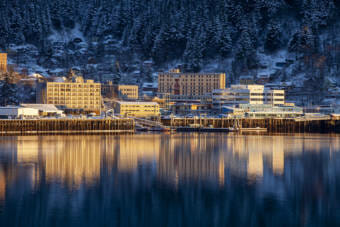
The sun rises over downtown on Dec. 22, 2021, in Juneau, Alaska. (Photo by Rashah McChesney/KTOO)
With an omicron wave on the horizon, city leaders decided to extend Juneau’s emergency measures to combat COVID-19 through April 30. Community members both praised and pushed back against that extension.
Juneau has a system of rules that it puts in place based on COVID-19 risk levels — things like the city-wide mask mandate, how many people can get together and how businesses operate. They’re designed to slow the spread of the virus.
Right now the city’s risk level is high. Hundreds of people have tested positive for COVID-19 in recent weeks as the omicron variant barrels through Alaska.
Bartlett Regional Hospital has had problems with staffing because so many people are out because of exposure to the virus. That means the city is mandating that masks and face coverings must be worn in public spaces indoors or outdoors when people can’t be socially distanced. They’re also limiting indoor gatherings to 50 people if people are unvaccinated.
When they met on Monday night, Assembly members heard public testimony on extending that system past its expiration date. They’ve extended this system before. They also got dozens of emails in advance of the meeting. About half of the nearly 20 people who spoke up at the meeting were against the idea of an extension. According to the city manager’s office, the email responses were evenly split as well.
Several people said they would like to leave Juneau and take their business and businesses elsewhere.
“My children don’t deserve to grow up in a town like this,” said Amy Miller. “We can’t do anything in this cold weather. We’re like, locked in the house, and our only option to go out is if we choose to go out and — we don’t wear masks. So, just imagine how that feels, going into any place and the looks that we get. As if we’re lepers.”
The people who spoke out in favor of the city’s ongoing management of the pandemic said they know people who have died from COVID-19. Or that they wanted to wear masks to protect themselves and others from spreading the virus.
Laura Steele said her daughter isn’t old enough to be vaccinated.
“So keeping these mitigation strategies in place is really important for me and my family in order to feel safe, pretty much leaving my house,” Steele said. “It’s both a health concern and an economic concern for me. I love to support local businesses. That’s something that’s a big value of mine. But I don’t feel comfortable at this point — until my daughter is able to be vaccinated — taking her into a business where people are unmasked.”
Steele told Assembly members that she believes having a mask mandate keeps people who have health concerns comfortable enough to shop in local stores.
At times, public testimony was contentious.
Some people called assembly members fascists or accused the city of profiting off of the pandemic. Another likened the mask mandate enforcement to the Gestapo — the secret police in Nazi, Germany. The city has issued just one citation for someone failing to wear a mask, and that was early in the pandemic.
Amanda Spratt also spoke against the extension. She said she thinks the city’s efforts to limit the spread of COVID-19 aren’t working against the omicron variant, which is causing case counts to spike regardless of vaccination status.
“214 cases reported today and just one person in the hospital,” Spratt said. “This no longer constitutes an emergency, not by any stretch of the imagination.”
Others said they worried that after an anemic cruise ship season, local businesses will suffer from the capacity limits on indoor spaces that go into effect at the higher risk levels. Laura Martinson is a local business owner.
“Just when our businesses are trying desperately to come out of this pandemic, adding another three months onto capacity mandates with a risk level that’s, two years old, doesn’t reflect that we have an 80% vaccination rate — which I’m very proud of,” Martinson said. She asked Assembly members to consider that the Omicron wave could end quickly. She said they could wait and reconsider an extension later.
Juneau’s Emergency Operations Manager Robert Barr and Rebecca Embler, a member of Bartlett Hospital quality team during Juneau’s COVID-19 vaccine clinic at Centennial Hall on Jan. 15, 2021, in Juneau. (Photo by Rashah McChesney/KTOO)
Robert Barr, who leads the city’s COVID-19 response, told Assembly members that they’re discussing an extension now because the legislative process they use — one that requires it to go through two Assembly meetings — is lengthy. He said they’re hopeful the omicron variant will burn fast and bright and then decline just as quickly.
“Honestly, we are just as hopeful as many of our testifiers … that we won’t need to do this again,” Barr said.
Ultimately, Assembly members said they are using the best available science to make their decisions. They passed the emergency measure extension with some changes, including changing the mask requirement to a recommendation when risk level goes down to “minimal.”
They also changed the definition of what it means for the city to be “fully open.” It used to be that if 97% of the community was eligible to get vaccinated, the city would remove all restrictions.
Now, it’s not clear what it will take to be fully open because the city will be waiting on guidance from federal and state health officials to decide when it’s time to fully reopen.
Correction: An earlier version of this story misstated the city’s old definition for “fully open.” The city would have removed all restrictions once 97% of the population was eligible to be vaccinated, not once 97% of eligible people were vaccinated.
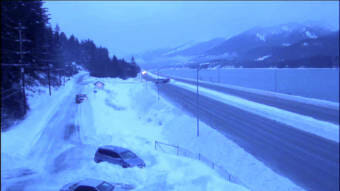
An image from the Alaska Department of Transportation Egan Drive/Glacier Highway traffic cam on Monday morning, Jan. 10, 2022.
Update — Tuesday, Jan. 11
Fred Meyer in Juneau reopened Tuesday morning, according to spokesperson Jeffrey Temple.
Original story — Monday, Jan. 10
State offices, schools and Juneau’s largest grocery store are closed as forecasters warn of potential flooding after heavy snow gave way to rain early Monday morning. Some trash service has also been suspended.
Juneau’s Fred Meyer closed early on Sunday evening and remains closed Monday. Spokesperson Jeffrey Temple wrote in an email that it was out of an “abundance of caution,” due to the amount of snow that accumulated on the store’s roof.
“We are working diligently to remove snow from our roof, and we have consigned engineering firms to help ensure structural integrity so that we can reopen the store as soon as possible,” Temple wrote.
Vehicles move cautiously down Whittier Street in Juneau on Monday, Jan. 10. Schools were closed for the day and other services were canceled due to hazardous weather and slippery road conditions. (Bridget Dowd/KTOO)
Forecasters with the local office of the National Weather Service are warning of rain and ice forming on top of the snow, which could cause flooding on Monday.
Forecasters are calling for rain and snow through Wednesday. With continued cold temperatures in the area, they’re also warning of the possibility of freezing rain in Juneau.
Deputy City Manager Robert Barr said the city is continuing its snow removal operations and concentrating on the Valley on Monday. He said they’re focusing on clearing storm drains.
The Department of Transportation wrote in an email that operators are still working on clearing Egan Drive and Mendenhall Loop. The department announced Monday morning that Thane Road is open again, but motorists should obey warning signs and should not park or stop in the avalanche zone.
“It looks pretty messy out there,” DOT spokesperson Sam Dapcevich wrote. “Our message to drivers is, if you have to be out on the road today, please be extra cautious. Drive slowly, and please give our trucks and equipment plenty of room.”
Other closures in town include Alaska Waste. In a recorded message, the company reports it suspended its trash collection because of extremely icy, unsafe road conditions. The company will be running Monday’s trash and recycle routes on Saturday, Jan. 15.
Many state offices in Juneau have also closed due to the weather. State employees who are required to protect the health and safety of Alaskans — like employees within the Department of Public Safety, Corrections and the Pioneer Home — are required to stay at work, according to a notice from the state.
According to flightaware.com, Alaska Airlines has canceled two flights that were headed out of Juneau on Monday. One was headed to Petersburg and the other to Ketchikan.
Neither Grigg nor the city gave a reason for his sudden departure. KTOO has requested access to Grigg’s expense reports. The city has refused to turn them over, saying that they’re part of an active criminal investigation.
Bartlett is Juneau’s only hospital and is the largest in Southeast Alaska.
Close
Update notification options
Subscribe to notifications
Subscribe
Get notifications about news related to the topics you care about. You can unsubscribe anytime.