Rashah McChesney

Daily News Editor

I help the newsroom establish daily news priorities and do hands-on editing to ensure a steady stream of breaking and enterprise news for a local and regional audience.
Newscast – Monday, Jan. 3, 2022

In this newscast:

  • High winds brought down trees in Thane, causing an overnight power outage Sunday night,
  • Gov. Mike Dunleavy declared a disaster emergency on Monday for some areas in Alaska affected by severe winter storms,
  • The Centers for Disease control and Prevention is once again asking Americans to avoid cruise ship travel,
  • A newborn baby was found a cardboard box Friday afternoon on the west side of Fairbanks,
  • The state of Alaska is preparing to sue the federal government over hundreds of contaminated sites that the feds conveyed to Alaska Native corporations,
  • The final research cruise of 2021 in the Bering and Chukchi Seas sailed through the region in November,
  • People in Juneau must mask up in indoor public spaces again as COVID-19 cases spike locally, likely due to the omicron variant


After a weekend of heavy snow in Juneau, forecasters warn of dangerously cold temperatures

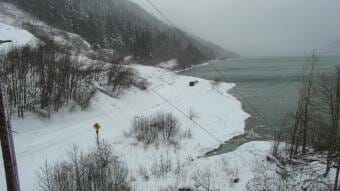
A screenshot from the Alaska Department of Transportation & Public Facilities Thane Road Snowslide Gulch Camera taken at 11:46 a.m. on Jan. 2, 2022, in Juneau, Alaska. (Courtesy of the Alaska Department of Transportation & Public Facilities)

Parts of Juneau got several inches of snow over the weekend, and forecasters are warning that next week could be extremely cold. 

An overnight avalanche appears to have occurred along Thane Road. On Sunday morning, the Alaska Department of Transportation and Public Facilities posted on its social media that the area is impassable and closed until further notice. Calls to DOT for more information were not immediately returned. 

The state closed the road to through traffic going into the weekend, which was forecasted to bring Juneau’s heaviest snowfall of the season. 

Meanwhile a high wind warning is in effect until Monday evening. The National Weather Service forecasts winds with gusts up to 65 mph, which could bring down power lines and trees. The agency warns that travel could be difficult, especially for high profile vehicles. 
On Sunday morning, the weather service had already reported gusts in the mid-50s. 

Single-digit temperatures are forecasted through the coming week, with temperatures on Wednesday potentially dipping to minus 1, according to the weather service.

Abandoned newborn found at Fairbanks intersection

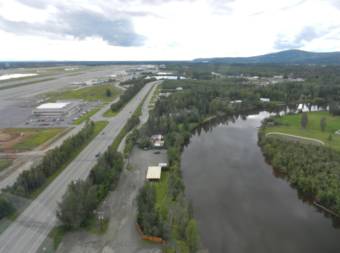
Fairbanks International Airport and Airport Way. (Photo courtesy Travis S/Creative Commons)

A newborn was abandoned in a cardboard box at an intersection in Fairbanks on Friday afternoon, according to a report from Alaska State Troopers 

Troopers say they got a report at about 2 p.m. that the child was left at an intersection near Chena Marina. 

When they found the child, who seemed to have been abandoned recently, they also found a note “indicating the parent could not take care [of] it,” the report said.  

Troopers say the child was taken to a local hospital, where they were found to be in good health. Fairbanks Memorial staff would not answer questions about the child’s condition. 

Troopers are still investigating the incident and have not yet responded to questions about the infant and the circumstances in which it was found. 

The temperature in the area was about 1 degree at the time. 

A Fairbanks woman named Roxy Lane posted on social media Friday night that she found the newborn near a row of mailboxes by her house.  In a video she posted, Lane shows a baby wrapped in a thick blanket. She also shows a note that says his name is Teshawn. 

According to the note, the baby was born at 6 a.m. on Friday and may be several weeks premature. The person who left him wrote, “My parents and grandparents don’t have food or money to raise me.”

The note also says that the family who left Teshawn behind lives nearby. 

Alaska does have laws in place for people who want to voluntarily surrender a child, but it has to happen under specific circumstances. The infant has to be younger than 21 days old and must be left with an emergency official, someone who has medical training or anyone the parent believes would keep the infant safe. 

Lane said Saturday that the parents may not have been aware of those safe haven laws or that they can call child protective services and surrender their baby without penalization. 

“Honestly this kind of stuff happens more often than you would think,” Lane wrote. “Somewhere along the line we’ve all failed this family…Everyone should have access to basic necessities and shouldn’t feel like they have to abandon their babies for it to have a better life.” 

Lane said that she has cycled through a lot of emotions — shock, anger and sadness — and is comforting herself by making wishes for his future. 

“He has endless possibilities in front of him, and who knows, maybe he can be reunited with his mother if she needs help and gets that help,” she wrote. 

In her post, Lane asked that anyone who knows Teshawn’s mother check on her. 

“She might be in a desperate situation, feeling abandoned herself,” Lane wrote. “Clearly someone in our community felt so lost and hopeless that they made probably the hardest choice of their lives to leave that innocent life on the side of the road with nothing but some blankets and a name.” 

This story has been updated to remove a link to Roxy Lane’s post which she has since taken down. 

Correction: A previous version of this story said the baby was found on the wrong day, it was Friday afternoon. 

New report details problems with Lemon Creek Correctional Center’s response to COVID-19

A view inside the tent at Lemon Creek Correctional Center as seen from a security monitoring screen. (Photo by Lisa Phu/KTOO)

In September of 2020, a woman housed at Juneau’s correctional center complained to the state that she wasn’t getting appropriate medical treatment.  She described living in a tent with no running water or indoor plumbing along with other women. She said it was unhygienic and put other inmates at risk of infection and illness. 

A month later, a man complained that Juneau’s correctional facility put him at risk of contracting COVID-19. He described an extra-long quarantine period of 27 days because new people kept being added to his group and they all got exposed. He said he didn’t get adequate medical attention at the time either. 

These complaints are detailed in a new report from the Alaska Ombudsman’s office. That’s the neutral office that investigates complaints against state agencies. 

The state’s ombudsman, Kate Burkhart, says there are a few important things to know about the investigation.  One, this is a crowded congregate living facility. 

“Lemon Creek is not designed for a pandemic, it is not even designed to hold inmates in separate cells, it’s much more barracks-style. And it’s I mean, there’s more people there, then there’s space,” Burkhart said.

And, when the complaints were made in 2020 — a lot of things were different than they are now. Vaccines weren’t yet available, case counts were still relatively low because the state hadn’t encountered some of the highly contagious variants that came along in 2021. 

So, Burkhart said they limited their investigation to what the Department of Corrections would have known about the virus and containing it at the time. 

She also noted that when state investigators were digging into the COVID-19 strategies at Lemon Creek – the facility hadn’t had an outbreak. That has since changed, in 2021 dozens of inmates tested positive for the virus. 

The allegations detailed violations of the state corrections department’s own plan for responding to the pandemic. For example, the man who complained said didn’t get his temperature checked for most of the time that he was in quarantine — including a full week when he didn’t get one. That was supposed to happen daily. 

“What we determined was that the facility did have trouble consistently conducting the temperature and symptom screenings, due in large part to lack of staffing because their medical staff — which is pretty skeletal to begin with — was also dealing with having to stay out because of COVID exposure,” Burkhart said.

We want to hear from you

If you have been incarcerated in Alaska during the pandemic, we want to hear from you. Contact Rashah McChesney via email or call 907-463-6441.


Inmates at Lemon Creek Correctional Center and outside volunteers participate in the Success Inside and Out program in 2015. The annual program offers resources to soon-to-be-released inmates, but many similar events and rehabilitative programs have been suspended indefinitely during the COVID-19 pandemic. (Photo by Lisa Phu/KTOO)
Inmates at Lemon Creek Correctional Center and outside volunteers participate in the Success Inside and Out program in 2015. The annual program offered resources to soon-to-be-released inmates. (Photo by Lisa Phu/KTOO)

Some of the problems stem from things that aren’t easily addressed — like overcrowding. The Lemon Creek Superintendent, Bob Cordle, is quoted in the report saying that it’s hard to socially distance when you’re living in a shoebox. 

But, overall Burkhart says the state corrections department was pretty responsive throughout the investigation. She says the department’s COVID-19 response plan is a living document; it has been updated several times during the pandemic. 

For instance, after the woman complained about living in a tent with no running water, corrections officials put a sink close to the tent that they say women living there can access at any time. And, the state started recruiting for more medical staff. It also contracted with two companies to help with COVID-19 testing. 

The ombudsman’s office did make one recommendation for another thing Lemon Creek Correctional could do. 

“We recommended that the correctional officers be trained to do a basic screening,” Burkhart said. “Kind of like what happens when you like try to go to your gym or other places in the community where they take your temperature and ask, ‘Do you have any symptoms?’”

But, it’s not clear if corrections officials will make that change – and the ombudsman can’t force them to. The state’s Department of Corrections hasn’t yet made anyone available to talk about the issues detailed in the report, but Lemon Creek Superintendent Bob Cordle detailed some of the problems and solutions in a recent interview with the Juneau Empire. 

Hundreds of other inmates have tested positive for the virus across the state. At least six of them have died. But this report only covers Juneau’s jail. Statewide, there could be other issues with other correctional facilities. It’s hard to know because the ombudsman’s office keeps investigations confidential until they’re finished.

Burkhart says her office was anticipating a wave of complaints about how state departments were handling COVID-19 and that didn’t happen. 

“The lack of complaints doesn’t mean there’s a lack of problems,” she said.

And if you are having a problem or have a complaint with a state agency or service, go to Alaska Ombudsman’s website or call 907-465-4970 for resources, referrals and assistance.

Disclosure: One of the assistant ombudsmen who investigated Juneau’s correctional facility is former KTOO reporter Elizabeth Jenkins. 


Contact KTOO’s Rashah McChesney:

State employee in Juneau charged with possessing child pornography, placed on administrative leave

A Juneau man who works for the state has been charged with more than a dozen counts of possessing child pornography. 

Juneau police arrested Bradley Waldron on Dec. 3 saying that he downloaded hundreds of images and videos of sexual abuse of children onto his cell phone. 

He faces 14 felony charges and up to 99 years in prison if convicted. After his arrest, he was released on a $5,000 bond. 
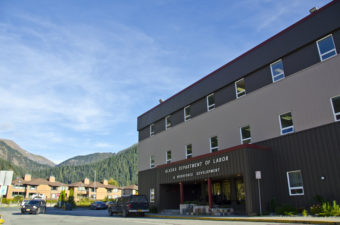
Waldron is a procurement officer for the Department of Labor. 

State law specifically allows for a state employee’s name, salary, job classification and history to be disclosed, but Labor Deputy Commissioner Cathy Muñoz said she wasn’t sure if he still worked for her department and said she wouldn’t share the information if she did know. She called it a personnel matter. 

The state’s personnel director said Waldron is currently on paid administrative leave. 

Juneau Assistant District Attorney Dara Gibson said his personal cell phone was the only thing that police searched — not equipment he used while working for the state. 

She cited other instances in which state employees have been accused of crimes but are still employed by the state pending the outcome of their trials. 

The charges against Waldron are allegations and not evidence of guilt. A phone message left for him on Friday was not returned.

Authorities identify remains of Juneau man who has been missing since 2017

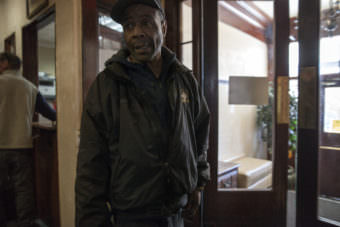
James Cole talks about his surprise at having to leave the Bergmann Hotel on Friday, March 10, 2017 in Juneau, Alaska. Tenants were kicked out after the city condemned the building for ongoing health and safety issues. (Photo by Rashah McChesney/Alaska's Energy Desk)
James Cole talks about his surprise at having to leave the Bergmann Hotel on Friday, March 10, 2017 in Juneau, Alaska. Tenants were kicked out after the city condemned the building for ongoing health and safety issues. (Photo by Rashah McChesney/KTOO)

Authorities have identified human remains found nearly two years ago on a downtown Juneau seawalk near the state Department of Labor building as one of two missing men thought to have drowned four years ago.

On Thursday, the state’s crime lab said they belong to James Christopher Cole. 

Cole has been missing since 2017 when a skiff he was riding in capsized near Aurora Harbor. Three people and a dog made it safely to shore but Cole and another man, Sheridan Scott Stringer were never found. 

Cole was 50 years old at the time that he disappeared. He and others in the boat were headed to the Lumberman, a derelict tugboat that was anchored in Gastineau Channel. That boat was used as a liveaboard for years. 

Nine months before he disappeared, Cole was one of about 50 tenants displaced from the Bergmann Hotel after it was condemned by the City and Borough of Juneau over health and safety hazards. Cole told KTOO at the time that he wasn’t sure where to go. 

Juneau police Lt. Krag Campbell said Friday that authorities are in touch with Cole’s next of kin who will decide what to do with his remains. Until then, his body will remain at the state medical examiner’s office. 

Correction: Cole’s remains were found nearly two years ago in January 2020. 

Site notifications
Update notification options
Subscribe to notifications