I help the newsroom establish daily news priorities and do hands-on editing to ensure a steady stream of breaking and enterprise news for a local and regional audience.
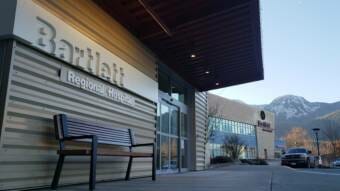
Bartlett Regional Hospital, pictured here on Dec. 1, 2018, is located at 3260 Hospital Drive in Juneau. (Photo by Jeremy Hsieh/KTOO)
Bartlett Regional Hospital’s Chief Operating Officer Vlad Toca is no longer employed there. Toca had been in that position for seven months. Before that, he worked at the Southeast Alaska Regional Health Consortium, or SEARHC, for nearly three years.
Toca is the fifth member of Bartlett’s management team to leave since last February, when CEO Chuck Bill retired.
Rose Lawhorne replaced him, but was fired in September after six months on the job. City officials said she had a relationship with a subordinate employee that violated the city’s conflict of interest code.
The same day that Lawhorne was fired, Chief Behavioral Health Officer Bradley Grigg quit. Neither Grigg nor the city gave a reason for his sudden departure. KTOO has requested access to his expense reports, but the city has refused to turn them over saying they’re part of an active criminal investigation.
Bartlett is Juneau’s only hospital and is the largest in Southeast Alaska. It is owned by the city but managed by a board of directors. Board President Kenny Solomon-Gross has not yet returned a phone call seeking more information. But a hospital spokesperson says Jerel Humphrey, the hospital’s current interim CEO, is planning to address Toca’s departure during a board meeting Tuesday at 5:30 p.m.
This is a developing story and will be updated as more information becomes available.
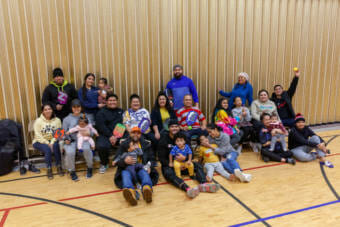
Melehoko Pauu Ma’ake talks to a friend during her family’s regular meetup to play pickleball on Saturday in Juneau. Most of the family is Tongan, and they’ve been trying to reach family and friends in the island nation after a volcanic eruption and tsunami. (Photo by Rashah McChesney/KTOO)
Melehoko Pauu Ma’ake has been dealing with two big problems since the volcanic eruption in Tonga. The first is reaching her uncle. He’s 84 and lives by himself near the capital, directly in the path of the tsunami.
She laid out the second problem in a Zoom call with some family members a few days after the eruption, as the group considered the best place to send aid money.
“The thing about Tonga is trying — is finding a very trustworthy source,” Ma’ake said. “You know, all of us here here, we’ve been to Tonga many times. And we know that when funds go to Tonga, sometimes it really doesn’t go directly to the people.”
She trusts the Red Cross and the Church of Jesus Christ of Latter-day Saints, but she’s still grappling with the problem of how best to fundraise in Juneau for her friends and family in Tonga.
So she called a group of her extended family to her home in Juneau to talk about what they know, to maybe figure out how they can help.
Ma’ake was born in Tonga but moved to the U.S. when she was four. Like many Alaskans, she and her husband moved to the state after a visit. She said she decided on Juneau because it’s a good place to raise a family — and they did. Now, when the family gets together, it’s always a sprawling intergenerational mix of babies, family born in the U.S. and family born in Tonga.
Members of the Ma’ake and Sekona and Paea families — and a few friends — meet up to play pickleball on Saturday in Juneau, Alaska. Most people in the group are Tongan, and they’re working to support their friends and family who have been affected by the disastrous volcanic eruption near the island nation. (Photo by Rashah McChesney/KTOO)
Telephone links between Tonga and the rest of the world are slowly being reconnected, but they’re unreliable, and the internet is still down.
“Everyone is trying to get a hold of someone in Tonga,” said Margaret Sekona. “So it’s going to be super hard and complicated, but you have to keep trying.”
Her father, Siua Sekona, said he’s been calling for days with no luck.
“There’s no connection,” he said. “It’s ringing, but there’s nothing like an answering machine or something that you can leave a message [on]. Nothing.”
Siua Sekona grew up in Tonga. Right now, his big concern is fresh water. He said most Tongans are not connected to city water, so they rely a lot on rainwater.
But a lot of the fresh water supply is tainted by volcanic ash and saltwater from the tsunami. A few aid flights have landed, and at least one ship has docked with supplies. But the family worries about there being enough to go around.
At one point, Margaret Sekona sits down at the dining room table hunched over her phone. Her father and Ma’ake huddle in.
Someone on the country’s main island, Tongatapu, managed to get a connection and live-streamed a drive through the devastation.
Margaret turns and looks at her dad. “Can you tell where this is?”
He pauses for a moment and then shakes his head. “I couldn’t really tell.”
She said she’s surprised to see buildings and houses standing, cars driving along the road. There are broken windows and downed trees, and everything is blanketed in this dark film of mud and ash.
“It’s a little comforting though, for sure, to be able to see at least something,” she said. “But you can still see there’s so much damage.”
Even though what she sees on the screen right now is terrible, it’s better than what she imagined.
Siua Sekona (right) watches a pickleball game on Sunday in Juneau. Sekona was born and raised in Tonga and, along with the rest of his family, has been waiting to hear from friends and family who still live there. (Photo by Rashah McChesney/KTOO)
Siua Sekona said it’s hard to know the extent of the damage right now, but he is hopeful. He has seen what happens after the islands take a hit. He said Tongans are resilient and won’t wait for the help that’s coming from other countries — they’ll help themselves and each other.
“They were sharing everything that they can share, and I was really touched by that,” he said.
He told the family that everything in life happens for a reason.
“I don’t belittle the experience that happens to them because I was one of those victims before. I feel for them, I pray for them. But, [at] the same time, I always look to see what’s coming behind the experience,” he said. “I know that they’ll feel the love and prayers of people everywhere — even people that are not Tongans. It’s amazing how this kind of catastrophe [brings] people together.”
This whole experience takes him right back to his own childhood. In 1982, one of the deadliest storms in Tonga’s history struck. Cyclone Isaac killed six people and left 45,000 people homeless.
When he sees the video on Margaret’s phone, his hand’s shake.
“It seems that I’m — I relive the experience again,” he said. “Because I know exactly how it feels.”
Siau Sekona says he was on one of the outlying islands at the time, on a mission for the Mormon church. He woke up at 2 a.m. as a storm surge swept him from his bed.
“You know, we were swimming because the wave was so high,” he said.
He remembers that most of the buildings were blown away, and everyone spent the night outside in the dark waiting for the sun to come up so they could figure out what was left behind.
He’s thankful that this time around, the eruption and tsunami happened during the day so at least people were able to see it coming.
As for Ma’ake’s uncle? She still hasn’t talked with him directly. But she finally heard from someone who heard from someone that he’s OK — one less person for her to worry about.
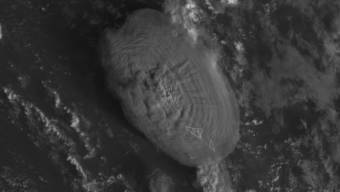
Image of volcanic eruption in Tonga taken from the Himawari-8 satellite on Jan. 15, 2022 at 5:50 p.m. Tonga Local Time. This volcanic eruption produced a 3.9 foot (1.2 meter) tsunami which struck Nukuʻalofa, the capital of Tonga. Also visible in this image is the remnants of Tropical Cyclone Cody to the southwest. (NASA/public domain)
A massive volcanic eruption near the Kingdom of Tonga sent people nearby scrambling for higher ground and prompted warnings of tsunamis throughout the Pacific.
While the physical impact in Alaska has been relatively minor, Alaskans with ties to Polynesian island communities say the emotional impact of waiting for news of friends, family and loved ones is heavy.
“Many Tongans over here did not sleep well,” Juneau resident Melehoko Pauu Ma’ake said on Saturday.
Melohoko Pauu Ma’ake with her mother and niece on Nuku’alofa in Tonga. Ma’ake, who lives in Juneau, knows her mother is safe, but she is concerned for other friends and family who live in Tonga after a volcanic eruption and tsunami that has largely cut off communication from the island nation to the outside world. (Photo courtesy Melohoko Pauu Ma’ake)
There has been very little contact with Tonga since Hunga Tonga-Hunga Ha’apai erupted. It has been difficult to get information about how the island communities are faring.Radio New Zealand reports that communication has been out since Friday evening, and there are reports that power has been cut in the capital.
Ma’ake and her husband have family in Australia and New Zealand and in other communities in the U.S. She said they are hungry for news and have been texting each other every update they find on social media.
“We’re dying for information to see what’s going on because we’re not hearing anything,” Ma’ake said. “The first thing — we’re waiting all ears to see more of our relatives — how they are doing.”
“She was driving from work with the ash and the rocks, raining rocks. And so she put on her phone the whole time for me so I can watch her drive home and see what’s going on,” Ma’ake said. “And it got to the point in her drive, she couldn’t see anymore, so she had to pull off the road.”
The approach to Fua’amotu Airport, Tongatapu, Tonga on Oct. 20, 2014. (photo by David Broad/Creative Commons)
The volcano is about 40 miles of north of Tongatapu, the island where the capitol is located. It has been erupting intermittently since December, according to a report from the Smithsonian Institution’s Global Volcanism Program.
Despite Tonga’s relative isolation, a booming sound after the initial eruption was heard 5,800 miles away in communities throughout Alaska several hours later.
Ma’ake said she goes home to Tonga every year. And when she heard that Tongatapu was submerged, it scared her because she said there’s not a lot of places to get to higher ground. The island is relatively flat — the highest point is about 92 feet above sea level.
And Ma’ake’s uncle lives 10 minutes away from Nuku’alofa, the capital on Tongatapu. He’s 84, and she says he lives by himself, is very stubborn and loves his home.
“You know, he’s not very far away from the oceanfront. Walking it took me just like 20 minutes to walk from his waterfront to his house when I was there last time,” she said. “I hope he left his place. You know, I can see his daughter coming to take him to higher ground and him like ‘no, you know, I’m staying here in my house.”
Pita Taufatofua with Melohoko Pauu Ma’ake’s niece. An undersea volcanic eruption near the Kingdom of Tonga prompted warnings of tsunamis throughout the Pacific, and cut off the Polynesian island community from the outside worlds. Taufatofua has posted on social media that he has been unable to reach his father who lives in Tonga. (Photo courtesy Melohoko Pauu Ma’ake)
With the lack of clear communication about what’s happening in Tonga, it’s hard to know what kind of aid the islands will need. Ma’ake said so far her friends and neighbors in Juneau have supported her by calling and checking in to make sure she’s OK.
And for Tonga, she said everything is still so fresh — but there will probably need to be some fundraising at some point because the eruption and tsunami will probably have a huge financial impact.
“They’re not poor in their friendliness and love, Tonga is very rich in that. But economically they are a poor island so I know they’re going to need a lot of help.”
A NOAA satellite image of an eruption of the Hunga Tonga-Hunga Ha’apai volcano, located in the South Pacific Kingdom of Tonga. According to local officials, the eruption had a radius of 260 km (161.5 miles) and sent ash, steam, and gas 20 kilometers (12.4 miles) into the air. The volcano has been erupting for more than a day but two large eruptions sent a tsunami warning throughout the Pacific Ocean. (Photo courtesy NOAA)
A tsunami advisory has been canceled for Alaska after an undersea volcano erupted near Tonga. Some Alaska communities did see significant waves, but officials did not issue an evacuation warning.
“We’re not going to try to put you in a warning right now,” Scott Langley, senior electronics technician for the National Tsunami Warning Center, told KUCB Saturday morning.
An advisory means a dangerous wave is on the way, according to the National Weather Service — but the wave is expected to be between 1 to 3 feet.
The Tsunami Warning Center canceled the advisory for Alaska in a bulletin issued at 3:31 p.m., though it remained in effect for the California coast. Earlier bulletins included coastal areas from Southeast Alaska to the western Aleutians.
In Alaska, the largest waves hit the Aleutians and Alaska Peninsula, Langley said. He said the 900-person community of King Cove has recorded waves of just over two feet. If those waves were to reach one meter — about 3.2 feet — he said the center would issue an evacuation warning.
The center hasn’t received any reports of damage from King Cove, Langley added — the only damage reported so far in the U.S. has been in Hawaii and California.
#Tsunami via reports from Hawaii and @NWS_PTWC : boats are up on the docks in Hawaii. Not seeing inundation.
West Coast residents be prepared for impacts in bays and harbors. Live-aboards seek shelter and high ground. Follow local instructions.
Dave Snider, the tsunami warning coordinator for the National Tsunami Warning Center in Palmer, said the volcano — Hunga Tonga-Hunga Ha’apai — has been erupting for at least a day.
But early Saturday morning there was a massive eruption.
“And then another eruption occurred, and this one seemed to be even larger and it sent a wave across the Pacific of basin-wide impact overnight,” Snider said.
By 7 a.m. on Saturday morning, the weather service reported waves arriving in the Aleutian Chain of just over a foot in Nikolski and just under a foot in Atka and Adak.
“We’re waking up to an expectation of the possibility of 1-2 feet of a tsunami along the Alaska shoreline,” Snider said.
While that wave height wouldn’t necessarily send coastal Alaskans running for the hills, it’s still dangerous, especially for people who live or work on boats or low lying coastal areas.
“So, if you’re a person in a liveaboard in Juneau or anywhere else in the Alaska coastline, you need to take this seriously. It would be a good time to get away from your boat, move to higher ground and away from the marina. Move up above that really low coastal area there,” Snider said.
It doesn’t take much of a tsunami wave to toss a boat around.
“We do have some minor damage, I think, reported in Hawaii. Nothing too significant coming in yet, but it did include a boat that was moved up out of the water and onto the dock,” Snider said.
A twitter user named Dr. Faka’iloatonga Taumoefolau reported hearing a violent volcanic eruption and that the sky was getting darker, raining ash and tiny pebbles.
There are no immediate reports of injuries or damage on Tonga, though communications with the small island nation are cut off according to the Associated Press.
“What we saw in Hawaii was impacts lasting for several hours, at least two to three hours after the initial wave continued,” Snider said. “So we’ll be watching this throughout the morning here.”
Mark Ibias, a lead maintenance tech with the Juneau School District, stands on waterlogged carpet in the Riverbend Elementary School library on Thursday, Jan. 13, 2022. Two pipes burst in the school and flooded nearly two-thirds of it with water. Ibias says they’ve been scrambling to get it dried out and cleaned up for several days. (Photo by Rashah McChesney)
There were so many fans blowing in Riverbend Elementary School on Thursday morning that it sounded like a jet was taking off inside.
Two pipes — one in the commons area where kids eat meals, another in the nurse’s office — burst during a cold snap and flooded most of the school.
The weekend weather was bad, and no one was in the school when the pipes burst, so they don’t know for how long it was filling with water. On the day Riverbend was supposed to open to students, the school custodian showed up early to shovel snow and found the mess.
He said custodial staff and maintenance crew shut off the water and the electricity first. About a dozen of them have been rushing to clean and dry the school out ever since.
“Its been crazy. It’s been crazy, crazy,” said Lead Maintenance Technician Mark Ibias. Asked if he’s slept, he jokes, “What’s that word?”
The inspection team looked at the floors, the furniture — they talked about the wet concrete under the carpet in the library.
“Mainly the mold,” Ibias said. “I mean, anytime that you have moisture, you’re going to get some kind of bacteria,” he said.
Riverbend Elementary School Principal Elizabeth Pisel-Davis flips through a water-logged basket of books that used to sit on the floor of her office. (Photo by Rashah McChesney/KTOO)
At least two-thirds of the building has been impacted. Ibias said some of it was under nearly three inches of water.
The school district sent out an email after the inspection team left saying that it will take several weeks to repair the school — that much of the flooring, carpet and drywall need to be replaced.
Teachers haven’t been back into Riverbend yet to fully catalog everything that’s been damaged. In the email, the school district said they’ll have to pack up their classrooms and move everything out of the way so that construction crews can come through.
Elizabeth Pisel-Davis is the principal of Riverbend. She walked through the school on Thursday and said she’s already seen a few things that will definitely need to be replaced. Some drawers in the nurse’s office were filled with water, so they’ll need new supplies.
Pisel-Davis points out the wet shelves in the Riverbend Elementary School library. (Photo by Rashah McChesney/KTOO)
“We’ve had a couple of computers that I know got hit. Some iPads that got hit,” she said.
Other damage may take longer to figure out, like in the library. None of the books are wet.
“But, if you look carefully at the bookshelves,” Pisel-Davis squats down to point at a corner of one. “See how at the bottom they’re starting to break apart?”
Most of the furniture in the school is pressboard, because it’s cheap.
“But it’s also one big sponge,” Pisel-Davis said. So, anything that was pressboard furniture sitting in water?”
She thinks insurance will cover a lot of those losses. And she’s hoping they’ll cover the cost of replacing any supplies teachers may have lost too.
The whole situation is stressful, and it’s piled on top of the COVID-19 pandemic and all of the other things that teachers are going through right now as they return to in-person learning during the largest spike of new cases the town has seen so far.
When she saw the photos of her school underwater, Pisel-Davis said she cried.
“Even though it’s just stuff, it’s our school, and it’s things that kids use. Just the amount of work that my teachers have already put in this year — I just knew that this was one step too far for them,” she said.
Still, even as she was talking about the frustration and sadness, there are some small moments in all of the chaos that make her smile.
Walking toward the library, she ducked around a corner into a dark room where a pile of musical instruments was shoved into a corner. When the custodians came in and found all the water, they made sure to come to this room and move all of the instruments up and away from the soaked carpet — including a set of xylophones that inmates at Lemon Creek made for the kids to use at home during the pandemic
Musical instruments were crowded together, up and away from wet carpet at Riverbend Elementary School. (Photo by Rashah McChesney/KTOO)
A company in the community showed up with industrial equipment to help vacuum up the water. Pisel-Davis has been hearing a lot from parents too. There’s basically an army of volunteers waiting to be told when and how to help.
And the kids are reaching out.
“I have already gotten a couple of texts from parents from kids who were worried about my turtles,” she said.
Peanut Butter and Jelly, two turtles who live in Riverbend Elementary School Principal Elizabeth Pisel-Davis’s office, safe and dry in their enclosure. (Photo by Rashah McChesney/KTOO)
Pisel-Davis keeps those turtles, Peanut Butter and Jelly, in an open enclosure in her office under a desk.
“The kids come and read to or hang out with [them] when they need to just have a break,” she said. “And a couple of kids were like ‘what about the turtles, are they ok?’ And my turtles are fine.”
She said she didn’t even have to ask about them. The custodians texted her right away to say that they were OK.
For now, the school is closed indefinitely, and the district is scrambling to figure out how and whereto teach the 270 Riverbend students.
According to the school district, Riverbend families will be updated on Monday and can also check juneauschools.org for more information.
This story has been updated.
Close
Update notification options
Subscribe to notifications
Subscribe
Get notifications about news related to the topics you care about. You can unsubscribe anytime.