The city will hire an expert to provide technical assistance in its dispute with the Federal Emergency Management Agency on Juneau flood plain maps.
CBJ disagrees with FEMA’s revision to the maps, adopted last year by the agency.
The Assembly Monday night agreed to transfer $50,000 from Areawide Drainage Improvements for the technical help. The city will contract with a hydrologist to work with city staff.
The transfer was recommended by the Public Works and Facilities Committee. In a recent meeting, CBJ Development Director Dale Pernulla said the city hopes to get FEMA to allow scientific review of the maps. He says the city disagrees with the model used for drawing the maps.
Steller's Sea Eagle. Courtesy National Geographic.
A Steller’s Sea Eagle has been seen in downtown Juneau – far afield from its habitat of eastern Russia.
Research wildlife biologist Dave Douglas saw the rare eagle Friday morning when he was looking out the window of his office in the NOAA building on Gastineau Channel.
He says the bird was inflight at about 200 feet, “and it was back dropped against the dark spruces, the dark of the mountain. You know the first thing that catches my eye is the glaring white and dark contrast on its wings.”
The bird had bright white on its wings. Douglas says for the first second he was “trying to coerce himself” into thinking it was a guillemot or a white-winged scoter.
“But yet it’s huge. It’s undisputedly an eagle. So then I try to wrestle for another second or so thinking that a bald eagle has something stuck on its wings, like white garbage bags, or something, (or) it flew through some paint, I don’t know, something,” he says. “Then it had just perfect form. There was nothing trailing or stuck on this eagle.”
He described what he was seeing to a colleague – a professional birder — who confirmed it was the Steller’s Sea Eagle. He says he jumped on the Internet and was quickly viewing what he had just seen in flight.
Douglas conducts satellite tracking studies for the U.S. Geological Service’s Alaska Science Center. In past jobs, he has spent countless hours identifying birds for the U.S. Forest Service and Fish and Wildlife Service, but he had never seen the rare eagle in the field.
Word of the sighting spread through an online eagle chat forum, confirming a story that a Steller’s Sea Eagle was seen up the Taku River about 1989.
Steller’s Sea Eagles are most commonly found on the Kamchatka Peninsula, where they breed. In the winter many individuals migrate to Japan, while others move to open water. Annual salmon runs provide much of their diet.
Douglas says they are occasionally seen in the Kodiak area. Click here for more information on the Steller’s Sea Eagle.
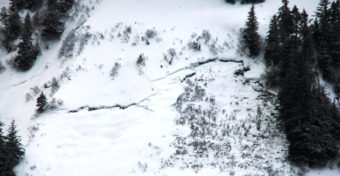
Snow fracture on avalanche path above Fish Creek Road. Photo by Rosemarie Alexander
Powerful winter storms, extreme cold, heavy snow, freezing rain and avalanches – that’s the winter Alaska has already had.
So last week most communities were prepared for table-top exercises testing the statewide coordination and communications capabilities of federal, state and local emergency responders, the military, some utility providers and the University of Alaska.
Alaska Shield 2012 ended Sunday. It began a week ago with a powerful winter storm to result in 100 mile-an-hour winds in Unalaska, avalanches in Juneau, and plummeting temperatures elsewhere. The storm was to be so mighty that city water lines would freeze, natural gas would be disrupted, there would be power outages, roads closed, trains derailed and fires.
The drills called for Anchorage, MatSu, the Kenai and Fairbanks residents to be without heat and water. Kodiak would lose communication.
In the capital city, the scenario was snow – sliding off the mountains. CBJ Emergency Program Manager Tom Mattice and public safety responders practice often for the real thing.
“The Juneau scenario is actually a large-scale avalanche that comes down and completely crosses Egan Drive,” Mattice said.
Just the week before Alaska Shield, though on a smaller scale, a real avalanche closed Juneau’s Thane Road and there were numerous avalanche paths sliding in the mountains around town.
Fracture on Showboat trail outside Eaglecrest boundary. Photo by Rosemarie Alexander.
“Even if we had had a large scale event last week, the boots on the ground that are going to be out saving lives, they already know what’s going on,” Mattice said.
Each community adapted the scenario to fit what it needed to test. In Juneau, for example, Mattice brought together emergency operations center staff, who would be commanding the boots on the ground and coordinating with emergency managers statewide.
According to Alaska Emergency Management Director John Madden, some problems occurred, particularly in communications, and the point was to quickly correct them.
“We’re trying to build up our ability to perform the mission wherever it happens when the real event happens,” Madden said.
“Seems as though we’ve had real events all winter,” I noted.
“I started out with this overarching scenario about a year and a half ago, and I think I predicted far too accurately,” Madden said. “We had the Prince William Sound storms, the adventure with the Coast Guard ice breaker going up to Nome, and all the extreme cold we had throughout most of the state. I may stop predicting!”
The scenario was so real that Cordova and Valdez decided not to participate in Alaska Shield 2012. They’re still dealing with the impact of hundreds of inches of snow in early January.
Madden says Alaska Shield was preparing emergency responders for the right things.
“Oddly enough, we did a tsunami workshop and evacuation just a few months before the Japanese tragedy. We had something set up for December simulating a widespread Bering Sea storm, which hit in November,” Madden said.
If such bad weather were to strike, suddenly there would be need for statewide warnings, emergency management, shelters for large numbers of people, medical care, and utility repairs. And in each community, the University of Alaska has a presence. Rick Forkel is UA Emergency Management Director.
“Those of us at the campus would be dealing with the issue of student housing units and people and sheltering them temporarily anyway and having the ability to assess what the impacts going of all of our buildings being without power for who knows how long,” Forkel said.
He said UA also needed to test the campus incident management teams on each campus as well as statewide communications.
The Alaska Shield exercises bring everyone together under the state’s emergency operations center. The 2012 drill is leading up to Alaska Shield 2014. That’s the 50th anniversary of Alaska’s great earthquake and tsunami, when there were catastrophic failures in multiple communities that required statewide response.
Bartlett Regional Hospital hopes for future sales tax revenue for a new unit.
Photo by Casey Kelly. The wish list for Juneau’s 1 percent temporary sales tax has grown to more than $81 million.
The City and Borough’s 5 percent sales tax is comprised of a permanent 1 percent, a temporary 3 percent and a temporary 1 percent tax; the temporary portions to be approved by voters.
The temporary 1 percent sales tax expires September 30, 2013. Voters will be asked to extend it this fall. It’s called a project tax, because it’s generally used to fund city construction and maintenance.
In recent weeks, city departments have come to the Assembly with their favorite project; non-profit organizations are also expected to ask for a share.
The Public Works and Facilities Committee is the first stop for requests, where this exchange was heard at a recent meeting:
“So are you asking for 28 million dollars out of the one percent sales tax?” Assembly Finance Chair Karen Crane asked.
“Oh we’d love to have 28 million dollars,” quipped Juneau International Airport Manager Jeannie Johnson.
Crane: “I don’t see it happening, Jeanie.”
Johnson: “No, I don’t see it happening either. What we ended up with the last time was 10 million dollars.”
Johnson hopes to use future sales tax revenue for phase two of the terminal renovation, which will remodel or replace parts of the old wing built 60 to 70 years ago. Johnson said it ranks “as one of third worst energy hogs of all CBJ buildings.”
“The question is,” said Port Director Carl Uchytil, “at what point do you want to stop funding good money after bad facility?”
Uchytil speaks for a lot of CBJ facilities that need maintenance, renovation, or complete replacement.
Parks and Recreation has $8.65 million worth of projects ranging from a new roof for Centennial Hall to Marine Park improvements to local trails.
Sales tax revenue has helped build Eaglecrest chair lifts. Photo by Rosemarie Alexander.The Eaglecrest Ski Area is hoping for $6.68 million for a three-phrase project that would renovate the crowded old lodge and build a new “Learning Center.” General Manager Matt Lillard told the Assembly committee that such a center is needed if Eaglecrest is going to manage its growth:
“Over the past years we’ve seen an over 3 percent growth yearly, and that is mainly coming from new users to the ski area,” he said.
Lillard said the center would house the Snow Sports School, which is enjoying 36 percent growth this year, as well as the rental shop, retail and repair shops, ticket sales, classroom space, staff offices, and a facility for the increasing number of adaptive skiers and boarders.
“We also feel that by having a learning center we will gain more users at Eaglecrest and hopefully increase our annual revenue by 50-thousand (dollars),” Lillard said.
Bartlett Regional Hospital is also vying for $5 million in sales tax revenue for a 21-bed mental health unit for children and adolescents, ages 5 to 17.
The library department wants to build in the Mendenhall Valley, at the Dimond Park site. A library has been part of the master plan for the area since the city purchased the land many years ago. The current valley library is in the Mendenhall Mall, where rent has increased 17 percent since 2009.
Library Director Barbara Berg called it “the elephant in the middle of our budget, essentially. We sacrifice collection money, computer money, everything else in order to be able to pay the rent.”
Berg said the mall has so many limits that it constrains programs the library can offer. The city’s portion of the project would be $4.7 million dollars, while most of the construction funds would come from the State of Alaska.
The Juneau Arts and Humanities Council is looking for $14 million for two small performing arts theatres. Former Assembly member Jeff Bush, now on the council’s board of directors, presented that request.
“We went out originally with a concept of a single theater or between 500 to 600 seats and the public user groups came back and said, ‘No, we need so many spaces that we would prefer to have two smaller spaces rather than one larger space,’ ” Bush said.
The only non-profit to submit a request so far is Sealaska Heritage Institute. SHI is asking for $3 million toward construction of the Soboleff Cultural Center to be built downtown.
The temporary 1 percent sales tax generates an average of $8 million a year, or $40 million over the five years it is in effect. Voters approved the last one in 2008.
It’s likely more projects will be proposed for those funds over the next few months. The Assembly will decide which projects will go on the fall municipal election ballot.
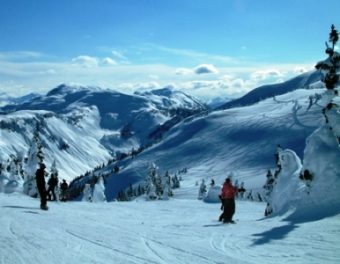
A beautiful day at Eaglecrest.
Photo by Rosemarie Alexander.
More than 1,000 responses have been received to an online survey about Juneau’s Eaglecrest Ski Area. Coupled with an earlier telephone survey of Juneau residents, the results are part of the master plan process underway by the Eaglecrest Board of Directors.
The surveys were conducted by McDowell Group research firm. Principal Jim Calvin says the board now has a strong benchmark for understanding what the community thinks about the city-owned ski area.
The survey was online late last fall, after a random telephone poll of 449 Juneau residents. That survey showed that 45 percent of all Juneau households use the city-owned area at least once a year.
Calvin says a draft plan will be available to the public at the end of the month for feedback, including a public meeting.
“And then we’ll work with the board, and based on community feedback, develop a final master plan that will be ready to hit the street sometime early to mid-April,” Calvin says.
The master plan will include development priorities of Eaglecrest users and the rest of the community as well as what consultants McDowell Group and SE Group have said about the feasibility of various proposals.
Calvin says he hopes the final master plan becomes a useful tool for the board of directors as it responds to developers’ proposals and city officials’ requests to increase revenues.
“There are no easy answers for Eaglecrest in terms of its development. Any of the development opportunities you look at have important cost implications, whether it’s development of a trail network, not much operations and maintenance costs with trails, but big upfront costs. Same thing in terms of lighting for night skiing or operations of terrain parks,” Calvin says. “So it’ll be the challenge for the board to take what is in the master plan and try and prioritize what to do next.”
Juneau school kids will get spring break next year. The school board voted Tuesday night to keep the week-long March break.
Public comments have been overwhelmingly against adopting a 2012 /13 calendar that would have done away with the vacation.
Spring break comes just before standardized tests are taken, and some school district officials said students could use the additional 25 hours of instruction. That proposal also had school getting out a week earlier.
But the Southeast Gold Medal Basketball Tournament also generally happens during spring break and it’s played at Juneau-Douglas High School. If school is in session, JDHS physical education classes have to be canceled and experience shows a high number of students are absent during the week-long tournament.
Opponents also argued that spring break is a family-vacation time, it’s used by many high school students to visit colleges, and teachers and kids just need a break.
Assistant Superintendent Laury Scandling said the administration was convinced after reading 160 public comments:
“We received 130 comments in favor of retaining a spring break and 17 comments that favored not having a spring break, and the administration is recommending that calendar Option A be adopted that retains spring break in the third week of March,” Scandling told the board just before the vote.
Bridget Lloyd is the Thunder Mountain High School student representative to the school board. She conducted a survey of TMHS students on the issue.
“Twenty-two students out of 222 said they would like spring break to be canceled and 200 said no,” she said.
The 2012 / 13 academic calendar shows school beginning Monday, August 20th. It ends on Friday, May 24th, and spring break is the third week of March.
The school board is considering a proposal to end the first semester before the winter holiday break in December, rather than January, after students get back from the holidays.
Close
Update notification options
Subscribe to notifications
Subscribe
Get notifications about news related to the topics you care about. You can unsubscribe anytime.