Rosemarie Alexander

Eaglecrest racers compete in Alyeska Cup

Racer trains at Eaglecrest. Photo by Susan Stopher

Twelve Juneau ski racers are competing this week in the Alaska State Alpine Skiing Championships at Alyeska Ski Resort in Girdwood.

The Alyeska Cup is the first of two state qualifying races for the United States Ski Association’s Junior Olympics as well as the Arctic Winter Games. Juneau’s Eaglecrest Ski Area will host the second contest later this month.

Rosemarie Alexander caught up with some of the young skiers in the noisy race room at Eaglecrest Lodge.

Seventeen year-old Peter Peel has had a lot of success so far this season. He won both the Juneau Ski Club’s slalom and giant slalom at Eaglecrest last month – but it wasn’t that long ago that he was happy just to finish a race.

“Consistency is key for me,” Peel says.

The high school senior says he worked hard during the off-season and is stronger this winter.

“You know, just putting a little more into it and I’m getting more out of it, so it’s working,” he says.

One of Peel’s ski coaches might say he’s putting less into it:

“We talked to Peter about ‘instead of trying 105 percent, knock it back to 95 and see if you finish,’ and yup, Peter’s consistently finishing,” says Coach Randy Bates.

Going into the Alyeska Cup, Bates is pleased with the Juneau skiers and their competitiveness on home snow. He says Matt Van Door is also skiing strong.

“He’s always finished races and he’s having consistent results, too. He and Peter are battling pretty good,” Bates says.

Van Dorr and Peel are the oldest junior skiers to represent Juneau. Racers ages 11 to 19 are competing at Alyeska from Juneau, Anchorage, Girdwood and Fairbanks.

Last year, Joe Greenough, of Juneau, finished first in slalom at the Alyeska Cup. He says it might be a little far-fetched, but he’s hoping to do it again.

“That would make my year, right there,” he says.

Slalom is the 15-year-old’s favorite event. “It’s just technical, it’s fast, it’s fun,” Greenough says. “You can be on the edge and still make it.”

Thirteen-year-old Gaby Hebert says she prefers giant slalom, “because you don’t have to think as much as slalom. Slalom has more gates and more turns.”

Like most of the Juneau ski team, Hebert learned the fundamentals of ski racing in Mitey Mites, for kids ages 7 to 12.

Fourteen-year-old Adrienne Audet also came up through Mitey Mites and the Development, or DeVo Team. She says she’s committed to the sport of alpine racing and has adopted Giant Slalom as her event. But Audet crashed in a recent GS race at Eaglecrest and admits she’s a little concerned as the Alyeska races begin.

“It’s actually my favorite race. But I just hope I can finish,” she says.

Bates isn’t concerned. He says the Juneau racers are prepped and ready to ski the technical and speed events, including Super G. That race is Wednesday morning.

“What an incredible year for us. The kids have had great snow. We’ve been able to get courses set. The grooming’s been impeccable from Eaglecrest,” Bates says. “There’s no shortage of gate time this year.”

The Alyeska Cup has new meaning for assistant coach Patrick Shanley. He’s now 25, and grew up racing as an Eaglecrest Race Rat, Mitey Mite, DeVo and junior.

“I’ve not been back to Alyeska since I had the big crash in 2005, when I broke my back,” Shanley says. “So I’m looking forward to standing on the top of Silver Tip again and skiing down it nice and easy and making it through without crashing.”

This is Shanley’s first year coaching; he calls it rewarding to see the young racers improve, get stronger and faster.

Ski instructor Nancy Peel says she’s relieved that son Peter’s racing is more consistent and he’s finishing races with good results. But she admits she can’t watch.

“It makes me nervous sometimes. I can’t watch the speed events, and that’s the truth,” Peel laughs. “I close my eyes.”

The Alyeska Cup continues through Sunday. Then the Anchorage, Girdwood and Fairbanks skiers come to Juneau for the Eaglecrest Cup, February 18 through 20.

The Juneau Ski Club’s youth racing program is in its 77th year.

Urban avalanche season is here

Heavy wet snow slithered down the gullies above Thane Road Tuesday as a Department of Transportation crew conducted avalanche control.

It was the second time this winter that DOT brought down snow before it could slide.

The road was closed for about two hours. Southeast Maintenance and Operations Manager Greg Patz says the snow stopped just short of Thane Road and no cleanup was necessary.

Urban avalanche danger in Juneau has been high since the rain started to fall on Monday. That has created an upside down snowpack — with high density and wind-driven snow over the looser, lighter stuff that fell over the weekend.

Patz says Tuesday’s controlled slides show more stability than avalanche forecasters expected.

“With all the snow that we’ve gotten, and then with this heavier wetter snow on top of light snow, you’d would expect anything triggering it to cause some big slides and maybe as they come down to pull out more of the deeper snow. And that didn’t happen, so it kind of seems to indicate that maybe there’s a little more stability,” he says. “That’s not to in any way underplay the avalanche danger out there, but we didn’t cause a big movement and big slab avalanches.”

The avalanche crew fires the mortars from a gun mount on a platform at Treadwell on Douglas Island, across Gastineau Channel. Patz says the avalanche crew shot 21 rounds into the main avalanche paths about the road.

“We view it as three main chutes, and there are points that we like to shoot around each main avalanche gully or chute,” he says.

DOT does avalanche control along Thane Road two to three times a year, according to Patz.

Meanwhile, avalanche danger today (Wednesday) in Juneau is moderate to considerable, according to CBJ Emergency Programs Manager Tom Mattice.

In his daily report at juneau.org/avalanche, Mattice says it will be considerable overnight tonight. He expects it to be high again from Thursday through mid-day on Friday. Mattice updates the avalanche warning every day at 7 a.m. and as conditions change.

Senate education bill is on the move

The Senate Education Committee Monday approved a three-year increase to the Basic Student Allocation, or BSA. That’s the amount of money to cover the cost of educating each student enrolled, and it’s the basis for calculating extra costs such as the difference in operating expenses in various communities.

Gov. Sean Parnell’s budget for next year proposes the same level of funding at $5,680 per student. Senate Bill 171 increases the BSA for each of the next three years — by $125 dollars per student in July of this year; $130 in 2013, and by $135 a student in 2014.

Kenai School Board member Sunny Hilz praised the committee’s decision to provide more than one year of funding. She said forward funding will allow schools to plan ahead.

“What it does in our school district, it changes the morale of the entire place. It lets us focus on what we know will work,” she said. “A program doesn’t work for one year and then start over again. We have to be able to plan ahead.”

SB 171 is priority legislation for the Senate. It’s next hearing will be in Senate Finance. But when it gets to the House, the outcome is unpredictable, said House Speaker Mike Chenault during Monday’s press availability. He said education needs more state money, but he’s concerned about making changes to the formula used to fund public schools.

“Sometimes it’s a lot harder to change it once we’ve put it in (law) so I think we’ve got to be careful,” he said. “Could we come up with something that’s a year or two or three years certainty for education? We’ve done it in the past, and we can certainly do it in the future. But I think we have to have those conversations as we look at the budget continuing to grow.”

Bills would increase school funding

As school districts across the state brace for budget cuts and layoffs, the Senate Education Committee this morning (Monday) will take up a bill to increase the Base Student Allocation – that’s the amount paid to districts for each student enrolled.

The Senate Majority coalition of Republicans and Democrats considers increased school operating funds a session priority, while Gov. Sean Parnell’s budget proposes flat funding at $5,680 per student. Senate Bill 171 would add $390 in three increments over the next three fiscal years: $125 per student this July, $130 in 2013, and $135 per student in 2014.

The Senate Education Committee held the first hearing on SB 171 on Friday. The Alaska Council of School Administrators said districts actually need a $320 increase in the BSA just to keep pace with current programs, and even then many districts will have to lay off staff.

But Senate President Gary Stevens said the Senate has to be realistic. He said a higher amount would not get past the House and Gov. Parnell.

“I don’t want to hear how this is not enough because I don’t think that takes us forward. I want to hear how this helps and how we can get the support of the other body and the administration to do what this bill says,” Stevens said.

Juneau Harborview Elementary School fourth grader Sierra Wood told the committee she was in a class of 27 students.

“In my classroom I see kids who need lots of help. If my school had more money we could have more classrooms so students could have more time with teachers. The best way to learn is to spend more time with the teacher because then you can feel more confident,” she said.

In the House, a bill just introduced would inflation-proof education funding. HB 143 would require the administration to increase the Base Student Allocation by at least the annual rise in the Anchorage Consumer Price Index. Anchorage Democrat Rep. Pete Peterson’s bill would provide an additional $187.52 for each student.

“And that’s just the minimum that is needed just to keep up with last year’s inflation,” Peterson said.

According to the Senate Education Committee, Alaska ranks 22nd among states in the amount it spends on education.

Senate Education Committee Co-chairman Kevin Meyer hopes SB 171 bill can be through the legislative process by mid-March, when districts must wrap up their budgets. School districts annually complete their spending plans long before they know the amount of state funding, which makes up about 60 percent of local district revenue. This morning’s hearing on SB 171 begins at 8 o’clock in room 105 of the state capitol (Beltz Room).

Meanwhile, the Juneau School Board holds another public hearing Tuesday on next year’s proposed budget. The district is facing a $5.8 million shortfall and could cut 69 positions, with at least 7 percent from the certified teaching staff and 10 percent from support staff.

The board also wants written testimony, which can be emailed to budgetinput@jsd.k12.ak.us.

Tuesday’s school board hearing starts at 6:00 p.m. in the Juneau-Douglas High School library.

Education settlement helps rural schools

A long-running lawsuit over rural education has been settled and will provide $18-million for Alaska’s poorest-performing schools.
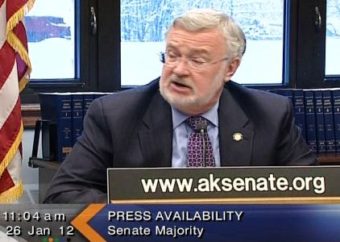
Filed in 2004, Moore vs. State of Alaska claimed the state failed to meet its constitutional obligation to provide quality education and adequate funding.

The state lost the original case in Superior Court. The settlement, announced Thursday, sets up a method for the Department of Education and local school districts to work together to focus resources on the state’s 40 lowest-performing schools. Education Commissioner Mike Hanley said negotiations have been based on the idea that neither the state nor the plaintiffs should be seen as winners or losers.

“The Moore settlement stated that it will need an $18-million one-time appropriation,” Hanley said. “The design has been that it will provide funding for several years and would lay a foundation that we could look to and a model that we could look to in the future for successful pedagogical strategies that would make a difference for our kids.”

The group Citizens for Educational Advancement of Alaska’s Children took the lead on the case by coordinating the schools, plaintiffs and attorneys. Executive Director Charles Wohlforth signed the settlement documents in the Attorney General’s office Thursday. He said the group continued to push the state for a settlement that would work to erase what he called a “waste of human potential” when children are not given a chance.

“So, have we solved all the problems with rural education in some of our schools in Alaska? Well, I think the answer would be no. Eighteen-million is clearly not going to be enough to solve this broad span of problems,” Wohlforth said. “But I think what we’ll do – and the commissioner alluded to it – we’re going to demonstrate some programs, we’re going to work on them collaboratively, and we’re going to see that they work. We’re going to prove that this is the right way to go – and there’s new hope for kids in rural schools across Alaska.”

The settlement specifically sets up a committee appointed by the citizens group and the Education Department to determine how resources should be shared to meet the court’s decision.

Senate oil tax bill expected soon

Courtesy Gavel Alaska
State Senate President Gary Stevens says nothing is more important this legislative session than coming to agreement on oil tax legislation.

The Senate’s bi-partisan coalition is writing its own bill to counter Gov. Sean Parnell’s proposal to reduce Alaska’s oil revenue by giving producers major tax breaks. Stevens says the Senate Resources Committee version will be drafted in about a week and a half.

Fairbanks Democrat Joe Paskvan – co-chair of the committee – says the legislation will treat Alaska as an “owner state.”

“You know we are different than most other jurisdictions in the United States and we need to act like a sophisticated owner with a world class resource,” Paskvan told reporters Thursday.

While details are scarce, the bill will include a progressive surcharge and tax credits.

Senators say they’ve been discussing their approach with the Parnell administration and the promise of more oil industry jobs for Alaskans may help bridge the gap between the two sides.

Parnell’s House Bill 110 passed the House last session, but the Senate refused to move it, asking for more and better information on the need to reduce oil taxes.

A report commissioned by the Senate Labor and Commerce Committee, chaired by Sen. Dennis Egan, D-Juneau, indicates the administration exaggerated when it claimed oil industry jobs were being shipped out of Alaska to other oil-rich states.

According to the McDowell Group report, average annual employment on Alaska’s North Slope reached a 20-year high in 2010.

Site notifications
Update notification options
Subscribe to notifications